Author: Naive 00
I was 39 years old when my wife was murdered. We’d been married for years, had a good marriage. I’d been unfaithful — had a couple of affairs — and I had no excuse for that. But we’d never had problems. We were doing well, never had any serious problems.
When she didn’t come home one night, I thought she’d stayed at her daughter’s house like she’d said she might. The next day, the police called me, said a pager had been found and turned in to them and they were just trying to find out who it belonged to. They knew. They were lying from the start.
I left work and went there. After about an hour of questions, they told me she was dead. I knew something was wrong before that — I could tell by what they were asking — but I didn’t think she was dead.
THE CASE THEY BUILT
They didn’t arrest me that day. They asked what firearms I had. I gave them the .22 handgun I had in my truck. They did a gunpowder residue test on my hands. Then we drove to my house, about 45 minutes away. I rode with them — they asked if I wanted to, I just didn’t want to drive alone. At the house, they went through everything. Took another .22 handgun I had, some ammunition, life insurance policies, bank statements. I cooperated with all of it. I was trying to help them figure out what happened.
Everything came back negative. The gunpowder test, the guns — nothing connected me to her death. But about three weeks later, they arrested me anyway.
My wife was killed at a motel on the east side of Atlanta. The police had nothing on me — no physical evidence, nothing putting me there. So they found two men and pressured them into signing statements saying they’d seen my work truck in the motel parking lot.
One was a local man having an affair. The other was living at the motel and on probation. Both were vulnerable. Both signed statements saying they saw my lowboy tractor trailer there. That’s a big, distinctive vehicle — you can’t miss it.
That was their case. Those two statements and the fact that I’d had affairs. That’s it.
Those statements weren’t even taken until two or three weeks after the murder. Plenty of time for the police to work on these guys.
THE TRIAL
When we went to trial, both men testified. And both of them contradicted what the police said they’d told them.
The guy on probation said the statement was a lie. He said he never told police he saw my truck there.
The other man said he saw a company truck, but when they showed him pictures of my truck, he said that wasn’t what he saw. He described a completely different truck — one the company didn’t even own. He was only trying to keep me from getting in trouble and keeping the police from telling his wife about the affair.
The prosecutor told the jury my attorney had gotten to both of them and made them lie. It was the State that actually lied. He said to believe the written statements instead. And that’s what they did.
THE TIMELINE: WHERE I ACTUALLY WAS
I moved heavy equipment for a construction company — paving equipment, mostly. Long hours, often into the night. That day, I was moving equipment between job sites in a lowboy tractor trailer.
The detective said my wife was killed around 4:45, based on cell phone records. The medical examiner never gave a precise time.
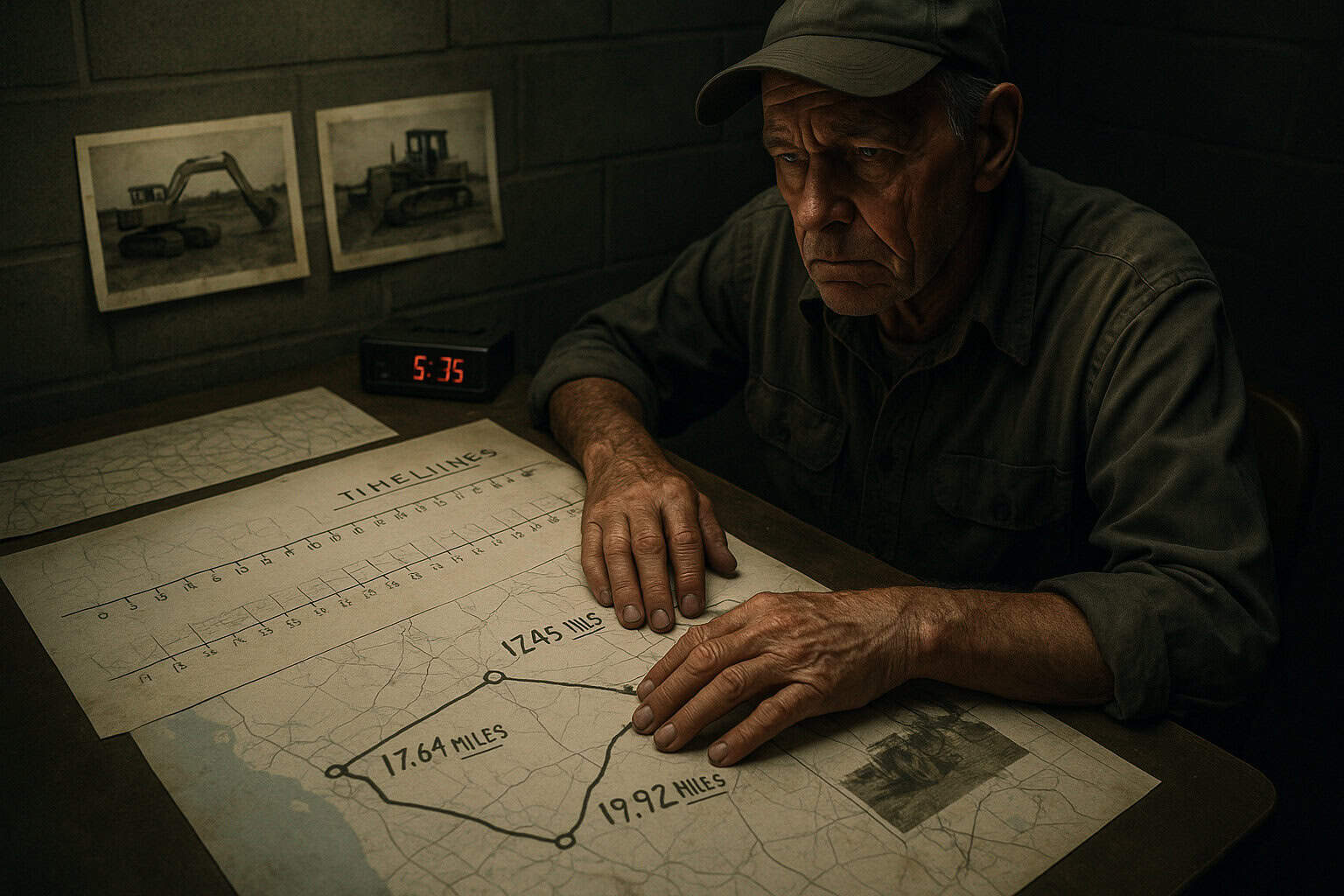
Here’s where I actually was:
Location 1 — 3:00 pm: A coworker was at this location and followed me in his pickup to the next location. I arrived and loaded three pieces of equipment. That took about 15 minutes.
3:15 pm: I left Location 1 and headed to Location 2, a distance of 17.64 miles. Driving time was about 30 minutes.
Location 2 — 3:45 pm: I arrived and unloaded the equipment. That took about 15 minutes.
4:00 pm: I left Location 2 to go to Location 3, a distance of 19.92 miles. Driving time was about 30 minutes.
Location 3 — 4:30 pm: I arrived and loaded two pieces of equipment. I left around 4:45 pm to return to Location 2. Right after leaving this location, I called my boss on the radio — he had paged me while I was loading the equipment. While talking with him, he asked where I was. I told him I had just gotten onto I-285 from I-20. He testified this was right at 5:00. He told me I would need to move another crew and to call the foreman and see where he was at. I called that foreman at 5:05 based on my cell phone records.
Location 2 — 5:15 pm: I arrived back and unloaded the equipment. I left at 5:35 pm. I remember seeing that time on the radio clock.
WHY THE POLICE TIMELINE IS IMPOSSIBLE
The police alleged I was at the motel at 4:20 pm.
But look at my actual timeline: At 4:00 pm, I left Location 2 heading to Location 3. The distance from Location 2 to the motel is approximately 22 miles. It’s impossible to drive that distance in 20 minutes in a tractor trailer, especially on the east side of Atlanta in rush hour traffic.
The police also alleged I was at the motel at 5:00 pm.
But to leave the motel at 5:00, drive to Location 3, load two pieces of heavy equipment, drive back to Location 2 — a distance of about 24.95 miles — unload the equipment, and be gone by the time the crew left at 6:00, it’s physically impossible.
Two witnesses testified that when they left Location 2 at 6:00 pm, the equipment was there, but they didn’t see me. Because I’d already left at 5:35.
THE TRUTH DOESN’T CHANGE
From the very first statements and interviews with the police, my times have never changed. They have been consistent. They always will be.
The truth doesn’t lie. Truth doesn’t need to change.
In 2018, a TV show called “Reasonable Doubt” did an episode about my case. They believed me. The guy on probation was in that show. He told them on camera how the police pressured him and threatened to violate his probation and send him back to prison if he didn’t sign that statement.
On the show, they drove part of the route I would have had to take. They confirmed the time didn’t permit me to be at the motel.
Even with that show confirming the timeline doesn’t work and the witness admitting on camera he was coerced, I’m still here.
NEW EVIDENCE THE COURTS IGNORED
We discovered new evidence and filed a Habeas Corpus. The motel owner gave an affidavit saying he’d never seen me, hadn’t seen any truck that day — and his office window looked right out on the parking lot. He also said the parking lot was actually too small for a tractor trailer to fit properly.
The motel maintenance worker gave an affidavit too. He said he didn’t see a truck. But he also said he saw two men around dusk go to my wife’s room, knock on the door, and get let in. Neither one was me.
Both of them had seen my wife at that motel a few times in the months before her death. Usually by herself. Never with me.
That evidence suggests my wife was meeting someone there regularly, and whoever killed her was someone she knew and let in.
Right before my trial, a different county called the detective investigating my case. They were looking into a man for a woman’s death in their county. During questioning, my wife’s name came up as a former girlfriend of his.
My attorney knew about this, but the guy wouldn’t cooperate with our investigators. And the police apparently weren’t interested. They already had their story with me.
The judge denied the Habeas. Against the court rules, she said none of this new evidence would prove I didn’t do it. But that’s not the standard. The law says I only have to show a reasonable likelihood of a different outcome if the new evidence had been presented at trial.
Two witnesses placing other men at the scene, evidence the parking lot couldn’t fit my truck, the motel staff saying my wife had been there multiple times without me, another suspect whose name came up in a different murder investigation — that absolutely could have changed the outcome.
We appealed to the State Supreme Court. They agreed with the judge.
26 YEARS AND COUNTING
I got a life sentence with the possibility of parole at 14 years. I’ve been in almost 26 years now.
I’ve been denied parole four times. I go up again in March — my fifth time. Every time, they give the same response: “Insufficient amount of time served to date given the nature and circumstances of your offenses.”
It doesn’t matter what programs I’ve completed, what certificates I’ve earned, how much time I’ve served past my eligibility. Their standard time is at least 30 years. The “possibility of parole” is basically a fiction.
I’m 67 now. My mom passed six years ago while I was in here. We didn’t even try to get me to her funeral. We knew they wouldn’t let me go.
My dad just turned 91. I haven’t seen him in a couple of years because of visitation rule changes after COVID. We talk on the phone, but after 26 years, my family is tired.
WHO I AM
I want people to know — I’m not a criminal. Never have been.
I had speeding tickets when I was young. But nothing more serious than that. No drugs. I don’t really drink, only occasionally.
I’ve worked since I was 16. Never been fired. Only had about four or five different jobs. I was on my last job for 17 years before this happened.
I’m a stable person. A normal blue-collar working man. That’s all I want to be.
WHAT THE SYSTEM DOES
The Innocence Project has been looking at my case for several years now, but they still haven’t decided to take it. It seems like no one wants to fight the corruption.
I see guys in here who’ve done 30, 40 years and more. I’m at 26. It’s hard to believe it’ll actually happen when the pattern is so clear.
The police coerced witnesses who recanted on the stand. The timeline is physically impossible. New evidence points to other suspects. A TV show confirmed I couldn’t have done it. The courts don’t care. The parole board doesn’t care.
Even though I feel like they owe me everything — my freedom, the years they took, compensation for what they did — I’ve been ground down enough to know I’ll probably never get it.
TIME DOESN’T LIE
The police story required me to be in two places at once. It required me to drive impossible distances in impossible times, in rush hour traffic, in a lowboy tractor trailer.
My timeline has never changed. From the very first interview to today, 26 years later, it’s been consistent. Because it’s the truth.
Time doesn’t lie. The distances don’t lie. The witnesses who were actually there — the crew who saw the equipment at 6:00, the motel staff who never saw me or my truck — they don’t lie.
But none of it matters when the system decides it doesn’t want to listen.
I simply want to go home. I would love to get out of this state and not be on parole, but I don’t think that will happen.
After 26 years of fighting a system that’s been corrupt from the start, I’m not even asking for justice anymore.
I just want the chance to live quietly on my dad’s land before he’s gone. Maybe get married again. Work with my hands. Stay away from all of it.
That’s all I want.
You Have Options
Free tools to take action — the law is on your side.
Demand records from the prison system. Reach the officials who set policy. File a grievance or a complaint the right way. And for families who’ve lost someone in custody, get the records that tell the truth. Plain-language, step-by-step, and free.
Explore the GPS Toolkits →