Executive Summary
Georgia’s Department of Corrections budget has undergone a dramatic escalation that demands legislative scrutiny:
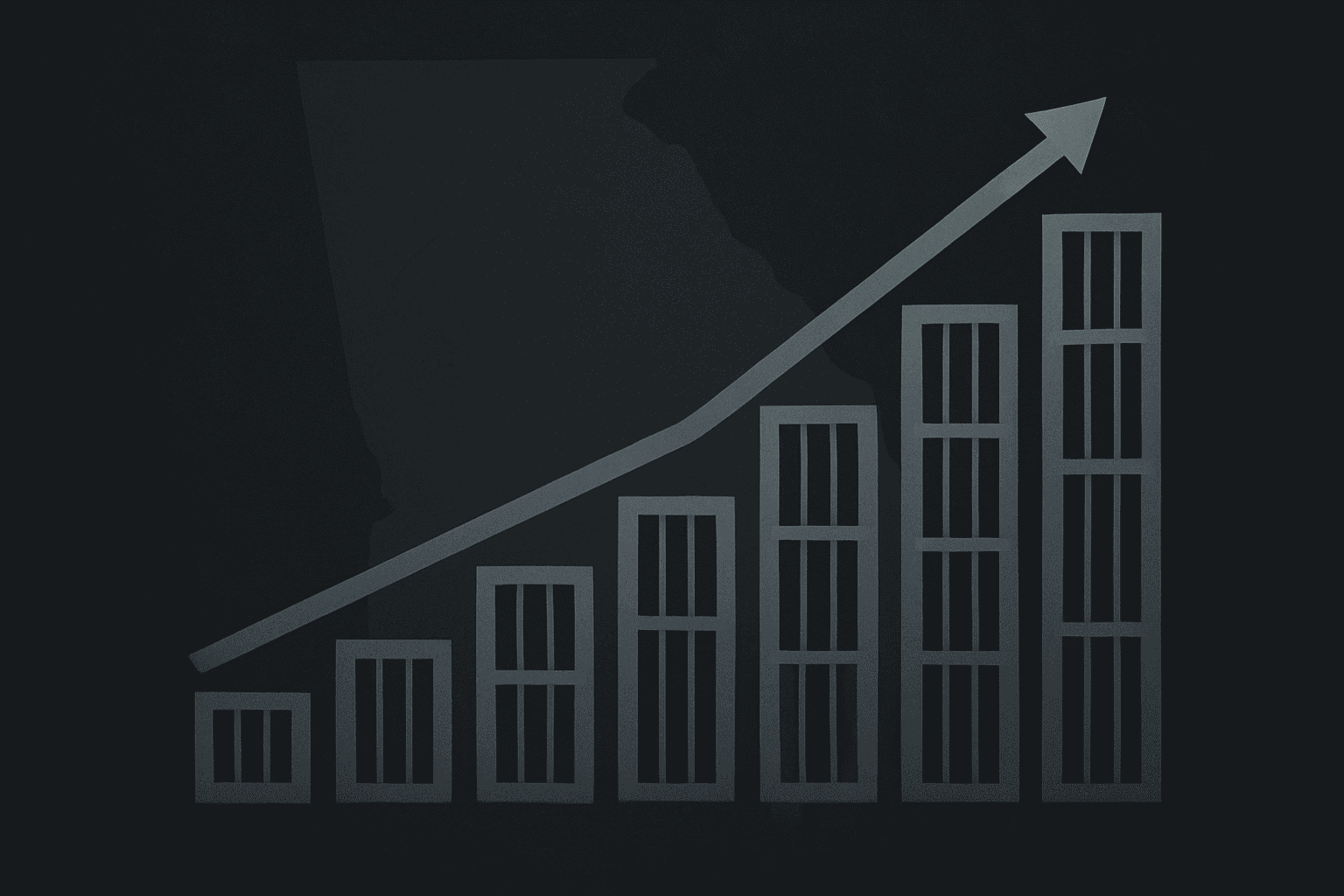
- $500 million increase in four years. The GDC budget rose from approximately $1.1 billion in FY2022 to $1,782,435,308 in amended FY2026 — a 44% increase in prison spending.
- Healthcare contracts are the largest cost driver. Health program spending increased approximately 40% since FY2022, with $39,777,721 added in amended FY2026 and another $54,769,710 proposed for FY2027.
- The state spends $31,612 per year to incarcerate one person ($86.61 per day), while charging those same people $5 medical co-pays and extracting more than $10 million annually in fees from incarcerated individuals and their families.
- The prison population grew to 49,828 by January 2025, up from a pandemic low of 42,795 — a 16.4% increase that the state has met with capacity expansion rather than population reduction strategies.
- Black Georgians comprise 58% of the prison population while representing only 33% of the state’s overall population, meaning this spending surge disproportionately funds a system that harms communities of color.
Key Takeaway: Georgia is spending nearly half a billion dollars more on prisons than it did four years ago, while the people confined inside those prisons bear escalating financial burdens with no corresponding investment in their well-being or release.
Fiscal Impact
Budget Trajectory (State General Funds)
| Fiscal Year | State General Funds | Year-Over-Year Change |
|---|---|---|
| FY2024 | $1,422,978,935 | — |
| FY2025 | $1,823,730,648 | +$153 million from FY2024 |
| Amended FY2026 | $1,782,435,308 | +$125 million from FY2025 original |
| FY2027 (Proposed) | $1,762,069,964 | +$66,771,687 in changes |
The amended FY2026 budget reflects $87,137,031 in additions to the original FY2026 appropriation of $1,695,298,277.
Where the Money Goes
Healthcare is the fastest-growing cost center. Health program expenditures rose from $325,613,120 in FY2024 to $389,939,841 in FY2025, with the amended FY2026 budget reaching $417,255,739 and the FY2027 proposal climbing to $432,247,728. The physical health contract alone accounts for $38,869,898 in added cost for amended FY2026 and $47,880,895 for FY2027.
State Prisons spending dominates the budget: $1,117,374,600 in FY2025 expenditures, with $36,746,804 added in amended FY2026. The FY2027 budget includes $26,824,134 for additional correctional officer positions.
Private prison expenditures grew from $144,251,930 in FY2024 to $152,648,138 in FY2025, with $4,227,620 proposed in FY2027 to add 263 new private prison beds.
Revenue Extracted from Incarcerated People
While the state pours hundreds of millions into expanding the system, it simultaneously extracts more than $10 million annually from incarcerated individuals through communication fees, medical co-pays, and other charges. People in Georgia’s prisons are charged a $5 medical co-pay for requested health services and medications — and the state will impose debt on those who cannot pay rather than waive the fee.
Taxpayer Cost Per Person
Georgia spends $86.61 per day — or $31,612 per year — to incarcerate one person. With more than 50,000 people serving prison sentences, the total annual operating cost approaches $1.5 billion. Every person who could safely be in the community rather than in a cell represents $31,612 in potential annual savings to taxpayers.
Key Takeaway: The GDC budget increased from $1.42 billion in FY2024 to $1.78 billion in amended FY2026, driven primarily by healthcare contract escalation and capacity expansion — while the state simultaneously extracts over $10 million annually from the people it incarcerates.
Key Findings
1. A System Built to Grow, Not to Shrink
Georgia’s prison population fell to 42,795 during the pandemic in early 2021, demonstrating that lower incarceration levels are achievable. Rather than building on that reduction, the state allowed the population to climb back to 49,828 by January 31, 2025. The budget responds to this growth with capacity expansion — not with strategies to reduce the number of people entering or remaining in prison.
The FY2027 budget allocates $4,227,620 to add 160 private prison beds at Coffee Correctional Institution and 103 private prison beds at Wheeler Correctional Institution. In amended FY2026, the state added $6,242,030 in jail subsidy payments to house GDC individuals in local jails — effectively outsourcing overflow to county facilities. The state also allocated $1,760,207 for operations at five modular correctional units (temporary housing structures) in FY2027.
2. Healthcare Spending Surges — But Access Barriers Remain
Healthcare contract costs represent the single largest budget pressure:
- Amended FY2026: $38,869,898 for physical health contracts (per diem increase of $10,946,108, outside-the-wire care of $15,000,000, and additional beds of $12,923,790)
- FY2027: $47,880,895 for physical health contracts alone, plus $1,917,644 for mental health, $1,498,347 for dental health, and $3,681,328 for pharmacy contracts
Yet despite these massive outlays, the state continues to charge incarcerated people a $5 medical co-pay for requested health services and medications. This co-pay deters people from seeking care, increases the likelihood that illnesses spread or worsen, and ultimately drives up the cost of subsequent treatment.
3. Security and Surveillance Over Rehabilitation
The budget prioritizes containment and surveillance:
- $13,387,475 for managed access and drone detection systems in amended FY2026
- $5,521,230 for OWL (Over Watch and Logistics) Unit technology in FY2027
- $4,982,902 for additional correctional officer positions in amended FY2026, growing to $26,824,134 in FY2027
Meanwhile, programming investments are minimal: $150,000 for a pilot peer-led program at Autry State Prison, $93,179 for additional programming at Metro Reentry Facility in amended FY2026.
4. Staff Costs Reflect Systemic Retention Failure
The state spent $12,050,341 on one-time $2,000 salary supplements for State Prisons staff alone in amended FY2026. Additional line items across all program areas bring total one-time supplements higher. FY2027 includes retirement enhancements for POST-certified officers. These recurring retention costs reflect a staffing crisis that the state has failed to resolve structurally.
5. Racial Disparities Compound Fiscal Harm
Black Georgians represent 58% of the state’s prison population while comprising only 33% of the overall state population. This means the financial burdens extracted from incarcerated people and their families — the $10 million-plus in annual fees, the $5 co-pays, the commissary price increases — fall disproportionately on Black communities. The GBPI identifies this overrepresentation as “evidence of the state’s legacy of slavery, segregation, Jim Crow, racialized criminalization through over-policing in communities of color.”
6. Incarcerated People Subsidize the System Through Forced Labor
The Governor’s own budget document states that “GDC requires offenders in its facilities to work to support the prison system and the community.” This coerced, unpaid labor — in food preparation, laundry, construction, facility maintenance, and manufacturing — subsidizes millions in public and private profits while the people performing it receive nothing.
Key Takeaway: Georgia’s prison budget is structured to expand incarceration capacity and enhance surveillance, while systematically underfunding rehabilitation and maintaining financial extraction from the people it incarcerates.
Comparable States
The source documents do not include direct state-to-state comparisons of corrections budgets or per-capita spending. However, two contextual data points are relevant for legislative consideration:
- The GBPI notes a 20-year cost growth of approximately 70% in prison operation costs, while the custody population “largely remained unchanged” over that same period — suggesting that Georgia’s cost trajectory outpaces population changes and may exceed national trends.
- The GBPI frames Georgia’s spending escalation in the context of policies that “effectively reverse criminal justice policy reforms passed under the Deal administration,” referencing proposals like Senate Bill 63 that would expand pre-trial detention.
Recommendation: The General Assembly should commission a comparative analysis of southeastern state corrections spending per capita, healthcare delivery models, and population reduction strategies to benchmark Georgia’s trajectory against peer states.
Key Takeaway: Data not available in source document for direct state comparisons, but Georgia’s 70% cost growth over 20 years with a largely unchanged population warrants benchmarking against peer states.
Policy Recommendations
1. Eliminate Medical Co-Pays for Incarcerated People
Fiscal rationale: The $5 co-pay deters people from seeking timely care, causing conditions to worsen and driving up the cost of subsequent treatment — contributing to the very healthcare cost escalation (40% since FY2022) that dominates the budget. Eliminating co-pays is a preventive health investment that reduces downstream costs.
2. Mandate an Independent Fiscal Audit of Fees Extracted from Incarcerated People and Their Families
Fiscal rationale: The state collects more than $10 million annually in fees from incarcerated individuals. The General Assembly should require a full accounting of all revenue streams — communication fees, co-pays, commissary markups — with analysis of who bears these costs and what services they fund.
3. Require Population Reduction Targets Before Approving Capacity Expansion
Fiscal rationale: At $31,612 per person per year, every 1,000-person reduction in the prison population saves taxpayers approximately $31.6 million annually. The General Assembly should require GDC to present population reduction strategies as a condition of approving new bed capacity, including the $4,227,620 for 263 new private prison beds.
4. Establish Compensation for Incarcerated Workers
Fiscal rationale: The state’s own budget acknowledges that it “requires” incarcerated people to perform labor in food preparation, construction, manufacturing, and other operations. This coerced, unpaid labor represents an unaccounted subsidy to state operations. Legislation should establish minimum compensation standards and worker safety protections.
5. Mandate Racial Impact Statements for Corrections Appropriations
Fiscal rationale: With Black Georgians comprising 58% of the prison population but only 33% of the state population, every dollar of corrections spending — and every dollar of fees extracted — has a racially disproportionate impact. The General Assembly should require racial impact analysis as part of the GDC budget process.
6. Redirect Surveillance Spending Toward Programming and Reentry
Fiscal rationale: The state allocated $13,387,475 for managed access and drone detection in amended FY2026 and $5,521,230 for OWL Unit technology in FY2027, while investing only $150,000 in a peer-led programming pilot and $93,179 in Metro Reentry Facility programming. Rebalancing this ratio toward evidence-based reentry programming would reduce recidivism and long-term costs.
7. Commission a Healthcare Delivery Model Review
Fiscal rationale: Physical health contract costs increased $38,869,898 in amended FY2026 and $47,880,895 in FY2027. The General Assembly should commission an independent review of the GDC healthcare contract model to determine whether alternative delivery approaches — including Medicaid enrollment for eligible individuals — could improve outcomes and reduce costs.
Key Takeaway: The most fiscally responsible path forward requires the General Assembly to address root cost drivers — population growth, healthcare delivery model failures, and financial extraction from incarcerated people — rather than continuing to fund system expansion.
Read the Source Document
This analysis draws from the Governor’s FY2026-FY2027 Budget Report (Department of Corrections sections), Georgia Budget & Policy Institute FY2025 and FY2026 GDC Budget Overviews by Ray Khalfani, and GBPI Criminal Legal Systems Budget Primer data.
Other Versions
- Public Version → — Plain-language summary for community members, families, and advocates
- Media Version → — Press-ready format with key data points and story angles for journalists