Executive Summary
- Georgia operates the largest felony probation system in the nation, with 191,000 people serving felony probation and 528,000 total residents under criminal justice supervision — imposing enormous fiscal and human costs on the state.
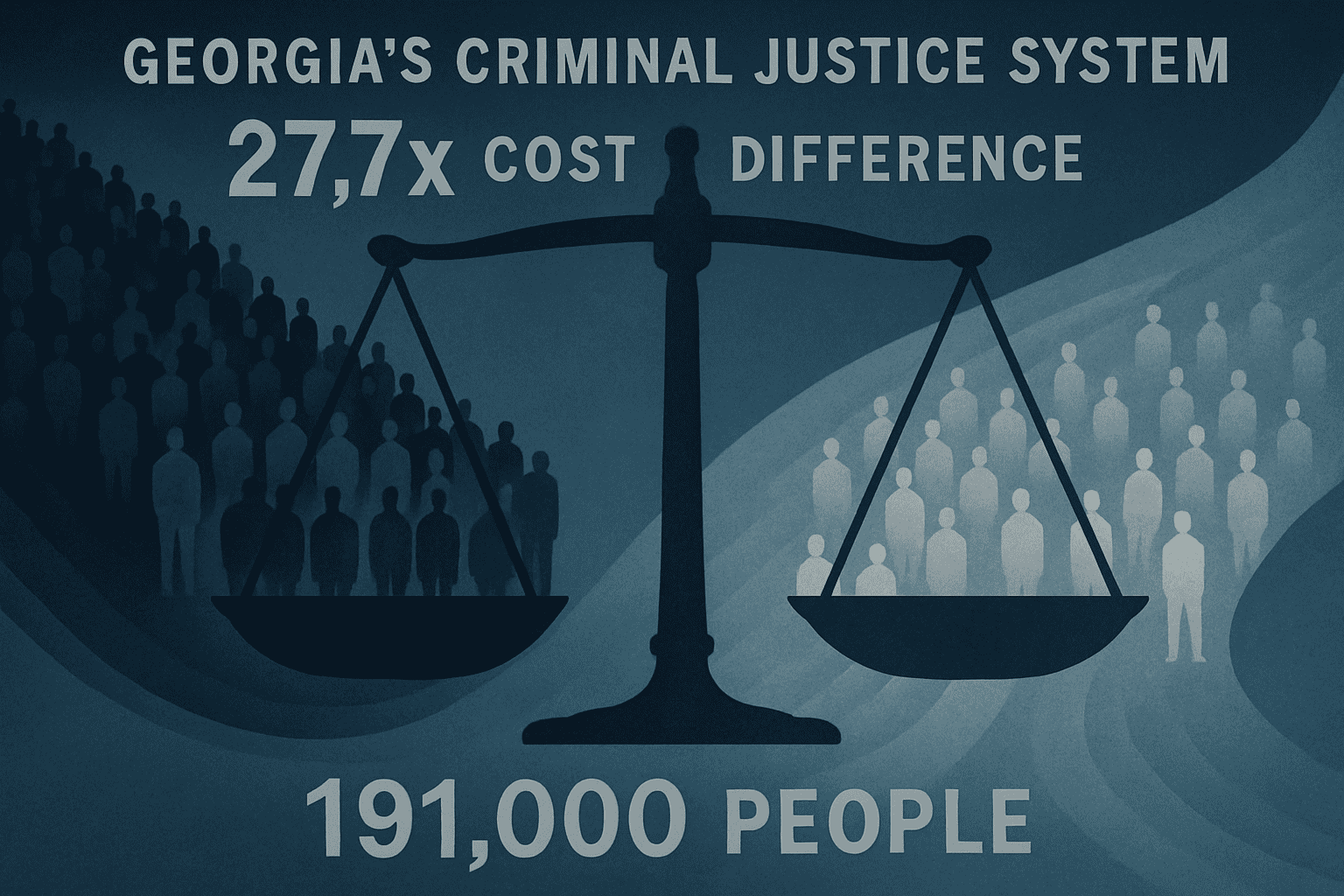
- Incarceration costs Georgia 27.7 times more than community supervision — $31,612 per person per year versus ~$1,142 for parole supervision. Every 1,000 people the state diverts from prison to supervision saves taxpayers ~$30.5 million annually.
- SB 105 (2021) enables $34 million in annual savings by allowing early termination of felony probation after 3 years, with up to 25% of all felony probationers qualifying immediately.
- The state imposes severe racial disparities: Black Georgians are at least 2x as likely as white Georgians to serve probation statewide, rising to 8x in some counties — despite comprising 31% of the population.
- Financial barriers imposed by the state drive re-incarceration: Electronic monitoring costs of $300-500/month, supervision fees, and drug testing costs push low-income people into technical violations and back into prison — not for new criminal behavior, but for inability to pay.
Key Takeaway: Georgia taxpayers fund the nation’s largest felony probation system while incarceration costs 27.7 times more than community supervision, and state-imposed financial barriers re-incarcerate people for poverty rather than criminal conduct.
Fiscal Impact
Daily Cost to Taxpayers
| Supervision Type | Daily Cost | Annual Cost |
|---|---|---|
| Incarceration | $86.61 per person (FY2024) | $31,612 per person |
| Parole Supervision | $3.13 per person (FY2025) | ~$1,142 per person |
| Savings per diversion | $83.48/day | ~$30,470/year |
Incarceration costs the state 27.7x more than parole supervision per person per day.
System-Wide Savings Potential
- Each 1,000 people diverted from prison to community supervision saves ~$30.5 million annually.
- SB 105 implementation is projected to save $34 million annually by enabling early termination for up to 25% of Georgia’s 191,000 felony probationers.
- Georgia’s parole completion rate of 73% exceeds the 60% national average, demonstrating that community supervision works and that expanded diversion is fiscally responsible.
Hidden Costs the State Shifts to Families
The state shifts significant supervision costs onto people and their families:
– Electronic monitoring: $300-500/month
– Supervision fees: assessed to probationers regardless of ability to pay
– Drug testing costs: borne entirely by the supervised individual
When people cannot pay these state-imposed costs, the state revokes their supervision for technical violations — then spends $31,612 per year to incarcerate them. This is a net fiscal loss to taxpayers.
Historical Federal Incentives
Georgia received $82 million in federal “truth in sentencing” grants from 1996-2001. These grants incentivized longer sentences and reduced parole eligibility, contributing to the bloated system Georgia taxpayers now fund.
Key Takeaway: Community supervision costs $1,142 per person annually compared to $31,612 for incarceration; every 1,000 people diverted saves taxpayers ~$30.5 million per year.
Key Findings
Scale of Georgia’s Supervision System
Georgia subjects more people to felony probation than any other state in the nation:
– 191,000 people serving felony probation
– 356,000 people total on probation or parole
– 528,000 Georgia residents under total criminal justice supervision
Racial Disparities in State-Imposed Supervision
Black Georgians comprise 31% of the state’s population. Yet the state places them under probation at vastly disproportionate rates:
– Black Georgians are at least 2x as likely as white Georgians to serve probation statewide
– In some counties, Black residents are 8x more likely to be on probation
– Disproportionate representation persists across all supervision types
These disparities are not incidental — they reflect decisions made at every stage of Georgia’s criminal justice system, from policing through sentencing.
Technical Violations Drive Re-Incarceration
Many revocations stem from technical violations — missed appointments, failed drug tests — rather than new criminal behavior. The state re-incarcerates people at $86.61 per day not because they pose a public safety risk, but because they missed an appointment or could not afford a fee.
Vocational Programming Reduces Recidivism
People who complete vocational programs demonstrate a recidivism rate of 13.64%, compared to the general rate of 26%. Vocational programming cuts re-offense by nearly half — yet access to these programs remains limited.
Legislative History: Decades of Punitive Expansion
- 1995: “Seven Deadly Sins” law (SB 441) eliminated parole for 7 serious violent crimes
- 1997: Parole Board implemented 90% sentence requirement
- 2006: HB 1059 increased life sentence parole eligibility from 14 to 30 years
- 2021: SB 105 began the first significant reversal, allowing early termination of felony probation after 3 years
Key Takeaway: Georgia supervises 528,000 residents under criminal justice control, with Black Georgians subjected to probation at 2x to 8x the rate of white Georgians depending on county.
Comparable States
The source document establishes Georgia as the largest felony probation system in the nation with 191,000 individuals, and benchmarks Georgia’s parole completion rate of 73% against the 60% national average — demonstrating that Georgia’s community supervision programs outperform most states.
Detailed state-by-state comparisons of probation populations, reform legislation, or racial disparity data are not available in the source document. However, the national average parole completion rate provides important context: Georgia’s supervised population succeeds at higher rates than the national norm, which strengthens the fiscal and public safety case for expanding community supervision rather than incarceration.
Key Takeaway: Georgia’s 73% parole completion rate exceeds the 60% national average, demonstrating community supervision effectiveness despite having the nation’s largest felony probation population.
Policy Recommendations
1. Fully Implement and Expand SB 105 Early Termination
Action: Direct the Department of Community Supervision to proactively identify and process all eligible individuals under SB 105’s early termination provision. Expand eligibility criteria to increase the percentage of qualifying probationers beyond the current 25%.
Fiscal impact: SB 105 is projected to save $34 million annually. Aggressive implementation and expansion could increase these savings significantly.
2. Eliminate Financial Barriers That Drive Technical Violations
Action: Enact legislation prohibiting revocation of probation or parole solely for failure to pay supervision fees, electronic monitoring costs ($300-500/month), or drug testing expenses. Require ability-to-pay determinations before any fee-based violation.
Rationale: Re-incarcerating people for poverty costs the state $31,612 per year per person — compared to ~$1,142 for continued supervision. This is a direct taxpayer loss with no public safety benefit.
3. Expand Vocational Programming Access
Action: Appropriate funds to expand vocational program capacity across all community supervision districts. Vocational program completers demonstrate a recidivism rate of 13.64%, nearly half the general rate of 26%.
Fiscal impact: Every percentage point reduction in recidivism reduces downstream incarceration costs. At ~$30,470 in annual savings per person diverted from prison, the return on investment is substantial.
4. Mandate Racial Disparity Reporting and Corrective Action
Action: Require the Department of Community Supervision and the Administrative Office of the Courts to publish annual county-level data on racial disparities in probation sentencing and supervision. Where disparities exceed 2x the population proportion, require corrective action plans.
Rationale: Black Georgians face 2x to 8x higher probation rates despite comprising 31% of the population. Transparency is the minimum accountability standard.
5. Reform Technical Violation Policies
Action: Enact legislation limiting re-incarceration for technical violations (missed appointments, failed drug tests) to cases involving demonstrated public safety risk. Require graduated sanctions — such as increased reporting or community service — before revocation.
Fiscal impact: Each person the state does not re-incarcerate for a technical violation saves ~$30,470 annually.
6. Review and Reverse Punitive Sentencing Expansions
Action: Convene a legislative study committee to review the cumulative fiscal and human impact of the 1995 “Seven Deadly Sins” law, the 1997 90% sentence requirement, and the 2006 increase in life sentence parole eligibility from 14 to 30 years. Assess whether these policies, originally incentivized by $82 million in federal grants that have long since expired, continue to serve Georgia’s public safety and fiscal interests.
Key Takeaway: Six actionable reforms — from full SB 105 implementation to eliminating poverty-based revocations — could save tens of millions annually while reducing racial disparities and improving public safety outcomes.
Read the Source Document
Download the full research compilation: Georgia Probation & Community Supervision (PDF)
This analysis is based on a GPS research compilation drawing from multiple sources on Georgia’s probation system, reform legislation, costs, racial disparities, and community supervision outcomes.
Other Versions
- Public Version — A plain-language summary for community members, families, and advocates
- Media Version — Key findings and data formatted for journalists and editorial boards