News Lead
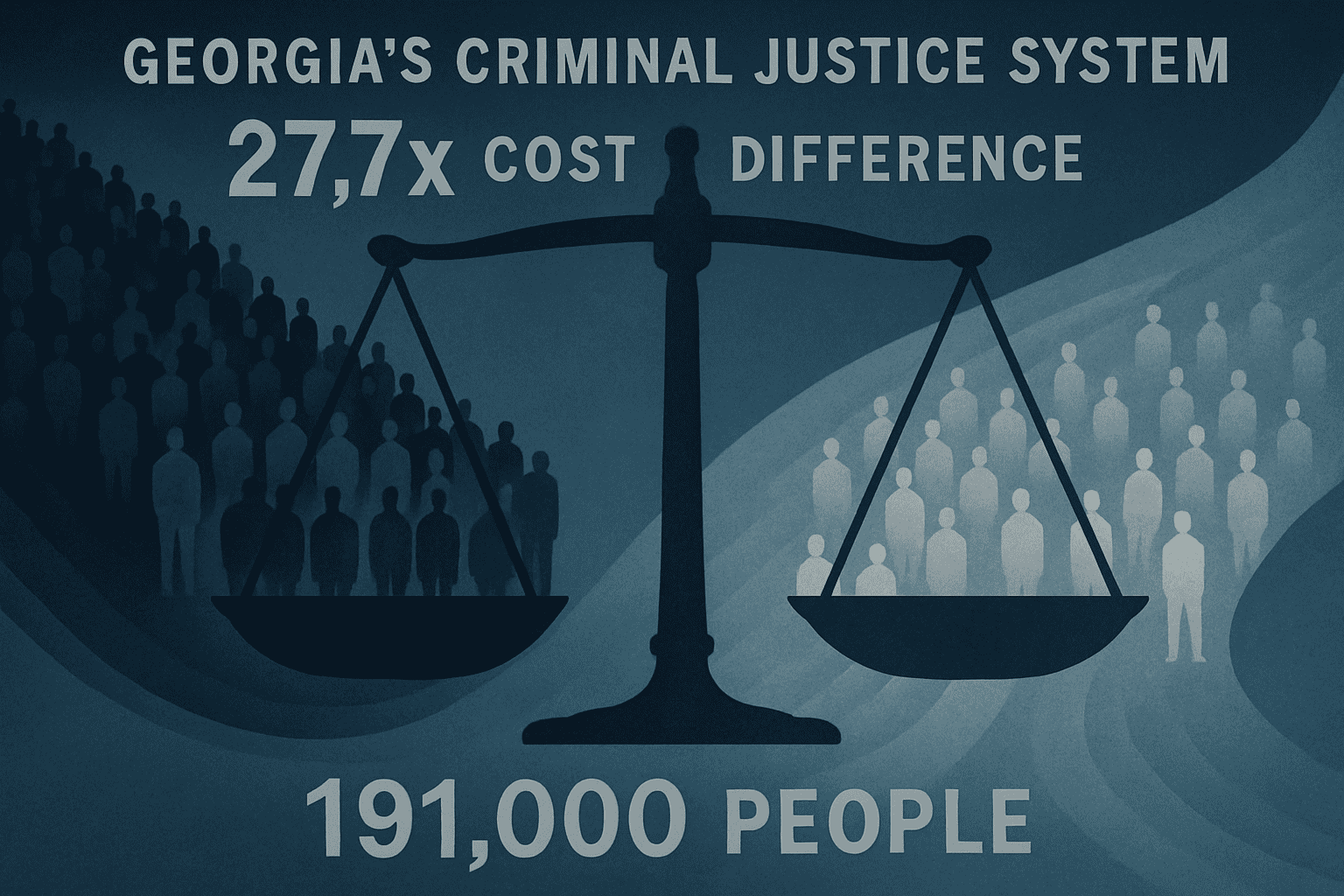
Georgia places more people on felony probation than any other state in the nation — 191,000 individuals — and subjects them to a system riddled with racial disparities that make Black Georgians at least twice as likely as white Georgians to serve probation statewide. In some counties, that disparity reaches eight times the rate.
The state holds 528,000 residents under some form of criminal justice supervision, while spending 27.7 times more to incarcerate people than to supervise them in the community. Incarceration costs Georgia $31,612 per person per year; parole supervision costs approximately $1,142. Yet the state continues to re-incarcerate people for technical violations — missed appointments, failed drug tests, and inability to pay fees — rather than new criminal behavior.
A 2021 reform law, SB 105, allows early termination of felony probation after three years and could free up to 25% of all felony probationers immediately, saving an estimated $34 million annually. But the deeper structural problems — racial targeting, punitive financial barriers, and decades of legislation designed to keep people under state control — remain largely unaddressed.
Key Takeaway: Georgia operates the nation’s largest felony probation system, with 191,000 people under supervision, severe racial disparities, and a cost structure that defies fiscal logic.
Quotable Statistics
Scale of Supervision
– 191,000 people are serving felony probation in Georgia — more than any other state
– 356,000 people are on probation or parole statewide
– 528,000 Georgia residents are under total criminal justice supervision
Racial Disparities
– Black Georgians are at least 2x as likely as white Georgians to serve probation
– In some counties, Black residents are 8x more likely to be on probation
– Black residents comprise 31% of Georgia’s population, yet disproportionate representation persists across all supervision types
Cost Comparison
– Incarceration costs $86.61 per person per day (FY2024); parole supervision costs $3.13 per parolee per day (FY2025)
– Annual incarceration cost: $31,612 per person; annual parole supervision cost: ~$1,142 per person
– Incarceration costs 27.7x more than parole supervision
– Each 1,000 people diverted from prison to supervision saves ~$30.5 million annually
Outcomes
– Georgia’s parole completion rate: 73%, exceeding the 60% national average
– Recidivism rate for vocational program completers: 13.64%, compared to 26% general recidivism rate
Reform Potential (SB 105)
– Up to 25% of all felony probationers qualify for immediate early termination
– Estimated savings: $34 million annually
Financial Barriers Imposed on People Under Supervision
– Electronic monitoring costs families $300–500/month
– Supervision fees, drug testing costs, and restitution payments fall on probationers, and failure to pay can trigger re-incarceration
Historical Policy Drivers
– Georgia received $82 million in federal “truth in sentencing” grants (1996–2001), which incentivized longer sentences and reduced parole
– In 2006, the state increased life sentence parole eligibility from 14 to 30 years
– A 90% sentence requirement was implemented by the Parole Board in 1997
Key Takeaway: Publication-ready data points covering scale, racial disparities, costs, outcomes, reform potential, and the financial burdens the state imposes on people under supervision.
Context and Background
How Georgia Built the Nation’s Largest Probation System
Georgia’s current mass supervision crisis did not emerge organically. It was constructed through decades of deliberate policy choices, many of them financially incentivized by the federal government. Between 1996 and 2001, Georgia received $82 million in federal “truth in sentencing” grants that rewarded the state for imposing longer sentences and restricting parole eligibility.
Key legislative milestones include the 1995 “Seven Deadly Sins” law (SB 441), which eliminated parole for 7 categories of serious violent crimes; the Parole Board’s 1997 implementation of a 90% sentence requirement; and HB 1059 in 2006, which more than doubled the parole eligibility threshold for life sentences from 14 to 30 years. These compounding restrictions funneled more people into longer supervision terms.
The Financial Trap
People on probation in Georgia are required to fund their own supervision. They pay supervision fees, drug testing costs, and electronic monitoring charges of $300–500 per month. For low-income individuals and families, these costs become insurmountable. The state then punishes them for their poverty: failure to pay fees can trigger technical violations and re-incarceration, even when no new criminal behavior has occurred. Many revocations stem from technical violations — missed appointments and failed drug tests — rather than new criminal behavior.
SB 105 and the Case for Reform
Signed on May 3, 2021, SB 105 allows early termination of felony probation after 3 years for individuals who have paid all restitution, had no revocations in the last 24 months, and no new arrests. The law was effective immediately upon signing and has bipartisan support, with sponsors including Senator Brian Strickland (R-McDonough) and Representative Tyler Paul Smith (R-Bremen). It was championed by the Georgia Justice Project and supported by organizations ranging from the Metro Atlanta Chamber to the Faith and Freedom Coalition.
Why Community Supervision Works Better
Georgia’s own data demonstrates that community supervision produces better outcomes at a fraction of the cost. The state’s parole completion rate of 73% exceeds the national average of 60%. Vocational program completers show a recidivism rate of 13.64%, nearly half the general rate of 26%. Each person diverted from prison to supervision saves approximately $30,470 per year.
2025 Legislative Priorities
The Georgia Justice Project is advancing additional reforms, including the Wrongful Conviction and Incarceration Compensation Act, effective July 1, 2025, which provides $75,000 for each year of wrongful incarceration, and HB 582, which updates Georgia code to reflect modern understanding of domestic violence and prevent unjust convictions of survivors.
Key Takeaway: Georgia’s mass supervision system was built through federal financial incentives and decades of punitive legislation; reform efforts like SB 105 offer proven, cost-effective alternatives.
Story Angles
1. The Racial Geography of Probation in Georgia
Black Georgians make up 31% of the state’s population but are at least twice as likely — and in some counties eight times as likely — to be placed on probation. A county-by-county investigation could map where these disparities are most extreme, identify the courts and prosecutors driving them, and examine why the state’s largest-in-the-nation probation system falls so disproportionately on Black communities.
2. The Poverty Penalty: How Georgia Re-Incarcerates People for Being Poor
People on probation in Georgia must pay for their own supervision, including electronic monitoring costs of $300–500 per month. When they cannot pay, the state treats their poverty as a violation and sends them back to prison — at a cost of $31,612 per year to taxpayers. This story would follow the financial journey of probation, documenting how fees designed to offset system costs instead create a revolving door that costs the state more money and destroys families.
3. The $34 Million Reform Nobody Talks About
SB 105 has been law since May 2021, qualifying up to 25% of Georgia’s 191,000 felony probationers for immediate early termination and projecting $34 million in annual savings. But how many people have actually been released? An accountability story could examine implementation — whether courts are actively applying the law, whether eligible people know about it, and whether the projected savings have materialized.
Read the Source Document
[Link to the original research compilation PDF will be provided here]
Other Versions
- Public Version: [Link to the public explainer of this document]
- Legislator Version: [Link to the legislative briefing on this document]