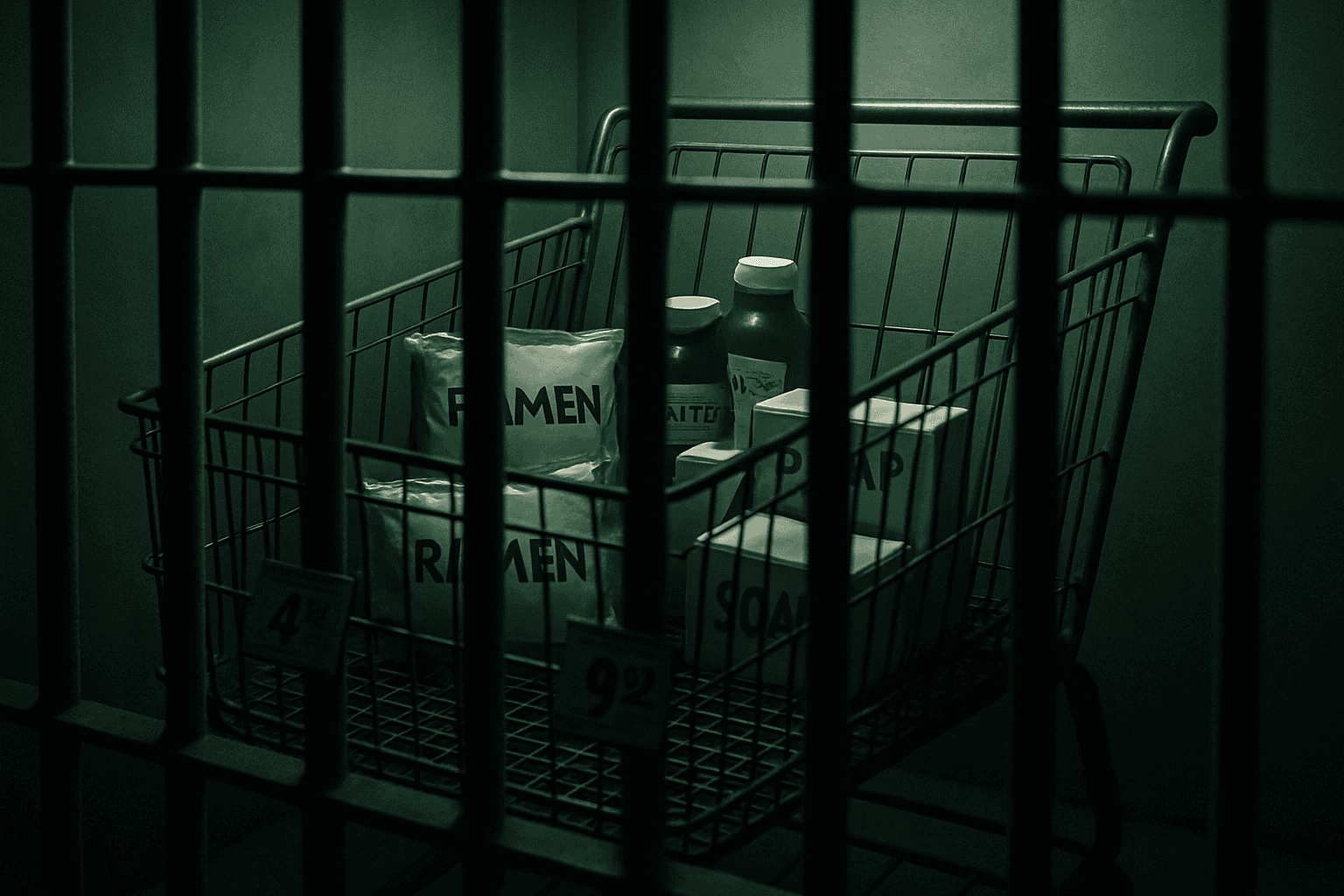
Executive Summary
An investigation of 20 high-volume commissary staples in Georgia’s state prisons reveals a systematic two-tier markup scheme that extracts an estimated $8–15 million annually from incarcerated people and their families compared to fair pricing models.
- Georgia operates a two-tier extraction system. The state’s vendor, Georgia Commissary Suppliers (Stewart’s Distribution), charges inflated “wholesale” prices that exceed legitimate bulk rates—ramen at $0.40 when true institutional wholesale is $0.20, chips at $0.73 when Sam’s Club charges $0.60. The state then adds 54–323% markups on top of these already-inflated costs.
- Essential items face the most extreme exploitation. Generic ibuprofen is marked up 833–1,150% over retail ($4.00 vs. $0.40–$0.48). Feminine hygiene products carry a 183–254% markup over generic retail. Bar soap costs people in prison 575–1,812% more than institutional wholesale.
- On just 5 high-volume items, fair pricing would return $2,806,247 annually to families. Ramen alone accounts for $1,472,000 in excess extraction across 2.3 million units sold of a single flavor.
- Vendor costs frequently exceed publicly available wholesale and even retail pricing, with overcharges of 22–465% above legitimate institutional markets—proving exploitation begins before the state adds its own markup.
- A June 2025 contract renewal creates an immediate legislative intervention opportunity to mandate competitive bidding, transparent pricing, and markup caps on essential categories.
Key Takeaway: Georgia’s commissary system extracts an estimated $8–15 million annually from incarcerated families through a two-tier markup structure that inflates vendor costs above market rates, then adds additional institutional markups of 54–323%.
Fiscal Impact
Direct Financial Burden on Georgia Families
The commissary markup system operates as a regressive wealth transfer from some of Georgia’s poorest families to the state and its contracted vendor. The fiscal dimensions are significant:
| Metric | Amount |
|---|---|
| Estimated annual excess extraction (20 items studied) | $3–5 million |
| Estimated annual excess extraction (all commissary items) | $8–15 million |
| Annual savings on 5 high-volume items under fair pricing | $2,806,247 |
| Annual savings achievable on 2 chip products via Sam’s Club | $127,726 |
| Annual excess extraction on ramen alone (single flavor) | $1,472,000 |
| Annual “menstrual tax” per incarcerated woman | $66–92 |
Cost of Inaction vs. Reform
Current system: The state pays vendor prices that exceed Sam’s Club Business retail by 22% on chips, exceed Walmart retail on tuna and ibuprofen, and exceed institutional wholesale by 60–465% across multiple categories. A Sam’s Club Business membership costing $50–100 annually would save $127,726 on just two chip products.
Fair pricing model (wholesale + 30% markup): Under this model, ramen would cost $0.26 instead of $0.90; ibuprofen would cost $0.52 instead of $4.00; bar soap would cost $0.18 instead of $1.68 (average). These prices still cover all legitimate administrative, handling, and distribution costs.
Revenue Redirection Opportunity
If commissary operations generated surplus revenue under fair pricing, statutory requirements could redirect those funds to educational programs, re-entry services, or victim restitution—rather than subsidizing general correctional operations, which creates a perverse institutional incentive to maximize extraction from families.
Key Takeaway: Fair commissary pricing reforms would return an estimated $8–15 million annually to Georgia families while still covering all legitimate operational costs, and a $50–100 warehouse club membership would save $127,726 on two chip products alone.
Key Findings
1. The Two-Tier Markup Structure
Georgia’s commissary pricing operates through compounding exploitation at two levels:
First tier (vendor overcharging): Georgia Commissary Suppliers charges the state prices that exceed legitimate wholesale markets:
– Ramen: vendor charges $0.40; true institutional wholesale is $0.20–$0.25 (60–100% overcharge)
– Doritos/Lay’s: vendor charges $0.73; Sam’s Club Business charges $0.60 (22% overcharge)
– Tuna: vendor charges $1.07–$1.81; Sam’s Club retail is $0.83–$0.91 (29–117% overcharge)
– Ibuprofen: vendor charges $1.92; retail equivalent is $0.40–$0.48 (368–465% overcharge)
– Bar soap: vendor charges $0.54–$1.24; institutional wholesale is $0.08–$0.14 (385–1,450% overcharge)
Second tier (institutional markup): The state adds 54–323% markups over these already-inflated vendor costs.
2. Strategic Targeting of Essential Items
The markup structure is not uniform—it is strategic. Items with high public visibility are priced reasonably to deflect scrutiny; items people in prison cannot avoid purchasing face extreme markups:
| Category | Item | Markup Over Retail |
|---|---|---|
| Healthcare (non-optional) | Generic ibuprofen | 833–1,150% |
| Healthcare (non-optional) | Tampons (8-ct) | 183–254% |
| Dignity necessities | Bar soap | 67–241% (575–1,812% over wholesale) |
| Dignity necessities | Toothbrush | 134% (267–550% over wholesale) |
| Protein staples | Peanut butter (16 oz) | 157–466% |
| Protein staples | Canned tuna | 175–227% |
| Visible/non-essential | Hot sauce | -22% to -2% (at or below retail) |
| Visible/non-essential | Doritos | -9% vs. single-unit retail |
| Visible/non-essential | Shampoo | -39% to -38% vs. retail |
This variability proves the system can price fairly when it chooses to. The state prices items that families can easily compare to retail at competitive levels, while imposing extreme markups on items where institutional wholesale pricing is less publicly visible.
3. The Five Most Exploitative Items
Generic ibuprofen ($4.00 for 20–24 tablets): Walmart sells 100-tablet bottles for $2.00, making the equivalent cost $0.40–$0.48. People in prison pay 833–1,150% above retail. The vendor charges Georgia $1.92—already 380–400% above retail—before the state adds another 108% markup.
Travel toothpaste ($0.55 for 0.15 oz packets): This size does not exist in consumer retail markets. Investigation reveals these exact-sized packets are provided free to hotels and dental offices as promotional samples, with suppliers explicitly stating “we offer samples which are free for you.” The vendor charges Georgia $0.13—below legitimate wholesale of $0.28—suggesting free sample or salvage sourcing. At 3,510 units sold, this generates nearly $2,000 in revenue from items that may cost nothing to acquire.
Bar soap ($1.10–$2.25 for 3–4 oz bars): Institutional wholesale suppliers charge $0.08–$0.14 per bar. Walmart’s Irish Spring 12-packs cost $0.66 per bar. People in prison pay 575–1,812% more than institutional wholesale.
Protein staples (peanut butter at $5.60, tuna at $2.70–$3.20): Peanut butter costs 157% more than Walmart’s $2.18 generic and 466% more than Kroger sale prices of $0.99. Tuna costs 175–227% more than Walmart’s $0.98 retail price.
Tampons ($3.40–$4.25 for 8-count boxes): Walmart’s Equate generic costs $1.20 for the same quantity. Women in prison face a mandatory annual “menstrual tax” of $66–92 in excess costs. Unlike any other commissary item, menstrual products are absolutely non-optional biological necessities.
4. Evidence of Liquidation Market Sourcing
Multiple indicators suggest the vendor sources products from near-expiration and salvage markets without adjusting pricing:
- Honey buns: vendor charges $0.95, below standard wholesale of $1.01, matching liquidation pricing of $0.89 from Bulkvana with 2-month expiration dates
- Marvell Foods, a major salvage food broker, explicitly states it serves “deep discount retail stores, prison system, and institutional entities” and specializes in “short-coded products, excess inventory, package changes” including “expired to 12-month-old inventory”
- Travel toothpaste vendor cost of $0.13 falls below legitimate wholesale of $0.28, consistent with free promotional sample acquisition
5. Scale of the Problem
Annual sales volumes demonstrate the enormous scale of extraction:
– Ramen (single flavor): 2.3 million units
– Beef sticks: 1,062,560 units
– Honey buns: 750,000 units (estimated)
– Doritos: 642,787 bags
– Water bottles: 456,922 units
– Lay’s: 339,721 bags
At these volumes, Georgia qualifies for manufacturer-direct pricing and deep bulk discounts. Instead, the state pays a middleman vendor who charges more than warehouse club retail.
Key Takeaway: Georgia’s commissary system strategically targets essential, non-optional items—healthcare products, hygiene necessities, and protein staples—for the highest markups, while pricing visible, non-essential items fairly to deflect scrutiny.
Comparable States
The source document references comparable state practices in two specific areas:
Free menstrual products: The analysis notes that “several states now provide free menstrual products recognizing them as basic healthcare necessities, not commissary profit opportunities.” Georgia continues to charge incarcerated women $3.40–$4.25 per 8-count box, imposing a $66–92 annual excess cost per woman.
State practice on basic hygiene provision: The analysis recommends following “growing state practice of providing certain items free as basic human needs,” including feminine hygiene products and basic hygiene items.
Detailed state-by-state comparison data on commissary markup caps, vendor procurement structures, and pricing oversight mechanisms was not available in the source document. GPS recommends the General Assembly direct the Legislative Budget Office or the Department of Audits and Accounts to conduct a multi-state comparison of commissary procurement and pricing practices as part of any legislative action on this issue.
Key Takeaway: Multiple states now provide menstrual products free to incarcerated women; Georgia continues to charge 183–254% above generic retail for these non-optional health necessities.
Policy Recommendations
The following recommendations are designed as actionable items from which legislation could be drafted. They are organized by implementation timeline.
Immediate Action (Before June 2025 Contract Renewal)
1. Mandate an independent forensic audit of the current vendor contract.
– Audit Georgia Commissary Suppliers/Stewart’s Distribution pricing against three market comparables: warehouse clubs (Sam’s Club Business, Costco Business), major institutional food distributors (US Foods, Sysco, Gordon Food Service), and liquidation markets.
– Identify specific line items where vendor pricing exceeds available market rates.
– Determine whether vendor contracts include profit-sharing, commissions, or other financial arrangements with GDC officials.
– Require vendor disclosure of product sourcing categories: standard wholesale, liquidation/salvage, near-expiration, or promotional samples.
2. Require competitive RFP for the June 2025 contract renewal.
– Mandate open competitive bidding with itemized pricing documentation and market comparisons.
– Require bidders to justify any pricing more than 20% above warehouse club or major distributor rates.
– Include performance clauses requiring annual pricing audits and automatic adjustment if market pricing drops.
Structural Reform
3. Establish statutory markup caps by item category.
| Category | Maximum Markup |
|---|---|
| Essential healthcare (pain relievers, feminine hygiene, first aid) | 10–15% over retail |
| Basic hygiene/dignity items (soap, toothpaste, toothbrushes, shampoo) | 20–25% over retail |
| Food staples (protein sources, meal components) | 30–35% over true wholesale |
4. Restructure procurement away from single-vendor model.
– Authorize direct purchasing through state procurement from Costco Business, Sam’s Club Business, and major institutional distributors.
– For highest-volume items (ramen at 2.3 million units, beef sticks at 1,062,560 units), negotiate direct manufacturer contracts.
– A Sam’s Club Business membership costing $50–100 annually would save $127,726 on two chip products alone.
5. Mandate transparent pricing disclosure.
– Require posting of comparison charts in housing units showing commissary prices versus Walmart retail equivalents.
– Publish vendor costs and institutional markups separately so families can identify where excess costs occur.
– Require annual public reporting of commissary revenue, costs, markups, and profit margins by item category.
Essential Items as Basic Provision
6. Provide feminine hygiene products free.
– Recognize menstrual products as healthcare necessities, not commissary profit opportunities, consistent with growing state practice nationwide.
– Eliminate the $66–92 annual excess cost imposed on incarcerated women for non-optional biological needs.
7. Provide basic hygiene items in adequate quantities at no charge.
– Minimal soap, toothbrush, and toothpaste provided free; commissary may offer upgraded or preferred brands.
– Over-the-counter pain relievers dispensed at clinic level for documented need.
Prohibitions and Oversight
8. Prohibit specific exploitative practices.
– Ban resale of promotional samples and travel-sized products clearly intended as free giveaways.
– Prohibit pricing that results in generic products costing as much as or more than name brands.
– Require disclosure of near-expiration or salvage-sourced products with pricing that reflects actual acquisition costs.
9. Establish independent commissary pricing oversight.
– Create a commissary pricing oversight board including independent auditors, family advocates, and procurement experts.
– Implement whistleblower protections for staff or vendors who report pricing irregularities.
10. Redirect commissary surplus revenue by statute.
– Require that any excess commissary revenue fund educational programs, re-entry services, victim restitution, or inmate welfare funds.
– Prohibit use of commissary profits to fund general correctional operations, which creates institutional incentives to maximize extraction.
Key Takeaway: The June 2025 contract renewal creates an immediate intervention window; legislators can mandate competitive bidding, forensic auditing, and statutory markup caps to return an estimated $8–15 million annually to Georgia families.
Read the Source Document
Read the full investigative analysis: Georgia’s Prison Commissary Extraction Machine (PDF)
This legislator explainer is based on an internal GPS investigation of 20 high-volume commissary items, comparing Georgia’s vendor costs and inmate pricing against retail, wholesale, warehouse club, and institutional bulk markets.
Other Versions
- Public Version — Plain-language summary for families, advocates, and community members
- Media Version — Press-ready summary with key findings and data points for journalists