News Lead
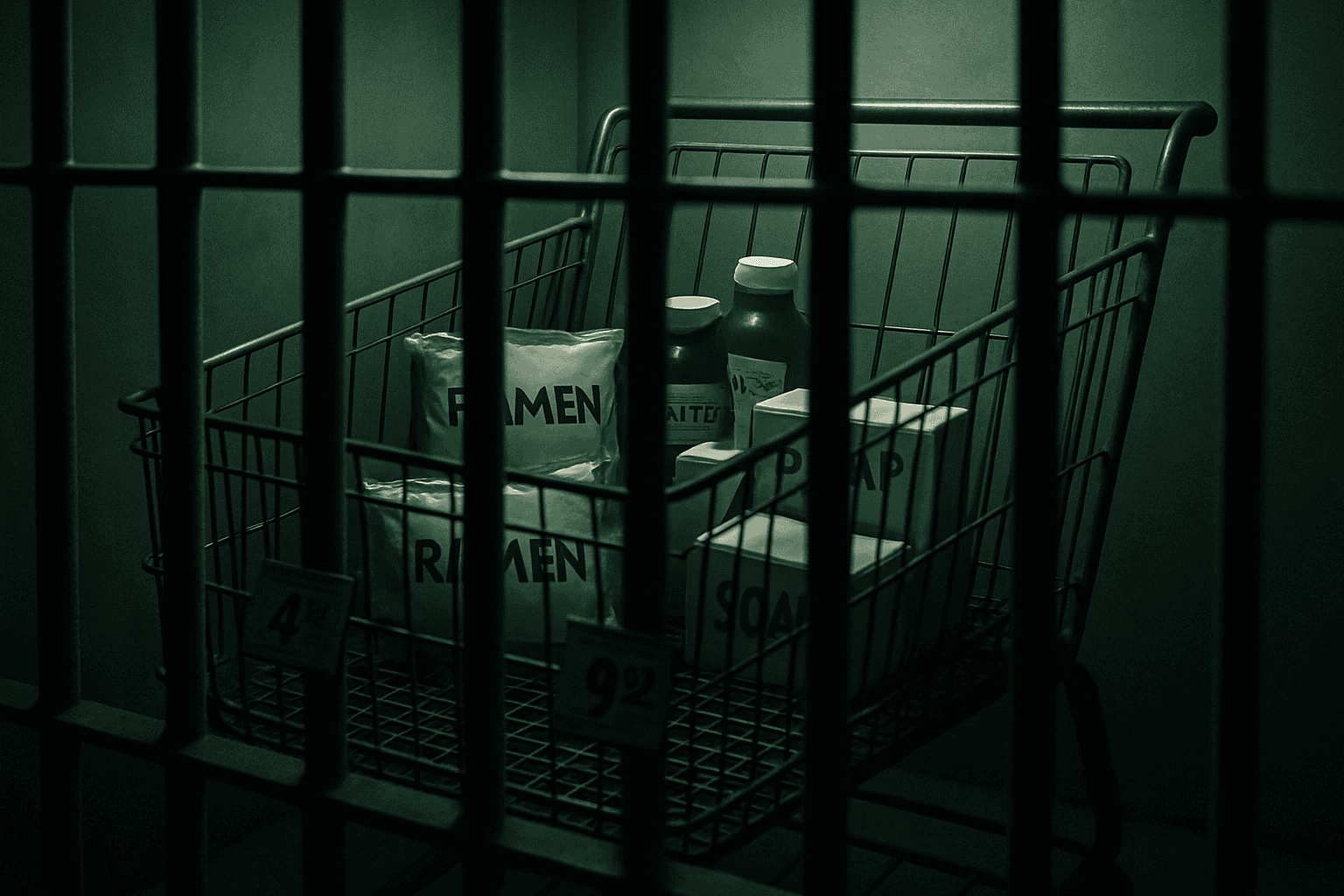
A new investigative analysis by Georgia Prisoners’ Speak reveals that Georgia’s prison commissary system operates a systematic two-tier markup scheme that extracts an estimated $8–15 million annually from incarcerated people and their families — charging up to 1,150% above retail prices for essential items like generic pain relievers, soap, and feminine hygiene products.
The investigation of 20 high-volume commissary staples found that the state’s vendor, Georgia Commissary Suppliers (Stewart’s Distribution), charges Georgia inflated “wholesale” prices that frequently exceed publicly available bulk rates — and the state then layers on additional markups of 54–323% before selling to people who have no alternative source for basic necessities. The most extreme case: generic ibuprofen sold at $4.00 for 20–24 tablets that cost $0.40–$0.48 at Walmart retail, an 833–1,150% markup over prices available to any consumer.
The analysis also raises questions about the sourcing of commissary products, presenting evidence that $0.13 travel toothpaste packets sold to incarcerated people for $0.55 may be free promotional samples never intended for resale, and that a major salvage food broker explicitly lists “prison system” among its core clients for near-expiration and excess inventory products.
Key Takeaway: Georgia’s prison commissary system uses a two-tier markup structure — inflated vendor pricing plus steep institutional markups — to extract an estimated $8–15 million annually from incarcerated people and their families on basic necessities.
Quotable Statistics
Scale of Extraction:
– $8–15 million annually — Estimated total excess extraction from incarcerated people and their families across all commissary purchases compared to fair pricing models
– $3–5 million annually — Estimated extraction on just the 20 high-volume items investigated
– $2,806,247 — Annual savings to families on just 5 high-volume items under fair wholesale-plus-30% pricing
– $1,472,000 — Annual excess extraction on a single ramen flavor alone (2.3 million units sold)
Most Exploitative Markups:
– 833–1,150% — Markup over retail on generic ibuprofen ($4.00 for 20–24 tablets worth $0.40–$0.48 at Walmart)
– 575–1,812% — Markup over institutional wholesale on bar soap ($1.10–$2.25 for bars available at $0.08–$0.14 wholesale)
– 350% — Total markup from true wholesale to inmate price on ramen ($0.20 → $0.90)
– 183–254% — Markup over generic retail on tampons ($3.40–$4.25 for 8-count boxes vs. $1.20 Walmart Equate generic)
– 267–550% — Markup over institutional wholesale on toothbrushes ($1.10 vs. $0.15–$0.40 bulk pricing)
The Vendor Problem:
– Georgia pays its vendor $0.40 per ramen packet when true institutional wholesale is $0.20–$0.25 (60–100% vendor overcharge)
– Georgia pays $0.73 per chip bag when Sam’s Club Business charges $0.60 (22% vendor premium)
– Georgia pays $1.92 for 20–24 generic ibuprofen tablets — already 380–400% above retail — before adding another 108% markup
– A $50–100 Sam’s Club Business membership would save $127,726 annually on just two chip products
Human Cost:
– Incarcerated women face an annual “menstrual tax” of $66–92 in excess costs for tampons they cannot opt out of purchasing
– People in prison pay $5.60 for a jar of peanut butter that costs $2.18 at Walmart — 157% more for a protein staple used to supplement inadequate meals
– 2.3 million units of a single ramen flavor sold annually demonstrates the scale of captive consumer purchasing
Strategic Pricing Pattern:
– Hot sauce is priced at $1.15–$1.45 vs. $1.48 retail — competitive or below retail
– Shampoo at $2.55–$2.60 matches or beats some retail options
– But essential protein staples face 157–466% markups and healthcare items face 833–1,150% markups — the system prices non-essential items fairly while exploiting necessities
Key Takeaway: The data reveals a pattern of strategic exploitation: items with visible retail comparisons are priced reasonably, while essential healthcare items, hygiene necessities, and protein staples face markups ranging from 183% to 1,812%.
Context and Background
What is this document? This is an internal investigative analysis produced by Georgia Prisoners’ Speak (GPS) examining pricing across 20 high-volume commissary items in Georgia’s state prison system. The analysis compares prices at every level of the supply chain: retail (Walmart, Kroger, Target), warehouse club (Sam’s Club, Costco), verified wholesale distributors, institutional bulk suppliers, and liquidation markets.
Who is the vendor? Georgia Commissary Suppliers, also known as Stewart’s Distribution, serves as the middleman vendor supplying commissary products to the state. The analysis identifies a June 2025 contract renewal as a critical intervention point.
What is the “two-tier” markup system? The investigation identifies two separate layers of price inflation: (1) the vendor charges the state prices that frequently exceed legitimate institutional wholesale rates, and (2) the state then adds its own institutional markup of 54–323% on top of already-inflated vendor costs. The compounding of these two markups is what produces the extreme final prices.
Why does this matter? Incarcerated people are captive consumers — they cannot comparison shop, switch suppliers, or boycott overpriced items. For non-optional necessities like pain relievers, menstrual products, and basic hygiene items, people in prison and their families have no choice but to pay whatever the commissary charges. The investigation frames this as a system that targets items with inelastic demand for maximum revenue extraction.
Key terminology: The analysis uses “menstrual tax” to describe the $66–92 in annual excess costs imposed on incarcerated women for tampon purchases. It uses “captive consumer market” to describe the economic conditions created by incarceration. “True wholesale” or “institutional wholesale” refers to legitimate bulk pricing available to large-volume purchasers — distinct from the inflated prices Georgia’s vendor charges.
What is the liquidation sourcing question? The analysis presents evidence that some commissary products may be sourced from salvage and near-expiration markets at steep discounts, then sold to incarcerated people at standard or near-retail prices. It cites Marvell Foods, a salvage food broker that explicitly lists “prison system” among its core clients for “short-coded products, excess inventory” including “expired to 12-month-old inventory.”
Verification note: The pricing comparisons in this analysis are based on publicly available retail prices (Walmart, Kroger, Target, Sam’s Club, Costco), publicly listed wholesale distributor pricing, and institutional supply catalogs. Reporters seeking independent verification can check current pricing at these retailers for the specific products and sizes cited.
Key Takeaway: Georgia’s commissary vendor contract is up for renewal in June 2025, creating an immediate window for reform of a system the investigation characterizes as optimized for revenue extraction from captive consumers.
Story Angles
1. “The $4 Ibuprofen: How Georgia Turns Pain Relief Into a Profit Center”
Generic ibuprofen — one of the cheapest mass-produced pharmaceuticals in America — costs incarcerated people in Georgia $4.00 for 20–24 tablets that any consumer can buy for $0.40–$0.48 at Walmart. The vendor charges Georgia $1.92, already 380–400% above retail, before the state adds another 108% markup. For people with chronic pain, this means spending $20–27 monthly on relief that should cost $2–3. This angle explores how the commissary system compounds physical suffering with economic extraction, and how incarcerated people are forced to ration essential healthcare because of pricing decisions made by the state and its vendor.
2. “Free Samples for Sale: Questions About What Georgia’s Prisons Are Actually Selling”
The investigation raises pointed questions about product sourcing. Travel-size toothpaste packets (0.15 oz) — a size that doesn’t exist in consumer retail — appear to match free promotional samples provided to hotels and dental offices. The vendor charges Georgia just $0.13, well below legitimate wholesale of $0.28, then the state sells them to incarcerated people for $0.55. Meanwhile, a major salvage food broker explicitly lists “prison system” among its clients for near-expiration and excess inventory. This angle investigates whether incarcerated people are unknowingly purchasing degraded or free products at premium prices, and what oversight exists over commissary sourcing.
3. “The Menstrual Tax: $66–92 a Year for Biology Behind Bars”
Incarcerated women in Georgia pay $3.40–$4.25 for 8-count tampon boxes that cost $1.20 in generic form at Walmart — a 183–254% markup on the one commissary item that is truly non-optional. The investigation calculates an annual “menstrual tax” of $66–92 per woman in excess costs, compounding to $330–460 over a five-year sentence. Multiple states have moved to provide menstrual products free, recognizing them as healthcare necessities. This angle examines how Georgia’s system imposes a gender-specific financial burden on incarcerated women and their families, and what reform efforts look like nationally.
Read the Source Document
Read the full GPS investigative analysis: Georgia’s Prison Commissary Extraction Machine (PDF)
Other Versions
- Public Explainer Version — Written for community members and families of incarcerated people
- Legislative Brief Version — Written for Georgia lawmakers and policy staff