This explainer is based on Truth in Sentencing & Fiscal Impact: The $40 Billion Story. All statistics and findings are drawn directly from this source.
TL;DR
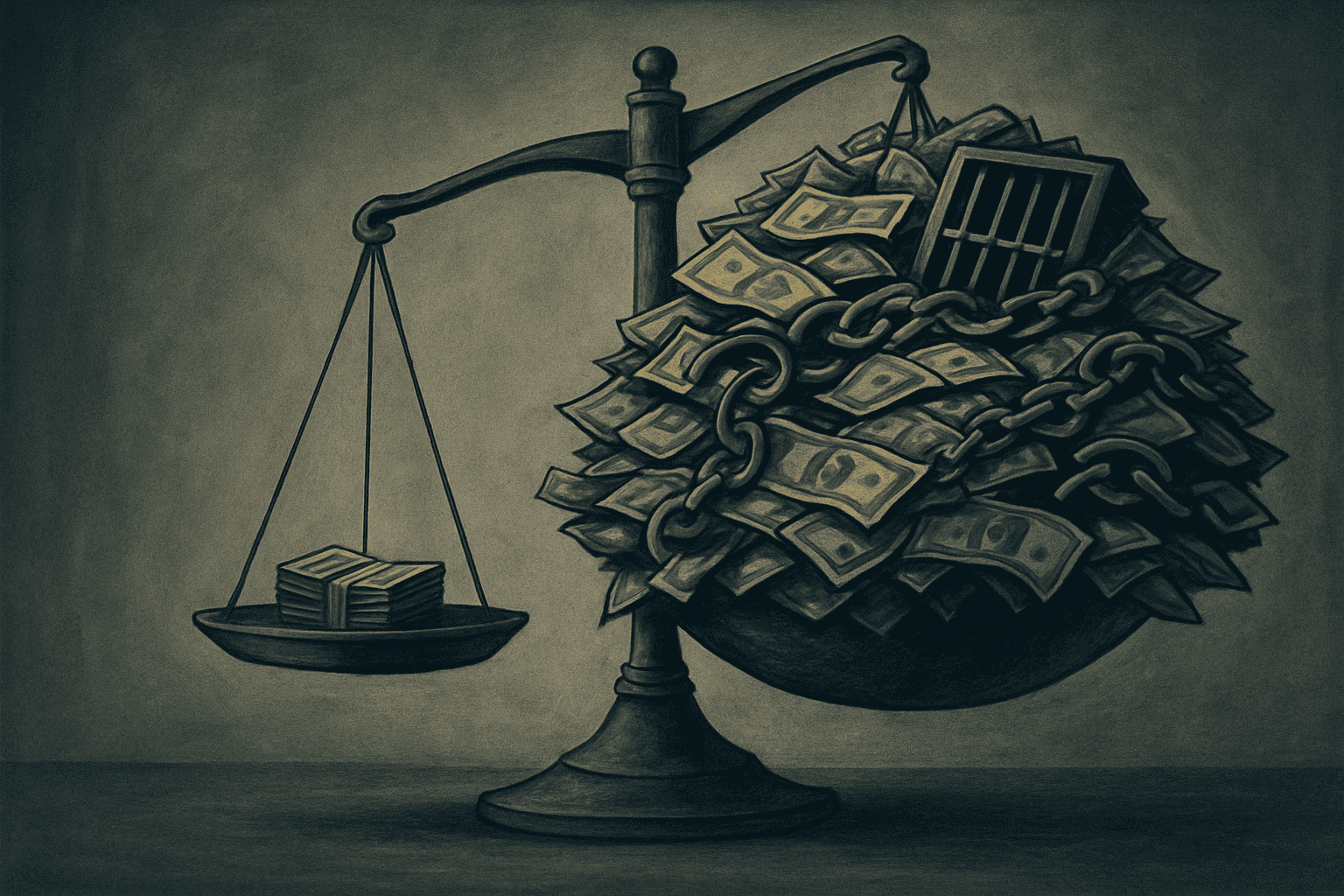
In the 1990s, the federal government gave Georgia $82 million to lock people up longer. That deal has cost Georgia $40 to $50 billion over 30 years. That means Georgia spent 400 to 600 times more than it got. Research shows these longer sentences do almost nothing to reduce crime. And they make it much harder for people to find work when they get out. Other states have cut prison costs AND crime at the same time.
Why This Matters
If your loved one is in a Georgia prison, these laws hit your family hard.
Georgia’s “Truth in Sentencing” (TIS) law means people must serve at least 85% of their time. Georgia also ended parole for crimes after 1996. That means your family member stays locked up much longer.
Longer time locked up means:
- More years apart from your family
- More money spent on phone calls, visits, and items from the prison store
- Worse job chances when your loved one comes home
- More crowded prisons with fewer staff and less safety
The research is clear. These laws do not make us safer. They just cost more money and hurt more families.
Key Takeaway: Georgia’s TIS laws keep people locked up longer without making the public safer, while families bear the cost in money, time, and pain.
The Deal That Started It All
In 1994, Congress passed a big crime bill. It gave money to states that agreed to keep people in prison longer. States had to make people serve at least 85% of their sentence.
The program set aside $12.5 billion for all states. Georgia got $82,211,036 between 1996 and 2001. The state ranked 9th in the country for how much it got. Georgia used the money to build 4,132 prison beds.
But here’s the catch. Georgia passed its tough laws BEFORE most of the money even came in. The state’s “Seven Deadly Sins” law came in 1995. Parole ended in 1996. A review by the Urban Institute found the grants had “limited influence” on whether states passed these laws. Georgia was going to do it anyway.
Key Takeaway: Georgia locked itself into harsh sentencing laws before most of the federal money even arrived.
The True Cost: $82 Million In, $40–50 Billion Out
Georgia got $82 million. But the prison costs that followed were huge.
Direct prison spending alone hit $30.6 billion from 1995 to 2025. When you add in county jails, probation, parole, courts, and building costs, the total reaches $40 to $50 billion over 30 years.
That $82 million in grants? It covers just 0.2–0.3% of what Georgia ended up spending. In other words, for every $1 the feds gave, Georgia spent $400 to $600 of its own money.
This is like taking a $100 gift card and signing up for a $50,000 bill.
Key Takeaway: Georgia accepted $82 million and took on $40–50 billion in costs — a ratio of roughly 1 to 500.
Longer Sentences Don’t Make Us Safer
The biggest myth about these laws is that they reduce crime. Decades of research say they don’t.
The Vera Institute found something striking. Since 2000, locking up more people has led to nearly zero percent drop in crime. Between 75–100% of the crime drop since the 1990s came from OTHER things:
- People getting older
- More people with jobs
- Higher wages
- More people finishing school
- Changes in how police do their work
Not from longer prison terms.
Nationally, time served went up 36% from 1990 to 2009. People convicted of violent crimes in 2009 could expect to spend about 7.1 years locked up. That’s over 2 years longer than before. But crime kept falling for reasons that had nothing to do with prison.
Key Takeaway: Since 2000, locking up more people has done almost nothing to reduce crime.
Longer Sentences Make Things Worse
Research shows that longer time in prison can actually make people MORE likely to come back.
A major study found that prison itself leads to more crime, not less. It breaks apart families. It takes parents away from children. It strips away job skills. It builds anger toward the system.
Here’s what the numbers show:
- Each extra year locked up cuts the chance of finding a job by 3.6 percentage points
- People who had steady work before prison and served 1 or more years saw their job chances drop by at least 24 percentage points
- People who get out need more food stamps and welfare
When people can’t find work, they are more likely to end up back in prison. This creates a cycle that costs everyone.
Key Takeaway: Each extra year in prison makes it harder to find work and may push people back into crime.
Georgia’s Hidden $2.7 Billion Cost
When harsh laws push people back to prison, that costs money too. GPS calls this the “return-to-prison tax.”
Georgia lets out about 15,000 people each year. If TIS laws push just 10% more of them back to prison, here’s what that looks like:
- 1,500 more people return to prison each year
- Each one serves about 3 more years
- That’s 4,500 extra years of prison time each year
- At $30,000 per person per year, that’s $135 million each year
- Over 20 years, that adds up to $2.7 billion
This $2.7 billion is money spent locking up people whose return was made more likely by the laws themselves.
Key Takeaway: Georgia may be spending $2.7 billion over 20 years to re-lock-up people that harsh sentencing pushed back into crime.
What Actually Works
The good news? We know what works better.
Prison education programs are one of the best tools we have. A large review of studies found:
- People who took classes in prison were 43% less likely to come back
- For every $1 spent on prison classes, it saved $4–5
- People who took classes were 13% more likely to find jobs
- The classes cost just $1,400–$1,744 per person
- The savings from fewer people coming back: $8,700–$9,700 per person over 3 years
Texas is a great example. The state put $241 million into programs that help people instead of just locking them up longer. The results?
- The rate of people on parole sent back to prison dropped 46%
- Crime fell to its lowest point since the 1960s
- Texas avoided over $3 billion in prison costs
Louisiana passed 10 reform laws in 2017. The prison population dropped 9%. The state shifted $30 million to programs in the community.
Key Takeaway: Prison education saves $4–5 for every $1 spent, and states like Texas have saved billions through smarter reforms.
19 States Prove There’s a Better Way
Between 2000 and 2015, 19 states cut their prison numbers AND their crime rates at the same time.
New Jersey stands out. It cut prison numbers by 37% and crime by 30%. That’s fewer people locked up and fewer victims.
Meanwhile, only 4 states saw crime go UP during this time. All 4 of those states also locked up MORE people.
This proves something important. Locking people up longer is not the only path to safety. It may not even be a good one. Georgia could follow the lead of these 19 states.
Key Takeaway: 19 states reduced both prison numbers and crime — proving Georgia doesn’t have to choose between safety and reform.
The Big Picture: America Pays More for the Same Safety
Here’s one more fact that puts it all in view.
In 1975, the U.S. spent $7.4 billion on prisons and had a certain level of safety. By 2000, the country spent $33 billion and had about the same level of safety.
By 2015, prison spending reached $87 billion. The safety level was about the same as in 1978, when the cost was just $5.5 billion.
As the Vera Institute put it, prison is an “expensive way to achieve less public safety.”
Georgia has been trapped in this bad deal for 30 years. The research is clear. The examples from other states are real. It’s time for a change.
Key Takeaway: The U.S. now spends $87 billion on prisons for the same safety it once got for $5.5 billion.
Glossary
Truth in Sentencing (TIS): Laws that force people to serve most of their sentence (usually 85%) before they can get out. These laws ended early release for most people.
VOI/TIS Grant Program: A federal program from 1994 that gave money to states if they passed laws keeping people in prison longer. “VOI” stands for Violent Offender Incarceration. “TIS” stands for Truth in Sentencing.
Parole: Early release from prison with rules to follow. Georgia ended parole for all crimes after 1996.
Recidivism: When a person who was released from prison ends up going back. Often called “return to prison.”
Recidivism Premium: The extra cost of locking up people who come back to prison BECAUSE the harsh laws made it harder for them to stay out.
Sleeper Effect: The delayed cost of long-sentence laws. People sentenced to decades pile up in prison over time. The true cost doesn’t show up for years.
Diminishing Returns: When you keep doing the same thing but get less and less out of it. Locking up more people now gives almost no crime reduction.
Justice Reinvestment: Taking money that would be spent on prisons and putting it into programs that actually reduce crime, like job training and drug treatment.
Criminogenic Effects: When prison itself makes people MORE likely to commit crime after they get out, by breaking apart families, cutting off job options, and creating anger.
Read the Source Document
📄 Truth in Sentencing & Fiscal Impact: The $40 Billion Story — Full Research Collection (PDF)
This post is based on a research collection by the GPS Research Library. It pulls together peer-reviewed studies, government reports, and data from groups like the Vera Institute, RAND, and Pew Charitable Trusts.
Other Versions of This Report
We write each report for different readers. Pick the one that fits your needs:
- 📋 Version for Lawmakers — Focuses on policy and budget details
- 📰 Version for Media — Focuses on key findings and story angles
- 🏛️ Version for Advocates — Focuses on reform strategy and legal action
Sources & References
- Incarceration, Recidivism and Employment — Manudeep Bhuller, Gordon B. Dahl, Katrine V. Løken, Magne Mogstad. Journal of Political Economy (2020-01-01) Academic
- The Impacts of Incarceration on Crime — David Roodman. Open Philanthropy Project (2017-01-01) Academic
- The Prison Paradox: More Incarceration Will Not Make Us Safer — Don Stemen. Vera Institute of Justice (2017-01-01) Academic
- The Criminal and Labor Market Impacts of Incarceration — Michael Mueller-Smith. University of Michigan (Working Paper) (2015-01-01) Academic
- The Growth of Incarceration in the United States: Exploring Causes and Consequences — National Research Council. The National Academies Press (2014-01-01) Academic
- How Effective Is Correctional Education, and Where Do We Go from Here?. RAND Corporation (2013-01-01) Academic
- How Should Inmates Be Released from Prison? An Assessment of Parole Versus Fixed-Sentence Regimes — Ilyana Kuziemko. Quarterly Journal of Economics (2013-01-01) Academic
- Stemming the Tide: Strategies to Reduce Growth and Cut Cost of Federal Prison System. Urban Institute (2013-01-01) Academic
- Time Served: The High Cost, Low Return of Longer Prison Terms. Pew Charitable Trusts (2012-06-01) Official Report
- Collateral Costs: Incarceration’s Effect on Economic Mobility. Pew Charitable Trusts (2010-01-01) Official Report
- The Crime-Control Effect of Incarceration: Does Scale Matter? — Raymond V. Liedka, Anne Morrison Piehl, Bert Useem. Criminology & Public Policy (2006-01-01) Academic
- Influence of Truth-in-Sentencing Reforms on Changes in States’ Sentencing Practices and Prison Populations — William J. Sabol et al.. Urban Institute (2002-01-01) Academic
- Diminishing Returns: Crime and Incarceration in the 1990s — Jenni Gainsborough, Marc Mauer. The Sentencing Project (2000-01-01) Official Report
- The Effects of Prison Sentences on Recidivism — Paul Gendreau, Claire Goggin, Francis T. Cullen. Public Works and Government Services Canada (1999-01-01) Academic
- GAO Truth in Sentencing State Grants Report 1998. Government Accountability Office (1998-01-01) Official Report
- Determinate Sentencing and Abolishing Parole: The Long-term Impacts on Prisons and Crime — Thomas B. Marvell, Carlisle E. Moody. Criminology (1996-01-01) Academic
- Bureau of Justice Assistance VOI/TIS Final Report. Bureau of Justice Assistance Official Report
- GPS analysis applying academic findings to Georgia corrections data. Georgia Prisoners’ Speak GPS Original
- GPS analysis of Georgia state budget documents. Georgia Prisoners’ Speak GPS Original
- Pew Charitable Trusts Justice Reinvestment Initiative reports. Pew Charitable Trusts Official Report
- RAND Corporation Oregon Measure 11 Evaluation. RAND Corporation Academic
2 thoughts on “Georgia’s $40 Billion Prison Trap: How an $82 Million Deal Became a Disaster”