This explainer is based on Prosecutor Accountability in Georgia: The Enforcement Gap. All statistics and findings are drawn directly from this source.
Why This Research Matters for Advocacy
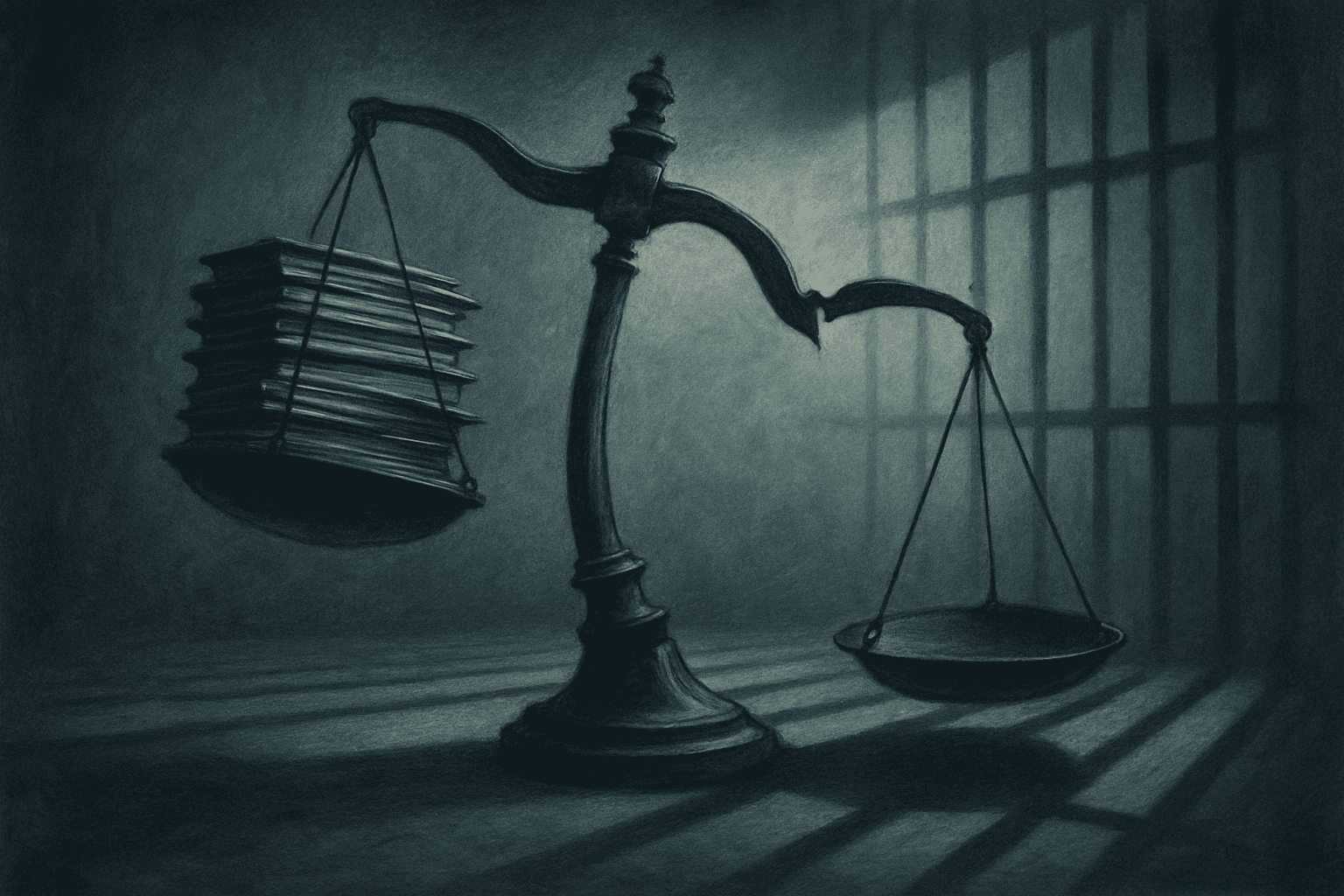
Georgia’s system for holding prosecutors accountable is broken — and this research proves it with data.
For decades, prosecutors in Georgia have wielded enormous power over people’s lives and liberty with virtually no meaningful oversight. This GPS internal analysis documents the enforcement gap in granular detail: the State Bar dismisses 88.6% of formal grievances at initial screening, only 0.66% of complaints result in any public discipline, and the State Bar does not even track complaints against prosecutors as a separate category — despite criminal matters constituting 39% of all complaints.
The consequences of this accountability vacuum are measured in human lives. An estimated 19 Georgia exonerations involved prosecutorial misconduct, representing approximately 228 person-years of wrongful imprisonment. Sixteen people freed by the Georgia Innocence Project collectively lost 372 years. These are not statistics — they are people whose lives were stolen by a system that failed them twice: first through wrongful prosecution, then through the refusal to hold anyone responsible.
Until 2022, Georgia had zero written ethical rules requiring prosecutors to disclose evidence of innocence after conviction. The maximum penalty for prosecutorial ethics violations was a public reprimand — among the weakest sanctions in the country. The 2022 amendments to Rule 3.8 were a step forward, but without enforcement mechanisms, new rules remain words on paper.
This research is directly relevant to several active advocacy fronts:
- The GPS Vision 2027 post-conviction justice reform campaign — this data supports adding prosecutor accountability as a component of the Georgia Post-Conviction Justice Act
- Legislative oversight hearings — the pipeline data (8,125 complaints → 54 public disciplines) is powerful testimony material
- The PAQC legal battle — understanding what independent oversight looks like and why Georgia needs it
- Coalition building — connecting wrongful conviction advocates, civil rights organizations, and criminal justice reformers around a shared data-driven agenda
This is the kind of research that changes conversations. Use it.
Key Takeaway: Georgia’s prosecutorial oversight system allows 99.34% of complaints to result in zero public accountability, while prosecutorial misconduct contributes to an estimated 19 wrongful convictions in the state — representing 228 person-years of stolen liberty.
Talking Points
Use these pre-written talking points in testimony, meetings, media interviews, and written communications. Each is backed by data from this research.
Georgia’s State Bar dismisses 88.6% of formal grievances at initial screening. Of 2,361 formal grievances received in 2023-24, 2,093 were dismissed before any investigation — meaning the overwhelming majority of people who report attorney misconduct never get their complaint examined.
Only 0.66% of complaints against Georgia attorneys result in any public disciplinary action. The pipeline narrows from 8,125 initial complaints to just 54 cases of public discipline — a system designed to protect lawyers, not the people they harm.
The State Bar does not track complaints against prosecutors as a separate category, despite criminal matters making up 39% of all complaints. Georgia literally cannot tell you how many prosecutors have been disciplined because the data doesn’t exist. You cannot fix what you refuse to measure.
Prosecutorial misconduct contributes to 30% of all wrongful convictions nationally, yet only 0.85% of prosecutors who committed Brady violations faced any discipline. Only 6 prosecutors were disciplined out of 707 Brady violation cases — a rate of accountability so low it functions as permission.
An estimated 19 Georgia exonerations involved prosecutorial misconduct, representing approximately 228 person-years of wrongful imprisonment. These are real people who lost over a decade of their lives, on average, because prosecutors broke the rules and no one held them accountable.
Until 2022, Georgia had zero written ethical rules requiring prosecutors to disclose post-conviction evidence of innocence. A prosecutor could discover that someone they convicted was innocent and had no written ethical obligation to say anything. That gap persisted for the entire history of the state until three years ago.
Until 2022, the maximum penalty for a Georgia prosecutor violating ethical codes was only a public reprimand — among the weakest sanctions in the country. Professor Clark Cunningham documented that Georgia’s prosecutorial oversight was “completely inadequate.” The penalty structure ensured that even the rare prosecutor who faced consequences received a slap on the wrist.
Only New York has a fully operational, prosecutor-specific independent oversight body in the entire country. Georgia created the PAQC in 2023, but it is currently facing constitutional challenge. Without independent oversight, prosecutors continue to police themselves — and the data shows how that works out.
Key Takeaway: Eight data-driven talking points demonstrate the systematic failure of Georgia’s prosecutorial accountability system, from the 88.6% grievance dismissal rate to the 228 person-years of wrongful imprisonment caused by prosecutorial misconduct.
Important Quotes
These quotes are drawn directly from the source document. Cite them in testimony, letters, and public statements.
“The situation in Georgia in terms of monitoring and deterring prosecutorial misconduct is completely inadequate.”
— Professor Clark Cunningham, W. Lee Burge Chair in Law & Ethics, Georgia State University College of Law, and Special Master for the Supreme Court of Georgia since 2010
(Section: Clark Cunningham’s Research on Prosecutorial Oversight)“Prior to 2022, Georgia had zero written ethical rules requiring prosecutors to disclose post-conviction innocence evidence.”
(Section: Georgia Rule of Professional Conduct 3.8)“From initial complaint to public discipline: approximately 0.66% result in any public action. The pipeline: 8,125 complaints → 80% resolved by CAP → 2,361 formal grievances → 88.6% dismissed → 185 referred for investigation → 54 cases of public discipline.”
(Section: State Bar of Georgia Grievance Data, subsection: The Pipeline Problem)“The OGC annual report does not break down grievances by complainant status (incarcerated vs. non-incarcerated), nor does it track grievances against prosecutors as a separate category. With criminal matters constituting 39% of all complaints, the absence of prosecutor-specific data is itself a significant gap.”
(Section: State Bar of Georgia Grievance Data, subsection: The Pipeline Problem)“Until the 2022 amendment to Rule 3.8, the maximum punishment for a prosecutor violating ethical codes was only a public reprimand — among the weakest in the country.”
(Section: Clark Cunningham’s Research on Prosecutorial Oversight)“A DA oversight commission could have a significant effect in deterring, disclosing and remedying prosecutorial misconduct.”
— Professor Clark Cunningham
(Section: Clark Cunningham’s Research on Prosecutorial Oversight)“This represents an estimated 228 person-years of liberty lost due to prosecutorial misconduct in Georgia alone.”
(Section: Prosecutorial Misconduct in Georgia Exonerations, subsection: Georgia-Specific Estimates)“Official misconduct was involved in 71% of fully overturned convictions in 2024.”
(Section: Prosecutorial Misconduct in Georgia Exonerations, subsection: 2024 Annual Report)“Only New York has a fully operational, prosecutor-specific independent body nationally.”
(Section: Models for Independent Prosecutor Review Boards)
Key Takeaway: These direct quotes from the research provide powerful, citable language for advocates to use in any setting — from legislative hearings to media interviews.
How to Use This in Your Advocacy
Legislative Testimony
This research is built for committee hearings. Here’s how to frame it:
- Lead with the pipeline: Start with the 8,125 → 54 pipeline. Legislators understand numbers, and this one tells the whole story in a single sentence. Only 0.66% of complaints result in public action.
- Name the structural blind spot: The State Bar does not track prosecutor complaints separately. Ask legislators: “How can we hold prosecutors accountable when the system designed to oversee them doesn’t even count them?”
- Connect to wrongful convictions: An estimated 19 Georgia exonerations involved prosecutorial misconduct — 228 person-years of liberty lost. These are constituents. These are taxpayer dollars spent incarcerating innocent people.
- Present the solution: Point to the New York Commission on Prosecutorial Conduct as a working model. Emphasize that Georgia’s PAQC was a step in the right direction but faces legal challenge and political complications. Advocate for a conviction integrity and prosecutorial ethics body framed around post-conviction justice.
- Use Professor Cunningham’s authority: He is a Special Master for the Supreme Court of Georgia. His conclusion that Georgia’s oversight is “completely inadequate” carries significant weight.
Public Comment
During public comment periods on criminal justice legislation or State Bar rule changes:
- Cite the 88.6% dismissal rate at initial screening to argue that the current system is structurally designed to fail complainants
- Emphasize that criminal matters are 39% of all complaints but prosecutors are invisible in the data
- Reference the 2022 Rule 3.8 amendment as evidence that Georgia has already acknowledged the problem — the question is whether it will enforce the solution
- Note that the “good faith” safe harbor in Comment [9] of Rule 3.8 creates a potential loophole that undermines the new disclosure requirements
Media Pitches
Reporters need angles, not data dumps. Here are three strong pitches:
“The 0.66% Problem” — Georgia’s attorney discipline system lets 99.34% of complaints disappear without any public consequence. And the state can’t even tell you how many of those complaints involve prosecutors, because it doesn’t track them. A deep dive into the enforcement gap.
“228 Years Lost” — An estimated 19 wrongful convictions in Georgia involved prosecutorial misconduct. The people wrongfully imprisoned lost a combined 228 years of their lives. How many prosecutors faced consequences? The state doesn’t know — because it doesn’t keep records.
“Georgia’s Zero Rule” — Until 2022, Georgia had zero ethical rules requiring prosecutors to disclose evidence of innocence after conviction. The rule finally changed, but enforcement remains virtually nonexistent. A story about the gap between rules on paper and accountability in practice.
Coalition Building
This research creates common ground across organizations:
- Innocence organizations share the wrongful conviction data and the 228 person-years figure
- Civil rights groups respond to the racial disparity: exonerees are disproportionately Black (~50% of Georgia exonerees vs. ~32% of the state population)
- Legal reform advocates engage with the State Bar pipeline data and the structural inadequacy argument
- Fiscal conservatives can be reached through the taxpayer cost argument: wrongful incarceration costs money, and failing to hold prosecutors accountable perpetuates it
- Victims’ rights groups have a stake too: when an innocent person is convicted, the actual perpetrator remains free
Use this research as a briefing document in coalition meetings. The data speaks across ideological lines.
Written Communications
In letters to legislators, the Governor’s office, State Bar leadership, or district attorneys:
- Open with the 0.66% figure — it’s the most powerful single number in this research
- Include the pipeline breakdown: 8,125 → 2,361 → 185 → 54
- Reference Georgia’s 64 exonerations and the estimated 228 person-years lost to prosecutorial misconduct
- Cite Professor Cunningham by name and title — his position as Special Master for the Georgia Supreme Court lends authority
- Close with a specific ask: support for independent prosecutorial oversight modeled on New York’s CPC, or support for including prosecutor accountability in the Georgia Post-Conviction Justice Act
Key Takeaway: This research can be deployed across five advocacy contexts — legislative testimony, public comment, media outreach, coalition building, and written communications — with specific framing strategies for each.
Use Impact Justice AI
Need to turn this research into a letter, testimony draft, email to a legislator, or public comment?
Impact Justice AI can help you generate advocacy materials using this research and other GPS data. The tool is designed to help advocates, families, and organizers create professional, evidence-based communications quickly.
Use it to:
– Draft legislative testimony incorporating the key statistics from this research
– Write letters to State Bar leadership demanding prosecutor-specific grievance tracking
– Create public comment submissions for rule-change proceedings
– Generate email campaigns for coalition partners
– Build fact sheets for community education events
Visit https://impactjustice.ai to get started.
Key Takeaway: Impact Justice AI at impactjustice.ai can help advocates generate letters, testimony, and other materials using this research.
Key Statistics
The following statistics are ready to copy-paste into testimony, letters, and advocacy materials. Each includes its context and source location.
8,125 — Total new complaints received by the State Bar’s Client Assistance Program in 2023-24. This is the entry point for all attorney grievances in Georgia.
(Section: State Bar of Georgia Grievance Data, subsection: Client Assistance Program)
2,361 — Formal grievances received by the State Disciplinary Board in 2023-24, down from 2,501 the previous year.
(Section: State Bar of Georgia Grievance Data, subsection: State Disciplinary Board)
88.6% — Percentage of formal grievances dismissed at initial screening. Of 2,361 grievances, 2,093 were dismissed for failure to state facts or jurisdiction.
(Section: State Bar of Georgia Grievance Data, subsection: State Disciplinary Board)
185 — Number of grievances referred to investigating Board members for containing allegations of Rules violations, out of 2,361 received.
(Section: State Bar of Georgia Grievance Data, subsection: State Disciplinary Board)
54 cases / 44 lawyers — Total public discipline imposed by the Georgia Supreme Court in 2023-24, out of approximately 55,000+ active Bar members.
(Section: State Bar of Georgia Grievance Data, subsection: Public Discipline by Supreme Court)
0.66% — Percentage of initial complaints that result in any public disciplinary action. The pipeline: 8,125 complaints → 54 cases of public discipline.
(Section: State Bar of Georgia Grievance Data, subsection: The Pipeline Problem)
39% — Percentage of State Bar complaints involving criminal matters — the largest single category. Yet no prosecutor-specific data is collected.
(Section: State Bar of Georgia Grievance Data, subsection: Client Assistance Program)
64 — Total exonerations recorded for Georgia in the National Registry of Exonerations as of 2025-2026.
(Section: Prosecutorial Misconduct in Georgia Exonerations, subsection: National Registry of Exonerations)
Over 12 years — Average wrongful imprisonment per exoneration case in Georgia.
(Section: Prosecutorial Misconduct in Georgia Exonerations, subsection: National Registry of Exonerations)
372 years — Total years of wrongful imprisonment collectively lost by 16 individuals freed by the Georgia Innocence Project.
(Section: Prosecutorial Misconduct in Georgia Exonerations, subsection: National Registry of Exonerations)
54% — Percentage of all exonerations nationally involving official misconduct (Gross & Possley study of 2,400 exonerations, 1989-2019).
(Section: Prosecutorial Misconduct in Georgia Exonerations, subsection: Gross & Possley Study)
30% — Percentage of all exonerations nationally involving specifically prosecutorial misconduct.
(Section: Prosecutorial Misconduct in Georgia Exonerations, subsection: Gross & Possley Study)
0.85% — Percentage of prosecutors disciplined for Brady violations. Only 6 prosecutors disciplined out of 707 cases.
(Section: Prosecutorial Misconduct in Georgia Exonerations, subsection: Gross & Possley Study)
71% — Percentage of fully overturned convictions in 2024 that involved official misconduct.
(Section: Prosecutorial Misconduct in Georgia Exonerations, subsection: 2024 Annual Report)
19 — Estimated number of Georgia exonerations involving prosecutorial misconduct (applying 30% national rate to 64 Georgia exonerations).
(Section: Prosecutorial Misconduct in Georgia Exonerations, subsection: Georgia-Specific Estimates)
228 person-years — Estimated total years of liberty lost due to prosecutorial misconduct in Georgia exoneration cases.
(Section: Prosecutorial Misconduct in Georgia Exonerations, subsection: Georgia-Specific Estimates)
13 — Total number of prosecutors disciplined in California over 26 years through its State Bar, demonstrating the inadequacy of traditional Bar oversight.
(Section: Models for Independent Prosecutor Review Boards, subsection: California)
Key Takeaway: Seventeen key statistics document every stage of Georgia’s prosecutorial accountability failure, from the complaint pipeline to the human cost of wrongful convictions.
Read the Source Document
Read the full GPS research document:
Prosecutor Accountability in Georgia: The Enforcement Gap (PDF)
This internal analysis compiles State Bar grievance data, the full text of Georgia Rule of Professional Conduct 3.8 as amended in 2022, national wrongful conviction research, Professor Clark Cunningham’s oversight findings, and comparative models from other states.
Other Versions
This research is available in versions tailored for different audiences:
- Public Version — Plain-language explainer for community members, families, and the general public
- Legislator Version — Policy brief formatted for Georgia legislators and their staff
- Media Version — Press-ready summary with key findings, data visualizations, and expert sources
Sources & References
- Eggena (2025): From Ballots to Bureaucrats — Mercer Law Review — Sutton M. Eggena. Mercer Law Review (2025-05-01) Academic
- 2023-24 OGC Annual Report. State Bar of Georgia, Office of General Counsel (2024-01-01) Official Report
- EJI: Record Number of Exonerations Involved Official Misconduct. Equal Justice Initiative (2024-01-01) Official Report
- Georgia PAQC. Prosecuting Attorneys Qualifications Commission (2023-01-01) Official Report
- Georgia Supreme Court Adopts Rule to Hold Prosecutors Accountable for Misconduct. Georgia Innocence Project (2022-07-06) Press Release
- Georgia Rule of Professional Conduct 3.8 (2022 Amendment). State Bar of Georgia / Supreme Court of Georgia (2022-01-01) Legal Document
- Georgia Rule of Professional Conduct 3.8 (as amended 2022). State Bar of Georgia / Georgia Supreme Court (2022-01-01) Legal Document
- In Georgia, few options to hold prosecutors accountable — Bill Rankin and Brad Schrade. Atlanta Journal-Constitution (2020-07-24) Journalism
- Clark Cunningham, Overview of Prosecutor Oversight in Georgia — Clark Cunningham. Georgia State University (2020-01-01) Academic
- Gross & Possley (2020): Government Misconduct and Convicting the Innocent — Samuel R. Gross, Maurice J. Possley. University of Michigan Law School (2020-01-01) Academic
- Innocence Project Prosecutorial Oversight Report. Innocence Project (2016-01-01) Official Report
- Clark Cunningham Homepage — Clark Cunningham. Clark Cunningham personal website Academic
- Fordham Urban Law Journal — Prosecutorial Oversight. Fordham Urban Law Journal Academic
- GSU Law Faculty Profile — Clark Cunningham. Georgia State University College of Law Official Report
- National Registry of Exonerations. National Registry of Exonerations Data Portal
- New York Commission on Prosecutorial Conduct. New York Commission on Prosecutorial Conduct Official Report
- State Bar of Georgia Disciplinary Process. State Bar of Georgia Official Report
Source Document
You just read about people suffering in state custody. The least you can do is make sure other people read it too. Share this story.