Author: Dena Ingram
I was 52 years old when they took me to county jail on January 9th, 2019. I’d never had so much as a speeding ticket. I thought it was just a formality, something they’d get straightened out. The charges were non-violent, and I knew I hadn’t done what they said I did. But I went in anyway, and I didn’t come out for two years.
Two years. Not convicted of anything. All charges dropped in the end.
The first thing that hit me was how cold and drab everything was. But what really got me was the feeling that I had no voice. Nobody had ever called me by my last name until then — it was odd to me, being treated like I was just a number. I was in shock.
My sister had told me once, “If you ever go to jail, say you’re addicted to everything so you can go to medical.” I don’t know why that stuck with me, but it did. So that’s what I said, and I spent about 30 days in medical before they moved me to general population.
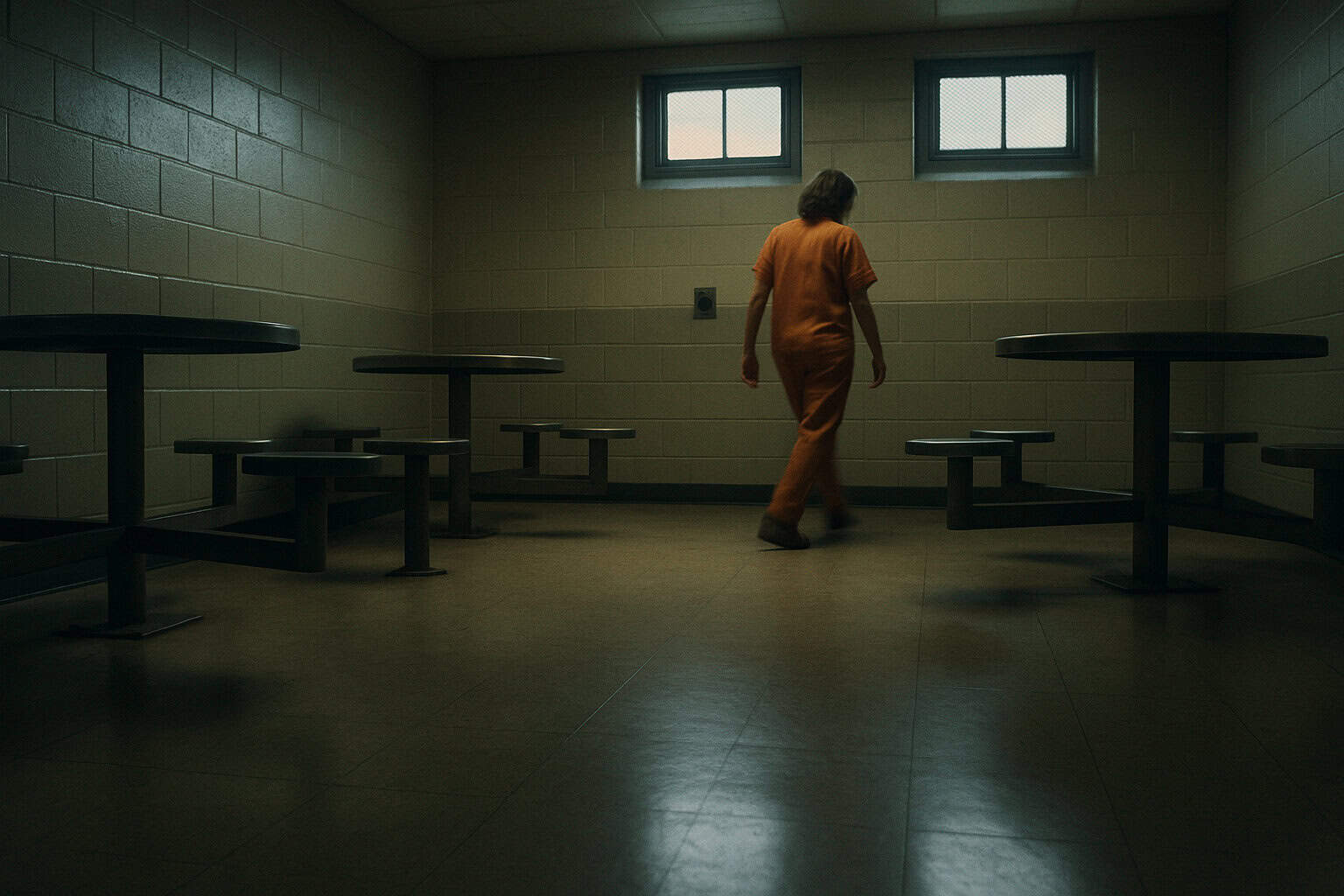
Medical was newer, more open, definitely safer. There were call buttons in each cell. When they moved me to GP, there was one call button for everyone in this tiny day room, and the place was hugely overpopulated.
I remember when they were taking me to GP, it was right after dinner. All the inmates were in the day room playing cards, laughing. I thought, what is wrong with y’all? Isn’t anyone trying to get out of here?
Little did I know. Life in there, for some people — and even for me in the end — it’s either laugh or cry.
Once you’re in there, you’re in there. It’s like a tiny little city within itself. You eat, sleep, go to the doctor, get your hair cut — all there. It becomes your whole world.
A typical day: up at 6 AM for breakfast. You line up, and if you forget something in your cell — say your cup — too bad. They will not open it. Then I started walking round and round that tiny day room until 10. At 10 we were locked down until 12 when lunch came. Walking again until 4. Locked down again until 6 when dinner came. Lock down at 10 for the night.
No magazines. The only books came from the chaplain, and not being a Christian made them a no-go for me. I felt like my brain was turning to marshmallows.
I had to get to trustee status. I knew that much.
But first, there was the toilet paper.
In GP, you had to beg for toilet paper every single day. That was shocking to me. When you asked, the guard would walk in the dorm, roll the tissue around her hand like three or four times, and hand that to you. It was simply to break the inmates down.
One time, a guard said over the intercom to the whole dorm: “I don’t care if you use your hand to wipe, rinse it and repeat. You will not get any toilet tissue.”
We were like, is this really happening?
We refused to lock down. The inmates in the dorm next to us were violent offenders — a door separated the dorms — so we beat on that door and said, y’all better not lock down either. We stood strong, and we got tissue.
I went to trustee shortly after that. When I saw that case of tissue just tossed in the trustee dorm, I got mad all over again.
Being a trustee was the hardest work I’ve ever done. We worked in the kitchen — everything was so heavy, no air conditioning. But it didn’t matter. I did it to be in a total open dorm with stainless steel showers. The ones in GP were cinder block with black mold on them.
As a trustee, an entire case of toilet paper was put in our dorm weekly. We got three of everything — shirts, underwear, socks — and it was all brand new. In GP, people got one T-shirt, one pair of underwear, and one pair of socks, and most of the time it was used.
We got to eat staff dining, which was real food. One guard bought us a soda once a week. Just little peeks that helped me get through it. Those little things that made you feel like a person were worth it.
But being a trustee meant being completely separated from GP. If we even got caught talking to GP — like in a hallway — we were kicked out of the kitchen and sent back. It happened all the time. For a female inmate, getting one of those 20 trustee spots was a must, and keeping it was too. I hated how separating it was, but I guess they didn’t want GP to know the difference in the treatment.
We woke up at 2 AM to make trays for over a thousand inmates. Everything had to be cooked and on the carts before 6. After that we went back to sleep. Up at 10, back to work at 1, trays on the carts before 6 again. Men did lunch because it was just sandwiches, and they cleaned the kitchen after each meal.
The trays would have roaches and rat feces on them. When we said something, we were told, just put the food on the tray.
Again — no voice.
We had no choice but to do it. We were in their house. You either did it or went back to GP right then. Only 20 of us were trustees, so we did it.
We found wood chips in the dehydrated potatoes. The meat was mechanically separated chicken that had “body #37” and “not for human consumption” stamped on the bottom of it. It was body #37 the entire time I was there. The sandwiches would be green. We said something about it all. Nobody listens to an inmate.
The staff food was completely different — prepared by an employee of the company that had the kitchen contract, Aramark. Real food for them. “Not for human consumption” for us.
When COVID hit, the National Guard came in hazmat suits to test us — but just the trustees, and only because we had contact with officers and their food. At the time it was happening, we didn’t know what was happening. We went in the hallway one at a time, and everyone came back in with a nosebleed. It was a little scary.
The courts closing was devastating. We all knew we had to go to court to get out of there, or take whatever plea deal we got. But there were no extra cleanings or anything. Cleaning in general was almost non-existent in GP when I was there.
We were expected to keep our cells clean and did the best we could with state soap — which was a joke. All state-issued stuff was garbage: the deodorant, the toothpaste, all of it.
I was lucky enough to be able to have commissary, so I always bought better stuff. But so many had nothing. When I was in GP, I bought people soap, fed people, anything I could. But as a trustee, you’re separated from GP completely.
As a trustee, it’s sad to say, but we looked forward to taking out the trash every day because it was outside, and that was hard to get. We would drag it out as long as we could. It was nasty and it stunk something awful, but to us it was everything.
It was only minutes.
I was in the kitchen when they said I had a lawyer video visit. I returned to the dorm, and when my lawyer said, you are going home, I fell to my knees and just cried.
But I soon realized — it had been two years. I had no home to even go to. I lost everything: my house and everything in it, my car, everything.
I had to stay at a friend’s for weeks until me and my youngest daughter were able to get an apartment. At my age, that was make it or break it time.
So I enrolled in school. Now I’m graduating with a bachelor’s degree in criminal justice. I plan to start a defense advocacy program in my city.
I want to assist public defenders with research, with the hope that people will start looking for the truth in court and not just a win. I want to help inmates have a voice. I want to help those coming back to society.
It sounds like a lot, but it’s really just being a good human being.
Unless you have actually been there, you have no idea. I did two years, not convicted of anything.
It can happen.
You Have Options
Free tools to take action — the law is on your side.
Demand records from the prison system. Reach the officials who set policy. File a grievance or a complaint the right way. And for families who’ve lost someone in custody, get the records that tell the truth. Plain-language, step-by-step, and free.
Explore the GPS Toolkits →