This explainer is based on Georgia Department of Corrections: Budget & Spending Trends FY2022-FY2027. All statistics and findings are drawn directly from this source.
Why This Research Matters for Advocacy
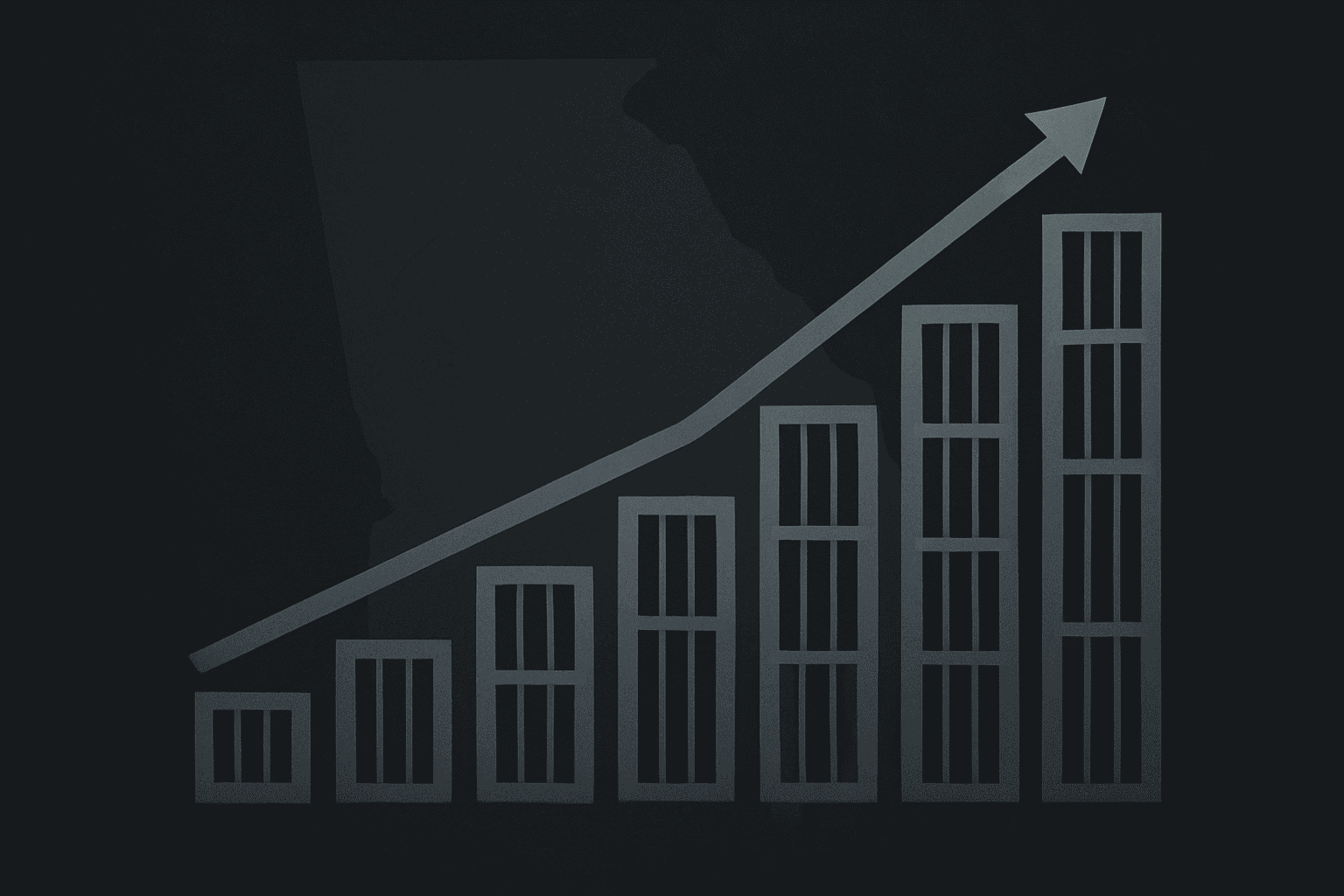
Georgia is in the midst of a historic escalation in prison spending. From FY2022 to proposed FY2026, the Georgia Department of Corrections (GDC) budget surged 44%—nearly $500 million in new spending—while the state continues to extract more than $10 million annually in fees from incarcerated people and their families.
This research compilation, drawing from the Governor’s official budget documents, the Georgia Budget & Policy Institute’s independent analyses, and Georgia Prisoners’ Speak data, exposes a fundamental contradiction at the heart of Georgia’s carceral policy: the state is spending hundreds of millions more to warehouse people while simultaneously charging those same people for the privilege of being locked up.
For advocates, this research is a powerful tool for several reasons:
- It connects budget line items to human suffering. The numbers reveal that Georgia is pouring money into contraband detection systems, private prison bed expansion, and jail subsidies—not into reducing the harms of incarceration or addressing the financial exploitation of incarcerated people and their families.
- It documents racial injustice with fiscal precision. Black Georgians represent 58% of the prison population while comprising only 33% of the state’s population, meaning this spending surge disproportionately funds the confinement of Black communities.
- It arms advocates with ammunition for upcoming budget fights. With the FY2027 budget proposing another $66.7 million in changes—including $4.2 million for 263 new private prison beds—the time to intervene is now.
- It reveals what the state refuses to fund. Despite nearly $500 million in added spending, there are zero line items addressing medical co-pay burdens, commissary price gouging, forced unpaid labor, or the needs of incarcerated women and birthing people.
This is not a story about a state investing in public safety. This is a story about a state doubling down on incarceration while extracting wealth from the people it confines.
Key Takeaway: Georgia’s prison budget increased 44% over four years—nearly $500 million—while the state continues to charge incarcerated people over $10 million annually in fees and ignores their most basic needs.
Talking Points
Georgia’s prison spending has exploded by 44% since FY2022—nearly $500 million in new spending—yet incarcerated people are still charged $5 medical co-pays, coerced into unpaid labor, and forced to bear rising commissary costs for basic hygiene products.
The state collects more than $10 million annually in fees from incarcerated people and their families—for phone calls, mail, and other services—while simultaneously asking taxpayers for hundreds of millions more to expand the prison system.
Black Georgians make up only 33% of the state’s population but represent 58% of its prison population, meaning this spending surge disproportionately funds the confinement of Black communities—a direct legacy of slavery, segregation, and racialized criminalization.
Georgia is spending $4.2 million to add 263 new private prison beds at Coffee and Wheeler Correctional Institutions in FY2027, enriching private prison corporations instead of investing in alternatives that reduce incarceration.
Healthcare contract spending alone increased approximately 40% since FY2022, with $47.9 million added in FY2027 for physical health contracts—yet incarcerated people still face $5 co-pays that deter them from seeking care and create debt.
The state invested $13.4 million in managed access and drone detection systems to prevent contraband, but allocated $0 to address the financial exploitation of incarcerated people through forced unpaid labor, regressive fees, and inflated commissary prices.
Georgia spends $86.61 per day—$31,612 per year—to incarcerate each person, yet cannot fund postpartum pumping rooms, lactation programs, or child-friendly visiting spaces for incarcerated women and birthing people.
The prison population grew from 42,795 at the pandemic low in early 2021 to 49,828 by January 2025, yet instead of investing in diversion and decarceration, the state responded with modular housing units, jail subsidies to county facilities, and private prison bed expansion.
Key Takeaway: These eight talking points, backed by budget data, equip advocates to challenge Georgia’s prison spending priorities in any setting.
Important Quotes
The following quotes are drawn directly from the source documents and can be cited in testimony, media statements, and written communications.
“Not including added spending from recent amended budgets, the proposed FY 2026 budget would reach annual spending levels that are nearly $500 million higher than FY 2022. If this is passed it would represent a 44% increase in prison spending from FY 2022 to FY 2026.”
— Georgia Budget & Policy Institute, FY2026 GDC Budget Overview, page 2“Black Georgians continue to represent an outsized 58% share of the state’s prison population (comprising only 33 percent of the overall state population), evidence of the state’s legacy of slavery, segregation, Jim Crow, racialized criminalization through over-policing in communities of color, racially biased school punishment and historic disinvestments in communities of color.”
— Georgia Budget & Policy Institute, FY2025 GDC Budget Overview, page 2“Incarcerated people are charged a $5 medical co-pay for requested health services and medications.”
— Georgia Budget & Policy Institute, FY2026 GDC Budget Overview, Medical Co-Pays box, page 3“Many of those serving sentences in Georgia prisons are coerced to provide unpaid and unprotected labor which help subsidize millions in public and private profits, while having to purchase prison health services and basic living necessities.”
— Georgia Budget & Policy Institute, FY2026 GDC Budget Overview, page 2“GDC requires offenders in its facilities to work to support the prison system and the community.”
— Governor’s Budget Report, Department of Corrections Roles and Responsibilities, page 145“Without a change of course, our criminal legal system will continue to undermine collaborative state efforts towards holistic community health, economic security and workforce prosperity.”
— Georgia Budget & Policy Institute, FY2025 GDC Budget Overview, page 3“Unaffordable co-pays or the threat of incurring debt can carry health and fiscal consequences, including deterring incarcerated Georgians from seeking care, increasing the likelihood that illnesses can spread or worsen and increasing the likelihood that subsequent care will be more expensive.”
— Georgia Budget & Policy Institute, FY2026 GDC Budget Overview, Medical Co-Pays box, page 3
Key Takeaway: These direct quotes from official budget documents and independent analysis provide advocates with authoritative, citeable language for all communications.
How to Use This in Your Advocacy
Legislative Testimony
When testifying before Georgia House or Senate Appropriations committees:
- Lead with the contradiction. Open by noting that the state has increased prison spending by 44% since FY2022—nearly $500 million—while simultaneously extracting more than $10 million annually in fees from incarcerated people and their families. Ask legislators: Who is this spending serving?
- Use the racial disparity data. State clearly that Black Georgians are 33% of the population but 58% of the prison population, and that every dollar of increased prison spending disproportionately funds the confinement of Black communities.
- Name what’s missing. Point out that across hundreds of millions in new spending, there is no line item for eliminating medical co-pays, compensating incarcerated workers, reducing commissary prices, or providing humane accommodations for incarcerated women and birthing people.
- Challenge private prison expansion. The FY2027 budget allocates $4.2 million for 263 new private prison beds. Ask legislators why the state is expanding capacity for CoreCivic and GEO Group instead of investing in programs that reduce incarceration.
Public Comment
During public comment periods on the state budget:
- Emphasize that healthcare spending has increased 40% since FY2022, yet incarcerated people still face $5 co-pays that create debt and deter them from seeking care.
- Note the $6.2 million increase in jail subsidies, which shifts state prisoners to county jails—often with even fewer resources and protections.
- Demand transparency on how the $13.4 million for contraband detection systems will be evaluated, and whether those funds could be redirected toward programming and communication access.
Media Pitches
- Budget story angle: “Georgia’s prison spending has surged $500 million in four years, but incarcerated people still can’t afford a $5 doctor’s visit.” Use the contrast between the $47.9 million physical health contract increase and the $5 medical co-pay that deters people from seeking care.
- Private prison angle: “Georgia is spending $4.2 million to add beds at private prisons run by CoreCivic and GEO Group, even as the state’s prison spending has grown 44% in four years.”
- Racial justice angle: “Black Georgians are 33% of the population but 58% of the people locked up. Georgia’s $1.78 billion prison budget is a racial equity issue.”
- Hidden costs angle: “The state extracts more than $10 million a year from incarcerated people and their families through fees—on top of $1.78 billion in taxpayer-funded prison spending.”
Coalition Building
- Share this research with fiscal conservatives. A 44% spending increase over four years with no measurable improvement in outcomes is a waste of taxpayer money. This data creates common ground between progressive reform advocates and fiscal responsibility groups.
- Connect with healthcare advocates. The 40% increase in prison health spending—combined with the $5 medical co-pay barrier—is a public health story. Healthcare organizations should know that Georgia is spending more on prison healthcare contracts while actively discouraging people from seeking care.
- Engage racial justice organizations. The 58% Black incarceration rate combined with the financial extraction from incarcerated families makes this a clear racial economic justice issue.
- Partner with labor organizations. The Governor’s budget explicitly states that “GDC requires offenders in its facilities to work.” This forced unpaid labor subsidizes state operations while incarcerated workers bear the costs of their own confinement.
Written Communications
In letters to legislators, the Governor’s office, and corrections officials:
- Cite the total amended FY2026 budget of $1,782,435,308 in state general funds to convey the scale of spending.
- Reference the annual cost of $31,612 per incarcerated person to make the per-person fiscal case for alternatives.
- Note the $10 million+ in annual fees collected from incarcerated people to challenge the narrative that the state is bearing the full cost of incarceration.
- Use the population growth data—42,795 in early 2021 to 49,828 by January 2025—to argue that the state is fueling its own budget crisis by driving up incarceration rates instead of investing in decarceration.
Key Takeaway: This research can be deployed across every advocacy context—from committee testimony to coalition meetings—to challenge Georgia’s prison spending priorities and center the experiences of incarcerated people.
Use Impact Justice AI
Need help turning this research into action? Impact Justice AI can help you:
- Draft legislative testimony using the statistics and findings from this budget analysis
- Generate letters to legislators that cite specific budget line items and demand accountability
- Create email campaigns for your coalition members with ready-to-send messages
- Write public comment submissions for state budget hearings
- Develop fact sheets and one-pagers for community education and media outreach
Impact Justice AI draws on GPS research and other criminal legal system data to help advocates produce professional, evidence-based materials quickly. Visit https://impactjustice.ai to get started.
Key Takeaway: Impact Justice AI at https://impactjustice.ai can help advocates generate letters, testimony, and other materials using this research.
Key Statistics
Budget Totals and Growth
- $1,782,435,308 — Total GDC amended budget for FY2026 (state general funds). (Governor’s Budget, Department Budget Summary, page 151)
- $1,762,069,964 — Proposed GDC budget for FY2027 (state general funds). (Governor’s Budget, Department Budget Summary, page 151)
- 44% — Total increase in prison spending from FY2022 to proposed FY2026. (GBPI FY2026 Overview, page 2)
- Nearly $500 million — Added spending over FY2022 levels in the proposed FY2026 budget. (GBPI FY2026 Overview, page 2)
- $125 million — Budget increase from FY2025 to proposed FY2026. (GBPI FY2026 Overview, page 1)
- $153 million — Budget increase from FY2024 to FY2025. (GBPI FY2025 Overview, page 1)
Per-Person Costs
- $86.61 — Daily cost of incarcerating one person in Georgia (FY2024). (GPS analysis)
- $31,612 — Annual cost per incarcerated person. (GPS analysis)
Population Data
- 49,828 — People incarcerated in GDC facilities as of January 31, 2025. (GBPI FY2026 Overview, chart, page 1)
- 42,795 — People incarcerated at the pandemic low point in early 2021. (GBPI FY2026 Overview, chart, page 1)
- More than 50,000 — People serving prison sentences according to the Governor’s budget. (Governor’s Budget, Roles and Responsibilities, page 145)
- 58% — Share of Georgia’s prison population that is Black, despite Black Georgians being only 33% of the state’s overall population. (GBPI FY2025 Overview, page 2)
Healthcare Spending
- 40% — Increase in prison health spending since FY2022. (GBPI FY2025 Budget Primer)
- $47,880,895 — Increase for physical health contract in FY2027 alone. (Governor’s Budget, Health section, page 148)
- $38,869,898 — Increase for physical health contract in amended FY2026. (Governor’s Budget, Health section, page 146)
- $54,769,710 — Total Health program budget increase for FY2027. (Governor’s Budget, Health section, page 148)
- $5 — Medical co-pay charged to incarcerated people for healthcare services and medications. (GBPI FY2026 Overview, Medical Co-Pays box, page 3)
Fees and Financial Extraction
- More than $10 million — Annual fees collected from incarcerated people for each of the last 3 years. (GBPI FY2025 Budget Primer)
Private Prison and Capacity Expansion
- $4,227,620 — Cost to add 263 private prison beds (160 at Coffee, 103 at Wheeler) in FY2027. (Governor’s Budget, Private Prisons section, page 149)
- $6,242,030 — Increase for jail subsidy payments to local jails in amended FY2026. (Governor’s Budget, Offender Management section, page 146)
Security and Technology Spending
- $13,387,475 — Investment in managed access and drone detection systems in amended FY2026. (Governor’s Budget, State Prisons section, page 147)
- $5,521,230 — Technology costs for the Over Watch and Logistics (OWL) Unit in FY2027. (Governor’s Budget, State Prisons section, page 150)
Staffing
- $12,050,341 — Cost of $2,000 one-time salary supplements in State Prisons for amended FY2026. (Governor’s Budget, State Prisons section, page 147)
- $26,824,134 — Investment in additional correctional officer positions in FY2027. (Governor’s Budget, State Prisons section, page 149)
Key Takeaway: These statistics are ready to copy-paste into testimony, letters, and media materials—each one sourced to the official budget documents or independent analysis.
Read the Source Document
Other Versions
This analysis is also available in versions tailored for different audiences:
- 📋 Public Version — Accessible overview for community members and the general public
- 🏛️ Legislator Version — Policy brief formatted for elected officials and staff
- 📰 Media Version — Press-ready summary with key findings and data points
Sources & References
- GBPI: Overview: 2026 Fiscal Year Budget for the Georgia Department of Corrections — Ray Khalfani. Georgia Budget and Policy Institute (2025-01-01) Academic
- Governor’s FY2026-FY2027 Budget: Department of Corrections — Office of the Governor of Georgia. Governor’s Budget Report Amended FY 2026 and FY 2027 (2025-01-01) Official Report
- GBPI: Criminal Legal Systems Budget Primer FY2025. Georgia Budget and Policy Institute (2024-01-01) Academic
- GBPI: Overview: 2025 Fiscal Year Budget for Georgia Department of Corrections — Ray Khalfani. Georgia Budget and Policy Institute (2024-01-01) Academic
- GDC Profiles of All Inmates Report — Georgia Department of Corrections. Georgia Department of Corrections (2024-01-01) Official Report
- GPS analysis: Cost per Inmate. Georgia Prisoners’ Speak (2024-01-01) GPS Original
- Atlanta Journal-Constitution: Number of African-Americans sent to Georgia prisons hits historic lows — B. Rankin. Atlanta Journal-Constitution (2018-01-25) Journalism
- Prison Policy Initiative: The steep cost of medical co-pays in prison — Wendy Sawyer. Prison Policy Initiative (2017-04-19) Academic
- GDC Friday Reports — Georgia Department of Corrections. Georgia Department of Corrections Official Report
Source Document
You just read about people suffering in state custody. The least you can do is make sure other people read it too. Share this story.