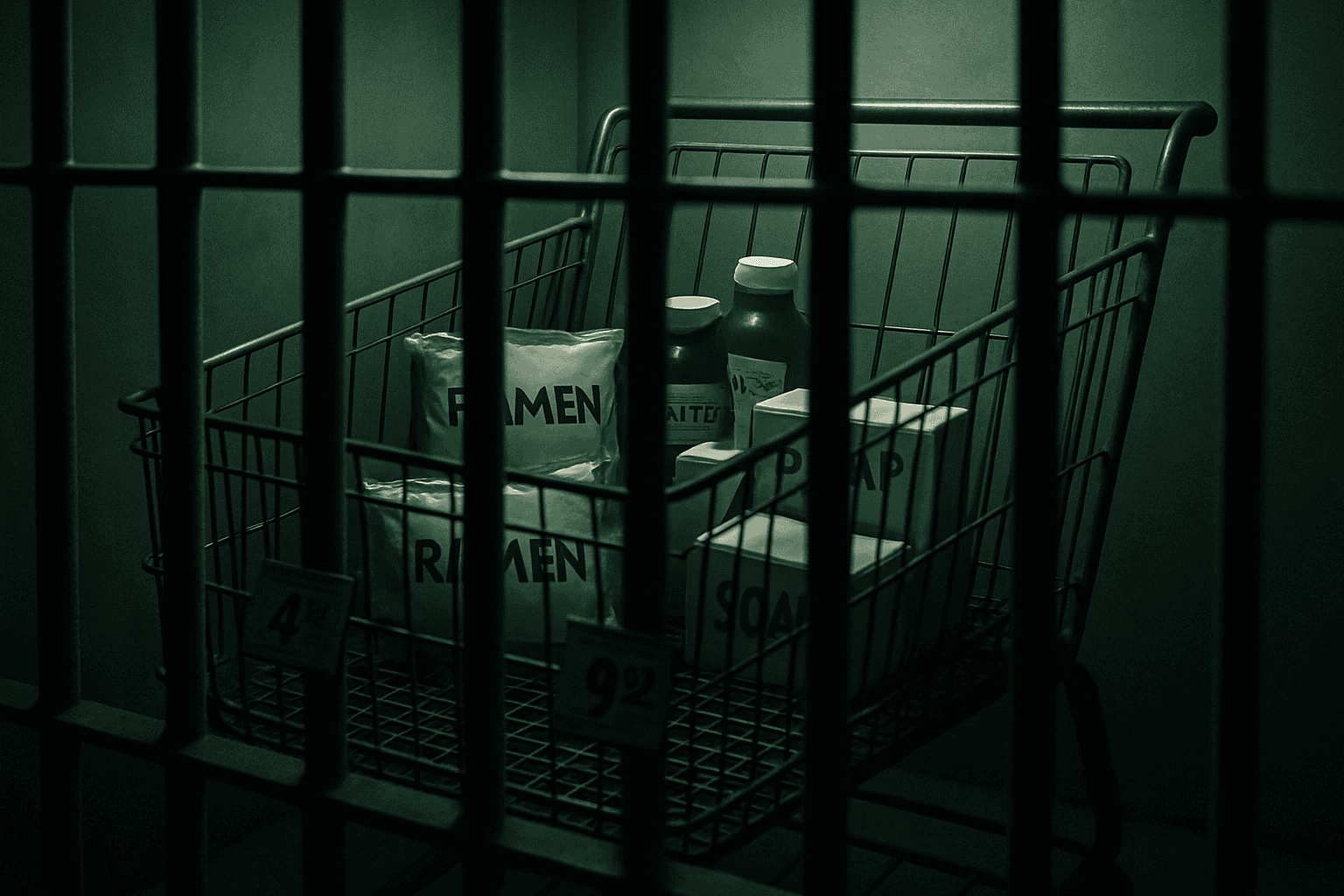
This explainer is based on Georgia’s Prison Commissary Extraction Machine. All statistics and findings are drawn directly from this source.
Why This Research Matters for Advocacy
This investigation dismantles the financial architecture of Georgia’s prison commissary system — and hands advocates the evidence they need to demand change.
For years, families of incarcerated people in Georgia have known commissary prices are unfair. Now, GPS’s item-by-item pricing analysis proves it with receipts. The research documents a two-tier markup scheme in which the state’s vendor, Georgia Commissary Suppliers (Stewart’s Distribution), charges the state inflated “wholesale” prices that exceed legitimate bulk rates — and then the state piles on additional markups of 54-323% before charging people in prison. The result: an estimated $8-15 million annually extracted from incarcerated people and their families across all commissary purchases, compared to fair pricing models.
This research is a powerful advocacy tool for several reasons:
- It names the mechanism. This isn’t just “high prices” — it’s a documented two-tier extraction system with inflated vendor costs and compounding institutional markups.
- It targets a contract renewal. The June 2025 vendor contract renewal creates an immediate, time-sensitive opportunity for legislative and public pressure.
- It provides retail comparisons anyone can verify. Every markup is benchmarked against Walmart, Kroger, Sam’s Club, and Costco prices that families and legislators can check themselves.
- It exposes strategic exploitation. The data proves that Georgia prices non-essential items fairly (hot sauce at or below retail) while imposing extreme markups on items people cannot avoid — pain relievers, menstrual products, soap, and protein staples. This isn’t a broken system; it’s a system working exactly as designed.
- It centers the people harmed. The research connects dollars to suffering — chronic pain sufferers rationing ibuprofen, women paying a “menstrual tax” of $66-92 annually, families choosing between sending money for food or paying their own bills.
This document gives advocates what they need to fight on every front: legislative testimony, media campaigns, public comment, coalition building, and litigation support.
Key Takeaway: GPS’s commissary pricing investigation provides verified, item-by-item evidence of a two-tier extraction scheme that advocates can use to demand reform before the June 2025 vendor contract renewal.
Talking Points
Use these pre-written talking points in meetings, testimony, media interviews, letters, and coalition communications. Each is backed by data from the GPS investigation.
Georgia operates a two-tier commissary markup scheme that extracts an estimated $3-5 million annually on just 20 high-volume items from incarcerated families. The vendor charges the state inflated “wholesale” prices — ramen at $0.40 when true institutional wholesale is $0.20 — and then the state adds markups of 54-323% on top of those already-inflated costs.
People in Georgia’s prisons pay $4.00 for generic ibuprofen that costs $0.40-$0.48 at Walmart — a markup of 833-1,150% over retail. The state’s vendor charges $1.92 for these tablets, already 380% above retail, before the state adds another 108% markup. Essential pain relief has been turned into a profit center.
The system strategically targets items people cannot avoid. Hot sauce is priced at or below retail ($1.15-$1.45 vs. $1.48 at Walmart), but protein staples like peanut butter are marked up 157-466% and tampons 183-254% over retail. The pricing isn’t broken — it’s calculated.
Georgia’s vendor charges more than Sam’s Club for basic items. The state pays $0.73 per bag for Doritos when Sam’s Club Business sells them for $0.60. A $50-100 annual warehouse club membership would save $127,726 on just two chip products.
Incarcerated women in Georgia pay a “menstrual tax” of $66-92 per year in excess costs above retail. They pay $3.40-$4.25 for 8-count tampon boxes that cost $1.20 at Walmart’s generic brand. Menstrual products are non-optional biological necessities — women cannot boycott or reduce consumption.
Evidence suggests the vendor may be reselling free promotional toothpaste samples to people in prison for $0.55. The 0.15 oz toothpaste packets sold in commissary don’t exist in consumer retail — they match the exact size hotels and dental offices receive free from manufacturers.
Fair pricing would save incarcerated families an estimated $8-15 million annually. On just five high-volume items alone — ramen, water, Doritos, Lay’s, and beef sticks — fair wholesale-plus-30% pricing would save $2,806,247 per year.
The June 2025 vendor contract renewal is the moment to act. Georgia must issue competitive RFPs, require transparent pricing documentation, cap markups on essential categories, and establish independent oversight — or this extraction scheme will continue unchecked.
Key Takeaway: Eight data-backed talking points ready for use in testimony, media, and written advocacy.
Important Quotes
These quotes come directly from the GPS investigation. Use them in testimony, letters, op-eds, and media materials with attribution to Georgia Prisoners’ Speak.
“First-tier markup: The state pays vendor Georgia Commissary Suppliers (Stewart’s Distribution) inflated ‘wholesale’ prices that frequently exceed legitimate institutional bulk costs — ramen at $0.40 when true wholesale is $0.20, chips at $0.73 when Sam’s Club charges $0.60.”
— Executive Summary section“Generic ibuprofen stands as the single most exploitative item: inmates pay $4.00 for 20-24 tablets that cost $0.40-$0.48 at Walmart (100-tablet bottles at $2.00 equal $0.40-$0.48 for 20-24 tablets). This represents a 833-1,150% markup over retail and a 975-1,076% markup over Costco’s bulk pricing.”
— The top five most egregious exploitations section“Unlike every other commissary item, menstrual products are absolutely non-optional. Women cannot reduce consumption, substitute alternatives, or boycott. They face forced purchases every month… The annual menstrual tax: $66-92 per woman in excess costs.”
— The healthcare exploitation section“This protein pricing pattern isn’t accidental — it’s strategic. Hot sauce (condiment, not nutritionally essential): fairly priced. Beef sticks (protein, but processed snack): reasonable at $1.00 (matching retail). Peanut butter and tuna (essential protein staples): marked up 157-227% over retail. The system identifies what inmates need most and extracts accordingly.”
— The protein problem section“Investigation of hotel amenity suppliers, dental supply companies, and promotional product distributors reveals these exact-sized packets are provided free to hotels and dental offices as promotional samples. Multiple suppliers explicitly state ‘we offer samples which are free for you’ for 0.15 oz packets.”
— The top five most egregious exploitations section“Marvell Foods, a major salvage food broker, explicitly states it serves ‘deep discount retail stores, prison system, and institutional entities’ and specializes in ‘short-coded products, excess inventory, package changes’ including products ‘expired to 12-month-old inventory.'”
— Liquidation markets section“This pricing variability proves the system isn’t applying consistent markups — it’s making strategic choices about what to price fairly and what to exploit… Items families can easily price-compare at retail stores (shampoo, toothpaste): kept closer to retail levels… Meanwhile: Essential healthcare items (ibuprofen, tampons), dignity necessities (soap, toothbrushes), and protein staples (peanut butter, tuna) face extreme markups.”
— The illusion of reasonableness section“Incarceration removes freedom, but it should not transform every basic human need — eating adequately, managing pain, maintaining hygiene, menstruating — into a profit opportunity for the state and its vendors.”
— Conclusion section
Key Takeaway: Eight powerful direct quotes from the investigation, ready for citation in advocacy materials.
How to Use This in Your Advocacy
Legislative Testimony
When testifying before committees on corrections, appropriations, or consumer protection:
- Lead with the two-tier structure. Legislators need to understand this isn’t just high prison markups — the vendor overcharges the state, and then the state overcharges incarcerated people. Frame it as a procurement failure and an exploitation problem.
- Use the retail comparisons. Tell legislators: “Your constituents’ family members pay $4.00 for generic ibuprofen that costs $0.40 at the Walmart down the street — that’s a 833-1,150% markup.” These are numbers anyone can verify.
- Emphasize the contract renewal. The June 2025 vendor contract renewal is the pressure point. Demand competitive RFPs, independent pricing audits, and markup caps as conditions of renewal.
- Present the fair pricing models. Show that fair wholesale-plus-30% pricing on just five items would save families $2,806,247 annually. This isn’t about eliminating commissary revenue — it’s about ending extraction.
- Name the vendor. Georgia Commissary Suppliers / Stewart’s Distribution charges the state more than Sam’s Club charges any business with a $50-100 membership. Ask legislators why.
Public Comment
During public comment periods on corrections budgets, procurement contracts, or policy changes:
- Focus on one or two items with the most powerful comparisons. Ibuprofen ($4.00 vs. $0.40 retail) and tampons ($3.40-$4.25 vs. $1.20 generic retail) resonate because they involve health necessities.
- State the annual cost to families. “This system extracts an estimated $8-15 million annually from Georgia’s incarcerated families compared to fair pricing.”
- Ask specific questions: “Why does the state pay $0.73 per bag of Doritos when Sam’s Club sells them for $0.60? Why does the state pay $1.92 for generic ibuprofen worth $0.40 at retail?”
- Request transparency requirements: public posting of vendor costs, institutional markups, and retail comparisons for all commissary items.
Media Pitches
Angles reporters will find compelling:
- “Free toothpaste sold for profit”: Evidence that 0.15 oz toothpaste packets — free promotional samples given to hotels and dental offices — may be resold to people in prison for $0.55. This is a concrete, verifiable story with investigative potential.
- “The menstrual tax”: Incarcerated women pay $66-92 per year in excess costs for tampons they cannot choose not to buy. Multiple states have moved to provide menstrual products free. Georgia profits from them.
- “A Sam’s Club membership would save $127,726”: The state pays a middleman vendor more than any business with a warehouse club membership would pay. This is a government waste story and an exploitation story.
- “833% markup on pain relief”: Generic ibuprofen — one of the cheapest pharmaceuticals in America — costs people in prison ten times what it costs at Walmart. Connect this to chronic pain, inadequate medical care, and the human cost of rationed pain relief.
- “The liquidation question”: A major salvage food broker explicitly lists “prison system” as a core client for near-expiration and discontinued products. Are people in Georgia’s prisons eating short-dated food at full-price markups?
Coalition Building
This research creates bridges to multiple advocacy communities:
- Criminal justice reform organizations: The commissary system is a concrete, winnable reform target with clear data.
- Consumer protection groups: This is a captive consumer market with no competition and no price transparency — the exact conditions consumer protection law exists to address.
- Women’s rights and reproductive justice organizations: The “menstrual tax” data connects prison reform to the broader fight for menstrual equity. Multiple states have legislated free menstrual products in prisons.
- Anti-poverty and economic justice groups: Commissary costs fall hardest on the poorest families. An estimated $8-15 million in annual excess extraction flows from low-income communities.
- Government accountability and taxpayer watchdog organizations: The vendor charges the state more than publicly available wholesale prices. This is also a procurement failure that costs taxpayers.
- Healthcare advocates: 833-1,150% markups on generic ibuprofen and 183-254% markups on tampons frame commissary pricing as a healthcare access issue.
Share the specific data points most relevant to each potential ally. The pricing data is the bridge — it speaks every advocacy language.
Written Communications
In letters to the Governor, GDC Commissioner, legislators, and oversight bodies:
- Open with the most striking comparison: “People in Georgia’s prisons pay $4.00 for generic ibuprofen that their families could buy at Walmart for $0.40.”
- Include 3-5 specific item comparisons as a table (ramen, ibuprofen, tampons, peanut butter, soap) — data-dense formats carry weight in official correspondence.
- Reference the June 2025 contract renewal and demand specific reforms: competitive RFPs, pricing audits, markup caps, and independent oversight.
- Close with the system-wide figure: “This pricing scheme extracts an estimated $8-15 million annually from incarcerated families compared to fair pricing models.”
- Request a response. Ask for the state’s justification for vendor costs that exceed publicly available wholesale pricing.
Key Takeaway: Practical, context-specific guidance for using this research in legislative testimony, public comment, media pitches, coalition building, and official correspondence.
Use Impact Justice AI
Need to turn this research into a letter to your legislator? Draft testimony for a committee hearing? Write a public comment or a media pitch?
Impact Justice AI can help you generate advocacy materials using this research and other GPS data. The tool can help you:
- Draft letters to officials citing specific commissary pricing data
- Prepare legislative testimony tailored to your committee and audience
- Write public comments for corrections budget or procurement processes
- Create media pitches and op-ed drafts with verified statistics
- Generate coalition communications connecting this research to your organization’s mission
Visit https://impactjustice.ai to get started.
Key Takeaway: Impact Justice AI at impactjustice.ai helps advocates generate letters, testimony, and other materials using GPS commissary pricing research.
Key Statistics
Use these statistics in testimony, letters, media materials, and public communications. Each is verified against the GPS source investigation.
System-Wide Extraction
- $3-5 million annually — Estimated extraction from incarcerated families on just 20 high-volume commissary items investigated. (Executive Summary section)
- $8-15 million annually — Estimated total excess extraction across all commissary purchases compared to fair pricing models. (What fair pricing actually looks like section; Conclusion section)
- $2,806,247 — Annual savings to families on just 5 high-volume items (ramen, water, Doritos, Lay’s, beef sticks) under fair wholesale-plus-30% pricing. (What fair pricing actually looks like section)
Most Exploitative Items
- Generic Ibuprofen (20-24 tablets): People in prison pay $4.00; Walmart retail equivalent is $0.40-$0.48; markup is 833-1,150% over retail. Vendor charges the state $1.92 — already 380% above retail. (The top five most egregious exploitations section; Summary Table)
- Bar Soap (3-4 oz): People in prison pay $1.10-$2.25; institutional wholesale is $0.08-$0.14 per bar; markup is 575-1,812% over institutional wholesale. (The top five most egregious exploitations section; Summary Table)
- Toothbrush: People in prison pay $1.10; institutional wholesale is $0.15-$0.40; markup is 267-550% over wholesale and 134% over Target’s $0.47 retail. (Summary Table; Hygiene necessities section)
Healthcare Items
- Tampons (8-count): People in prison pay $3.40-$4.25; Walmart Equate generic costs $1.20; markup is 183-254% over generic retail. (The top five most egregious exploitations section; Summary Table)
- Annual “menstrual tax”: Incarcerated women pay $66-92 per year in excess costs above retail for menstrual products. (The healthcare exploitation section)
Highest-Volume Items
- Ramen: 2.3 million units of a single flavor sold annually. People in prison pay $0.90; true institutional wholesale is $0.20-$0.25; total markup is 350%. Excess extraction on this single item: $1,472,000 annually. (Ramen: The flagship product section; Summary Table)
- Beef Sticks: Over 1,062,560 units sold annually at $1.00 each. (What fair pricing actually looks like section)
- Water (16.9 oz): 456,922 bottles sold annually at $0.59 each; Walmart 40-pack pricing is $0.137 per bottle; markup is 331%. (Summary Table)
Vendor Overcharging
- Ramen: Vendor charges Georgia $0.40; true institutional wholesale is $0.20-$0.25 — a 60-100% vendor overcharge. (Summary Table; Ramen section)
- Doritos/Lay’s: Vendor charges Georgia $0.73; Sam’s Club Business charges $0.60 — a 22% vendor premium. (Frito-Lay products section; Summary Table)
- $127,726 — Annual savings on just Doritos and Lay’s if purchased from Sam’s Club instead of the current vendor ($83,562 on 642,787 Doritos bags + $44,164 on 339,721 Lay’s bags). (Frito-Lay products section)
Protein Staples
- Peanut Butter (16 oz): People in prison pay $5.60; Walmart generic is $2.18; Kroger sale price is $0.99; markup is 157-466% over retail. (Summary Table; The protein problem section)
- Canned Tuna (3-5 oz): People in prison pay $2.70-$3.20; Walmart retail is $0.98; markup is 175-227% over retail. (Summary Table; The protein problem section)
Fair Pricing Comparison
- Ramen fair price (wholesale + 30% markup): $0.26 vs. current $0.90. (What fair pricing actually looks like section)
- Ibuprofen fair price (retail + 30% markup): $0.52 vs. current $4.00. (What fair pricing actually looks like section)
Suspicious Sourcing
- Travel Toothpaste (0.15 oz): Sold to people in prison for $0.55; vendor charges the state $0.13; the product size doesn’t exist in consumer retail and matches free promotional samples provided to hotels and dental offices. 3,510 units sold, generating nearly $2,000 in revenue. (The top five most egregious exploitations section; Summary Table)
- Honey Buns: Vendor charges Georgia $0.95 — 6% below standard wholesale of $1.01 — matching liquidation market pricing of $0.89 with 2-month expiration dates. (Liquidation markets section; Summary Table)
Key Takeaway: Comprehensive, copy-paste-ready statistics organized by category for use in testimony, letters, and media materials.
Read the Source Document
Read the full GPS investigation:
Georgia’s Prison Commissary Extraction Machine — Full Document (PDF)
The source document includes the complete 20-item pricing analysis, summary table, vendor cost comparisons, fair pricing models, liquidation market evidence, and detailed reform recommendations.
Other Versions
This research is available in versions tailored for different audiences:
- Public Version — Accessible overview for community members, families, and the general public
- Legislator Version — Policy-focused briefing for lawmakers and government officials
- Media Version — Press-ready summary with story angles, key data, and background context
Sources & References
- Georgia GDC June 2025 Commissary Contract Renewal. Georgia Department of Corrections (2025-01-01) Legal Document
- Georgia Prisoners’ Speak (GPS) Commissary Pricing Investigation. Georgia Prisoners’ Speak (2025-01-01) GPS Original
- AAA Closeout Liquidators Supplier Information. AAA Closeout Liquidators Data Portal
- Amazon Subscribe & Save pricing. Amazon Data Portal
- Bulk Wholesale Hygiene Supplier Pricing (Soap, Toothbrushes). Multiple bulk hygiene suppliers Data Portal
- Bulkvana Wholesale Pricing (Ramen and Honey Buns). Bulkvana Data Portal
- Continental Wholesale Supplier Information. Continental Wholesale Data Portal
- Costco Bulk Pricing (Ibuprofen). Costco Data Portal
- FoodServiceDirect pricing. FoodServiceDirect Data Portal
- Georgia Commissary Suppliers / Stewart’s Distribution Vendor Pricing Data. Georgia Commissary Suppliers (Stewart’s Distribution) Data Portal
- Georgia Department of Corrections Commissary Sales Data (Unit Volumes). Georgia Department of Corrections Official Report
- Georgia’s Prison Commissary Extraction Machine. Georgia Prisoners’ Speak GPS Original
- Gordon Food Service Retail Foodservice Pricing. Gordon Food Service Data Portal
- Hotel Amenity / Dental Supply / Promotional Product Distributor Information (Travel Toothpaste). Multiple hotel amenity and dental supply companies Data Portal
- Institutional Food Distributor Pricing References (US Foods, Sysco). US Foods / Sysco / institutional food distributors Data Portal
- Kroger Retail Pricing. Kroger Data Portal
- Marvell Foods Salvage/Overstock Broker Information. Marvell Foods Data Portal
- S&B Provisions Liquidation Supplier Information. S&B Provisions Data Portal
- Sam’s Club / Sam’s Club Business Pricing (Multiple Products). Sam’s Club Data Portal
- Select Liquidation Supplier Information. Select Liquidation Data Portal
- Target Dealworthy Brand Pricing. Target Data Portal
- Walmart Retail Pricing (Multiple Products). Walmart Data Portal
- WebstaurantStore Bulk Hygiene Pricing (Bar Soap). WebstaurantStore Data Portal
Source Document
You just read about people suffering in state custody. The least you can do is make sure other people read it too. Share this story.