This explainer is based on Georgia Probation & Community Supervision: Reform, Costs & Outcomes. All statistics and findings are drawn directly from this source.
Why This Research Matters for Advocacy
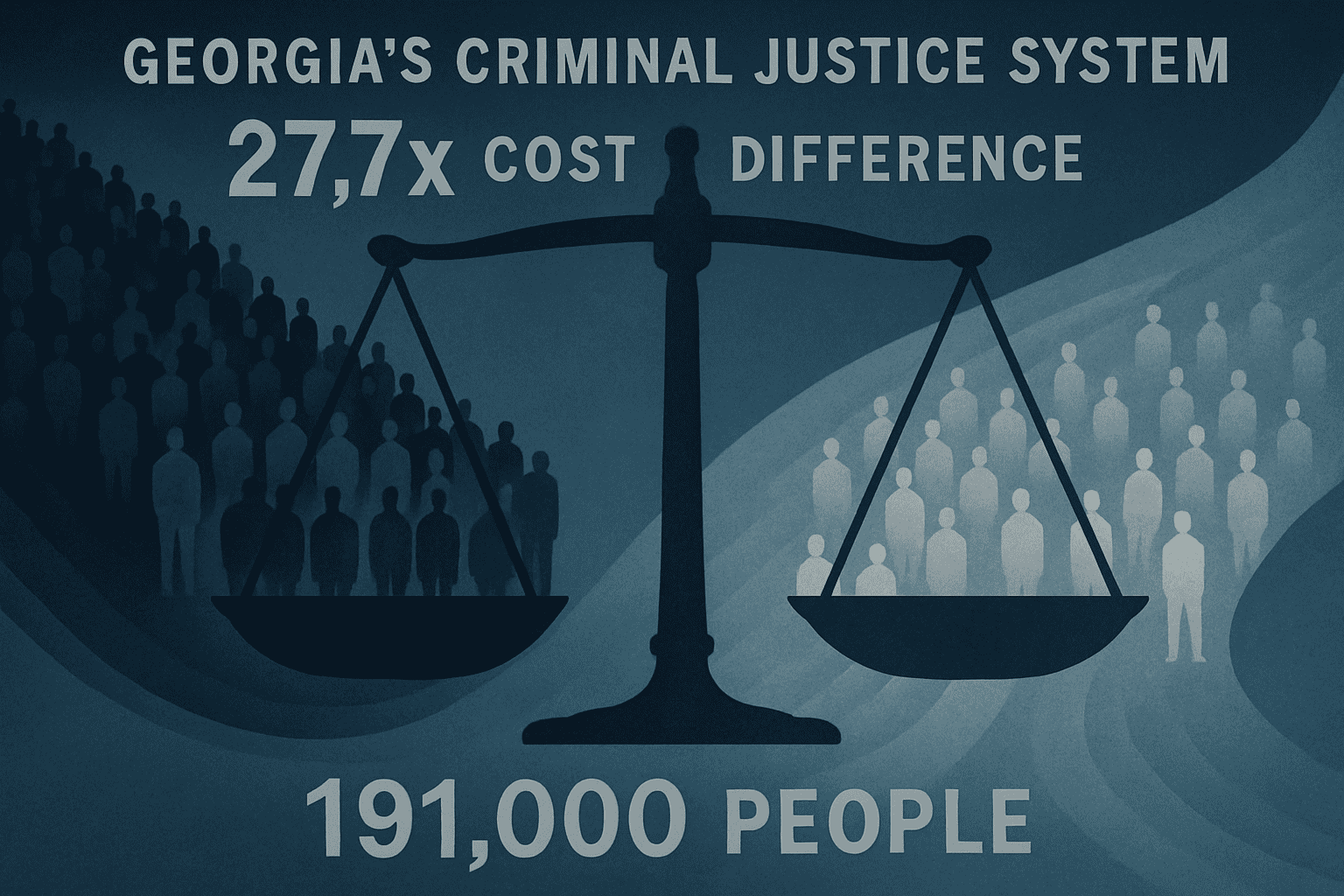
Georgia holds a distinction no state should want: it operates the largest felony probation system in the entire United States. The state keeps 191,000 people on felony probation, 356,000 on probation or parole combined, and a staggering 528,000 residents under some form of criminal justice supervision. These are not abstract numbers. They represent hundreds of thousands of Georgians — disproportionately Black — whose lives are constrained by a system that costs more, achieves less, and perpetuates racial inequality.
This research compilation is a critical advocacy tool because it connects the dots that legislators, media, and the public need to see:
- The racial injustice is measurable. Black Georgians are at least 2x as likely as white Georgians to serve probation statewide, and in some counties that disparity reaches 8x — despite Black residents comprising only 31% of the state’s population.
- The fiscal case for reform is overwhelming. Incarcerating one person costs $31,612 per year. Supervising that same person in the community costs ~$1,142 — a 27.7x cost difference. Every 1,000 people diverted from prison to supervision saves ~$30.5 million annually.
- Existing reform law is underutilized. SB 105, signed in 2021, allows early termination of felony probation after 3 years and could save $34 million annually. Up to 25% of all felony probationers qualify for immediate early termination — yet the law’s potential remains largely unrealized.
- The system punishes poverty. Electronic monitoring costs families $300-500 per month. Supervision fees, drug testing costs, and other financial burdens fall on probationers, and failure to pay can trigger re-incarceration — not for new crimes, but for being poor.
This compilation arms advocates with the data to challenge Georgia’s mass supervision apparatus at every level — in the legislature, in the courts, in coalition rooms, and in the press. The evidence is clear: Georgia’s probation system is too large, too racially biased, too expensive, and too punitive. Reform is not just morally necessary — it is fiscally imperative.
Key Takeaway: Georgia operates the nation’s largest felony probation system, marked by extreme racial disparities and fiscal waste, and this research provides the data advocates need to drive reform.
Talking Points
Georgia supervises more people on felony probation than any other state in the nation — 191,000 individuals — and 528,000 Georgians total are under criminal justice supervision. This is mass supervision, and it demands urgent reform.
Black Georgians are at least twice as likely as white Georgians to be placed on probation, and in some counties, Black residents are 8x more likely to be on probation — even though Black people make up just 31% of the state’s population. This is systemic racial discrimination.
Georgia spends $31,612 per year to incarcerate one person, but only ~$1,142 per year to supervise them in the community — incarceration costs 27.7 times more. Every 1,000 people diverted from prison to supervision saves taxpayers ~$30.5 million annually.
SB 105 already allows up to 25% of all felony probationers to receive early termination, saving an estimated $34 million annually. The law exists — we need full implementation.
People on probation are being punished for poverty, not for crime. Electronic monitoring alone costs families $300-500 per month, and failure to pay supervision fees can trigger re-incarceration — even when no new criminal behavior has occurred.
Georgia’s own data proves community supervision works. The state’s parole completion rate is 73%, exceeding the 60% national average. Vocational program completers have a recidivism rate of just 13.64%, compared to 26% overall.
Federal ‘truth in sentencing’ grants totaling $82 million between 1996 and 2001 incentivized Georgia to impose longer sentences and reduce parole. The federal government helped create this crisis — and Georgia is still living with the consequences.
Technical violations — missed appointments, failed drug tests — drive re-incarceration and inflate the prison population, even though these violations involve no new criminal behavior. Georgia must stop cycling people back to prison for administrative infractions.
Key Takeaway: These eight talking points translate the research into ready-to-use language for testimony, meetings, media interviews, and written advocacy.
Important Quotes
The following quotes are drawn directly from the source document. Advocates can cite these verbatim:
“Georgia has MORE felony probationers than any other state in the nation.”
— Section: Georgia’s Probation Population – SCALE“Black Georgians are at least 2x as likely as white Georgians to serve probation.”
— Section: Georgia’s Probation Population – RACIAL DISPARITIES“In some counties, Black residents are 8x more likely to be on probation.”
— Section: Georgia’s Probation Population – RACIAL DISPARITIES“While 31% of Georgia’s population is Black, disproportionate representation persists across all supervision types.”
— Section: Georgia’s Probation Population – RACIAL DISPARITIES“Up to 25% of all felony probationers qualify for immediate early termination.”
— Section: SB 105: Probation Reform – IMPACT“Incarceration costs 27.7x more than parole supervision.”
— Section: Cost Comparison – DAILY COSTS“Many revocations stem from technical violations (missed appointments, failed drug tests) rather than new criminal behavior.”
— Section: Community Supervision Challenges – TECHNICAL VIOLATIONS“Electronic monitoring adds $300-500/month burden on families.”
— Section: Community Supervision Challenges – FEES AND FINANCIAL BARRIERS“Georgia received $82 million in federal ‘truth in sentencing’ grants (1996-2001) — Grants incentivized longer sentences and reduced parole.”
— Section: Historical Context – FEDERAL GRANTS“Georgia’s parole completion rate: 73% (exceeds 60% national average).”
— Section: Cost Comparison – SYSTEM-WIDE IMPACT“Recidivism rate for vocational program completers: 13.64% (vs 26% general).”
— Section: Cost Comparison – SYSTEM-WIDE IMPACT
Key Takeaway: These direct quotes from the source document provide advocates with citeable, authoritative language for testimony, reports, and media communications.
How to Use This in Your Advocacy
Legislative Testimony
When testifying before Georgia House or Senate committees, lead with the fiscal case — it crosses partisan lines. Open with the 27.7x cost ratio: Georgia spends $31,612 per year to incarcerate one person versus ~$1,142 for community supervision. Then pivot to SB 105 implementation: the law already exists to release 25% of felony probationers and save $34 million annually. Ask legislators directly: Why isn’t this law being fully implemented?
For committees focused on appropriations, emphasize that every 1,000 people diverted from prison to supervision saves ~$30.5 million per year. For judiciary committees, present the racial disparity data — Black Georgians face 2x to 8x higher probation rates — and frame this as a constitutional equal protection concern.
Reference Georgia’s 73% parole completion rate exceeding the 60% national average to preempt safety concerns. Cite the 13.64% recidivism rate for vocational program completers versus 26% generally to argue for increased programming investment.
Public Comment
During public comment periods on criminal justice policy, corrections budgets, or sentencing guidelines, focus on three core data points:
– 191,000 people on felony probation — the largest such population in the nation
– The $300-500 monthly electronic monitoring cost that punishes families for poverty
– Technical violations driving re-incarceration without any new criminal behavior
Keep comments concise. Name the human cost: people are being returned to prison not because they committed new crimes, but because they missed an appointment or couldn’t afford a fee.
Media Pitches
This research supports several compelling media angles:
- “Georgia’s Hidden Tax”: Families of people on probation pay $300-500/month for electronic monitoring, plus supervision fees and drug testing. Pitch this as a personal finance/justice story to business and general interest reporters.
- “The Law Nobody’s Using”: SB 105 could free 25% of felony probationers and save $34 million — but implementation lags. This is an accountability story.
- “8x More Likely”: County-level racial disparities in probation rates are a civil rights story. Reporters can localize this with county-specific data requests.
- “$82 Million in Federal Incentives Built Georgia’s Mass Supervision System”: The historical angle — federal truth-in-sentencing grants created the conditions for today’s crisis. This connects Georgia to a national narrative.
Coalition Building
This research is uniquely powerful for building cross-ideological coalitions:
- Fiscal conservatives: Lead with the 27.7x cost ratio and $34 million in SB 105 savings. Note that SB 105 was sponsored by Republican legislators and supported by the Faith and Freedom Coalition and American Conservative Union Foundation.
- Racial justice organizations: The 2x-8x racial disparity data is actionable evidence for civil rights litigation and policy campaigns.
- Business community: The Metro Atlanta Chamber and Georgia Chamber of Commerce supported SB 105. Use this precedent to engage business leaders on further reform.
- Faith communities: Frame the financial burden on families — $300-500/month monitoring costs — as a moral issue affecting communities of faith.
Written Communications
In letters to legislators, the Governor’s office, the Board of Pardons and Paroles, or county officials, structure your argument around this framework:
- Scale: 191,000 on felony probation; 528,000 under total supervision
- Disparity: 2x to 8x racial gaps in probation rates
- Cost: $31,612 vs. ~$1,142 annually; 27.7x ratio
- Existing solution: SB 105 — 25% eligible, $34 million in savings
- What works: 73% parole completion rate; 13.64% recidivism for vocational completers
- Specific ask: Full SB 105 implementation, elimination of poverty-driven revocations, investment in vocational programming
Key Takeaway: This research supports advocacy across five key contexts — legislative testimony, public comment, media engagement, coalition building, and written communications — with data that resonates across political and ideological lines.
Use Impact Justice AI
Need help turning this research into a letter to your legislator? A draft of testimony for a committee hearing? An email to a reporter? A fact sheet for a coalition meeting?
Impact Justice AI can help you generate advocacy materials using this research and other GPS data. The tool is designed for advocates, organizers, family members, and anyone working to reform Georgia’s criminal justice system.
Use it to:
– Draft letters to elected officials citing specific data from this compilation
– Generate testimony scripts tailored to specific legislative committees
– Create fact sheets and one-pagers for coalition partners
– Write public comment submissions with sourced statistics
– Prepare media pitches and press statements
Visit https://impactjustice.ai to get started.
Key Takeaway: Impact Justice AI at https://impactjustice.ai helps advocates generate letters, testimony, and advocacy materials using GPS research data.
Key Statistics
Population and Scale
| Statistic | Context | Source |
|---|---|---|
| 191,000 people on felony probation | Largest felony probation population in the U.S. | Section: Georgia’s Probation Population – SCALE |
| 356,000 people on probation or parole | Combined community supervision population | Section: Georgia’s Probation Population – SCALE |
| 528,000 people under criminal justice supervision | Total supervised population in Georgia | Section: Georgia’s Probation Population – SCALE |
Racial Disparities
| Statistic | Context | Source |
|---|---|---|
| 2x more likely | Black Georgians are at least 2x as likely as white Georgians to serve probation | Section: Racial Disparities |
| 8x more likely | In some counties, Black residents face 8x higher probation rates | Section: Racial Disparities |
| 31% | Black share of Georgia’s population — yet disproportionate representation persists across all supervision types | Section: Racial Disparities |
Cost Comparison
| Statistic | Context | Source |
|---|---|---|
| $86.61/day | Cost of incarceration per person (FY2024) | Section: Cost Comparison – DAILY COSTS |
| $3.13/day | Cost of parole supervision per person (FY2025) | Section: Cost Comparison – DAILY COSTS |
| 27.7x | Incarceration costs 27.7 times more than parole supervision | Section: Cost Comparison – DAILY COSTS |
| $31,612/year | Annual incarceration cost per person | Section: Cost Comparison – ANNUAL COSTS |
| ~$1,142/year | Annual parole supervision cost per person | Section: Cost Comparison – ANNUAL COSTS |
| ~$30,470 | Annual savings per person diverted from prison to supervision | Section: Cost Comparison – ANNUAL COSTS |
| ~$30.5 million | Annual savings from diverting 1,000 people from prison to supervision | Section: Cost Comparison – SYSTEM-WIDE IMPACT |
SB 105 Impact
| Statistic | Context | Source |
|---|---|---|
| 25% | Proportion of felony probationers eligible for immediate early termination | Section: SB 105 – IMPACT |
| $34 million | Estimated annual savings from SB 105 implementation | Section: SB 105 – IMPACT |
| 3 years | Minimum time served before early termination eligibility | Section: SB 105 – PURPOSE |
| 24 months | Required period with no revocations for eligibility | Section: SB 105 – ELIGIBILITY CRITERIA |
Outcomes and Effectiveness
| Statistic | Context | Source |
|---|---|---|
| 73% | Georgia’s parole completion rate (exceeds 60% national average) | Section: Cost Comparison – SYSTEM-WIDE IMPACT |
| 60% | National average parole completion rate | Section: Cost Comparison – SYSTEM-WIDE IMPACT |
| 13.64% | Recidivism rate for vocational program completers | Section: Cost Comparison – SYSTEM-WIDE IMPACT |
| 26% | General recidivism rate | Section: Cost Comparison – SYSTEM-WIDE IMPACT |
Financial Barriers
| Statistic | Context | Source |
|---|---|---|
| $300-500/month | Cost of electronic monitoring borne by families | Section: Community Supervision Challenges |
Historical Context
| Statistic | Context | Source |
|---|---|---|
| $82 million | Federal truth-in-sentencing grants Georgia received (1996-2001) | Section: Historical Context – FEDERAL GRANTS |
| 90% | Sentence required before parole eligibility (1997 Parole Board rule) | Section: Historical Context – KEY LEGISLATION |
| 14 → 30 years | Life sentence parole eligibility increase under HB 1059 (2006) | Section: Historical Context – KEY LEGISLATION |
| $75,000/year | Compensation for each year of wrongful incarceration (effective July 1, 2025) | Section: 2025 Legislative Priorities |
Key Takeaway: These statistics — covering population scale, racial disparities, costs, reform impact, and outcomes — are formatted for direct use in testimony, letters, and advocacy materials.
Read the Source Document
📄 Read the full Research Compilation: Georgia Probation & Community Supervision (PDF)
This advocacy explainer is based on a GPS research compilation drawing from multiple sources on Georgia’s probation system, including state data, legislative analysis, and cost comparisons.
Other Versions
This analysis is available in versions tailored to different audiences:
- 📢 Public Version — Accessible overview for community members, families, and the general public
- 🏛️ Legislator Version — Policy brief formatted for elected officials and staff
- 📰 Media Version — Background briefing for journalists and editorial boards
Sources & References
- Georgia Justice Project (GJP) Policy and Advocacy Materials. Georgia Justice Project (2025-01-01) Official Report
- HB 582: Survivor Justice Act. Georgia General Assembly (2025-01-01) Legislation
- Wrongful Conviction and Incarceration Compensation Act. Georgia General Assembly (2025-01-01) Legislation
- SB 105: Probation Reform Legislation — Senator Brian Strickland, Representative Tyler Paul Smith. Georgia General Assembly (2021-05-03) Legislation
- SB 174: Expanded Judicial Discretion in Sentencing. Georgia General Assembly (2017-01-01) Legislation
- HB 1176: Governor Deal’s Criminal Justice Reform Package. Georgia General Assembly (2012-01-01) Legislation
- HB 1059: Life Sentence Parole Eligibility Amendment. Georgia General Assembly (2006-01-01) Legislation
- Georgia Parole Board 90% Sentence Requirement Policy. Georgia State Board of Pardons and Paroles (1997-01-01) Official Report
- SB 441: ‘Seven Deadly Sins’ Law. Georgia General Assembly (1995-01-01) Legislation
- Federal Truth in Sentencing Grants Data (1996-2001). U.S. Department of Justice Official Report
- Georgia Department of Community Supervision / GDC Cost and Supervision Data. Georgia Department of Corrections / Georgia State Board of Pardons and Paroles Official Report
- Georgia Racial Disparities in Probation Data Data Portal
- GPS Research Compilation: Georgia Probation & Community Supervision. Georgia Prisoners’ Speak GPS Original
Source Document
You just read about people suffering in state custody. The least you can do is make sure other people read it too. Share this story.