This explainer is based on Racial Disparities in Georgia’s Criminal Justice System. All statistics and findings are drawn directly from this source.
Why This Research Matters for Advocacy
This research compilation draws from four of the most authoritative sources in criminal justice data — the Prison Policy Initiative, Vera Institute of Justice, Council of State Governments Justice Center, and The Sentencing Project — to document what advocates in Georgia have long known: the state’s criminal justice system operates with deep, structural racial bias at every level.
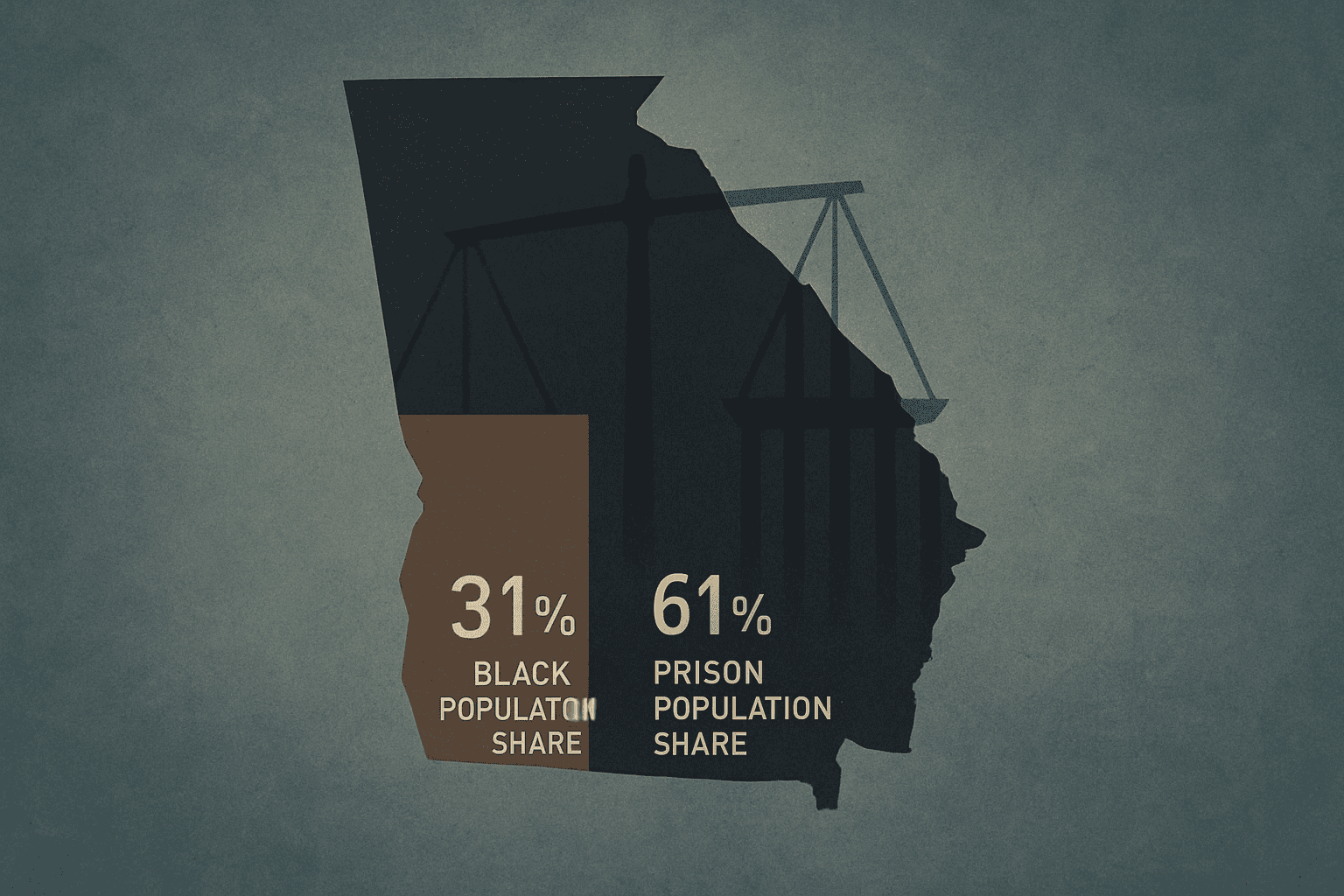
The data is devastating in its consistency. Black Georgians make up 31% of the state’s population but 61% of people in state prisons. They are arrested at 4.0 times the rate of white adults, incarcerated in prison at 2.6 times the rate, and subjected to parole supervision at 2.1 times the rate. And 80% of youth serving life sentences for crimes committed as children are Black.
This compilation is a powerful advocacy tool because it does something no single report can: it traces racial disparity across every decision point in the system — from arrest, to pretrial detention, to sentencing, to probation, to parole, to reentry. The compounding effect is undeniable. Each stage amplifies the disparity introduced at the last.
This research arrives at a critical moment. Georgia’s prison population increased 7% between 2021 and 2023, bucking national downward trends. The parole board has slashed releases by 34% and cut hearings by 44% since the pandemic. Meanwhile, 59% of people in Georgia’s jails have not been convicted of any crime — they are legally innocent, held pretrial because they cannot afford bail.
For advocates working on bail reform, parole reform, sentencing equity, juvenile justice, women’s incarceration, rural justice, or reentry — this compilation provides the numbers you need to make your case. Use it in legislative testimony, in media outreach, in coalition building, and in direct communications with decision-makers. The evidence is clear. Georgia’s criminal justice system is failing its own people, and Black communities are bearing the heaviest cost.
Key Takeaway: This multi-source research compilation documents racial disparity at every stage of Georgia’s criminal justice system, providing advocates with authoritative data to support reform campaigns across bail, parole, sentencing, juvenile justice, and reentry.
Talking Points
Black Georgians are nearly twice as overrepresented in state prisons as they are in the general population. While Black people make up 31% of Georgia’s population, they constitute 61% of people in state prisons — a disparity that places Georgia among 12 states where Black individuals make up more than half the prison population.
Georgia’s parole board is actively driving prison growth. The board has released 34% fewer people and held 44% fewer hearings since the pandemic, directly contributing to a 7% prison population increase between 2021 and 2023 — even as national prison populations have declined.
More than half the people in Georgia’s jails are legally innocent. 59% of people held in Georgia jails have not been convicted of any crime. They are held pretrial, often because they cannot afford cash bail — a system that punishes poverty, not danger.
Racial disparity compounds at every stage of the system. Compared to white adults, Black adults in Georgia are 4.0 times more likely to be arrested, 1.6 times more likely to be on probation, 2.6 times more likely to be in prison, and 2.1 times more likely to be on parole.
Georgia sentences children to die in prison — and 80% of them are Black. Approximately 900 youth are serving life or virtual life sentences (50+ years) in Georgia. The state ranks 3rd nationally for this practice, and some individuals were as young as 14 when charged.
Georgia’s arrest rates for Black people exceed even the disparity in victimization. In 2022, the Black violent victimization rate was 3.2 times higher than the white rate, but Black people were arrested for violent crimes at 3.9 times the rate — suggesting enforcement bias beyond actual crime patterns.
Georgia spends over $5.3 billion annually on law enforcement and corrections — $3.2 billion on law enforcement and $2.1 billion on corrections — while 1,219,000 adults who need substance abuse treatment cannot access it and 68% of violent crimes go unsolved.
Women’s incarceration has exploded in Georgia. The number of women in Georgia’s jails increased 1,107% since 1980, and the number in prisons increased 600%. These rates of growth far exceed men’s, signaling gender-specific drivers that demand targeted reform.
Key Takeaway: Eight data-backed talking points covering racial disparity, parole board failures, pretrial detention, compounding bias, youth life sentences, enforcement disparities, fiscal priorities, and women’s incarceration.
Important Quotes
The following quotes are drawn directly from the source documents and can be cited in testimony, reports, and media communications.
“While 31% of Georgia’s population is Black, 61% of people in state prisons are Black.”
— Prison Policy Initiative / Vera Institute (Prison Policy Initiative section; Vera Institute page 1)“Incarceration is not only an urban phenomenon. In fact, on a per capita basis, the most rural places in the state often lock up the most people in jail and send the most people to prison.”
— Vera Institute of Justice (Vera Institute page 1)“Since 1980, the number of women in jail has increased 1,107%, and the number of women in prison has increased 600%.”
— Vera Institute of Justice (Vera Institute pages 1-2)“Compared to White adults, Black adults in Georgia are 4.0x more likely to be arrested, 1.6x more likely to be on probation, 2.6x more likely to be in prison, 2.1x more likely to be on parole.”
— Council of State Governments Justice Center (CSG Justice Center page 34)“In 2022, the Black violent victimization rate was 3.2 times higher than the White violent victimization rate in Georgia. Black people were arrested for violent crimes at a rate 3.9 times higher than White people.”
— Council of State Governments Justice Center (CSG Justice Center page 32)“80% of those serving life sentences for crimes as children are Black.”
— The Sentencing Project (Sentencing Project section)“Georgia had the highest probation supervision rate in the country in 2021.”
— Council of State Governments Justice Center (CSG Justice Center page 23)“In Georgia, 68 percent of violent crimes were not solved in 2022, 6 percentage points worse than the national average.”
— Council of State Governments Justice Center (CSG Justice Center page 16)“In Georgia, 80 percent of collateral consequences for convictions are employment related.”
— Council of State Governments Justice Center (CSG Justice Center page 27)“45 percent of consequences in Georgia are mandatory and prohibit, without exception, the employment, retention, or licensing of a person with a conviction for a specified offense.”
— Council of State Governments Justice Center (CSG Justice Center page 27)
Key Takeaway: Ten directly quotable passages from authoritative sources documenting racial disparity, geographic inequity, women’s incarceration growth, compounding system bias, and reentry barriers.
How to Use This in Your Advocacy
Legislative Testimony
This compilation is built for the hearing room. When testifying before Georgia legislative committees — whether on criminal justice reform, appropriations, or oversight — lead with the compounding disparity data: Black Georgians are 4.0 times more likely to be arrested, 2.6 times more likely to be in prison, and 2.1 times more likely to be on parole than white Georgians. Frame these as system-wide failures, not isolated incidents.
For parole reform testimony, emphasize that the parole board has cut releases by 34% and hearings by 44% since the pandemic, directly contributing to a 7% prison population increase. Highlight that 11,827 people were eligible for parole in 2020, making up 46% of the prison population — and that 11% of those released had waited 3 or more years past their eligibility date.
For bail reform testimony, center the fact that 59% of people in Georgia jails are legally innocent, held pretrial without conviction. Connect this to the finding that pretrial incarceration increased 33% in rural counties while decreasing 46% in urban counties.
For juvenile justice hearings, the statistic that 80% of youth serving life sentences are Black — with some as young as 14 when charged — is among the most powerful data points in this compilation.
Public Comment
During public comment periods on corrections budgets, sentencing guidelines, or parole board rules, use the fiscal data: Georgia spends $3,222,875,000 on law enforcement and $2,120,035,000 on corrections annually, totaling over $5.3 billion — while 1,219,000 adults who need substance abuse treatment go without it. Frame this as a misallocation of resources that fails both public safety (68% of violent crimes unsolved) and community health.
Media Pitches
Several angles are ripe for media coverage:
- “Georgia’s Parole Board Is Quietly Driving Prison Growth” — The 34% reduction in releases and 44% fewer hearings since the pandemic is a story of institutional choices with human consequences.
- “80% of Children Sentenced to Die in Georgia’s Prisons Are Black” — The youth life sentencing data is among the most striking in the country, with Georgia ranking 3rd nationally.
- “The Rural Incarceration Crisis Georgia Isn’t Talking About” — Irwin County’s jail admission rate of 125,429 per 100,000 and the 33% increase in rural pretrial detention challenge assumptions about who is most affected by mass incarceration.
- “Georgia’s $5.3 Billion Criminal Justice System Can’t Solve 68% of Violent Crimes” — A fiscal accountability story that resonates across political lines.
- “Women’s Incarceration in Georgia Has Increased 1,107% — And Nobody’s Talking About It” — The dramatic growth in women’s incarceration demands attention.
Coalition Building
This research supports coalition-building across issue areas:
- Racial justice organizations: The compounding disparity data (4.0x arrest, 2.6x prison, 2.1x parole) provides irrefutable evidence of systemic racism.
- Fiscal conservatives: The $5.3 billion combined spending alongside 68% unsolved violent crimes makes the case for smarter resource allocation.
- Rural advocacy groups: The finding that rural counties have the highest per-capita incarceration rates and increasing pretrial detention opens doors to bipartisan reform coalitions.
- Women’s organizations: The 1,107% increase in women’s jail populations and 600% increase in prison populations makes gender-specific reform a priority.
- Mental health and substance abuse advocates: With 1,219,000 adults unable to access needed substance abuse treatment, the case for treatment over incarceration is clear.
- Voting rights organizations: The Sentencing Project’s finding that Georgia should restore voting rights to over 249,000 citizens connects criminal justice reform to democratic participation.
Written Communications
In letters to legislators, the Governor, the Board of Pardons and Paroles, or county officials, use the following framework:
- Open with scale: 528,000 Georgia residents are under criminal justice supervision. 95,000 people are behind bars.
- Name the disparity: Black Georgians are 31% of the population but 61% of the prison population.
- Show the compounding: Disparity at arrest (4.0x) feeds disparity in prison (2.6x) feeds disparity on parole (2.1x).
- Identify the responsible actors: The parole board’s decisions to reduce hearings by 44% and releases by 34% are policy choices, not inevitable outcomes.
- Demand specific action: Whether it’s parole reform, bail reform, sentencing reform, or investment in behavioral health — tie your ask to specific data points from this compilation.
Key Takeaway: Detailed, context-specific guidance for using this research in legislative testimony, public comments, media outreach, coalition building, and written communications to officials.
Use Impact Justice AI
Need help turning this research into action? Impact Justice AI can help you generate:
- Letters to legislators citing specific data points from this compilation
- Testimony drafts tailored to upcoming committee hearings
- Email campaigns for your advocacy network
- Public comment submissions for corrections budgets and policy reviews
- Media pitches and op-ed drafts using the most compelling findings
- Coalition outreach materials customized for different partner organizations
Impact Justice AI draws on GPS research and data to help advocates create professional, evidence-based communications quickly. Whether you’re preparing for a hearing tomorrow or planning a year-long campaign, this tool puts the data at your fingertips.
Visit https://impactjustice.ai to get started.
Key Takeaway: Impact Justice AI at https://impactjustice.ai can help advocates generate letters, testimony, emails, and other advocacy materials using this research.
Key Statistics
System Scale
| Statistic | Context | Source |
|---|---|---|
| 881 per 100,000 | Georgia’s overall incarceration rate across prisons, jails, immigration detention, and juvenile facilities | Prison Policy Initiative section |
| 95,000 people | Currently behind bars in Georgia | Prison Policy Initiative section |
| 528,000 people | Georgia residents under criminal justice supervision | Prison Policy Initiative section |
| 356,000 people | On probation or parole in Georgia | Prison Policy Initiative section |
| 236,000+ people | Different people booked into local jails annually | Prison Policy Initiative section |
Racial Disparities
| Statistic | Context | Source |
|---|---|---|
| 61% | Share of Georgia’s state prison population that is Black (vs. 31% of state population) | Prison Policy Initiative section; Vera Institute page 1 |
| 51% | Share of Georgia’s jail population that is Black (vs. 32% of state population) | Vera Institute page 1 |
| 4.0x | Rate at which Black adults are more likely to be arrested than white adults | CSG Justice Center page 34 |
| 2.7x | Rate at which Black individuals are incarcerated in prison compared to white people | Prison Policy Initiative section; Vera Institute page 2 |
| 2.6x | Rate at which Black adults are more likely to be in prison compared to white adults | CSG Justice Center page 34 |
| 2.1x | Rate at which Black adults are more likely to be on parole compared to white adults | CSG Justice Center page 34 |
| 1.6x | Rate at which Black adults are more likely to be on probation compared to white adults | CSG Justice Center page 34 |
| 3.9 times | Rate at which Black people were arrested for violent crimes compared to white people in 2022 | CSG Justice Center page 32 |
| 80% | Share of youth serving life sentences for crimes committed as children who are Black | Sentencing Project section |
Arrest and Enforcement
| Statistic | Context | Source |
|---|---|---|
| 3.2 times | Black violent victimization rate compared to white rate in Georgia in 2022 | CSG Justice Center page 32 |
| 3.9 times | Black violent crime arrest rate compared to white rate in 2022 — exceeding the victimization disparity | CSG Justice Center page 32 |
| 1.6 times | Black property crime arrest rate compared to white rate in 2022 | CSG Justice Center page 32 |
Pretrial Detention and Jails
| Statistic | Context | Source |
|---|---|---|
| 59% | People in Georgia jails who are legally innocent (unconvicted, held pretrial) | Prison Policy Initiative section |
| 1,562% | Increase in Georgia’s total jail population since 1970 | Vera Institute page 1 |
| 33% | Increase in pretrial incarceration rate in rural counties (2000-2015) | Vera Institute page 3 |
| 46% | Decrease in pretrial incarceration rate in urban counties (2000-2015) | Vera Institute page 3 |
| 125,429 per 100,000 | Jail admission rate in Irwin County — the highest in the state | Vera Institute page 1 |
Prisons and Parole
| Statistic | Context | Source |
|---|---|---|
| 7% | Prison population increase between 2021-2023 | Prison Policy Initiative section |
| 34% | Reduction in parole board releases since the pandemic | Prison Policy Initiative section |
| 44% | Reduction in parole board hearings since the pandemic | Prison Policy Initiative section |
| 11,827 | People with sentences of 1-25 years who were eligible for parole in 2020 (46% of prison population) | CSG Justice Center page 24 |
| 222% | Increase in Georgia’s prison custody population since 1983 | Vera Institute page 1 |
| 13% | Share of Georgia prison population over age 55 | Prison Policy Initiative section |
Women’s Incarceration
| Statistic | Context | Source |
|---|---|---|
| 1,107% | Increase in women’s jail population since 1980 | Vera Institute pages 1-2 |
| 600% | Increase in women’s prison population since 1978 | Vera Institute pages 1-2 |
Youth Sentencing
| Statistic | Context | Source |
|---|---|---|
| ~900 | Youth serving life with parole or virtual life sentences (50+ years) in Georgia | Sentencing Project section |
| 80% | Share of youth serving life sentences who are Black | Sentencing Project section |
| 14 years old | Age of youngest individuals when charged | Sentencing Project section |
Community Supervision and Reentry
| Statistic | Context | Source |
|---|---|---|
| Highest in the country | Georgia’s probation supervision rate in 2021 | CSG Justice Center page 23 |
| 24% | Decrease in probation population since 2011, yet rate remains highest nationally | CSG Justice Center page 23 |
| 80% | Share of collateral consequences for convictions that are employment-related | CSG Justice Center page 27 |
| 45% | Share of collateral consequences that are mandatory (no exceptions) | CSG Justice Center page 27 |
| 62% | Share of collateral consequences that may be indefinite in duration | CSG Justice Center page 27 |
| 71% | People released from prison in 2012 who were arrested within 5 years | CSG Justice Center page 28 |
| 249,000 | Georgia citizens who should have voting rights restored | Sentencing Project section |
Fiscal Data
| Statistic | Context | Source |
|---|---|---|
| $3,222,875,000 | State and local spending on law enforcement in 2021 | CSG Justice Center page 14 |
| $2,120,035,000 | State and local spending on corrections in 2021 | CSG Justice Center page 19 |
| $5.00 | Healthcare copay per visit for incarcerated people | Prison Policy Initiative section |
| $4.65 | Maximum cost for 15-minute jail phone call | Prison Policy Initiative section |
| up to 18% | Money transfer fees charged to families | Prison Policy Initiative section |
Public Safety Context
| Statistic | Context | Source |
|---|---|---|
| 68% | Violent crimes not solved in Georgia in 2022 (6 points worse than national average) | CSG Justice Center page 16 |
| 80% | Rape incidents not solved in 2022 | CSG Justice Center page 16 |
| 2,752 | Drug overdose deaths in Georgia in 2022 (vs. 1,234 homicides) | CSG Justice Center page 2 |
| 1,219,000 | Adults who needed but did not receive substance abuse treatment in 2021 | CSG Justice Center page 5 |
| 51% | Decrease in property crime in Georgia between 2012 and 2022 | CSG Justice Center page 9 |
Key Takeaway: Comprehensive, copy-paste-ready statistics organized by category — system scale, racial disparities, pretrial detention, prisons and parole, women’s incarceration, youth sentencing, reentry barriers, fiscal data, and public safety context.
Read the Source Document
📄 Read the full research compilation (PDF)
This advocacy toolkit is based on a comprehensive compilation drawing from the Prison Policy Initiative Georgia State Profile (2024-2025), Vera Institute of Justice Incarceration Trends in Georgia, Council of State Governments Justice Center Georgia Criminal Justice Data Snapshot (December 2023), and The Sentencing Project data on Georgia. We encourage advocates to review the full source documents for additional context and data.
Other Versions
This research has been formatted for different audiences:
- 📋 Public Version — Accessible overview for community members and the general public
- 🏛️ Legislator Version — Policy brief formatted for Georgia legislators and staff
- 📰 Media Version — Press-ready summary with key findings and story angles
Sources & References
- CSG Justice Center: Supervision Violations and Their Impact on Incarceration. Council of State Governments Justice Center (2024-01-01) Official Report
- The Sentencing Project: Racial Disparities Data. The Sentencing Project (2024-01-01) Official Report
- Council of State Governments Justice Center: Georgia Criminal Justice Data Snapshot — Matt Herman, Amund Tallaksen, Myles Moore, Madeleine Dardeau. Council of State Governments Justice Center (2023-12-01) Official Report
- CSG: Georgia Criminal Justice Data Snapshot — Matt Herman, Amund Tallaksen, Myles Moore, Madeleine Dardeau. Council of State Governments Justice Center (2023-12-01) Official Report
- AH Datalytics YTD Murder Comparison. AH Datalytics (2023-11-13) Data Portal
- Bureau of Labor Statistics Local Area Unemployment Statistics (LAUS). Bureau of Labor Statistics (2023-01-01) Data Portal
- HRSA National Center for Health Workforce Analysis. Health Resources & Services Administration (2023-01-01) Data Portal
- National Inventory of Collateral Consequences of Conviction. National Reentry Resource Center (2023-01-01) Data Portal
- BJS National Crime Victimization Survey. Bureau of Justice Statistics (2022-01-01) Data Portal
- BLS Occupational Employment and Wage Statistics. Bureau of Labor Statistics (2022-01-01) Data Portal
- CDC National Center for Health Statistics. Centers for Disease Control and Prevention (2022-01-01) Data Portal
- FBI Uniform Crime Reporting Program NIBRS. Federal Bureau of Investigation / Bureau of Justice Statistics (2022-01-01) Data Portal
- FBI Uniform Crime Reporting Program SRS. Federal Bureau of Investigation (2022-01-01) Data Portal
- HUD Annual Homelessness Assessment Report. U.S. Department of Housing and Urban Development (2022-01-01) Official Report
- Murder Accountability Project. Murder Accountability Project (2022-01-01) Data Portal
- SAMHSA Treatment Episode Data Set. Substance Abuse and Mental Health Services Administration (2022-01-01) Data Portal
- U.S. Census Bureau American Community Survey. U.S. Census Bureau (2022-01-01) Data Portal
- U.S. Census Bureau Annual Survey of State and Local Government Finances. U.S. Census Bureau (2022-01-01) Data Portal
- BJS Annual Survey of Jails. Bureau of Justice Statistics (2021-01-01) Data Portal
- BJS Prisoners in the United States. Bureau of Justice Statistics (2021-01-01) Official Report
- BJS Probation and Parole in the United States. Bureau of Justice Statistics (2021-01-01) Official Report
- Michigan Department of Health and Human Services: Age-Adjusted Homicide Death Rates by Race and Sex 1980-2021. Michigan Department of Health and Human Services (2021-01-01) Data Portal
- SAMHSA National Survey on Drug Use and Health. Substance Abuse and Mental Health Services Administration (2021-01-01) Data Portal
- BJS National Corrections Reporting Program. Bureau of Justice Statistics (2020-01-01) Data Portal
- Council on Criminal Justice: Tracking the Size of America’s Criminal Justice System. Council on Criminal Justice (2020-01-01) Data Portal
- Vera Institute of Justice: Incarceration Trends in Georgia — Christian Henrichson, Eital Schattner-Elmaleh, Jacob Kang-Brown, Oliver Hinds, James Wallace-Lee. Vera Institute of Justice (2019-12-01) Official Report
- BJS Recidivism of Prisoners Released in 34 States in 2012. Bureau of Justice Statistics (2012-01-01) Official Report
- Arnold Ventures (funder acknowledgment for Vera Institute report). Arnold Ventures Press Release
- Bureau of Justice Assistance Grant No. 2019-ZB-BX-K002 (CSG Justice Center funding). Bureau of Justice Assistance, U.S. Department of Justice Official Report
- Bureau of Justice Statistics Census of Jails. Bureau of Justice Statistics Data Portal
- Bureau of Justice Statistics Jail Inmates Series. Bureau of Justice Statistics Data Portal
- Georgia Department of Corrections Statistical Trends Reports. Georgia Department of Corrections Data Portal
- Jacob Kaplan – Cleaned FBI Offenses Known and Clearances by Arrest Dataset — Jacob Kaplan Data Portal
- Prison Policy Initiative, Georgia Profile. Prison Policy Initiative Data Portal
- Prison Policy Initiative: Georgia State Profile (2024-2025). Prison Policy Initiative Official Report
Source Document
You just read about people suffering in state custody. The least you can do is make sure other people read it too. Share this story.