
Why cell phone crackdowns, tablet contradictions, and tactical theater protect power while conditions collapse.
Georgia spends $50 million a year trying to stop contraband cell phones. It spends $1.62 billion running a prison system the Department of Justice has declared unconstitutional. Five people died at Washington State Prison in a single week this January. The department’s response? Tactical squads for the cameras—while 50% of correctional officer positions remain unfilled across the state.
This is not about phones. It is not about tablets. It is about control without transparency, profit without accountability, and policies frozen in time while human beings absorb the consequences.
Much of the analysis in this article draws from insights shared by Yolanda Hamilton, whose examination of GDC’s technology policies reveals the contradictions at the heart of Georgia’s approach to communication and control. Her observations about the generational disconnect, the tablet program contradiction, and the profit motives behind prohibition informed significant portions of this investigation.
Tactical Theater
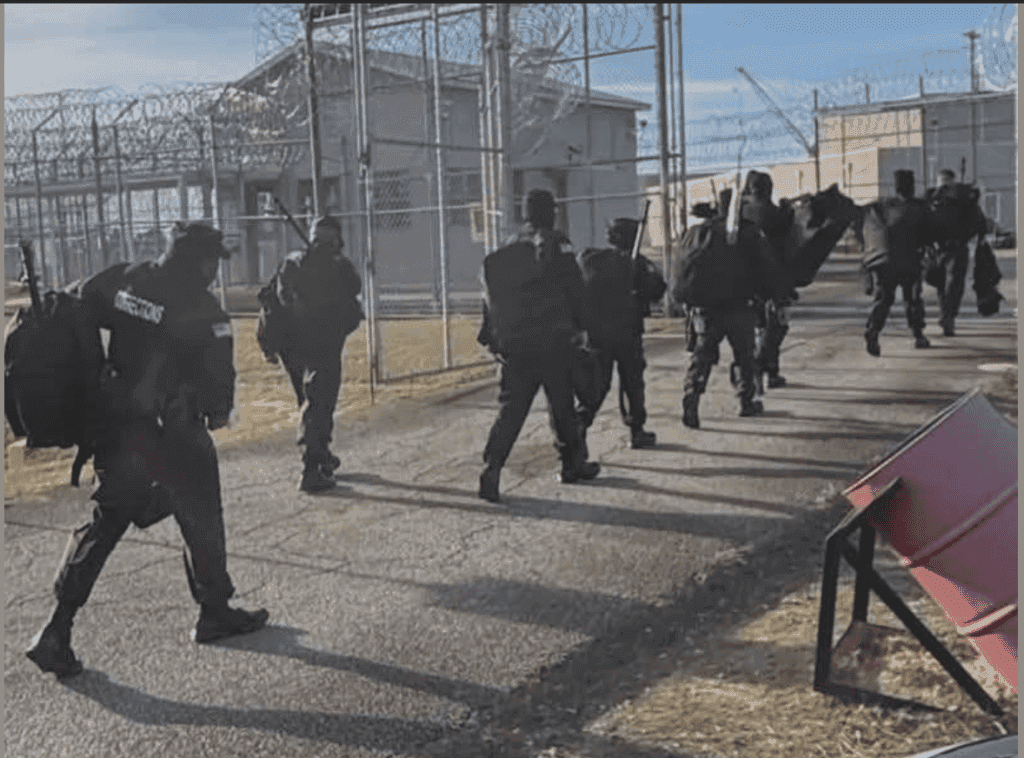
In the photograph circulating on social media, a tactical squad stands geared up and ready to enter a Georgia correctional facility. The optics are unmistakable: order being restored, authority reasserted, security guaranteed. But as families across Georgia know all too well, the image conceals far more than it reveals.
What you are not seeing is that these officers were pulled from facilities across the state—facilities already critically understaffed. Their sudden redeployment left entire prisons vulnerable, further thinning supervision, reducing emergency response capacity, and increasing risk for both staff and inmates elsewhere. This is not a strategic surge; it is a reactive shuffle that exposes the depth of the staffing crisis within the Georgia Department of Corrections.
Following the riots at Washington State Prison on January 11, 2026, the initial response was appropriate—get things under control. But the response time was troublingly slow, taking hours to mobilize. In the aftermath, a large contingent of TAC and IRT members—regular officers pulled from other prisons—spent the entire following week stationed at Washington SP, with no clear end date. Every officer stationed there is an officer not protecting another facility.
The Generational Disconnect
Thirty years ago, the technology that now defines daily life simply did not exist. That reality shaped prison policies, procedures, and laws written in a different era. But the simple and unavoidable truth is this: that era is over.
Many of today’s inmates have never lived without digital access. They were raised in a world of instant information, electronic communication, and constant connectivity. Most have never written a handwritten letter. Many were never required to memorize information because knowledge was always accessible with a few keystrokes. That is not a moral failing—it is the reality of the society that raised them.
“When you strip an entire generation of everything they have ever known how to use to function, the question should not be why do they struggle, but rather how could they not?”
Abruptly forcing people to exist in a world that no longer resembles the one they were raised in—without transitional support, education, or accommodation—creates confusion, frustration, anxiety, and volatility. Those reactions are then labeled “behavior problems,” when in fact they are predictable responses to systemic disconnect.
Policies that made sense half a century ago are now being applied rigidly to a population living in a completely different reality. What was once considered “unnecessary technology” has become essential for navigating modern life. Denying access without providing meaningful alternatives does not promote rehabilitation—it deepens dysfunction and widens the gap between incarceration and successful reentry.
The Tablet Contradiction
The Georgia Department of Corrections often points to OCGA Title 42, Penal Institutions, which states that communication devices are illegal for inmates. But this is where the contradiction becomes impossible to ignore.
GDC’s own Standard Operating Procedures define a “communication device” as any device capable of internet access and communication—including tablets and cell phones.
In 2016, the Georgia Department of Corrections issued tablets to the entire inmate population.
These tablets were, by their own definition, communication devices. And they were not free. Every song, every game, every email, every digital book made available on those tablets was sold to inmates. The department found a way to monetize communication—and once profit entered the equation, the legal and moral objections conveniently disappeared.
This exposes the first underlying reality: the resistance to certain technologies has never been about legality alone—it has been about control and profit.
The tablets issued to inmates were deliberately designed without cameras. That omission was not accidental. Cameras mean documentation. Cameras mean evidence. Cameras mean transparency. And transparency is precisely what an institution facing long-standing allegations of abuse, neglect, and constitutional violations does not want.
A System That Fears Visibility
A system that claims to operate lawfully should not fear being seen. A system that claims to provide safe and humane conditions should not need to obscure them.
The Department of Justice investigation released in October 2024 found that Georgia’s prison conditions violate the Eighth Amendment to the Constitution. The findings documented systemic failures: critical understaffing, widespread physical violence, sexual abuse, gang control of housing units, and what investigators called “complete indifference and disregard to the safety and security of people Georgia holds in its prisons.” 1
The DOJ documented over 142 homicides in Georgia prisons between 2018 and 2023. GPS documented nearly 100 homicides in 2024 alone—nearly triple the previous year’s record. 2
Contraband phones and jailbroken tablets have been among the most prominent means that prisoners, their loved ones, and prison reform activists have to compel transparency and demand accountability. Prisoners’ use of cellphones to document and share evidence of abusive guards, inadequate medical care, and unsanitary living conditions has put pressure on the GDC to address these issues.
The prohibition of cell phones in 2008 coincided with a significant decline in the conditions within Georgia prisons. Reports of overcrowding, medical neglect, and abuse began surfacing shortly after inmates used cell phones to document and share their experiences with journalists and advocacy groups. The crackdown intensified when the Department of Justice launched its investigation into Georgia’s prisons, bringing national attention to these failings.
By criminalizing cell phones and vilifying their use, the GDC sought to silence whistleblowers and suppress evidence of its inadequacies.
The Profit Motive
Behind the propaganda lies a financial agenda. For 2025, Georgia Corrections Commissioner Tyrone Oliver proposed a $50 million plan to combat cell phone use in prisons. This follows large expenditures in previous years aimed at the same goal, which yielded little measurable success. 3
Securus Technologies—the telecommunications company that provides phone and video services to Georgia’s prison system—has a contract with the Georgia Department of Corrections. The company stands to benefit if the use of contraband cellphones is reduced. When prisoners use Securus’ tablets and pay phones, the company charges them and their families high rates.
A monthly basis internet bill costs around $35. One phone call on the inmate Securus phone costs around $5 to $7.
The question that should be asked: If staff can be given state-issued cell phones that are monitored (according to SOP policy) and internet service provided through the department of corrections, why can’t they do the same thing with phones issued to inmates and charge the inmate a monthly fee to receive internet service?
If staff-issued phones can be monitored as policy states, then inmate-issued phones can be monitored as well. Then you would know who is doing the right thing and who is not. And you would not have such a high maintenance cost for destruction of property trying to hide a phone. There would also be less violence.
This structure turns communication into a revenue stream, transparency into a liability, and accountability into a threat.
The Staffing Emergency
The tactical team photograph tells another story—one of systemic failure masked as strength.
According to consultants hired by Governor Brian Kemp, staffing vacancies for correctional officers at 20 of Georgia’s 34 state prisons have reached “emergency levels,” making it impossible to keep up with even basic protocols such as routine counts of prisoners. 4
At some prisons, gangs are “effectively running the facilities,” in part due to a lack of staff, using violence to maintain control. While national standards say a correctional facility should operate with no more than 10% of its officer jobs open, Georgia’s prisons are nowhere close to meeting that staffing standard.
In 20 of the 34 state prisons, more than half of the correctional officer jobs weren’t filled. In eight of those prisons, the vacancy rate was 70% or more.
The realization of working alone in a prison and concerns for their own safety and security prompt some officers to leave. Between January 2021 and November 2024, 82.7% of new hires left within the first year.
Commissioner Tyrone Oliver acknowledged in December 2025 that the department currently averages about one correctional officer for every 14 inmates—still short of the department’s goal of 1 to 11. Some facilities remain 50-70% vacant. 5
The Budget Explosion
For Fiscal Year 2026, Governor Brian Kemp proposed a $1.62 billion budget for the Georgia Department of Corrections—$125 million higher than what was approved for FY 2025. 6
This increase is part of a four-year trend in rising state prison spending. As GPS documented in our recent investigation, Georgia added $700 million to its corrections budget between FY 2022 and FY 2026—the fastest spending growth in agency history. 7 Governor Kemp has proposed allocating an additional $600 million over 18 months to address staffing, emergency repairs, and infrastructure improvements.
Yet despite these massive investments, prison homicides rose from 8 annually in 2017-2018 to over 100 in 2024. Staffing remains 50-76% vacant at many facilities. The DOJ found healthcare unconstitutional. The money has bought nothing measurable.
Georgia’s accelerated pace of prison spending is in tandem with its accelerated pace of growth in criminal legal system policies that place more Georgians under carceral control and debt. This pace is reinforced by over-policing and state and local dependence on fines and fees revenue streams tied to criminal legal system entanglement.
The Double Standard on Display
There are signs outside of every prison that say “No cell phones beyond this point,” but conveniently this practice is ignored for all the administrative staff that bring their state-issued cell phones into the prison every day.
This is not about security. If it were, administrative staff would face the same restrictions as everyone else. The issue is visibility.
When communication is allowed only in ways that can be monitored, controlled, monetized, and stripped of independent documentation, the intent becomes clear: manage the narrative, not the conditions.
The uncomfortable truth is this: incarcerated people in Georgia are often afforded fewer protections and dignities than animals under state care. Animal welfare laws mandate minimum standards of treatment, environmental enrichment, and oversight. Yet inmates—human beings—are routinely denied basic tools for communication, documentation, and connection to the outside world, even as they remain entirely dependent on the state for their safety and well-being.
Theater Instead of Reform
The public was shown the tactical team entering the facility not once, but on consecutive days. Cameras were present. Coverage was encouraged. The message was unmistakable: “We are taking action.”
But this kind of public display is itself a deviation from standard correctional practice. Longstanding policy exists for a reason—day-to-day prison operations are not publicized because doing so creates security risks. Advertising movements, tactics, and staffing patterns compromises safety for everyone involved.
That policy was set aside, not for safety, but for optics.
This was not about solving a problem; it was about calming public outrage. It was an attempt to reassure a public that has grown increasingly alarmed by years of violence, deaths, and DOJ-confirmed constitutional violations inside Georgia’s prisons.
What the public is demanding is not spectacle. It is reform.
True reform does not arrive in riot gear days after people have died. It does not come in the form of short-term deployments that weaken other facilities. And it certainly does not come from repeating the same tactics that have failed for more than three decades.
The Path Forward
Georgia did not arrive at this point overnight. The overcrowding, the understaffing, the violence, the contraband, and the breakdown of internal control are the cumulative result of policies that prioritize reaction over prevention and image over accountability.
Bringing in tactical teams after the fact does nothing to address overcrowded dorms, exhausted staff, untreated mental illness, or a system stretched beyond its limits.
The tools for meaningful reform already exist. The data exists. The DOJ report exists. The warning signs have been flashing for years. The public is not asking whether reform is possible—they are asking why it continues to be avoided.
Solutions Exist – Leadership Doesn’t
The solutions are not mysterious. As GPS has outlined: separate gangs, bring back tablets, provide daily yard time, end triple bunking, fix the food, and indict in-prison murders. Until these basic steps are taken, the bloodshed will continue. 8
But there is an even more effective solution: decarceration. Georgia should parole people who have demonstrated they are ready to return to society. 9
The numbers make the case. Over 5,600 people in Georgia’s prisons—more than 10% of the population—are 60 years or older. 10 Research consistently shows that people age out of criminal behavior; recidivism rates for those over 50 drop to single digits. Yet Georgia continues housing thousands of elderly inmates at costs that can exceed $100,000 per year when chronic illness and end-of-life care are factored in—three to four times the cost of younger prisoners.
The math is unavoidable: GDC cannot safely manage 50,000+ prisoners with 50-70% staffing vacancies and a workforce that lacks both the training and leadership to run an organization of this scale. No amount of tactical deployments or budget increases will change that equation. The only sustainable path forward is reducing the population to a level the system can actually supervise, house, and care for humanely.
As one commenter noted: “The problems began 9 years ago when Deal left as Governor and Kemp was sworn in. Deal promoted rehabilitation for prisoners, but once he left office, changes started and were not for the benefit of the prisoners. Even if more COs are hired, things won’t change until there is a training program for the correctional officers. Every organization—whether it be medicine, legal, even correctional—must have a discipline or a code of conduct, rules of behavior. The GDC has no discipline.“
This observation cuts to the heart of the crisis. GDC has no institutional discipline—no professional standards, no code of conduct, no training in how to manage human beings rather than warehouse them. Until that changes, more bodies in uniform will not translate to safer prisons.
What the tactical photograph ultimately represents is not strength—it is a system reacting to its own long-ignored failures, hoping that visibility will substitute for change.
The answer cannot keep being “more of the same.”
Doing what has been done for the last 30 years is precisely how Georgia ended up here. Tactical responses may temporarily suppress chaos, but they do not fix the conditions that produce it. Until leadership confronts overcrowding, staffing failures, mental health neglect, and the absence of accountability at the policy level, these highly visible deployments will remain what they are: carefully staged responses to systemic problems no one seems willing to truly resolve.
Call to Action: What You Can Do
Five people died at Washington State Prison in one week while Georgia spent $50 million fighting cell phones instead of filling vacant officer positions. The DOJ called it unconstitutional. Sharing this story is the minimum response to 100+ preventable deaths.
Spread the Word — It Takes 15 Seconds
Awareness without action changes nothing. Here are the most effective ways you can help push for accountability and real reform:
Use Impact Justice AI
Our free tool at https://impactjustice.ai helps you instantly draft and send personalized emails to lawmakers, journalists, and agencies. No expertise required—just your voice and your concern.
Contact Your Representatives
Your state legislators control GDC’s budget, oversight, and the laws that created these failures. Demand accountability and transparency.
- Find your Georgia legislators: https://open.pluralpolicy.com/ga/
- Governor Brian Kemp: (404) 656-1776
- Georgia Department of Corrections Commissioner: (478) 992-5246
Demand Media Coverage
Journalists need to know these stories matter. Contact newsrooms at the Atlanta Journal-Constitution, local TV stations, and national outlets covering criminal justice. More coverage means more pressure for reform.
Amplify on Social Media
Share this article and call out the people in power.
Tag: @GovKemp, @GDC_Georgia, your local representatives
Use hashtags such as #GAPrisons, #PrisonReform, #GeorgiaPrisonerSpeak
Public pressure works—especially when it’s loud.
File Public Records Requests
Georgia’s Open Records Act gives every citizen the right to access government documents. Request:
- Incident reports
- Death records
- Staffing data
- Medical logs
- Financial and contract documents
Transparency reveals truth. https://georgiadcor.govqa.us/WEBAPP/_rs/SupportHome.aspx
Attend Public Meetings
The Georgia Board of Corrections holds public meetings monthly. The next meeting is January 29, 2026 at 10:00 a.m. at State Offices South, 300 Patrol Road, Forsyth, GA. Full schedule at: https://gdc.georgia.gov/upcoming-board-meetings
Legislative committees review corrections issues during session. Your presence is noticed.
Georgia Board of Corrections 2026 Meeting Schedule
| Date | Status |
|---|---|
| January 29, 2026 | Scheduled |
| February 1, 2026 | CANCELLED |
| March 5, 2026 | Scheduled |
| April 2, 2026 | Scheduled |
| May 7, 2026 | Scheduled |
| June 4, 2026 | Scheduled |
| July 2, 2026 | Scheduled |
| August 6, 2026 | Scheduled |
| September 3, 2026 | Scheduled |
| October 1, 2026 | Scheduled |
Contact the Department of Justice
For civil rights violations in Georgia prisons, file a complaint with the DOJ Civil Rights Division:
https://civilrights.justice.gov
Federal oversight has forced abusive systems to change before.
Support Organizations Doing This Work
Donate to or volunteer with Georgia-based prison reform groups fighting for change on the ground.
Vote
Research candidates’ positions on criminal justice. Primary elections often determine outcomes in Georgia. Your vote shapes who controls these systems.
Contact GPS
Georgia Prisoners’ Speak exists because incarcerated people and their families deserve to be heard. If you have information about conditions inside Georgia’s prisons, contact us securely at GPS.press.
About Georgia Prisoners’ Speak (GPS)
Georgia Prisoners’ Speak (GPS) is a nonprofit investigative newsroom built in partnership with incarcerated reporters, families, advocates, and data analysts. Operating independently from the Georgia Department of Corrections, GPS documents the truth the state refuses to acknowledge: extreme violence, fatal medical neglect, gang-controlled dorms, collapsed staffing, fraudulent reporting practices, and unconstitutional conditions across Georgia’s prisons.
Through confidential reporting channels, secure communication, evidence verification, public-records requests, legislative research, and professional investigative standards, GPS provides the transparency the system lacks. Our mission is to expose abuses, protect incarcerated people, support families, and push Georgia toward meaningful reform based on human rights, evidence, and public accountability.
Every article is part of a larger fight — to end the silence, reveal the truth, and demand justice.
Further Reading
- $700 Million More—And Nothing to Show for It *Georgia added $700 million to its corrections budget between FY 2022 and FY 2026—the fastest spending growth in agency history—while homicides tripled and staffing collapsed.*
- The Truth About Cellphones in Georgia’s Prisons *Discover the truth about cell phones in Georgia’s prisons and their surprising role in saving lives, exposing corruption, and bringing hope to inmates.*
- Stop the Silence: Why Georgia Must Legalize and Monitor Cell Phones in Prisons *Georgia already bought the tech to control prison cellphones—MAS can register and monitor devices without silencing families.*
- Georgia’s Cell Phone Crackdown: Security or Silence? *An examination of whether GDC’s cell phone policies are about security or suppressing transparency.*
- Amathia: The Moral Failure Behind Georgia’s Prison Crisis *The ancient Greeks called it amathia—willful ignorance, a moral failure. Governor Kemp commissioned reports documenting Georgia’s prison crisis. The evidence exists. Leadership refuses to see.*
Footnotes
- DOJ Findings Report October 2024, https://www.justice.gov/crt/media/1371406/dl [↩]
- GPS Mortality Statistics, https://gps.press/gdc-mortality-statistics/ [↩]
- GBPI Overview FY2026, https://gbpi.org/overview-2026-fiscal-year-budget-for-the-georgia-department-of-corrections/ [↩]
- AJC January 2025, https://www.ajc.com/news/investigations/georgia-prisons-in-crisis-say-consultants-hired-by-governor/5P6BELWL4ZE7LK2BKWP3QT6Y2E/ [↩]
- WJCL December 2025, https://www.wjcl.com/article/georgia-prison-population-rising-staffing-shortages/69776087 [↩]
- GBPI FY2026 Overview, https://gbpi.org/overview-2026-fiscal-year-budget-for-the-georgia-department-of-corrections/ [↩]
- “$700 Million More—And Nothing to Show for It,” GPS, https://gps.press/700-million-more-and-nothing-to-show-for-it/ [↩]
- “A Simple Message for the GDC,” GPS, https://gps.press/a-simple-message-for-the-gdc/ [↩]
- Decarceration as a Solution to Georgia’s Prison Crisis, GPS, https://gps.press/decarceration-as-a-solution-to-georgias-prison-crisis/ [↩]
- GPS Statistics, https://gps.press/statistics-data/ [↩]
I am completely stunned by the conditions I just learned about. We as human beings are responsible to fix thus mess.