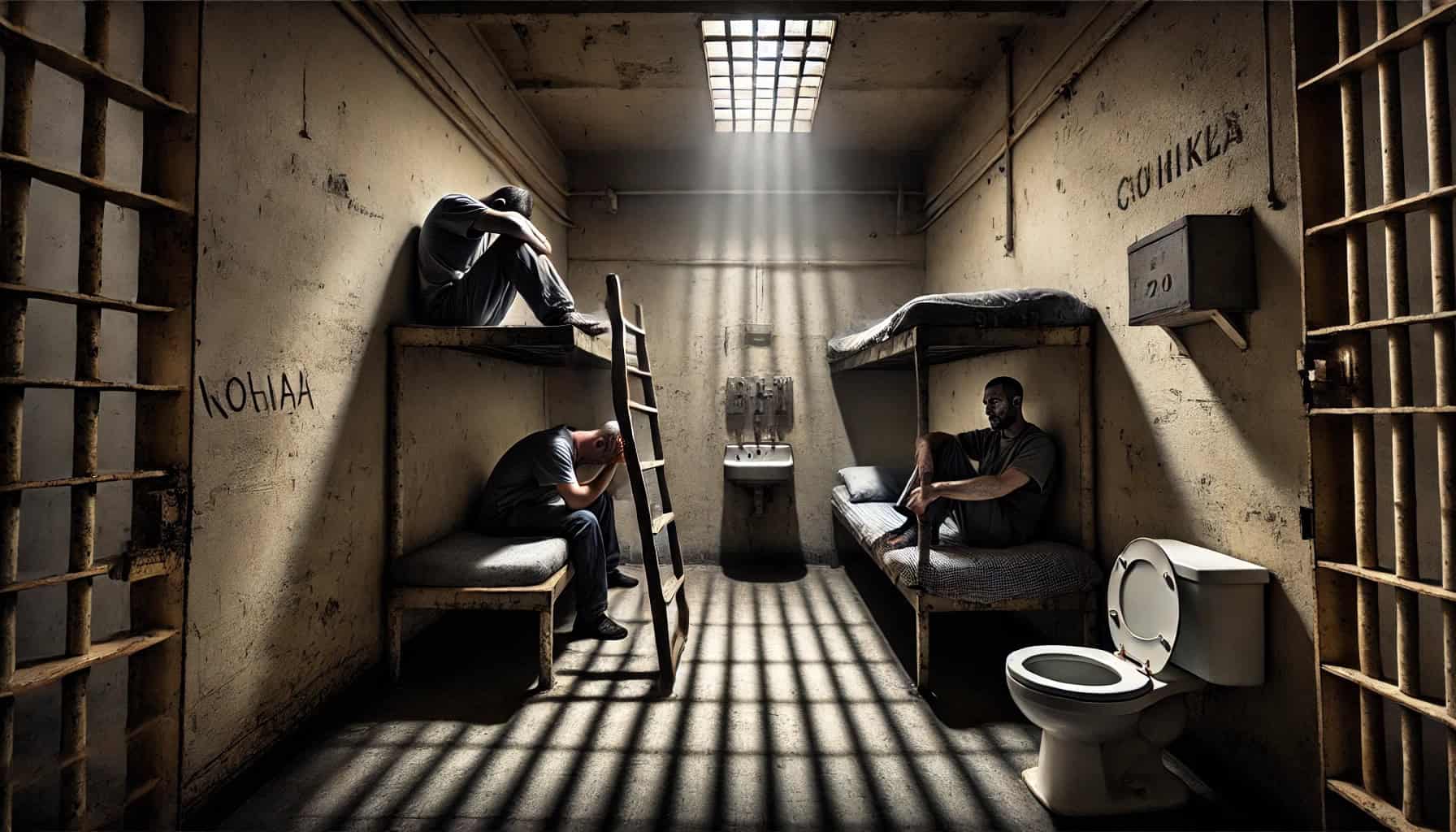
In a cramped 82.6-square-foot cell designed for one man at a medium-security Georgia prison, three men are forced to live together with only 12 square feet of standing room. That’s about 4-square-feet per person once the beds, toilet, and minimal furnishings are accounted for. That’s an area roughly the size of a small closet – 3 feet by 4 feet. During lockdowns, which can last for weeks, men are confined to these spaces 24 hours a day with no relief.
“It’s not living, it’s barely existing,” says one of the founders of Georgia Prisoners’ Speak (GPS), a prisoner-led organization working to expose the horrific conditions inside Georgia’s prison system. “We’re treated like animals, packed into spaces too small for human dignity, with little supervision, surrounded by violence, and abandoned by a system that claims to rehabilitate but only warehouses.”
A RECORD TOLL OF DEATH
The death toll in Georgia’s prisons continues to set grim records. Already in 2025, just seven weeks into the year, 33 people have died in GDC custody. At least 15 of these deaths were confirmed homicides, with 3 more still under investigation. Two were suicides.
This follows the deadliest year on record: 330 people died in Georgia prisons in 2024, with GPS documenting approximately 100 of those deaths as homicides (the AJC’s open-records tally found 66). In 2023, GPS documented at least 262 deaths behind bars.
According to the Department of Justice investigation released in October 2024, Georgia’s prison homicide rate far exceeds the national average. The DOJ found that at least 142 homicides occurred from 2018 through 2023, with the annual death toll steadily increasing year after year.
“Each death means a family devastated, a future erased,” an incarcerated person at Phillips State Prison told GPS. “And the worst part? Most of these deaths are preventable. They’re the direct result of a system that’s abandoned its most basic responsibility: keeping people in its custody alive.”
DELIBERATE INDIFFERENCE
The DOJ report concluded that the Georgia Department of Corrections (GDC) is “deliberately indifferent” to the suffering within its walls. This legal standard requires not just awareness of problems, but a conscious disregard for them.
The evidence supporting this finding is overwhelming. The GDC has operated for years with correctional officer vacancy rates above 50% systemwide. At many facilities, including some of the most dangerous, vacancy rates exceed 70%. This means more officers’ posts are empty than filled.
One incarcerated person at Macon State Prison described to GPS what this looks like in practice: “Some days there’s one officer trying to watch over four housing units at once. They’ll show up for count, then disappear for hours. If someone gets stabbed, you have to beat on the windows and hope someone hears you. People have bled to death waiting for help.”
COVERING UP THE CRISIS
As violence has escalated, the GDC has systematically worked to conceal the true extent of the crisis. According to multiple sources, including The Appeal and the Atlanta Journal-Constitution, the department regularly categorizes obvious homicides as deaths from “unknown causes” in official reports. In some instances they declared a person found hanging in a mop closet with stab winds in the back and broken legs as a suicide!
The DOJ confirmed this practice in its investigation, noting that “GDC inaccurately reports these deaths both internally and externally, and in a manner that underreports the extent of violence and homicide in GDC prisons.”
In March 2024, the GDC stopped including cause of death information in its monthly mortality reports altogether, making it even harder to track the true toll of prison violence. The 2025 death statistics reported by GPS were compiled through sources inside the prisons, communications with families, and cross-referencing with available public records – work the GDC has made deliberately difficult.
“They’re hiding the bodies,” says Susan Burns, founder of the prison watchdog group They Have No Voice:
“By manipulating data and withholding information, the GDC is attempting to avoid accountability for a human rights catastrophe occurring under their watch.”
THE HUMAN COST
Behind every statistic is a human story. Charles “Tristen” McKee, a 24-year-old who identified as LGBTQ and had a history of mental illness, was murdered at Hancock State Prison in May 2022. According to court records and the DOJ report, McKee was beaten and stabbed 12 times by gang members while officers were nowhere to be found. The day before his death, he had repeatedly asked to be moved, stating his life was in danger.
“He was tortured for seven years,” said Lisa Spradlin, McKee’s mother. “My son’s life meant nothing to them.”
Christina Buttery’s story reveals another facet of the crisis. Sentenced to prison for trafficking methamphetamine, her father Stephen hoped incarceration would at least keep her away from drugs. Instead, she died from a toxic mix of meth and fentanyl at Pulaski State Prison four days before Christmas 2022.
“I’m so angry I can’t stand it,” Buttery told the AJC. “You can’t lock somebody up forever. But (you hope) while she’s there, she’s safe. Well, come to find out, she wasn’t.”
BEYOND INCARCERATION: GEORGIA’S BROKEN JUSTICE SYSTEM
The crisis in Georgia’s prisons is part of a larger systemic failure. As GPS has documented in recent articles like “The Felon Train: How Georgia Turns Citizens Into Convicts” and “Punishment for Profit: How Georgia’s Justice System Makes Millions,” the state’s criminal legal system appears designed to maximize convictions and incarceration rather than promote justice or rehabilitation.
The organization has also exposed how Georgia’s parole system fails to provide meaningful opportunities for release even for those who have demonstrated rehabilitation. In “Fixing Georgia’s Parole System: The Ultimate Plan for Justice,” GPS details how reform of the parole process could alleviate prison overcrowding while promoting public safety.
“From arrest to conviction to imprisonment to parole denial, it’s a system that seems designed to keep people trapped,” says an incarcerated GPS member. “And the conditions inside make it near impossible to survive, let alone rehabilitate.”
MEDICAL CRISIS
The violence has created a secondary financial crisis. Wellpath, the medical provider for Georgia prisons, terminated its contract after incurring more than $30 million in unanticipated costs, with $15 million directly attributed to trauma care for victims of prison violence.
In an email to GDC officials, Wellpath Vice President Sam Britton noted that trauma costs in Georgia were more than twice as high as in other states where the company provides prison healthcare, and that the company spent an additional $7.1 million trying to convince healthcare workers to take jobs in such dangerous environments.
A SYSTEM RESISTANT TO REFORM
Despite overwhelming evidence of crisis, GDC officials have rejected claims that the system is failing. In testimony before state lawmakers, Commissioner Tyrone Oliver described news reports of undisclosed homicides and record deaths as “propaganda.”
The GDC’s immediate response to the DOJ report was equally dismissive, claiming the department is “exceeding constitutional standards.”
This pattern of denial extends to court proceedings. In April 2024, U.S. District Judge Marc T. Treadwell issued a blistering 100-page contempt order finding that GDC officials had “willfully disregarded” requirements to improve conditions at the Special Management Unit, Georgia’s supermax prison.
“The Court has long passed the point where it can assume that even sworn statements from the defendants are truthful,” Treadwell wrote, detailing how GDC officials had falsified documents and backdated forms to make it appear they were complying with court orders.
VOICES FROM WITHIN
Despite the GDC’s efforts to silence them, incarcerated people continue to speak out through contraband cell phones and underground networks established by organizations like GPS.
According to GPS’s primary spokesperson, the organization has more than 300 incarcerated members working to document conditions and advocate for change. Their demands include more dignified living conditions, separation of gangs from unaffiliated prisoners, quality medical care, and the elimination of solitary confinement.
“We believe that prisoners should have a say in the conditions they live in,” one member told Shadowproof in an interview. “We want to empower prisoners to advocate for themselves and to be a part of the solution.”
As outlined in GPS’s “A Simple Message for the GDC,” incarcerated people are demanding basic human dignity and constitutionally mandated protections – requirements the state continues to ignore.
THE PATH FORWARD
The DOJ report included extensive recommendations for reform, including immediate measures to increase staffing, improve classification and housing systems, better control contraband and gangs, and ensure adequate investigations of serious incidents.
Whether these changes will occur remains uncertain. Georgia appears poised to fight the federal findings, having hired the same attorney who has represented Alabama in its years-long court battle with the DOJ over similarly horrific prison conditions.
Meanwhile, the human toll continues to mount, with the death count for 2025 rising almost daily. As one incarcerated person at Smith State Prison told GPS: “Every day in here is a fight to survive. Not just against the violence, but against a system that sees us as less than human. The public needs to know what’s happening behind these walls before more people die.”
TAKE ACTION NOW
You just read about 33 deaths in 7 weeks and families burying loved ones killed by deliberate neglect. Sharing this story takes 30 seconds - less time than it took Charles McKee to bleed out while officers were nowhere to be found. Your silence makes you complicit in what happens next.
Spread the Word — It Takes One Click
The crisis in Georgia’s prisons demands immediate public response. While incarcerated people risk their safety to document these conditions, those of us on the outside have a responsibility to amplify their voices and demand change.
Georgia Prisoners’ Speak has created a powerful tool to help you take action: Impact Justice AI (https://ImpactJustice.AI). This innovative platform makes it simple for anyone to send effective messages to legislators, decision makers, and news media about the crisis in Georgia’s prisons.
Here’s how it works:
- Visit https://ImpactJustice.AI in your web browser
- Choose an issue you care about – whether it’s prison violence, medical neglect, or unjust parole practices
- The AI system will help you craft a personalized, compelling message based on factual information
- Select recipients from a curated list of Georgia legislators, officials, and media contacts
- Send your message with a single click
“Public pressure is absolutely critical,” says Susan Burns of They Have No Voice. “Officials have shown they won’t act unless forced to by public opinion. Every email, every call, every message matters.“
Your voice can make a difference. When legislators receive hundreds of messages about prison conditions, it becomes impossible to ignore. When journalists receive tips and personal stories, they’re more likely to investigate and report.
The people trapped inside Georgia’s deadly prison system cannot wait for slow-moving reforms or court battles that might take years. They need action now. With just a few minutes of your time, you can help push for the urgent changes needed to save lives.
Visit https://ImpactJustice.AI today and join the movement for justice and accountability in Georgia’s prison system.

The Architecture Is the Evidence
Across the 32 state prisons whose original design figures we hold, Georgia built for 15,737. They hold 34,019 — 216% of design capacity.
Dorms tripled. Cells double- and triple-bunked. Medical, kitchens, libraries — unchanged. Every facility, every design figure, every source.
See the receipts →You Have Options
Free tools to take action — the law is on your side.
Demand records from the prison system. Reach the officials who set policy. File a grievance or a complaint the right way. And for families who’ve lost someone in custody, get the records that tell the truth. Plain-language, step-by-step, and free.
Explore the GPS Toolkits →
Incarcerated Individuals are Human Too.
When God created each of us, he made us Equal and Only God can Judge.