This explainer is based on GDC Mission vs. Reality: The Rehabilitation That Doesn’t Exist. All statistics and findings are drawn directly from this source.
Executive Summary
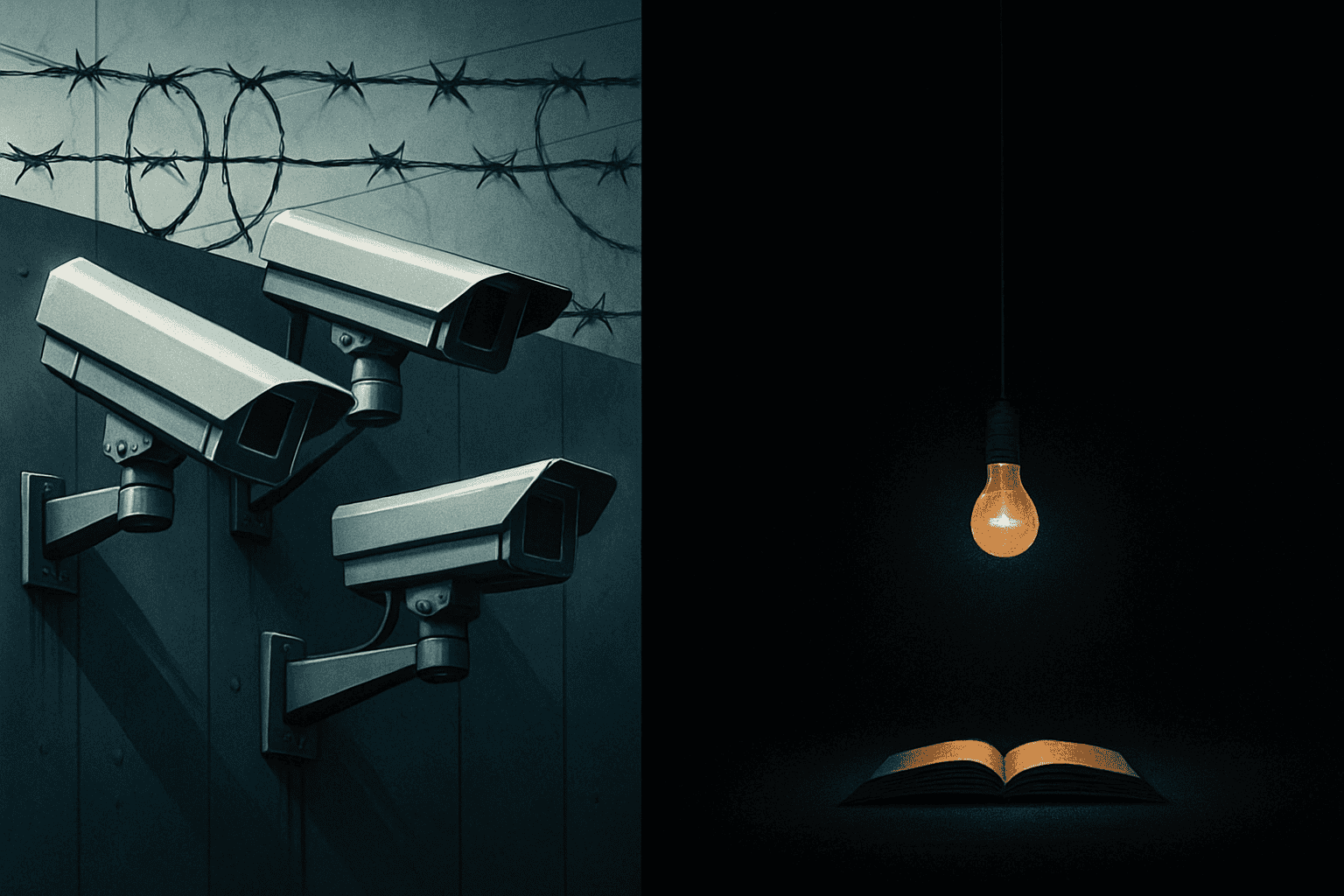
The Georgia Department of Corrections operates on a $1.9 billion annual budget with a stated mission to provide “opportunities for offender rehabilitation.” This analysis finds the state systematically fails that mission — investing $2.6 million in rehabilitation programming across two budget years while directing over $120 million to surveillance and technology, a ratio of 46:1. The fiscal and public safety consequences are severe:
- $52 per person per year on rehabilitation — $0.11 per day — while spending $34,000 per person per year on incarceration. Education spending equals 0.11% of the corrections budget.
- Georgia ranks dead last among Southern states in per-person prison education spending at $39/year. Alabama, under federal oversight for unconstitutional conditions, outspends Georgia 19:1. Florida outspends Georgia 26:1.
- Approximately 12,000 people return to Georgia communities annually — 33 per day — with a $25 prepaid Visa card and no transitional support, despite RAND Corporation evidence that educational programs reduce recidivism by 43% and return $4–$5 for every $1 invested.
- A 10 percentage point reduction in recidivism would prevent approximately 1,200 crimes per year and save taxpayers approximately $40 million in avoided incarceration costs.
- The U.S. Department of Justice found reasonable cause that Georgia violates the Eighth Amendment, documenting 142 homicides (2018–2023), a nearly 50% corrections officer vacancy rate, and programming that has been “slashed rather than expanded.”
Key Takeaway: Georgia invests 46 times more in surveillance than rehabilitation while ranking last among Southern states in prison education spending, creating a public safety liability as 12,000 underprepared people return to communities each year.
Fiscal Impact
Current Spending Profile
The GDC FY2025 budget totals $1,913,888,054. In 2025, the legislature approved $634 million in new corrections spending — the largest corrections funding increase in Georgia history ($434 million in AFY2025 plus $200 million in FY2026). Yet new rehabilitation and education investment across AFY2026 and FY2027 totals approximately $2.6 million.
| Category | Spending | Share of Budget |
|---|---|---|
| Healthcare | $417–$432M (FY2026-27) | ~24% |
| Technology/Surveillance | $150+ million (multi-year) | Significant |
| Rehabilitation/Education | ~$2.6M (two-year total) | 0.11% |
The statewide vocational education budget is $172,000 for FY2025 — $3.44 per incarcerated person.
The Cost of Inaction
- Georgia’s official 3-year reconviction rate is 25–27%, meaning approximately 3,000–3,200 people per release cohort will be reconvicted.
- National BJS data (30 states including Georgia) show 3-year rearrest rates of 68%, 6-year rates of 79%, and 9-year rates of 83%, with an average of 5 arrests per person. Georgia’s actual return-to-incarceration rate is estimated at approximately 50% — double the official figure.
- At $34,000 per person per year to incarcerate, each percentage point of recidivism carries substantial taxpayer cost.
- A 10 percentage point reduction in recidivism would yield approximately 1,200 fewer crimes per year, 1,200 fewer victims, and approximately $40 million in avoided incarceration costs.
The Return on Investment the State Is Leaving on the Table
- RAND Corporation: every $1 invested in prison education saves $4–$5 in reduced reincarceration costs.
- Vocational education produces a 205% return on investment.
- College programs generate $16,908 in economic impact per student.
- Georgia’s own data confirm the model works: vocational program completers recidivate at 13.64% versus 26% for the general population. The Bard Prison Initiative achieves under 4% recidivism.
Education Spending Disparities Within Georgia
| Program | Budget | Per Person | Ratio to GDC Education |
|---|---|---|---|
| K-12 (all sources) | ~$28 billion | $16,526/pupil | 413:1 |
| TCSG Technical Education | $444 million | $2,788/student | 69:1 |
| DREAMS Scholarship | $325 million | — | 162:1 |
| HOPE Scholarship | $1 billion/year | — | Incarcerated students banned |
| GDC Prison Education | ~$2 million | $40/person | Baseline |
Incarcerated students are banned from both the HOPE Scholarship and the DREAMS Scholarship. The HOPE ban stems from a 1995 administrative regulation — not state law — and could be reversed by executive action.
Key Takeaway: Georgia spends $34,000 per year to incarcerate each person but only $52 on rehabilitation, forgoing proven $4–$5 returns per dollar invested in education and an estimated $40 million in annual savings from a modest recidivism reduction.
Key Findings
1. The State Fails to Protect People from Violence
The U.S. Department of Justice found reasonable cause that Georgia violates the Eighth Amendment prohibition on cruel and unusual punishment. The evidence:
- 142 people were killed in Georgia prisons from 2018–2023 (DOJ confirmed)
- 100+ people were killed in 2024 alone (per the Atlanta Journal-Constitution; GDC’s own count was 66)
- 1,400+ reported violence incidents from January 2022 to April 2023
- Of those incidents, 19.7% involved a weapon, 45.1% resulted in serious injury, and 30.5% required offsite medical treatment
- 27,425 weapons were recovered from prisons between November 2021 and August 2023
- Violence is systematically underreported — incidents are coded as “injury” or “disruptive event” instead of assault
2. Chronic Understaffing Makes Both Safety and Rehabilitation Impossible
- 5,991 budgeted corrections officer positions; 2,985 vacant — a nearly 50% vacancy rate
- At one close-security prison, one officer was responsible for nearly 400 beds
- Hundreds of GDC officers have been arrested on criminal charges in the past six years
- The DOJ found that “prisons do not have enough staff to prevent or even respond to the most blatant gang activities, let alone provide programs”
3. Violence Biologically Prevents Learning
Peer-reviewed neuroscience research demonstrates that chronic threat exposure — the daily reality in Georgia’s prisons — makes rehabilitation neurologically impossible:
- Yale research: “Even quite mild acute uncontrollable stress can cause a rapid and dramatic loss of prefrontal cognitive abilities.” Structural brain damage begins after only one week of chronic stress.
- A Rikers Island study (N=197) found that cognitive control declined significantly over just 4 months of incarceration (Cohen’s d=0.41, p<0.001), with emotion regulation also declining (Cohen’s d=0.32, p=0.005).
- 74% of incarcerated youth had Individual Education Plans, reflecting pre-existing educational deficits compounded by prison conditions.
4. Lockdowns and Understaffing Eliminate Programming Access
- Facilities spend an estimated ~60 days per year on lockdown, during which all programming ceases
- Washington State Prison has been continuously locked down since January 11 riots
- Evening programming was eliminated after COVID in 2020 and has never been restored — 6 years later
- Reentry centers provide only 2,344 beds for approximately 50,000 incarcerated people — 4.7% capacity
- 50–66% of incarcerated people have substance use disorders, but Residential Substance Abuse Treatment capacity is “severely limited”
- 40% lack a high school credential
5. The State Releases 12,000 People Per Year With Virtually No Preparation
Georgia released 11,681 people in 2022 and 11,798 in 2023, with an additional 5,443 parole releases in FY24. At least 95% of all state prisoners will eventually be released.
Upon release, individuals receive:
– A $25 prepaid Visa card
– Clothing and a bus ticket
– No housing referral, no job placement, no ID, no phone, no transitional support
Post-release mortality is dramatically elevated in the first two weeks.
6. GDC Inflates Program Metrics
GDC claims 45,000 certificates issued in FY2024. However, this figure bundles micro-credentials (CPR, food handler, “Business Etiquette”) with meaningful vocational certifications. The AJC found GDC officials “repeatedly presented false or misleading information to federal investigators, state lawmakers and a federal judge.”
7. Georgia Closes College Programs While 44 States Expand Them
Federal Pell Grants were restored for incarcerated students on July 1, 2023, and programs are expanding in 44 states. Georgia moved in the opposite direction: Georgia State University shut down its prison education program in March 2024 — a program that served 60 students at $180,000 per year.
Georgia’s financial aid ban for incarcerated students is not a law — it is a 1995 administrative regulation from Governor Zell Miller’s administration that could be reversed without legislation.
Key Takeaway: Georgia’s prisons fail both stated missions — security and rehabilitation — with DOJ-confirmed constitutional violations, over 100 homicides in a single year, and education spending so low it ranks behind every other Southern state including Mississippi.
Comparable States
Georgia ranks last among Southern states in per-person prison education spending by wide margins. Every comparable state — including states with lower per-capita income and states under federal oversight for unconstitutional conditions — invests substantially more.
| State | Education Budget | Population | Per Person | Recidivism | Notes |
|---|---|---|---|---|---|
| Georgia | ~$2M | 51,000 | $39/yr | 25–27%* | Dead last; closing programs |
| Florida | ~$91M | 88,500 | $1,028/yr | 21% | 26x Georgia; 119% budget increase in 3 years |
| Alabama | ~$19.3M | 26,000 | $742/yr | — | Under federal oversight; still outspends GA 19x |
| Texas | ~$66–76M | 130,000 | $508–585/yr | 15% | Windham School District; 6,000 men annually in entrepreneurship program |
| North Carolina | ~$13.9M | 30,000 | $463/yr | — | Community college partnerships |
| Mississippi | ~$4M+ | 10,549 | ~$379+/yr | — | Poorest state; 80% enrolled in programming |
| South Carolina | — | 16,400 | — | 17.1% | Lowest recidivism in nation; 8,294 credentials/yr |
*Georgia’s official 25–27% reconviction rate uses a narrow methodology. The actual return-to-incarceration rate is estimated at approximately 50%.
Key comparisons:
– Texas invests $508–$585 per person and achieves a 15% recidivism rate through the Windham School District, which operates as a dedicated educational entity within corrections.
– South Carolina achieves the nation’s lowest recidivism rate at 17.1%, issuing 8,294 credentials annually for a population of 16,400.
– Mississippi, despite being the nation’s poorest state, enrolls 80% of its incarcerated population in programming.
– Alabama, even while under federal oversight for its own unconstitutional prison conditions, outspends Georgia 19 to 1 on prison education.
The correlation is consistent: states that invest in programming achieve lower recidivism. Georgia’s $39 per person is not a fiscal constraint — it is a policy choice.
Key Takeaway: Every Southern state — including Mississippi (the nation’s poorest) and Alabama (under federal oversight) — invests dramatically more in prison education than Georgia, and achieves better recidivism outcomes.
Policy Recommendations
1. Create a Dedicated Rehabilitation Budget Line Item
Education and programming are currently buried inside the $901–$938 million “State Prisons” appropriation with no standalone line item. The legislature should establish a dedicated, transparent appropriation for rehabilitation, education, and reentry programming — enabling oversight, accountability, and year-over-year tracking.
2. Fund Prison Education at a Minimum Southern-State Benchmark
Georgia’s $39 per person ranks last among all Southern states. Funding at even the lowest comparable level — Mississippi’s approximate $379 per person — would require approximately $19 million annually, a modest allocation within a $1.9 billion budget. Funding at the Southern median (~$500/person) would cost approximately $25 million — and RAND research projects $4–$5 in savings for every $1 invested.
3. Rescind the 1995 Financial Aid Ban by Executive or Legislative Action
The ban on financial aid for incarcerated students is an administrative regulation, not state law. The Governor could reverse it by executive action, or the legislature could codify eligibility. Federal Pell Grants were restored July 1, 2023, and 44 states are expanding college programs. Georgia is moving backward — closing the GSU prison education program ($180,000/year, 60 students) while allocating $325 million for the DREAMS Scholarship and $1 billion annually for HOPE, both of which exclude incarcerated students.
4. Establish an Independent Corrections Oversight Body
The December 13, 2024 Senate Study Committee voted down proposals for an oversight body, de-escalation training, and reintegration programming. Only 3 of the DOJ’s 82 remedial measures address programming — with no mandates for education, vocational training, GED, or college programs. Georgia needs an independent oversight entity with authority to monitor rehabilitation outcomes, programming access, and budget compliance.
5. Mandate Reporting on Actual Programming Access and Outcomes
GDC publishes no data on what percentage of incarcerated people can actually access programming. The legislature should require annual reporting on: programming enrollment rates by facility, wait times, lockdown-related cancellations, credential types (distinguishing micro-credentials from vocational certifications), and recidivism outcomes by program type. GDC’s claim of 45,000 certificates should be audited to separate meaningful vocational certifications from micro-credentials.
6. Scale Reentry Programming Capacity
Reentry centers serve only 2,344 beds for approximately 50,000 people — 4.7% capacity. The state should expand transitional programming to ensure that all individuals approaching release have access to job placement, housing referral, and substance abuse treatment, given that 50–66% of incarcerated people have substance use disorders and individuals currently receive only a $25 prepaid Visa card upon release.
7. Address the Staffing-Programming Connection
The nearly 50% corrections officer vacancy rate directly prevents programming delivery. The legislature should examine whether the $634 million in new corrections spending addresses the staffing crisis in ways that enable — not just permit — rehabilitation programming. Walker State Prison demonstrates GDC’s own proof-of-concept: adequate staffing combined with programming produces zero homicides.
8. Restore Evening Programming
Evening programming was eliminated after COVID in 2020 and has never been restored — 6 years later. This represents a low-cost, immediate action that could substantially increase programming access hours without new facility construction.
Key Takeaway: Eight specific actions — from creating a dedicated budget line item to rescinding a 1995 administrative regulation — could align Georgia’s $1.9 billion corrections investment with evidence-based rehabilitation practices that reduce recidivism and save taxpayer money.
Read the Source Document
Read the full analysis: GDC Mission vs. Reality: The Rehabilitation That Doesn’t Exist (PDF)
Sources cited in the original document include: Governor’s Budget Report AFY2026/FY2027, GBPI budget overviews, BJS Prisoners in 2023, DOJ Findings Report (September 2024), RAND Corporation (2013), AJC investigations, 2024 Senate Study Committee Report, and the GPS Research Library (5,000+ data points across 80+ collections).
Other Versions
This analysis is available in four formats tailored to different audiences:
- Public Version — Plain-language summary for Georgia residents and families
- Media Version — Press-ready summary with key data points and sourcing
- Advocate Version — Detailed analysis for legal advocates, policy organizations, and researchers
- Legislator Version — This document
Sources & References
- GBPI Budget Overviews. Georgia Budget and Policy Institute (2025-01-01) Official Report
- Governor’s Budget Report AFY2026/FY2027. Office of the Governor of Georgia (2025-01-01) Official Report
- GPS Analysis of Georgia Parole System (2025) — Georgia Prisoners’ Speak. Georgia Prisoners’ Speak (2025-01-01) GPS Original
- 2024 Senate Study Committee Report. Georgia Senate (2024-12-13) Official Report
- DOJ Findings Report (September 2024). U.S. Department of Justice (2024-10-01) Official Report
- AJC Investigations. Atlanta Journal-Constitution (2024-01-01) Journalism
- BJS Prisoners in 2023. Bureau of Justice Statistics (2024-01-01) Official Report
- Rikers Study (PMC5961486). PubMed Central (2018-01-01) Academic
- Montgomery v. Louisiana 577 U.S. 190. U.S. Supreme Court (2016-01-01) Legal Document
- PMC4561403. PubMed Central (2015-01-01) Academic
- PMC4120991. PubMed Central (2014-01-01) Academic
- RAND Corporation (2013). RAND Corporation (2013-01-01) Academic
- Miller v. Alabama 567 U.S. 460. U.S. Supreme Court (2012-01-01) Legal Document
- Graham v. Florida 560 U.S. 48. U.S. Supreme Court (2010-01-01) Legal Document
- Yale (Arnsten 2009) — Arnsten, Amy F.T.. Yale University (2009-01-01) Academic
- NEJM (Binswanger 2007) — Binswanger, Ingrid A.. New England Journal of Medicine (2007-01-01) Academic
- Holt v. Sarver 300 F. Supp. 825. U.S. District Court for the Eastern District of Arkansas (1970-01-01) Legal Document
- Education Commission of the States. Education Commission of the States Official Report
- GDC Official Website. Georgia Department of Corrections Official Report
- GPS Research Library. Georgia Prisoners’ Speak GPS Original
- Vera Institute. Vera Institute of Justice Official Report
Source Document
You just read about people suffering in state custody. The least you can do is make sure other people read it too. Share this story.