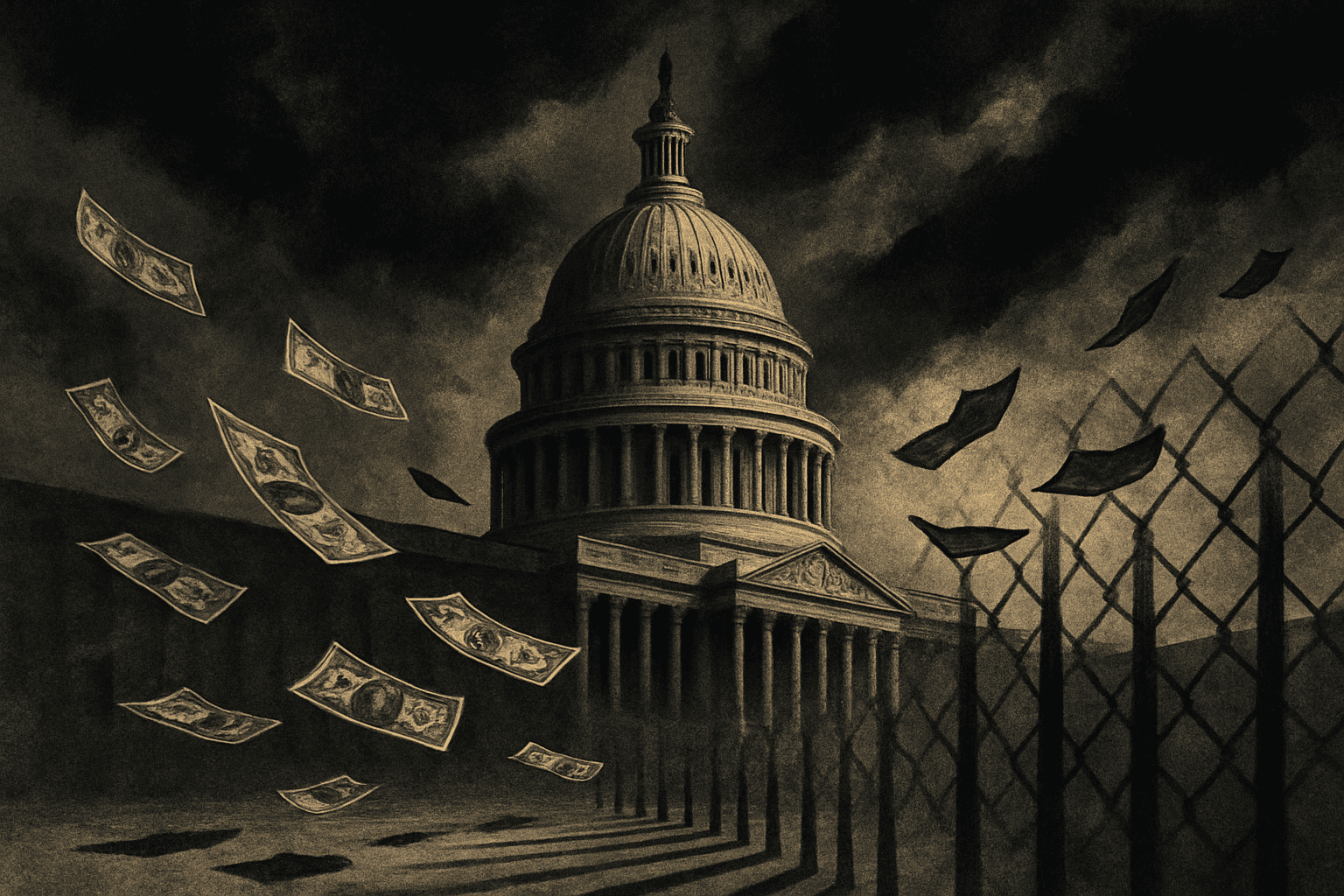
This explainer is based on Georgia’s $600 Million Prison Spending Infusion: An Accountability Analysis. All statistics and findings are drawn directly from this source.
Executive Summary
Between January and May 2025, the General Assembly approved approximately $634 million in new corrections spending — the largest such increase in state history. Total additional corrections spending now approaches $700 million above the FY2022 baseline, a 44% increase in four years. Despite this historic investment:
- Violence is accelerating. In the first six months of 2025, 42 people were killed in suspected homicides — nearly two-thirds of 2024’s full-year record of 66. The projected 2025 total of approximately 84 homicides represents a 27% increase over 2024.
- Staffing remains at emergency levels. Twenty of 34 state prisons have correctional officer vacancy rates above 50%. The 82.7% first-year attrition rate for new officers makes the crisis mathematically unsolvable through hiring alone.
- Infrastructure repairs will take years. Lock replacement alone requires 5–6 years. Twenty-nine of 34 prisons need critical upgrades — a multi-billion-dollar, multi-decade challenge.
- No structural reforms were funded. Zero dollars were allocated for population reduction, parole reform, classification overhaul, or independent oversight — the reforms federal investigators and independent consultants identified as prerequisites for constitutional conditions.
- No accountability mechanisms exist. Georgia has no prison ombudsman, no independent inspector general for corrections, and no public reporting requirement on spending or outcomes tied to the $634 million.
Key Takeaway: Georgia approved its largest-ever corrections funding increase, yet every measurable outcome — homicides, staffing, infrastructure — has worsened, because the spending funds operational maintenance rather than the structural reforms experts identified as necessary.
Fiscal Impact
Four-Year Spending Trajectory
| Fiscal Year | Corrections Budget | Change from FY2022 |
|---|---|---|
| FY2022 | $1.12 billion (baseline) | — |
| FY2023 | ~$1.18 billion | +$60 million |
| FY2024 | $1.32 billion | +$200 million |
| FY2025 | $1.50 billion + $434 million emergency infusion | +$814 million (cumulative with infusion) |
| FY2026 | $1.62 billion (proposed) | +$500 million annually |
The total additional spending between FY2022 and FY2026 approaches $700 million above the FY2022 baseline — the fastest spending growth in agency history.
Where the $634 Million Goes
- Infrastructure and facility repairs: ~$330 million (lock replacement, emergency repairs at 29 facilities, four 126-bed modular units, $40 million for new prison planning)
- Healthcare contracts: ~$97 million (mental, dental, physical, pharmacy expansion)
- Contraband interdiction technology: ~$50 million (cell phone detection, drone interdiction, managed access)
- Staffing and recruitment: ~$40+ million (4% CO salary increase, 8% counselor increase, marketing, 330 near-term officers)
- Capacity expansion: 446 additional private prison beds, modular housing units
What the $634 Million Does Not Fund
The appropriation includes zero funding for: population reduction (no parole expansion, geriatric release, or reclassification); parole reform (SB 25 still pending); classification and housing overhaul; sexual safety and PREA compliance infrastructure; evidence-based gang management programs; co-pay reduction or commissary price reform; or independent oversight or accountability mechanisms.
Return on Investment
Georgia taxpayers are spending nearly $500 million more per year on corrections than in FY2022. During this period, people killed in Georgia prisons rose from 8 annually (2018) to a projected 84 in 2025. Staffing reached emergency levels at the majority of facilities. The state faces a potential federal consent decree with additional costs. Without structural reform, these costs will continue to compound with no improvement in outcomes.
Key Takeaway: Georgia’s corrections budget grew 44% in four years — from $1.12 billion to $1.62 billion — with no measurable improvement in safety, staffing, or infrastructure, because the spending maintains a failing system rather than transforming it.
Key Findings
1. The State Is Failing to Protect People from Lethal Violence
Prison homicides have risen tenfold in seven years:
| Year | Homicides |
|---|---|
| 2018 | 8 |
| 2019 | 13 |
| 2023 | At least 38 |
| 2024 | 66 (GDC-investigated; AJC identified 62) |
| 2025 (projected) | Approximately 84 |
In the first six months of 2025 alone, 42 people were killed — nearly two-thirds of 2024’s full-year total. June 2025 saw 9 investigated homicides in a single month. Total deaths in 2024 reached 330–333. Georgia’s prison homicide rate is nearly triple the national average according to the DOJ.
The violence continued unabated through early 2026: 9 people were hospitalized with stab wounds after a gang fight at Wilcox State Prison (January 2025); 3 people were killed at Middle Georgia State Prison, including Jimmy Trammell, age 42, who was scheduled for release days later (January 2026); and ongoing human rights conditions at Coastal State Prison included staff beatings, 7–10 day lockdowns without showers, black mold, and pest infestations (February 2026).
2. The Staffing Crisis Is Mathematically Unsolvable Through Hiring
- 20 of 34 state prisons have CO vacancy rates above 50% (emergency level)
- 8 prisons have vacancy rates of 70% or more
- Valdosta State Prison: 80% of CO positions vacant as of April 2024
- National standard: vacancy rates no higher than 10%
The retention arithmetic is devastating:
– 800 applicants → 118 hires (14.75% conversion rate)
– 82.7% of new officers leave within their first year
– Net retention from 800 applicants: approximately 20 officers
– To fill approximately 3,500 vacancies at this rate would require processing roughly 140,000 applicants
The 4% salary increase leaves starting pay at $40,000–$43,000, below most Southern state competitors. Commissioner Oliver admitted: “Trying to hire 2,600 people in a fiscal year is just not possible.” As of December 2025, prison guards were at a 15-year low while the incarcerated population was at a 15-year high.
3. Gangs Fill the Vacuum the State Created
Approximately 15,000 verified security threat group members now constitute one-third of Georgia’s prison population — nearly double since 2014. At some facilities, gangs effectively control operations: selling bed space, extorting family members for protection payments, using violence to collect debts, and pressuring women for sex recorded on cellphones. This is a direct consequence of the state’s failure to maintain adequate staffing and security.
4. Infrastructure Decay Exceeds the Appropriation by Orders of Magnitude
Twenty-nine of 34 state prisons need critical upgrades per a January 2023 internal GDC evaluation. Lock replacement alone will take 5–6 years. At Georgia Diagnostic and Classification Prison, correctional officers conduct rounds by flashlight because electrical systems have been vandalized. The $330 million in one-time repairs cannot resolve what the source document describes as a “multi-billion-dollar, multi-decade challenge.”
5. The State Eliminated Its Own Safety Valve
Parole releases decreased 38% between 2019 and 2023 while the incarcerated population grew. Both staff and people in prison requested additional transparency from the Parole Board concerning denial decisions. The $634 million appropriation does not fund parole reform despite recommendations from Guidehouse.
6. The DOJ Case Has Stalled
The DOJ’s 93-page CRIPA report (October 2024) concluded Georgia is deliberately indifferent to unconstitutional conditions, documented more than 1,400 violent incidents between January 2022 and April 2023, and included 13 pages of minimum remedial measures. Georgia was given 49 days to respond. The deadline passed without action. Under the current federal administration, there is no public indication the CRIPA case is being pursued.
7. No Independent Oversight Exists
There is no independent oversight mechanism attached to the $634 million. Georgia has no prison ombudsman, no independent inspector general for corrections, and no public reporting requirement on spending or outcomes. GDC has a documented history of misclassifying homicides and providing false or misleading information. The legislature has no mechanism to verify whether this historic appropriation produces results.
Key Takeaway: Every category of evidence — violence, staffing, infrastructure, gang control, parole, federal compliance, and oversight — shows deterioration despite the largest corrections spending increase in Georgia history.
Comparable States
The source document provides limited direct state-to-state comparisons but includes the following relevant benchmarks:
- Salary competitiveness: Most Southern states pay new correctional officers more than Georgia’s $40,000–$43,000 starting range. The source identifies this gap as a direct driver of Georgia’s 14.75% hiring rate and 82.7% first-year attrition.
- National staffing standard: National standards require facility vacancy rates no higher than 10%. Georgia has 20 prisons above 50% and 8 above 70%.
- National homicide rate: The DOJ found Georgia’s prison homicide rate is nearly triple the national average.
- Georgia’s own history as comparator: Georgia’s Deal-era Council on Criminal Justice Reform (created 2013) was a national model for evidence-based reform and corresponded with single-digit annual homicide years. The source document presents Georgia’s own pre-crisis reforms as proof that alternatives exist.
Detailed fiscal and policy comparisons with specific peer states (Alabama, South Carolina, Mississippi, Florida, Texas) are not available in the source document. GPS recommends the General Assembly commission such a study as part of any oversight framework.
Key Takeaway: Georgia’s correctional officer pay, staffing levels, and homicide rates all fall far below national standards and peer-state benchmarks, and the state’s own Deal-era reform history demonstrates viable alternatives.
Policy Recommendations
The source analysis identifies two mathematically viable paths to adequate staffing ratios and constitutional conditions. Both require legislative action.
1. Establish Independent Oversight (Immediate)
Create a legislatively authorized, independently funded corrections oversight body — an inspector general or ombudsman with subpoena authority — as a precondition for accountability over the $634 million appropriation. Require quarterly public reporting on spending by facility and category, staffing levels by facility, violence data disaggregated by facility, and infrastructure project timelines.
2. Pursue Population Reduction (2026 Session)
A 20% reduction — 10,000 people — would bring staffing ratios into manageable territory at current workforce levels. Legislative vehicles include:
– Pass SB 25 (parole reform, currently pending)
– Expand parole eligibility and restore parole release rates (which fell 38% between 2019 and 2023)
– Enact geriatric release provisions
– Reclassify nonviolent populations to lower-security or community supervision
– Require Parole Board transparency on denial decisions, as recommended by both staff and incarcerated people in the Guidehouse assessment
3. Make Corrections Employment Competitive (FY2027 Budget)
The 4% salary increase is insufficient. The source analysis identifies a 30–50% increase as necessary to address recruitment and retention. At current attrition rates (82.7% first-year), Georgia would need to process approximately 140,000 applicants to fill approximately 3,500 vacancies. Competitive salaries are a prerequisite for any staffing strategy to succeed.
4. Fund Structural Reforms the $634 Million Excluded
- Classification and housing overhaul
- Evidence-based gang management programs (approximately 15,000 verified gang members)
- Sexual safety and PREA compliance infrastructure
- Healthcare co-pay reduction and commissary price reform (commissary prices remain inflated from a $5 million FY2021 budget cut offset by price increases on basic hygiene products)
- Education and reentry programming
5. Require Full Transparency on Current Spending
The legislature should request through its oversight authority:
– Complete final Guidehouse report (only a draft has been made public)
– Detailed spending breakdowns by facility and category
– Monthly staffing data by facility
– Private prison contract details (446 beds)
– DOJ settlement proposal terms
– Lock replacement and infrastructure project timelines
Key Takeaway: Independent oversight, population reduction, competitive salaries, and structural reforms are the evidence-based policy levers available to the General Assembly — and the $634 million appropriation funded none of them.
Read the Source Document
Read the full analysis: Georgia’s $600 Million Prison Spending Infusion: An Accountability Analysis
Other Versions
This explainer is written for Georgia legislators and staff. Other versions of this analysis are available:
- Public Version — Plain-language summary for general audiences
- Media Version — Press-ready format with key quotes and data points
- Advocate Version — Detailed analysis for criminal justice reform organizations
Sources & References
- Georgia’s $600 Million Prison Spending Infusion: An Accountability Analysis. Georgia Prisoners’ Speak / The GDC Accountability Project, Inc. (2026-03-01) GPS Original
- Workers and inmates report human rights crisis at Coastal State Prison. WTOC (2026-02-12) Journalism
- Georgia Decarceration: Addressing the Prison Crisis. Georgia Prisoners’ Speak (2026-01-01) GPS Original
- Georgia Public Broadcasting prison staffing report. Georgia Public Broadcasting (2025-12-15) Journalism
- The Hidden Violence in Georgia’s Prisons: Beyond the Death Toll. Georgia Prisoners’ Speak (2025-09-24) GPS Original
- Georgia prison homicides on the rise, already approaching last year’s total. Atlanta Journal-Constitution (2025-09-01) Journalism
- Georgia prisons get $600M for overhaul. Lawmakers say it’s a start. Atlanta Journal-Constitution (2025-05-01) Journalism
- Georgia Prisons Cover Up Murders. The Appeal (2025-02-01) Journalism
- Overview: 2026 Fiscal Year Budget for the Georgia Department of Corrections, GBPI. Georgia Budget and Policy Institute (2025-02-01) Official Report
- Gov. Kemp Unveils Recommendations from System-wide Corrections System Assessment, Office of Governor Brian Kemp. Office of Governor Brian Kemp (2025-01-07) Press Release
- Georgia prisons are in crisis, say consultants hired by Gov. Kemp. Atlanta Journal-Constitution (2025-01-01) Journalism
- Project 2025’s Plan for Criminal Justice Under Trump. Brennan Center for Justice (2025-01-01) Official Report
- CRIPA Investigation of Georgia Prisons. U.S. Department of Justice Civil Rights Division (2024-10-01) Official Report
- Gov. Kemp Announces GDC Assessment as Next Phase of Public Safety Improvements — Office of the Governor. Office of the Governor of Georgia (2024-06-17) Press Release
- Georgia Prison Crisis Worsens. The Appeal (2024-02-01) Journalism
- DOJ Report Exposes Brutality (SCHR). Southern Center for Human Rights (2024-01-01) Official Report
- Justice Department Announces Investigation of Conditions in Georgia Prisons. U.S. Department of Justice (2021-09-01) Press Release
- Overview: 2022 Fiscal Year Budget for the Georgia Department of Corrections. Georgia Budget and Policy Institute (2021-02-01) Official Report
Source Document
You just read about people suffering in state custody. The least you can do is make sure other people read it too. Share this story.
1 thought on “Georgia’s $634 Million Prison Spending Infusion: Accountability Analysis for the 2026 Legislative Session”