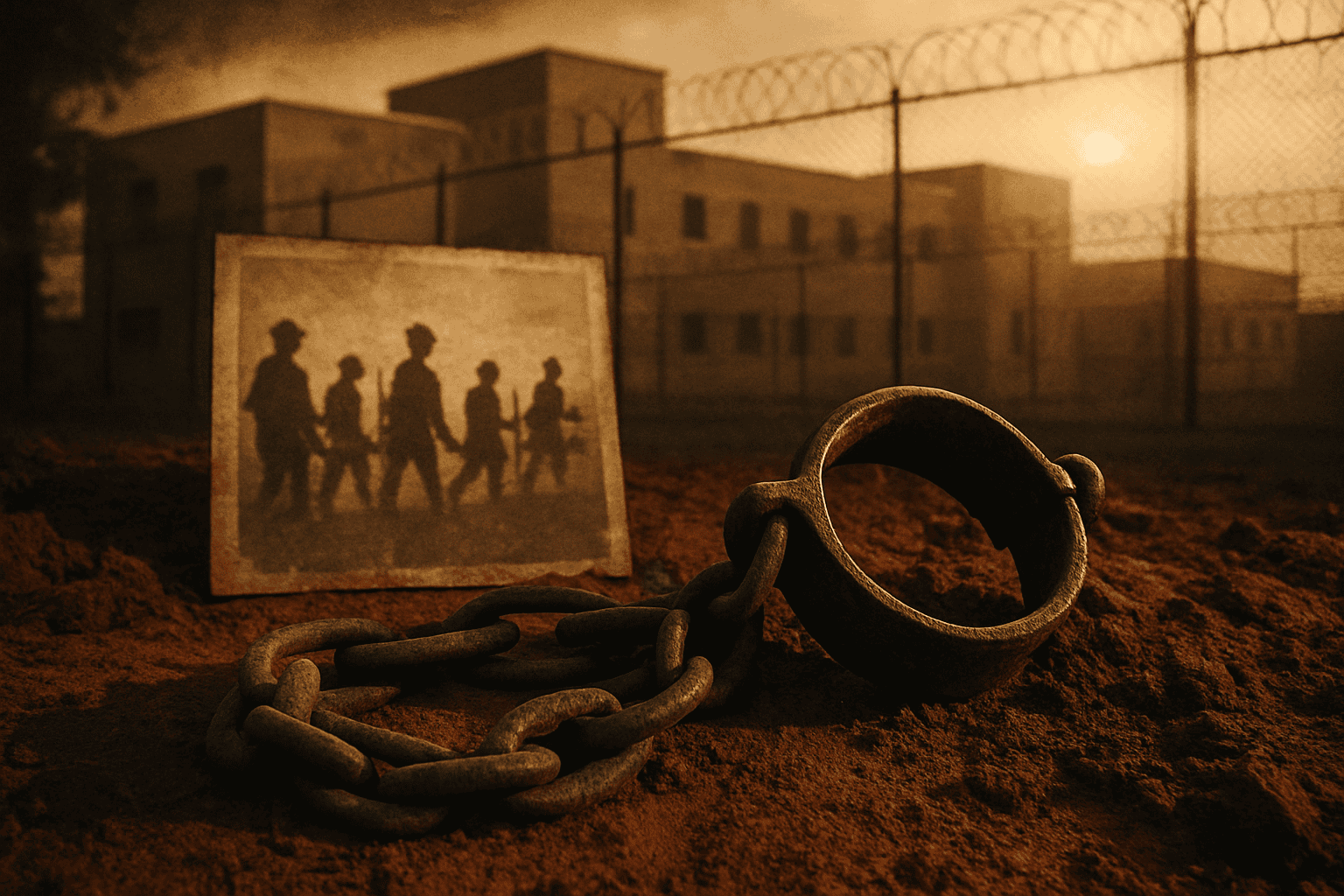
This explainer is based on Georgia’s Convict Leasing Program: Historical Origins and Modern Prison Labor (1866–Present). All statistics and findings are drawn directly from this source.
Executive Summary
This research document traces 160 years of state-sponsored forced labor in Georgia — from the convict leasing system established in 1866 through the modern prison labor apparatus that generates tens of millions of dollars annually using unpaid workers.
- $64 million in annual revenue is generated by Georgia Correctional Industries (GCI) in FY2023 through 21 manufacturing plants and over 13,000 acres of farmland — overwhelmingly staffed by people paid nothing or pennies per hour.
- 80% of able-bodied people in Georgia’s prisons work in labor programs; the vast majority receive $0 in wages. Georgia counties receive an estimated $100+ million annually in value from unpaid prison labor.
- Racial disparities persist across 160 years: Georgia’s convict leasing population was approximately 90% Black when Black Georgians were 45% of the population. Today, Georgia’s prison population is approximately 60% Black while the state’s general population is approximately 33% Black.
- Georgia ranks 4th highest in the nation for incarceration rate, with approximately 47,000 people in state facilities and approximately 250,000+ on probation — many supervised by approximately 40 private companies charging monthly fees.
- HR 1530, the “Ending Slavery in Georgia” amendment, would remove the slavery exception from the state constitution. Eight states have already passed similar measures since 2018.
Key Takeaway: Georgia operates one of the nation’s largest forced labor systems, generating over $164 million in combined value annually through unpaid or minimally-paid prison labor, with racial disparities that mirror the convict leasing era.
Fiscal Impact
Current Revenue from Unpaid and Low-Wage Prison Labor
Georgia’s prison labor system represents a substantial fiscal interest for state and county governments:
| Revenue Source | Estimated Annual Value |
|---|---|
| Georgia Correctional Industries (GCI) | ~$64 million (FY2023) |
| County Work Details (road crews, maintenance, public works) | $100+ million |
| Combined estimated annual value | $164+ million |
GCI operates approximately 21 manufacturing plants producing furniture, signs, license plates, cleaning chemicals, mattresses, clothing, metal products, and printing services. GCI also manages over 13,000 acres of farmland producing vegetables, dairy, beef, pork, and poultry.
Workers in GCI operations typically receive either no pay or nominal pay — a few cents per hour to a few dollars per day. Georgia pays $0 for institutional maintenance labor, which constitutes the majority of prison work.
Private Probation Revenue Extraction
Georgia has approximately 250,000+ individuals on probation at any given time, with a significant portion supervised by approximately 40 private companies charging monthly fees of $35–$50. This system extracts millions from Georgia’s poorest residents. In 2018, Judicial Correction Services paid $2.4 million to settle a federal lawsuit alleging it operated a “judicially sanctioned extortion racket.”
Fiscal Implications of HR 1530
The Georgia Department of Corrections and corrections industry oppose HR 1530, arguing that eliminating compulsory labor would increase incarceration costs. However, this framing obscures the question legislators must answer: whether $164+ million in annual value justifies a system that scholars document as a direct continuation of racial exploitation authorized by the 13th Amendment’s slavery exception.
Under the Prison Industry Enhancement Certification Program (PIECP), up to 80% of wages can be deducted for taxes, room and board, victim restitution, and family support — meaning that even in programs designed to pay “prevailing wages,” incarcerated workers retain minimal compensation.
Key Takeaway: Georgia extracts an estimated $164+ million annually in value from unpaid and minimally-paid prison labor, creating powerful fiscal incentives to maintain mass incarceration.
Key Findings
1. Georgia Designed Its Post-Civil War Criminal Justice System to Re-enslave Black Labor
Georgia began leasing state prisoners to private companies in 1866 — one year after ratification of the 13th Amendment. The state legislature authorized the governor to lease people to railroad companies and other private enterprises. By 1868, Georgia had formalized this system through legislation giving the governor full authority to contract with private parties for convict labor.
The system was built on Black Codes — laws that criminalized vagrancy (unemployment), breach of labor contracts, and “enticement” (accepting better job offers). These laws were designed to funnel Black Georgians into the criminal justice system, providing a steady supply of forced laborers.
While Georgia’s free population was approximately 45% Black in the late 19th century, the convict population was roughly 90% Black. Black people were preferentially leased for the most dangerous work — mining and railroad construction — while white people were more often kept in state facilities or assigned lighter tasks.
2. The State Killed Thousands Through Lethal Working Conditions
Georgia’s convict death rate was consistently among the highest in the nation. In the 1870s and 1880s, annual mortality rates ranged from 10% to over 25% in some camps. An 1881 legislative investigation found that approximately 1 in 4 people in the system died each year. By comparison, even the harshest Northern prisons had death rates of 1–2%.
Between 1870 and 1910, thousands of people died in Georgia’s leasing system — the exact number is unknown because record-keeping was deliberately poor.
At Joseph E. Brown’s Dade Coal Company at Cole City, death rates exceeded 10–15% in some years. Miners worked 12–16 hour shifts in cramped, poorly ventilated shafts. An 1881 investigation found people sleeping in their own waste, chained at night, and beaten regularly.
Documented torture methods included hanging by thumbs, “watering” (forcing water into a person’s stomach), the “sweat box” (confinement in a small, heated enclosure), and chaining people in stress positions overnight.
3. Political Elites Profited Directly and Blocked Reform for Decades
The Bourbon Triumvirate — Joseph E. Brown, Alfred H. Colquitt, and John B. Gordon — dominated Georgia politics from the 1870s through the 1890s. All three were deeply invested in convict leasing and used their political power to block reform efforts and expand the system.
Convict leasing generated more revenue per capita for Georgia than any other state function in the 1880s and 1890s. Brown became one of the wealthiest men in the New South while serving as U.S. Senator (1880–1891).
James W. English’s Chattahoochee Brick Company used hundreds of people to produce millions of bricks that literally built Atlanta’s infrastructure. Despite multiple legislative investigations documenting deadly conditions, political opposition from beneficiaries delayed abolition until 1908.
4. Abolition of Convict Leasing Did Not End Forced Labor — It Changed Form
When Georgia abolished convict leasing in 1908, the state transitioned to a county-based chain gang system that retained virtually all the brutal features: people were chained together, worked under armed guard, housed in mobile cages, subjected to whipping, and suffered high rates of disease and death. The chain gang system persisted into the 1940s.
5. Modern Georgia Perpetuates the Same Structure
Today, Georgia operates approximately 47,000 people across 34 state prisons, 8 transitional centers, and various other facilities. The GDC estimates that approximately 80% of able-bodied people participate in work programs. The vast majority receive no wages.
Georgia’s prison population is approximately 60% Black, while the state’s general population is approximately 33% Black — a disparity ratio of roughly 1.8:1 that mirrors historical patterns. The document identifies the same structural elements across all eras: legal authorization through the 13th Amendment exception, racial targeting, economic exploitation, geographic continuity (many modern GDC facilities occupy land used for forced labor for 150+ years), and political influence of beneficiaries.
6. People in Georgia’s Prisons Have Consistently Resisted
In December 2010, thousands of Georgia prisoners across multiple facilities staged a coordinated work stoppage — one of the largest prisoner strikes in U.S. history. They demanded fair wages for work, educational opportunities, better healthcare, nutritious food, and an end to cruel and unusual punishment. Georgia prisoners also participated in the 2016 nationwide prison strike.
7. Georgia Leads the Nation in Private Probation Exploitation
Georgia leads the nation in the use of private probation companies, with approximately 40 private companies supervising hundreds of thousands of people. Courts sentence individuals — often for minor misdemeanor offenses — to probation with fines and fees supervised by for-profit companies charging $35–$50 per month. Failure to pay can result in incarceration. Human Rights Watch documented in 2015 how this system disproportionately impacts poor and Black residents.
Key Takeaway: The evidence documents direct legal, economic, racial, and geographic continuity from chattel slavery through convict leasing to Georgia’s modern $164+ million prison labor system.
Comparable States
States That Have Removed the Slavery Exception from Their Constitutions
Eight states have passed constitutional amendments removing the slavery exception since 2018:
| State | Year | Mechanism |
|---|---|---|
| Colorado | 2018 | Voters approved Amendment A |
| Nebraska | 2020 | Voters approved removal |
| Utah | 2020 | Voters approved Amendment C |
| Alabama | 2022 | Voters approved removal |
| Tennessee | 2022 | Voters approved Amendment 3 |
| Oregon | 2022 | Voters approved Measure 112 |
| Vermont | 2022 | Voters approved Proposal 2 |
| Nevada | 2024 | Voters approved Question 4 |
Georgia’s HR 1530, the “Ending Slavery in Georgia” amendment, sponsored by a bipartisan coalition, would amend Article I, Section I of the Georgia Constitution to prohibit slavery and involuntary servitude without exception. If passed by the legislature, it would go before Georgia voters as a referendum.
Georgia’s National Standing
Georgia has the 4th highest incarceration rate in the nation. The source document identifies Georgia as one of several states that pays incarcerated workers $0 for institutional labor.
Historically, Douglas Blackmon documented that between 1865 and 1945, an estimated 100,000+ Black Americans were forcibly pressed into labor through the criminal justice system across the South, with Georgia being one of the primary states.
Key Takeaway: Eight states have already removed the slavery exception from their constitutions; Georgia’s HR 1530 would place the question before voters.
Policy Recommendations
Based on the evidence in this research document, Georgia legislators should consider the following actions:
1. Advance HR 1530 — Remove the Slavery Exception
Pass the “Ending Slavery in Georgia” constitutional amendment to prohibit slavery and involuntary servitude without exception, placing it before voters as a referendum. Eight states have already done so with bipartisan support.
2. Mandate Compensation for Prison Labor
Enact legislation requiring meaningful wages for all incarcerated workers. Georgia currently pays $0 for institutional maintenance labor and nominal pay for GCI operations. Minimum compensation standards would reduce the economic incentive for mass incarceration and provide returning citizens with savings to support successful reentry.
3. Conduct a Comprehensive Fiscal Audit of Prison Labor
Direct the Georgia General Assembly Budget Office or an independent body to audit the full fiscal scope of prison labor, including the estimated $64 million in GCI revenue and $100+ million in county work detail value. The audit should assess whether these savings are offset by the costs of mass incarceration and recidivism.
4. Reform Private Probation
Enact legislation to end or strictly regulate the use of private, for-profit probation companies. Georgia leads the nation in private probation use, with approximately 40 companies supervising hundreds of thousands of people. Legislation should prohibit incarceration for inability to pay supervision fees and require meaningful ability-to-pay determinations.
5. Require Racial Impact Statements
Mandate racial impact analysis for all criminal justice legislation. With Georgia’s prison population approximately 60% Black in a state that is approximately 33% Black, legislators need standardized data to evaluate whether proposed policies will deepen or reduce racial disparities.
6. Establish a Commission on Georgia’s Forced Labor History
Create a legislative commission to document the full human and economic toll of convict leasing, chain gangs, and modern prison labor in Georgia — including the thousands of people who died in state custody between 1870 and 1910 whose deaths were never properly recorded.
7. Increase Transparency and Oversight of County Prison Labor
County prison labor programs are less regulated than state programs and have been the subject of numerous complaints about conditions and treatment. Require standardized reporting on hours worked, conditions, and any incidents for all county work details.
Key Takeaway: HR 1530, mandatory prison wages, private probation reform, and a comprehensive fiscal audit of prison labor are actionable steps Georgia legislators can take this session.
Read the Source Document
This document is maintained in the GPS Research Library.
Other Versions
- Public Version — Plain-language summary for general audiences
- Media Version — Press-ready brief with key data points and context
- Advocate Version — Action-oriented guide for organizers and directly impacted communities
Sources & References
- No Mercy Here: Gender, Punishment, and the Making of Jim Crow Modernity — Sarah Haley. University of North Carolina Press (2016-01-01) Academic
- Chained in Silence: Black Women and Convict Labor in the New South — Talitha L. LeFlouria. University of North Carolina Press (2015-01-01) Academic
- Profiting from Probation: America’s ‘Offender-Funded’ Probation Industry — Human Rights Watch. Human Rights Watch (2015-01-01) Official Report
- Northward Migration and the Rise of Racial Disparity in American Incarceration, 1880-1950 — Christopher Muller. American Journal of Sociology (2012-01-01) Academic
- Burial for a King: Martin Luther King Jr.’s Funeral and the Week that Transformed Atlanta and Rearranged a Race — Rebecca M. Burns (2011-01-01) Academic
- Slavery by Another Name: The Re-Enslavement of Black Americans from the Civil War to World War II — Douglas A. Blackmon. Anchor Books/Random House (2008-01-01) Academic
- One Dies, Get Another: Convict Leasing in the American South, 1866–1928 — Matthew J. Mancini. University of South Carolina Press (1996-01-01) Academic
- Twice the Work of Free Labor: The Political Economy of Convict Labor in the New South — Alex Lichtenstein. Verso (1996-01-01) Academic
- Worse Than Slavery: Parchman Farm and the Ordeal of Jim Crow Justice — David M. Oshinsky. Free Press (1996-01-01) Academic
- Georgia Nigger — John L. Spivak. Brewer, Warren & Putnam (1932-01-01) Journalism
- I Am a Fugitive from a Georgia Chain Gang! — Robert Elliott Burns. Vanguard Press (1932-01-01) Academic
- The Effects of Convict Leasing in Georgia — Hightower. Master’s thesis Academic
Source Document
You just read about people suffering in state custody. The least you can do is make sure other people read it too. Share this story.