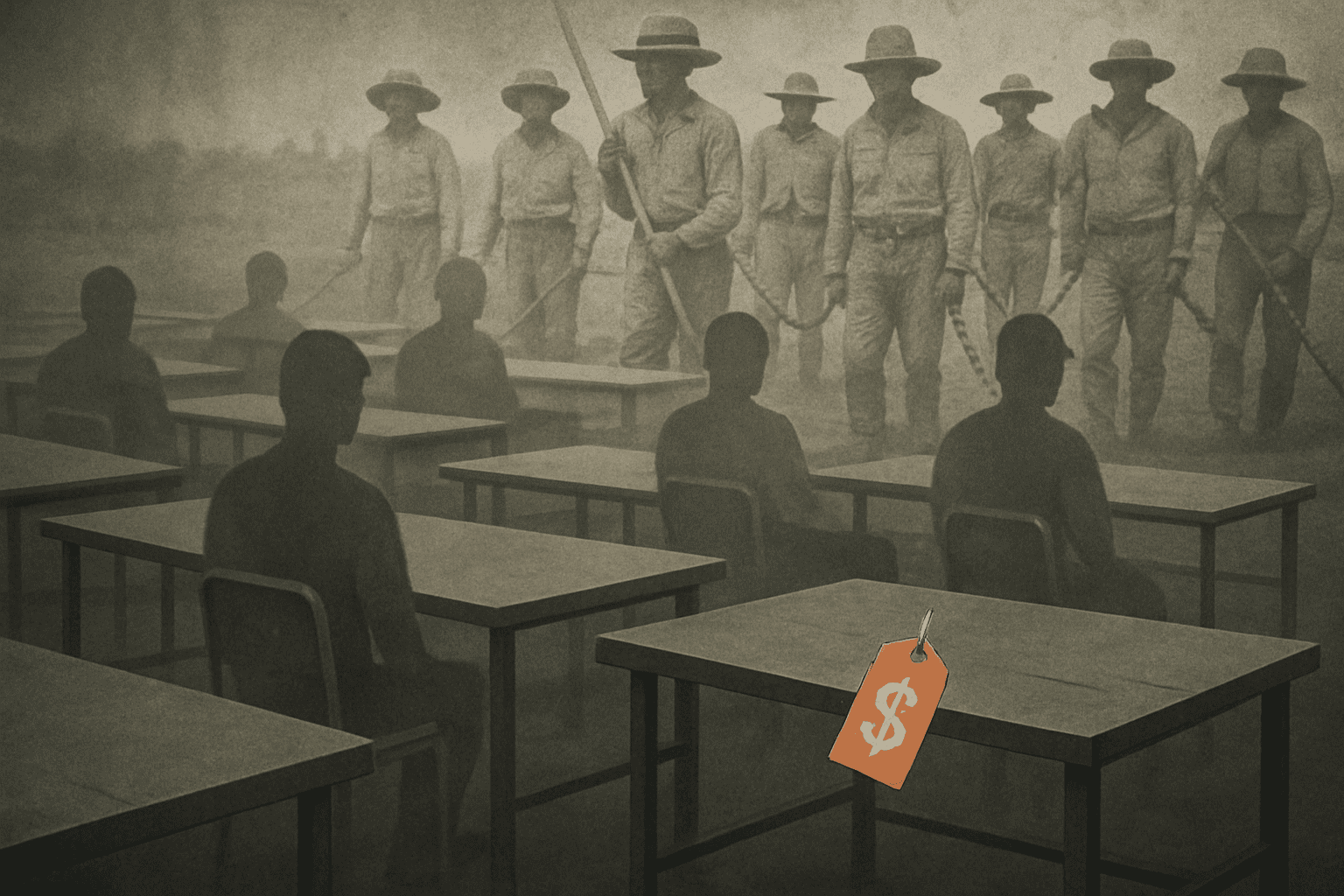
This explainer is based on Prison Labor & Wage Exploitation in Georgia. All statistics and findings are drawn directly from this source.
Executive Summary
- Georgia is one of seven states that pay incarcerated workers nothing for regular prison jobs — kitchen labor, laundry, janitorial, groundskeeping, facility maintenance, and construction. There is no state statute requiring compensation, and GDC has no published pay scale for regular work assignments.
- The state’s zero-wage policy suppresses per-prisoner costs to approximately 39% of the national average. Georgia spends $27,664–$31,489 per person against a national average of $33,274. If the state paid federal minimum wage for currently unpaid work, the corrections budget would need to increase by an estimated $180–400+ million annually.
- Georgia Correctional Industries (GCI) employs approximately 1,000 people daily who produce over 39 million meals annually, process 3.25 million pounds of meat, and work 12,700 acres of farmland — all without compensation. GCI deposits 75% of its profits into the State’s General Fund.
- The zero-wage policy creates a closed-loop extraction system. The state compels free labor, fails to adequately provide for basic needs, then extracts $18.76 million in commissary profit (2024) — projected to exceed $60 million annually after November 2025 price increases of 30% — from families forced to fill the gap at markups of 67% to 1,150% above retail.
- Eight states have removed slavery exception language from their constitutions since 2018. Georgia has taken no action. The state constitution (Article I, Section 1, Paragraph XXII) still explicitly permits involuntary servitude as criminal punishment.
Key Takeaway: Georgia compels tens of thousands of people to work for zero compensation, saves hundreds of millions in labor costs, and then extracts tens of millions more from their families through commissary markups — a system that eight other states have begun to dismantle.
Fiscal Impact
Current Budget Context
Georgia’s FY 2025 GDC budget is $1.48 billion for approximately 47,000–53,500 incarcerated people. The state’s per-person spending of $27,664–$31,489 falls significantly below the national average of approximately $33,274. According to the NAACP and prison reform advocates, Georgia’s cost per prisoner is approximately 39% of the national average — a gap directly attributable to the state’s reliance on unpaid labor.
Value of Unpaid Labor
If Georgia has approximately 47,000 incarcerated people and even half (23,500) work an average of 6 hours per day, 250 days per year, at the federal minimum wage of $7.25/hour, the value of that labor would be approximately $256 million per year. At Georgia’s state minimum wage of $5.15/hour, it would still exceed $180 million. These estimates are conservative — many people work longer hours, and the actual economic value of output (meals served, goods manufactured, acres farmed) likely exceeds minimum-wage calculations.
Revenue Streams from the Incarcerated Population
| Revenue Stream | Estimated Annual Value |
|---|---|
| Commissary profit (2024 baseline) | $18.76 million |
| Commissary profit (post-Nov 2025 increase) | $60+ million (projected) |
| Value of unpaid labor (at federal minimum wage) | $200–400+ million (estimated) |
| GCI revenue (ZoomInfo estimate, likely understated) | ~$5 million |
County-Level Fiscal Impact
The Muscogee County Prison saves Columbus, Georgia approximately $17 to $20 million annually through prison labor paid at approximately $3 per day or nothing. The Columbus Public Works Department alone saves approximately $140,000 per week — over $7.2 million annually — from prison labor.
Cost of Reform
Implementing even minimum wage for currently unpaid work would require an estimated $180–400+ million in additional annual corrections spending. However, this figure must be weighed against the current extraction from families: nationally, families spend $5.6 billion annually on commissary, phone calls, and basic necessities. Georgia families with an incarcerated member spend a median of $172/month (roughly 6% of household income) on direct support, averaging $4,200/year in direct out-of-pocket costs.
Key Takeaway: Georgia’s zero-wage prison labor policy saves the state an estimated $180–400+ million annually in labor costs while shifting an average of $4,200/year in direct costs onto each incarcerated person’s family.
Key Findings
Georgia’s Zero-Wage Policy
Georgia is one of approximately seven states that pay incarcerated workers nothing for regular prison jobs. The others include Alabama, Arkansas, Florida, Mississippi, South Carolina, and Texas. All regular work assignments — kitchen labor, laundry, janitorial, groundskeeping, facility maintenance, construction — are unpaid. There is no state statute requiring any compensation.
The Scale of Unpaid Labor
Georgia Correctional Industries (GCI), a public corporation owned by the State, employs approximately 1,000 incarcerated workers daily across three divisions:
- Food Service: Over 39 million meals annually; meat processing of 3.25 million pounds of beef and chicken per year; average monthly food distribution valued at $1.8 million; GCI produces over 40% of food items used in prisoner menus
- Agribusiness: 12,700 acres across multiple facilities including 1,200 head of beef cattle, a 450-sow pork operation, dairy operations, and row crops
- Manufacturing: Office furniture, road signs, garments, license plates, shoes, mattresses, cleaning chemicals, eyeglasses, and more
By statute, GCI retains 25% of its profits for employee bonuses (for GDC staff, not incarcerated workers) and self-investment, with the remainder going to the State’s General Fund.
Coercion, Not Choice
Nationally, 76% of incarcerated workers report being required to work or face punishment. In Georgia, refusal to work triggers:
- Solitary confinement
- Loss of visitation privileges
- Denial of commissary access
- Denial of good time credits — directly extending time served
- Denial of parole — the Georgia Parole Board considers work history
- Transfer to harsher facilities
The Georgia Parole Board’s consideration of work history in parole decisions means that refusing to work for free can directly extend a person’s sentence.
National Context
Approximately 800,000 incarcerated people work in state and federal prisons nationally, producing more than $2 billion per year in goods and more than $9 billion per year in services. Only 1% of state correctional budgets goes to incarcerated worker wages. Average wages nationally range from $0.13 to $0.52 per hour in states that pay anything — representing 1.8% to 7.2% of the federal minimum wage. In Georgia, the rate is 0%.
Even in states that pay, 70% of surveyed incarcerated workers reported they could not afford basic necessities. Deductions for taxes, court costs, “room and board,” and fees can take up to 80% of gross wages. Prison wages have actually declined over time: the average maximum daily wage fell 27% from $4.73 in 2001 to $3.45.
The Commissary Extraction Loop
GPS documented $18.76 million in commissary profit extracted by GDC in 2024. Following a 30% average price increase in November 2025, projected annual extraction exceeds $60 million. Commissary prices carry markups of 67% to 1,150% above retail. GPS documented 153 items where vendor prices dropped but GDC maintained or raised prices, pocketing an estimated $420,000 in additional profit from price manipulation alone.
Racial Disproportionality
Black Georgians make up approximately 60% of the state’s incarcerated population but only 31% of the overall state population. The unpaid labor force in Georgia prisons is disproportionately Black, performing work that directly descends from the convict lease system (1866–1908), which itself was designed as a continuation of chattel slavery. Black family members average $2,256/year on prison visit travel alone, compared to $1,703 overall.
The 2010 Georgia Prison Strike
On December 9, 2010, people incarcerated in at least seven Georgia state prisons launched what was then the largest prison work stoppage in U.S. history, lasting six days. The strikers issued nine demands including living wages, decent healthcare, nutritional meals, and access to families. Every one of these demands remains unmet as of 2026. GDC responded with lockdowns, tactical squads with assault weapons, pepper spray, tear gas, and physical beatings — including reports of guards beating people with hammers. Seven prison guards were arrested in February 2011 for assaulting people during or after the strike.
Key Takeaway: Georgia compels labor through a system where refusal can extend a person’s sentence, extracts hundreds of millions in economic value, pays nothing in return, and then profits again through commissary markups on families forced to fill the gap — a system that disproportionately impacts Black Georgians.
Comparable States
States That Have Removed Slavery Exceptions
As of early 2026, eight states have removed the slavery/involuntary servitude exception from their state constitutions:
| State | Year | Notes |
|---|---|---|
| Colorado | 2018 | First state to act |
| Utah | 2020 | |
| Nebraska | 2020 | |
| Alabama | 2022 | Has not yet implemented prison wages; litigation continues |
| Oregon | 2022 | |
| Tennessee | 2022 | |
| Vermont | 2022 | |
| Nevada | 2024 |
California attempted to join this list in 2024 with Proposition 6, which would have banned forced prison labor, but voters rejected it. California Democrats have announced they will reintroduce the measure (ACA 6) for 2026.
States With Zero-Wage Policies
Georgia is one of approximately seven states that pay nothing for regular prison jobs: Alabama, Arkansas, Florida, Georgia, Mississippi, South Carolina, and Texas. Notably, Alabama has removed its constitutional slavery exception but has not yet implemented wages.
National Wage Landscape
In states that do pay:
– Average minimum daily wage for non-industry prison jobs: $0.86/day (down from $0.93 in 2001)
– Average maximum daily wage: $3.45/day (down from $4.73 in 2001)
– At least seven states appear to have lowered their maximum wages since 2001
– South Carolina eliminated wages for most regular prison jobs entirely since 2001
Federal Reform Efforts
Georgia Congresswoman Nikema Williams (D-GA) co-sponsors the federal Abolition Amendment alongside Senator Jeff Merkley (D-OR), which would revise the 13th Amendment to eliminate the punishment exception entirely. The amendment requires ratification by 38 states to take effect.
Key Takeaway: Eight states have already removed slavery exceptions from their constitutions, and Georgia’s zero-wage policy places it in the company of only six other states — all in the Deep South — that pay incarcerated workers nothing.
Policy Recommendations
1. State Constitutional Amendment to Remove the Slavery Exception
Following the model of Colorado (2018), Alabama (2022), Nevada (2024), and five other states, the General Assembly should place a ballot measure before voters to remove the involuntary servitude exception from Article I, Section 1, Paragraph XXII of the Georgia Constitution. This requires a two-thirds vote in both chambers to place on the ballot.
2. Statutory Minimum Compensation for Prison Labor
The General Assembly should pass legislation requiring minimum compensation for all prison work assignments. Several states that still have the slavery exception have nonetheless implemented pay scales. A phased approach could begin with GCI workers who produce goods for state revenue and extend to all work assignments over a defined timeline. Revenue from GCI production could partially fund compensation.
3. Extend Occupational Safety Protections
Georgia should extend OSHA-equivalent occupational safety protections to incarcerated workers through state legislation, as advocated by Rep. Spencer Frye. Currently, incarcerated workers are not classified as “employees” under Georgia law unless working for private gain, meaning they lack workplace safety protections, workers’ compensation, and overtime protections.
4. Commissary Price Transparency and Markup Caps
The General Assembly should require GDC to publish vendor costs alongside commissary prices and cap markups at a reasonable percentage above wholesale. The current system of markups ranging from 67% to 1,150% above retail — imposed on families of people who earn nothing — functions as a regressive tax on some of the state’s most economically vulnerable households.
5. Mandate Inmate Welfare Fund Transparency
Require GDC to publish annual, itemized Inmate Welfare Fund receipts and expenditures. GDC has resisted transparency on how commissary profits are spent. Legislation should mandate quarterly public reporting of all funds collected from incarcerated people and their families, including commissary revenue, phone/tablet charges, and medical co-pays.
6. Independent Audit of GCI Operations
Direct the Georgia Department of Audits and Accounts to conduct an independent audit of Georgia Correctional Industries, including total economic value of production (goods, food, agricultural output), labor hours by assignment, and the distribution of GCI profits between the General Fund and staff bonuses.
7. Parole Board Work History Policy Reform
The Georgia State Board of Pardons and Paroles should be directed to cease using prison work history as a factor in parole decisions where work is uncompensated. Using unpaid work participation as a parole criterion transforms nominally voluntary labor into coerced labor by threatening extended incarceration for refusal.
Key Takeaway: Seven specific, actionable reforms — from constitutional amendment to commissary transparency — could begin to dismantle Georgia’s zero-wage extraction system while improving fiscal accountability and aligning the state with the national reform trajectory.
Read the Source Document
This analysis is based on Prison Labor & Wage Exploitation in Georgia, a GPS Investigative Research Brief published February 2026.
📄 Read the full source document (PDF)
Other Versions
This analysis is also available in versions tailored for different audiences:
- 📢 Public Version — Written for general audiences, community organizations, and advocates
- 📰 Media Version — Formatted for journalists, editors, and newsrooms
Sources & References
- The New South and the New Slavery: Convict Labor in Georgia. New Georgia Encyclopedia (2026-01-01) Academic
- Slavery by Another Name: Forced Labor in Georgia Prisons. Georgia Prisoners’ Speak (2025-12-01) GPS Original
- Georgia’s Prison Commissary Extortion: Convenience Store Rejects Sold at Premium Prices for $47 Million. Georgia Prisoners’ Speak (2025-11-01) GPS Original
- California Democrats Revisit Anti-Slavery Ballot Measure. End Family Members’ Re-entry Now (2025-02-01) Journalism
- Carceral Employment Opportunities or Modern-Day Slavery? — Spencer Frye. Rep. Spencer Frye (2025-02-01) Legislation
- The direct financial costs of having a family member incarcerated — Baker et al.. Science Advances (2025-01-01) Academic
- We Can’t Afford It: Mass Incarceration and the Family Tax. FWD.us, Duke University, NORC (2025-01-01) Official Report
- Georgia Criminal Legal Systems Budget Primer for State Fiscal Year 2025. Georgia Budget and Policy Institute (2024-08-01) Official Report
- Voters in 4 states reject slavery, involuntary servitude as punishment for crime. PBS NewsHour (2022-11-09) Journalism
- Labor Day 2022: Georgia’s Correctional Control and Carceral Abuse Hurt All Workers. Georgia Budget and Policy Institute (2022-09-06) Official Report
- Captive Labor: Exploitation of Incarcerated Workers — ACLU and Global Human Rights Clinic. ACLU and University of Chicago Law School Global Human Rights Clinic (2022-06-01) Official Report
- Georgia Correctional Industries Fact Sheet (2019, 2020). Digital Library of Georgia (2020-01-01) Official Report
- How much do incarcerated people earn in each state?. Prison Policy Initiative (2017-04-10) Official Report
- Do Prison Strikes Work?. The Marshall Project (2016-09-21) Journalism
- Georgia 2010 Work Stoppages. Perilous Chronicle (2010-12-09) Journalism
- Georgia Prison Strike: A Hidden Labor Force Resists. In These Times (2010-12-01) Journalism
- 2010 Georgia prison strike. Wikipedia Academic
- Constitution of the State of Georgia, Article I, Section 1, Paragraph XXII. Justia Legal Document
- End the Exception Campaign. End the Exception Data Portal
- GA Rules and Regulations, Subject 300-9-1, Prison Industry Enhancement Certification Program. Georgia Secretary of State Legal Document
- Georgia Correctional Industries — Operations. Georgia Correctional Industries Official Report
- Georgia Correctional Industries, Georgia Department of Corrections. Georgia Department of Corrections Official Report
- Georgia, USA, inmates strike for prison reform. Global Nonviolent Action Database Academic
- GPS Research Library. Georgia Prisoners’ Speak GPS Original
- Penal labor in the United States. Wikipedia Academic
- Prison Wages Appendix — Pay scales and policies. Prison Policy Initiative Data Portal
Source Document
You just read about people suffering in state custody. The least you can do is make sure other people read it too. Share this story.