This explainer is based on Prison Labor & Wage Exploitation in Georgia. All statistics and findings are drawn directly from this source.
News Lead
Georgia operates one of the most exploitative prison labor systems in the country, compelling people to work in kitchens, farms, factories, and on road crews for zero pay — then charging their families markups of 67% to 1,150% on basic necessities through the prison commissary. The state is one of only seven that pay incarcerated workers nothing for regular prison jobs.
A new investigative research brief from Georgia Prisoners’ Speak documents a closed-loop extraction system in which approximately 1,000 workers in Georgia Correctional Industries alone produce over 39 million meals annually, process 3.25 million pounds of meat, and farm 12,700 acres — all without compensation. The state’s corrections system extracted $18.76 million in commissary profit in 2024, a figure projected to exceed $60 million annually after a 30% average price increase imposed in November 2025.
Eight states have removed slavery exception language from their constitutions since 2018. Georgia, where Black residents make up 60% of the incarcerated population but only 31% of the state population, has taken no action. The state’s constitution still explicitly permits involuntary servitude as criminal punishment.
Key Takeaway: Georgia compels incarcerated people to work for nothing, then extracts tens of millions more from their families through inflated commissary prices — a system that disproportionately harms Black Georgians.
Quotable Statistics
The Zero-Wage System
– Georgia is one of approximately seven states that pay incarcerated workers nothing for regular prison jobs. The others: Alabama, Arkansas, Florida, Mississippi, South Carolina, and Texas.
– Georgia Correctional Industries employs approximately 1,000 incarcerated workers daily across manufacturing, food service, and agribusiness — all unpaid.
– GCI produces over 39 million meals annually, processes 3.25 million pounds of beef and chicken per year, and manages 12,700 acres of farmland.
– GCI produces over 40% of the food items used in prisoner menus.
– Average monthly food distribution from GCI is valued at $1.8 million — over $21.6 million annually.
– By statute, GCI retains 25% of its profits for employee bonuses (for GDC staff, not incarcerated workers) and deposits the rest into the State’s General Fund.
The Cost of Free Labor
– Georgia’s cost per prisoner is approximately 39% of the national average, a gap attributed to the state’s reliance on unpaid labor.
– Georgia’s FY 2025 GDC budget is $1.48 billion for approximately 47,000–53,500 people, translating to roughly $27,664–$31,489 per person — compared to the national average of approximately $33,274.
– If Georgia paid federal minimum wage for currently unpaid work, the corrections budget would need to increase by an estimated $200–400+ million annually.
– The Muscogee County Prison saves Columbus, Georgia approximately $17 to $20 million annually through prison labor paid at roughly $3 per day or nothing.
The Commissary Double Extraction
– Commissary prices carry markups of 67% to 1,150% above retail.
– Georgia extracted $18.76 million in commissary profit in 2024.
– After a 30% average price increase in November 2025, projected annual commissary profit exceeds $60 million.
– GPS documented 153 items where vendor prices dropped but GDC maintained or raised prices, pocketing an estimated $420,000 in additional profit from price manipulation alone.
The Family Burden
– Families spend a median of $172/month (roughly 6% of household income) supporting incarcerated loved ones.
– Average direct out-of-pocket family spending: $4,200/year.
– Total annual costs to families nationally from mass incarceration approach $350 billion.
– Families nationally spend $5.6 billion annually on commissary, phone calls, and basic necessities.
– Black family members average $2,256/year on prison visit travel alone, compared to $1,703 overall.
The Racial Dimension
– Black Georgians make up approximately 60% of the state’s incarcerated population but only 31% of the overall state population.
National Context
– Approximately 800,000 incarcerated people work in state and federal prisons nationwide.
– They produce more than $2 billion in goods and $9 billion in services annually.
– 76% of incarcerated workers report being required to work or face punishment.
– Only 1% of state correctional budgets goes to incarcerated worker wages.
– Average prison wages nationally range from $0.13 to $0.52 per hour — in states that pay anything at all.
– 70% of surveyed incarcerated workers cannot afford basic necessities on prison wages.
The 2010 Strike
– In December 2010, people in at least 7 Georgia prisons launched a 6-day work stoppage — then the largest in U.S. history.
– Strikers issued 9 demands. None have been met as of 2026.
– 7 prison guards were arrested in February 2011 for assaulting people during or after the strike.
Reform Movement
– Eight states have removed slavery exceptions from their constitutions since 2018. Georgia has taken no action.
Key Takeaway: Every statistic tells the same story: Georgia forces people to work for free, fails to meet their basic needs, then profits again when families pay inflated prices to fill the gap.
Context and Background
What reporters need to know:
The legal foundation: Georgia’s constitution (Article I, Section 1, Paragraph XXII) explicitly permits involuntary servitude as punishment for crime, mirroring the 13th Amendment’s exception clause. This provides the legal architecture for the state to compel labor without any obligation to pay.
The coercion mechanism: Prison labor in Georgia is not voluntary. People who refuse to work face solitary confinement, loss of visitation privileges, denial of commissary access, denial of good time credits, denial of parole, and transfer to harsher facilities. The Georgia Parole Board considers work history in parole decisions — meaning refusing to work for free can directly extend time served.
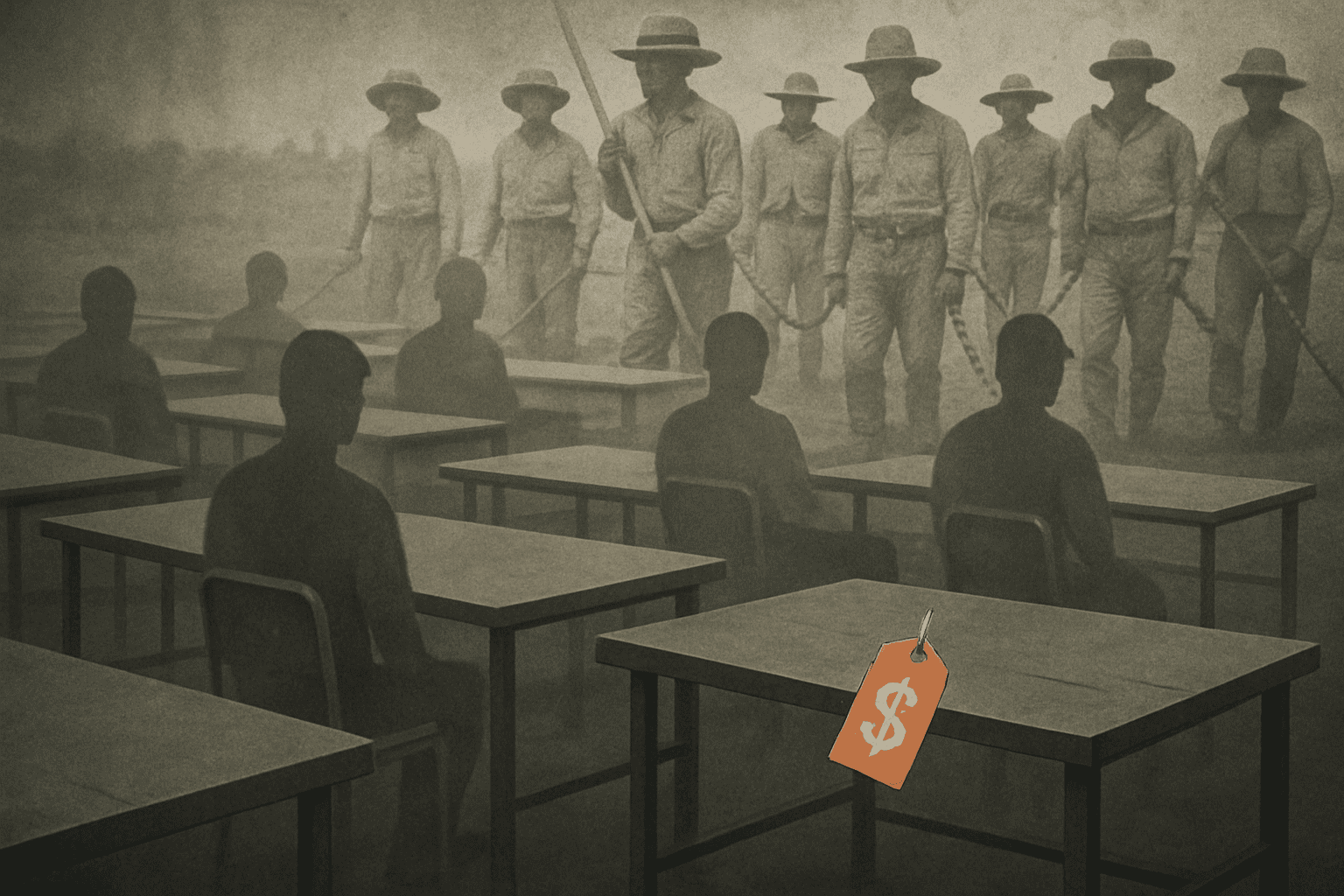
The historical lineage: Georgia’s prison labor system descends directly from the convict lease system (1866–1908) and chain gangs (1908–1943), both of which were explicitly designed to continue the extraction of labor from Black Georgians after the formal abolition of slavery. The Georgia Budget and Policy Institute has stated that Georgia’s current system “maintains much of the same captive labor and treatment towards incarcerated Georgians” as those earlier systems.
The legal void: Incarcerated workers have no minimum wage coverage under the FLSA, no OSHA workplace safety protections, no right to unionize under the NLRA, and no access to workers’ compensation. Courts have ruled the prison-worker relationship is “primarily penological,” not economic.
The 2026 window: Governor Kemp is term-limited. The 2026 gubernatorial race, combined with the September 2024 DOJ report finding unconstitutional conditions in Georgia prisons and Kemp’s proposed $600 million emergency prison spending plan, creates a significant moment of political accountability on this issue.
GPS’s unique position: Georgia Prisoners’ Speak has separately documented both sides of this system — the commissary price-gouging and the zero-wage labor policy — and is the first organization to map the complete closed-loop extraction cycle. GPS paid $88,944 in FOIA costs to obtain commissary financial records the state resisted disclosing.
Who to contact for comment: Georgia Department of Corrections; Georgia Correctional Industries; Georgia Budget and Policy Institute; Rep. Spencer Frye (who has written on carceral employment); Congresswoman Nikema Williams (co-sponsor of the federal Abolition Amendment); the End the Exception campaign; ACLU National Prison Project.
Key Takeaway: Georgia’s zero-wage prison labor system is legally enabled by a slavery exception in the state constitution, enforced through punishments that can extend sentences, and rooted in a direct historical lineage from convict leasing.
Story Angles
1. “The $60 Million Tax on Prisoners’ Families”
Georgia forces incarcerated people to work for free, then charges their families markups as high as 1,150% on commissary items to meet the needs the state refuses to provide. With projected commissary profits now exceeding $60 million annually after a 30% price hike in November 2025, this story follows the money from unpaid labor through commissary extraction to the families — predominantly Black, predominantly low-income, predominantly women — who bear the cost. GPS has the financial data, the price comparisons, and the documentation of 153 items where the state pocketed vendor savings instead of passing them on.
2. “Fifteen Years, Zero Reforms: The Forgotten Georgia Prison Strike”
In December 2010, people in seven Georgia prisons launched the largest prison work stoppage in U.S. history. They issued nine demands, including a living wage and decent healthcare. The state responded with tactical squads, beatings, and lockdowns. Seven guards were later arrested for assaulting people in custody. Fifteen years later, every one of the nine demands remains unmet. Meanwhile, eight other states have removed slavery exceptions from their constitutions. This story examines what happened, what didn’t, and why Georgia remains among the last holdouts.
3. “Georgia’s Hidden Workforce: The Economics of Zero-Dollar Labor”
Georgia Correctional Industries employs approximately 1,000 people daily who produce 39 million meals, process 3.25 million pounds of meat, farm 12,700 acres, and manufacture everything from license plates to furniture — for zero compensation. The Muscogee County Prison alone saves Columbus $17 to $20 million per year. Georgia’s per-prisoner cost runs at 39% of the national average. This story quantifies the total economic value of unpaid prison labor in Georgia and asks: who benefits, and at whose expense? The racial dimension — a 60% Black prison population in a 31% Black state — makes this a civil rights story as much as an economic one.
Read the Source Document
The full GPS investigative research brief, Prison Labor & Wage Exploitation in Georgia (February 2026), is available at: [Link to PDF]
For questions, data requests, or to arrange interviews, contact Georgia Prisoners’ Speak at [contact information].
Other Versions
- Public version (plain-language explainer for general audiences): [Link to public version]
- Legislator version (policy brief with reform recommendations): [Link to legislator version]
Sources & References
- The New South and the New Slavery: Convict Labor in Georgia. New Georgia Encyclopedia (2026-01-01) Academic
- Slavery by Another Name: Forced Labor in Georgia Prisons. Georgia Prisoners’ Speak (2025-12-01) GPS Original
- Georgia’s Prison Commissary Extortion: Convenience Store Rejects Sold at Premium Prices for $47 Million. Georgia Prisoners’ Speak (2025-11-01) GPS Original
- California Democrats Revisit Anti-Slavery Ballot Measure. End Family Members’ Re-entry Now (2025-02-01) Journalism
- Carceral Employment Opportunities or Modern-Day Slavery? — Spencer Frye. Rep. Spencer Frye (2025-02-01) Legislation
- The direct financial costs of having a family member incarcerated — Baker et al.. Science Advances (2025-01-01) Academic
- We Can’t Afford It: Mass Incarceration and the Family Tax. FWD.us, Duke University, NORC (2025-01-01) Official Report
- Georgia Criminal Legal Systems Budget Primer for State Fiscal Year 2025. Georgia Budget and Policy Institute (2024-08-01) Official Report
- Voters in 4 states reject slavery, involuntary servitude as punishment for crime. PBS NewsHour (2022-11-09) Journalism
- Labor Day 2022: Georgia’s Correctional Control and Carceral Abuse Hurt All Workers. Georgia Budget and Policy Institute (2022-09-06) Official Report
- Captive Labor: Exploitation of Incarcerated Workers — ACLU and Global Human Rights Clinic. ACLU and University of Chicago Law School Global Human Rights Clinic (2022-06-01) Official Report
- Georgia Correctional Industries Fact Sheet (2019, 2020). Digital Library of Georgia (2020-01-01) Official Report
- How much do incarcerated people earn in each state?. Prison Policy Initiative (2017-04-10) Official Report
- Do Prison Strikes Work?. The Marshall Project (2016-09-21) Journalism
- Georgia 2010 Work Stoppages. Perilous Chronicle (2010-12-09) Journalism
- Georgia Prison Strike: A Hidden Labor Force Resists. In These Times (2010-12-01) Journalism
- 2010 Georgia prison strike. Wikipedia Academic
- Constitution of the State of Georgia, Article I, Section 1, Paragraph XXII. Justia Legal Document
- End the Exception Campaign. End the Exception Data Portal
- GA Rules and Regulations, Subject 300-9-1, Prison Industry Enhancement Certification Program. Georgia Secretary of State Legal Document
- Georgia Correctional Industries — Operations. Georgia Correctional Industries Official Report
- Georgia Correctional Industries, Georgia Department of Corrections. Georgia Department of Corrections Official Report
- Georgia, USA, inmates strike for prison reform. Global Nonviolent Action Database Academic
- GPS Research Library. Georgia Prisoners’ Speak GPS Original
- Penal labor in the United States. Wikipedia Academic
- Prison Wages Appendix — Pay scales and policies. Prison Policy Initiative Data Portal
Source Document
You just read about people suffering in state custody. The least you can do is make sure other people read it too. Share this story.