
Janice Buttrum was seventeen years old when the state of Georgia sentenced her to die. She was abandoned at birth, raised in foster care, sexually abused before her fourteenth birthday, and married at fifteen to a twenty-six-year-old divorced man with a history of substance abuse. In 1981, she joined her husband in the brutal murder of a nineteen-year-old woman at a North Georgia motel. Danny Buttrum hanged himself in custody three days after his wife was sentenced. Janice received the death penalty.
Four decades later, Buttrum is sixty-three years old. She is a great-grandmother who uses a walker and is going blind. She has completed thousands of hours of job training, earned a high school equivalency certificate, taken college courses at Mercer University, and secured a spot in the Honor Dorm at Pulaski State Prison. Her last disciplinary infraction was in 1999 — more than a quarter century ago.
Five times, she has asked the State Board of Pardons and Paroles to let her go home. Five times, the board has said no, issuing nearly identical form letters citing the seriousness of her crime and the amount of time served. The board has never explained what she could do differently. When her attorneys asked for documents showing how the board distinguishes between juvenile and adult offenders — as the U.S. Supreme Court requires — the board responded that it has none.
Now, a federal judge has ruled that the parole process Georgia offered Buttrum may have been a sham all along.
The Ruling
On March 17, 2026, U.S. District Judge Amy Totenberg of the Northern District of Georgia denied the State Board of Pardons and Paroles’ motion to dismiss Buttrum’s lawsuit. In her opinion, Totenberg found that Buttrum’s attorneys had plausibly alleged that Georgia’s parole process for people serving life sentences for crimes committed as juveniles is so hollow it may violate the Eighth Amendment’s prohibition on cruel and unusual punishment. 1
The court’s language was direct: the state cannot dodge constitutional scrutiny by calling a sentence “life with parole” when in practice it functions as life without parole. Judge Totenberg pointed to Buttrum’s own history — five denials since 2017 — alongside broader evidence suggesting that juvenile lifers in Georgia are virtually never released. 2
“If a life-sentenced juvenile offender like Plaintiff has no real chance — however remote — of actually obtaining release on parole, because her parole proceedings are a sham and it is a foregone conclusion that the Board will deny parole, she is effectively serving a sentence of life-without-parole.”
— Judge Amy Totenberg, U.S. District Court for the Northern District of Georgia
The ruling is not a complete victory. Totenberg dismissed a due process claim and a related argument that juvenile offenders are entitled to a meaningful opportunity for release — both blocked by a recent Eleventh Circuit ruling that is itself under challenge. If that ruling is reversed, both claims could be revived. What survived is narrower but significant: the Eighth Amendment claim that Georgia’s parole system, as applied to people who committed crimes as children, is constitutionally deficient.
The case now moves to discovery — a phase that will force the board to produce internal records and testimony about how it actually makes decisions for juvenile lifers. The board has long refused to provide such records, claiming “confidential state secrets” when attorneys and journalists have sought them. 3
The Supreme Court Said Children Are Different. Georgia Didn’t Listen.
The legal foundation of Buttrum’s case rests on a line of U.S. Supreme Court decisions spanning more than two decades — decisions that have fundamentally reshaped how the Constitution treats people who committed crimes as children.
In 2005, Roper v. Simmons struck down the death penalty for juveniles, recognizing that young people’s brains are not fully developed. In 2010, Graham v. Florida extended this reasoning, holding that life without parole is unconstitutional for juveniles convicted of non-homicide offenses. In 2012, Miller v. Alabama banned mandatory life-without-parole sentences for all juveniles, even those convicted of murder. And in 2016, Montgomery v. Louisiana made Miller retroactive, requiring that people already serving such sentences be resentenced or offered parole. 4
The Court’s reasoning across these cases rested on a simple truth: children are constitutionally different from adults. Their lack of maturity, their vulnerability to negative influences, and — critically — their capacity for change mean that sentencing them to die in prison is almost always disproportionate. Only in the rarest cases, involving youth found to be “irreparably corrupt,” could such sentences stand. 5
Georgia’s response to these rulings has been minimal. The state has not changed its juvenile sentencing laws. It has not created guidelines requiring the parole board to consider age, development, or rehabilitation when evaluating juvenile lifers. It has not implemented any process to distinguish children from adults in parole review. Instead, it has relied on the same opaque, discretionary system it uses for everyone else — a system that produces no written explanations, no public hearings, and no accountability.
Nobody Has Come Home
The most damning evidence in Buttrum’s case may be the simplest: not a single person resentenced under the Montgomery decision has been released from a Georgia prison through parole.
A 2023 Atlanta Journal-Constitution investigation found that of eleven people who received new, parole-eligible sentences after the Supreme Court rulings, nine had gone before the Georgia parole board. Every one of them was denied. 6
Judge Totenberg cited this finding directly, noting that it distinguished Georgia from other states. In Florida, the Eleventh Circuit upheld the state’s parole system in part because juvenile lifers were actually being released — roughly one percent per year. Georgia’s total absence of releases, the judge wrote, supports the inference that parole consideration in the state is procedural in name only.
The contrast extends far beyond Florida. Nationally, approximately thirty-five percent of the roughly 2,900 juvenile lifers identified at the time of the Miller decision have been released. Michigan, which had the second-highest number of juvenile lifers, has seen over 180 — more than half — go home. Research from Montclair University found that recidivism rates among released former juvenile lifers in Philadelphia were just 1.14 percent. 7
Georgia leads the nation in the opposite direction. Since 2012, the state has increased its number of juvenile lifers by one hundred percent — sentencing more children to life without parole than any other state — while releasing none of those resentenced under the Supreme Court’s mandate. Eighty-one percent of those sentenced since 2012 are Black.
A System Designed to Say No
Georgia’s parole board operates unlike those in most other states. Its five members are appointed by the governor for staggered seven-year terms and face no elections, no public confirmation hearings, and no requirement to explain their decisions. 8
For people serving sentences shorter than life, the board must follow established guidelines that weigh crime severity and risk of reoffending. For people serving life with the possibility of parole — including juvenile lifers — no such guidelines exist. There are no required criteria, no mandated considerations, and no rules requiring the board to weigh rehabilitation, maturity, or change.
A GPS analysis of 257,180 GDC records revealed the scope of the collapse. The board’s FY 2024 annual report touts 5,443 paroles granted, but thirty-seven percent of current parolees were released within twelve months of their maximum release date. For these thousands of people, “parole” was not early release — it was paperwork on an inevitable outcome. Meanwhile, parole grant rates have plummeted from roughly sixty percent in the 1990s to under five percent today.
The board has quietly extended actual time served by twenty-seven percent over the past decade — not through new legislation, but through changed practice. GPS has called this “shadow sentencing”: a system where unelected officials add years to sentences without any legislative action, public debate, or judicial oversight. 9
For juvenile lifers, the consequences are even starker. The board does not hold hearings. Decisions are made through administrative review of case files — no testimony, no opportunity for the incarcerated person to speak, no public record of deliberation. When Buttrum’s attorneys asked the board to produce any documents demonstrating how it has implemented the Supreme Court’s command to treat juvenile offenders differently from adults, the board twice responded: it has none.
Judge Totenberg found this troubling, writing that a system permitting the board to act with “zero accountability” could easily become a mechanism for automatic denial regardless of how much a person has changed.
Buttrum’s Story: From Foster Care to Death Row to Parole Limbo
The details of Janice Buttrum’s life before prison read like a case study in the kind of childhood trauma the Supreme Court has said must be considered when evaluating juvenile offenders.
She was abandoned at birth and raised by foster parents in conditions described by teachers and social workers as the worst neglect they had ever seen. Before turning fourteen, she had run away from home and endured physical and sexual abuse. At fifteen, she returned to one of her original foster parents, where she met Danny Buttrum — a twenty-six-year-old divorced father of two with a substance abuse history. They married within a month. 10
In 1981, the couple killed nineteen-year-old Demetra Parker at a motel in Dalton, Georgia. The crime was horrific — Parker was raped, sodomized, and stabbed ninety-seven times. Janice Buttrum was sentenced to death. Danny Buttrum also received a death sentence but hanged himself in custody three days after his wife was sentenced.
Over the following decades, Buttrum’s sentence was revised multiple times to reflect evolving constitutional law. In 1991, after a federal habeas review, she was resentenced to life without parole. In 2017, following the Montgomery decision requiring retroactive application of Miller, she was resentenced to life with the possibility of parole. The local district attorney’s office consented to the sentence reduction.
On paper, it was a chance at freedom. In practice, it has been no such thing.
Mark Loudon-Brown, an attorney with the Southern Center for Human Rights who represented Buttrum in the appellate process, described the transformation his client has undergone: four decades of self-improvement, education, disciplinary compliance, and personal growth — all met with form-letter denials from a board that never explains what more she could do.
Georgia’s Parole Problem Is Bigger Than One Case
Buttrum’s lawsuit is one of two federal cases currently challenging Georgia’s parole board. Together, they represent the most significant legal tests of whether a state can offer parole on paper while making release functionally impossible.
The stakes extend far beyond eleven resentenced juvenile lifers. Georgia’s parole crisis affects tens of thousands of people. The state incarcerates 881 people per 100,000 residents — the seventh highest rate in the nation, higher than any country in the world except El Salvador. Over 12,900 people in Georgia’s prisons are aged fifty or older, costing taxpayers dramatically more to incarcerate while posing minimal public safety risk. 11
The DOJ found reasonable cause to believe Georgia prisons violate the Eighth Amendment through unconstitutional conditions — with 142 homicides between 2018 and 2023, staffing shortages leaving facilities at half capacity, and gang-controlled dorms where violence is a daily reality. 12
Within this broader crisis, the parole board’s refusal to release people who have served decades and demonstrated rehabilitation is not merely unjust — it is a driver of the crisis itself. Overcrowding fuels violence. Hopelessness fuels despair. When people who have done everything the system asks of them are told it will never be enough, the message reaches every person behind those walls: nothing you do matters.
What Happens Next
The Buttrum case now enters discovery. For the first time, a federal court will compel the Georgia parole board to produce records about how it makes decisions for juvenile lifers — records the board has fought to keep secret for years.
For Buttrum herself, now sixty-three and in declining health, the ruling does not mean freedom. It means that a court will examine whether the promise made to her in 2017 — that she would have a genuine opportunity for release — was ever intended to be kept.
The broader implications are significant. If the court ultimately finds that Georgia’s parole system violates the Eighth Amendment as applied to juvenile lifers, it could require the state to create meaningful parole standards — written criteria, genuine hearings, and consideration of the factors the Supreme Court has said must matter: youth, development, and capacity for change.
Sixteen states and the District of Columbia have already banned juvenile life without parole entirely. Georgia has moved in the opposite direction, sentencing more children to die in prison since 2012 than any other state. Now, a federal court will determine whether the promise of parole the state offers in their place is real — or whether it was always a sentence of death by another name.
Call to Action: What You Can Do
Georgia has sentenced more children to die in prison than any other state since 2012, while releasing exactly zero through parole. A federal judge now says this may be unconstitutional. If you believe children deserve a chance at redemption, sharing this investigation is the bare minimum.
Spread the Word — It Takes 15 Seconds
Awareness without action changes nothing. Here’s how you can help push for accountability and real reform:
Join the GPS Advocacy Network — Sign up at https://gps.press/become-an-advocate/ and we’ll advocate on your behalf every week. GPS identifies your state legislators, crafts personalized letters on the most pressing prison issues, and sends them directly to the representatives who represent you. You receive a copy of every letter. It takes two minutes to sign up — we handle the rest.
Tell My Story — Are you or a loved one affected by Georgia’s prison system? GPS publishes first-person accounts from incarcerated people and their families. Submit your story at https://gps.press/category/tellmystory/ and help the world understand what’s really happening behind the walls.
Contact Your Representatives — Your state legislators control GDC’s budget, oversight, and the laws that created these failures. Find your Georgia legislators at https://gps.press/find-your-legislator/ or call Governor Kemp at (404) 656-1776 or the GDC Commissioner at (478) 992-5246.
Demand Media Coverage — Contact newsrooms at the AJC, local TV stations, and national criminal justice outlets. More coverage means more pressure.
Amplify on Social Media — Share this article and tag @GovKemp, @GDC_Georgia, and your local representatives. Use #GAPrisons, #PrisonReform, #GeorgiaPrisonerSpeak.
File Public Records Requests — Georgia’s Open Records Act gives every citizen the right to request incident reports, death records, staffing data, medical logs, and financial documents at https://georgiadcor.govqa.us/WEBAPP/_rs/SupportHome.aspx.
Attend Public Meetings — The Georgia Board of Corrections and legislative committees hold public meetings. Your presence is noticed.
Contact the Department of Justice — File civil rights complaints at https://civilrights.justice.gov. Federal oversight has forced abusive systems to change before.
Support Organizations Doing This Work — Donate to or volunteer with Georgia-based prison reform groups fighting for change on the ground.
Vote — Research candidates’ positions on criminal justice. Primary elections often determine outcomes in Georgia.
Contact GPS — If you have information about conditions inside Georgia’s prisons, reach us securely at GPS.press.
Further Reading
The Illusion of Parole: A Comprehensive Analysis of Georgia’s Parole System
GPS analysis of 257,180 GDC records reveals how Georgia’s parole board has quietly transformed parole from early release into a rubber stamp on inevitable outcomes.
Let Them Go Home: Georgia Spends Its Most Expensive Dollars on the People Least Likely to Reoffend
Why Georgia continues to incarcerate thousands of elderly prisoners who pose virtually no public safety risk at enormous taxpayer expense.
Every Door Locked: Innocent People Trapped in Georgia Prisons
How Georgia’s interlocking legal barriers prevent incarcerated people from challenging wrongful convictions — even when new evidence proves their innocence.
Georgia Survivor Justice Act: Guide for Incarcerated DV Survivors
A comprehensive guide to resentencing rights under Georgia’s new Survivor Justice Act for people convicted of offenses connected to domestic violence.
Blackstone Is Dead: Georgia Abandoned American Justice
How Georgia’s post-conviction system has abandoned the foundational principle that it is better to let the guilty go free than to imprison the innocent.
Decarceration IS Inevitable — Georgia Can Choose How, or Let the Courts Decide
The case for proactive prison population reduction before federal courts force Georgia’s hand.
Research Explainers
GPS Research Explainers distill complex data and legal research into accessible briefings. These explainers are directly relevant to the issues covered in this article:
Georgia’s Parole System: Denial Rates, Life Sentences & Fiscal Impact
GPS Research Library analysis of parole grant rates, the collapse of meaningful early release, and the fiscal consequences of Georgia’s shadow sentencing system.
The Unconstitutional Suspension of Habeas Corpus in Georgia
How Georgia’s post-conviction barriers — including habeas corpus deadlines and parole secrecy — create an interlocking system that traps people in prison even when the law demands their release.
Explore the Data
GPS makes GDC statistics accessible to the public through several resources:
- GPS Statistics Portal — Interactive dashboards translating complex GDC reports into accessible formats, updated within days of official releases.
- GPS Lighthouse AI — Ask questions about Georgia’s prison system and get answers drawn from GPS’s investigative archive and data analysis.
- Machine-Readable Pages for Researchers — GPS maintains AI-optimized pages for data analysis:
- AI Content Index — https://gps.press/ai-index/
The AI Content Index has links to numerous machine readable pages, but this is all that is needed by an AI to fully understand all the data. You can learn more about using GPS Data with AI in are article on the topic:
How to Use GPS Data with AI Tools (https://gps.press/how-to-use-gps-data-with-ai-tools/)
A step-by-step guide showing researchers, advocates, families, and journalists how to use GPS’s machine-readable data pages with AI tools like ChatGPT, Claude, and Gemini to analyze Georgia prison conditions, statistics, and policy.
Contact GPS at media@gps.press for access to underlying datasets used in this analysis.
About Georgia Prisoners’ Speak (GPS)
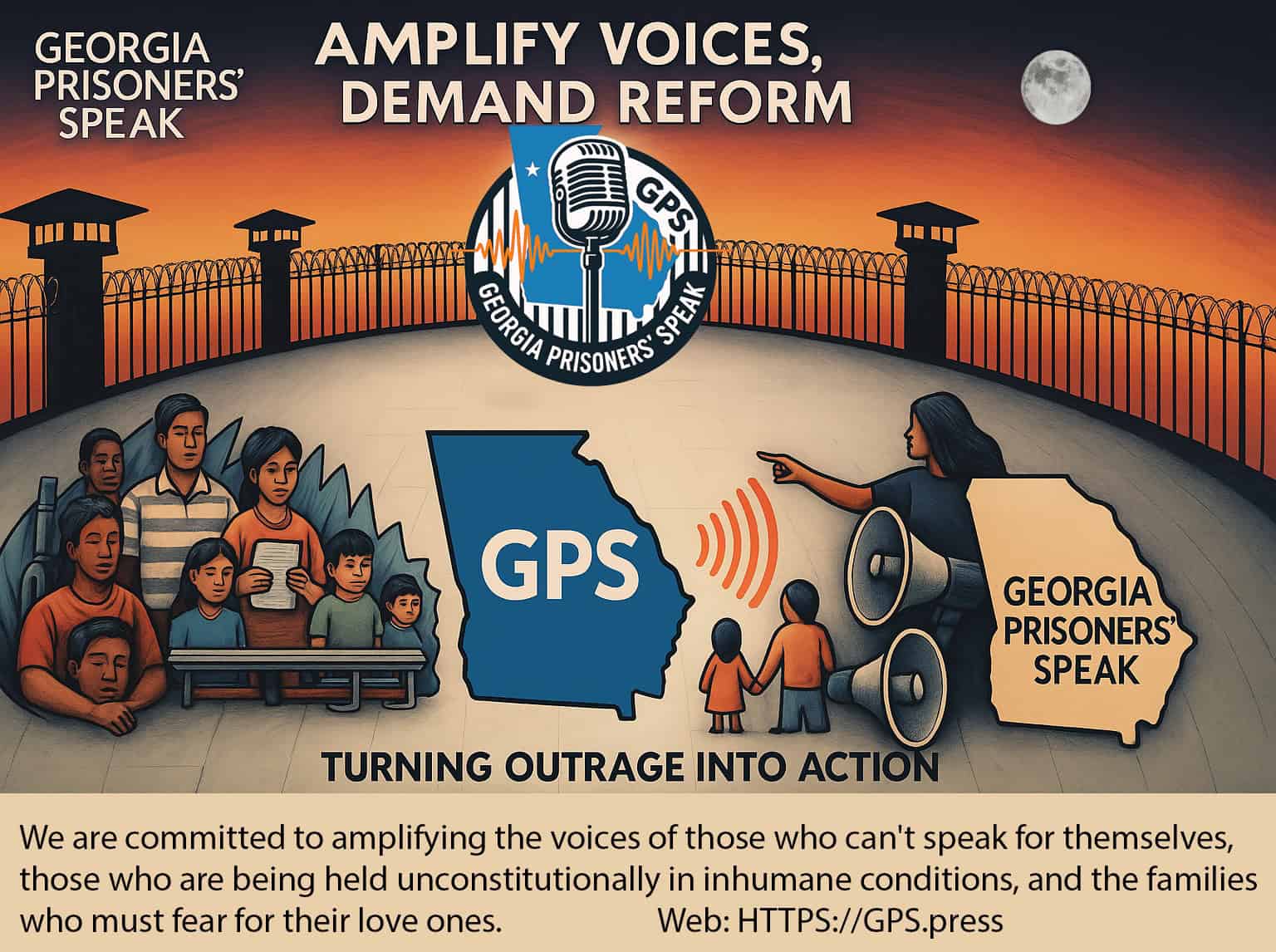
Georgia Prisoners’ Speak (GPS) is a nonprofit investigative newsroom built in partnership with incarcerated reporters, families, advocates, and data analysts. Operating independently from the Georgia Department of Corrections, GPS documents the truth the state refuses to acknowledge: extreme violence, fatal medical neglect, gang-controlled dorms, collapsed staffing, fraudulent reporting practices, and unconstitutional conditions across Georgia’s prisons.
Through confidential reporting channels, secure communication, evidence verification, public-records requests, legislative research, and professional investigative standards, GPS provides the transparency the system lacks. Our mission is to expose abuses, protect incarcerated people, support families, and push Georgia toward meaningful reform based on human rights, evidence, and public accountability.
Every article is part of a larger fight — to end the silence, reveal the truth, and demand justice.
Footnotes
- Buttrum v. Herring, U.S. District Court for the Northern District of Georgia, Case No. 1:25-cv-01116-AT, March 2026 [↩]
- AJC reporting on Buttrum ruling, March 24, 2026, https://www.ajc.com/news/2026/03/federal-judge-questions-georgias-parole-system-lets-womans-lawsuit-proceed/ [↩]
- Courthouse News Service, “Georgia Parole Board Defends Parole Process for Juvenile Lifers,” December 10, 2025, https://www.courthousenews.com/georgia-parole-board-defends-parole-process-for-juvenile-lifers/ [↩]
- Montgomery v. Louisiana, 577 U.S. 190 (2016), https://supreme.justia.com/cases/federal/us/577/190/ [↩]
- Miller v. Alabama, 567 U.S. 460 (2012), https://supreme.justia.com/cases/federal/us/567/460/ [↩]
- AJC Investigation on Georgia Juvenile Lifers, 2023, https://www.ajc.com/sp/news/investigations/juvenile-lifers/ [↩]
- The Sentencing Project, “Still Cruel and Unusual: Extreme Sentences for Youth and Emerging Adults,” 2025, https://www.sentencingproject.org/reports/still-cruel-and-unusual-extreme-sentences-for-youth-and-emerging-adults/ [↩]
- GPS analysis of Georgia’s Parole System, January 2026, https://gps.press/the-illusion-of-parole/ [↩]
- GPS, “Georgia’s Shadow Sentencing System,” December 2025, https://gps.press/georgias-shadow-sentencing-system/ [↩]
- Buttrum v. Herring complaint, Case No. 1:25-cv-01116-AT, filed March 3, 2025 [↩]
- GPS, “Let Them Go Home,” March 2026, https://gps.press/let-them-go-home/ [↩]
- DOJ Findings Report, October 2024, https://www.justice.gov/crt/case/us-v-georgia [↩]