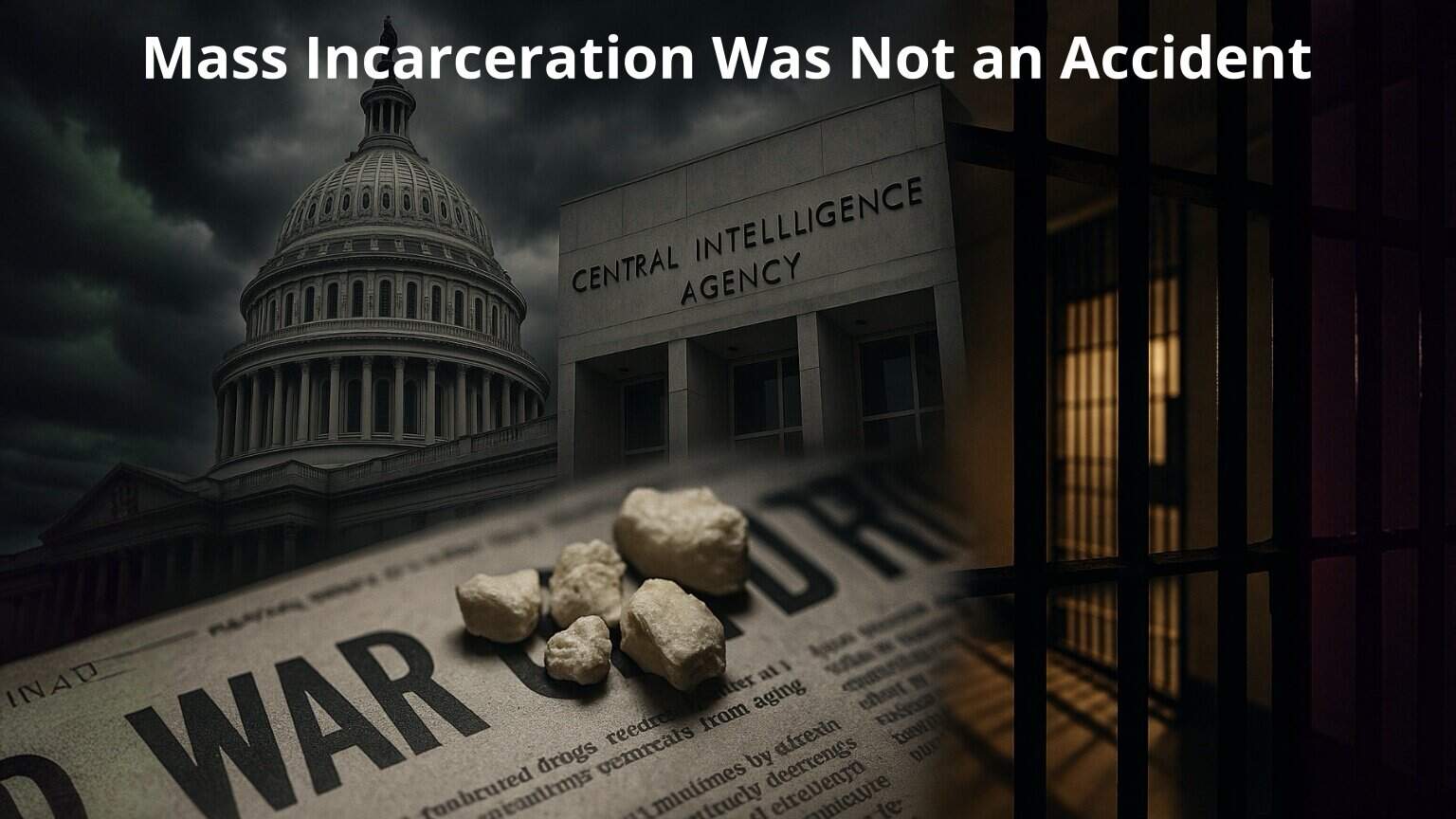
The modern system of mass incarceration in the United States did not arise from a sudden moral collapse, a crime wave that spun out of control, or a failure of individual responsibility. It emerged from policy decisions—made deliberately, repeatedly, and with full awareness of their likely consequences.
For most of the 20th century, incarceration rates in the United States remained relatively stable. That stability ended in the late 1970s. Over the next four decades, the U.S. prison population would increase by more than 500 percent, even as crime rates eventually declined.1 This divergence tells us something essential: mass incarceration was not a response to crime—it was a political project.
At the center of that project was the War on Drugs.
Framed as a necessary response to public danger, the War on Drugs reshaped policing, sentencing, and punishment in ways that fundamentally altered American life. It criminalized addiction, expanded police power, eroded constitutional protections, and normalized extreme punishment. Most importantly, it did so unevenly, concentrating its force on poor communities and communities of color.
This article examines how that war—combined with Cold War foreign policy and domestic political incentives—helped create the conditions for mass incarceration. Not through conspiracy theory, but through documented decisions, tolerated abuses, and a willingness to sacrifice entire communities in pursuit of power, control, and geopolitical advantage.
The War on Drugs: Criminalizing Social Crisis
When President Richard Nixon declared drugs “public enemy number one” in 1971, the United States was already grappling with profound social change. The civil rights movement had exposed the brutality of racial hierarchy. The Vietnam War had eroded trust in government. Economic restructuring was beginning to hollow out urban employment.
Rather than address these challenges directly, the federal government reframed them as a problem of crime and drugs.
Internal White House records and later admissions from Nixon administration officials made clear that the War on Drugs was never solely—or even primarily—about public health. John Ehrlichman, Nixon’s domestic policy chief, would later acknowledge that drug criminalization was used as a tool to target political opponents and Black communities without explicitly naming them. 2
From the beginning, the war emphasized punishment over treatment. Drug use was framed as moral failure rather than medical condition. Law enforcement, not healthcare, became the primary response. Federal funding flowed toward policing, surveillance, and incarceration, while social services withered.
This approach intensified dramatically in the 1980s.
Under the Reagan administration, drug policy shifted from punitive to draconian. Mandatory minimum sentences removed judicial discretion. “Three strikes” laws guaranteed life sentences for repeat offenses. Truth-in-sentencing laws ensured people would serve nearly all of their imposed time. The infamous 100-to-1 sentencing disparity between crack and powder cocaine meant that possession of a drug more common in Black neighborhoods carried penalties exponentially harsher than a chemically similar drug more common in white ones. 3
These policies were not blind to their racial impact. Lawmakers were warned—explicitly—that enforcement would fall hardest on Black communities. They proceeded anyway.
The result was predictable: arrests soared, prison populations exploded, and entire neighborhoods were destabilized. But this was only part of the story. While communities were being aggressively policed at home, something very different was happening abroad.
Iran–Contra, the CIA, and a Tolerated Drug Trade
In the mid-1980s, the United States government was embroiled in a foreign policy scandal that would later become known as the Iran–Contra affair. Senior officials in the Reagan administration secretly approved the sale of weapons to Iran—despite an arms embargo—and diverted the proceeds to fund the Contra rebels fighting the Sandinista government in Nicaragua, in direct violation of Congressional bans. 4
These facts are undisputed.
What received far less attention at the time—and what would later come into sharper focus—was how the Contras and their supporters funded themselves beyond those illegal arms transfers. Investigative reporting and subsequent government reviews revealed that Contra-affiliated individuals and networks were deeply involved in cocaine trafficking throughout the 1980s.
Journalist Gary Webb’s reporting brought national attention to how some of this cocaine was distributed in U.S. cities, particularly in urban areas already suffering from disinvestment. 5His work was initially attacked and discredited, but later investigations—including reviews by the CIA’s own Inspector General—confirmed key elements of his reporting. 6
Those investigations found that U.S. intelligence agencies were aware that Contra-linked groups were involved in drug trafficking. They documented repeated failures to investigate, intervene, or report these activities. In some cases, traffickers received protection or leniency because they were considered valuable to U.S. foreign policy objectives. 7.
What has not been proven—is that the CIA deliberately orchestrated a plan to flood Black neighborhoods with drugs—though many believe precisely that, and not without reason.
What can be stated honestly, based on official records, is this:
The U.S. government knowingly tolerated large-scale drug trafficking by its foreign policy allies, even as it launched an unprecedented domestic war against drugs.
That contradiction lies at the heart of the moral failure that followed.
As cocaine flowed into the United States—regardless of intent or design—the federal government responded not by examining its own role, but by escalating punishment at home. The same state that ignored or enabled trafficking abroad turned its full power on the communities most affected by the resulting drug crisis.
The consequences would be devastating—and enduring.
Crack Cocaine and the Architecture of Racialized Punishment
By the mid-1980s, crack cocaine had spread rapidly through urban neighborhoods already destabilized by decades of segregation, redlining, deindustrialization, and state abandonment. Crack was cheaper than powder cocaine, easier to distribute in small quantities, and far more visible to police. Its emergence was treated not as a public health emergency, but as proof that harsher punishment was needed.
The federal response was swift—and punitive.
In 1986, Congress passed the Anti-Drug Abuse Act, establishing mandatory minimum sentences and creating the now-infamous 100-to-1 sentencing disparity between crack and powder cocaine. 8. Under this law, possession of five grams of crack cocaine triggered the same mandatory minimum sentence as possession of 500 grams of powder cocaine, despite the two substances being pharmacologically similar.
The racial impact was immediate and devastating.
Crack cocaine enforcement was concentrated almost entirely in poor Black neighborhoods, even though studies consistently showed that drug use rates were comparable across racial groups. 9. Powder cocaine—more common in white and wealthier communities—was rarely policed with the same intensity. Prosecutors and lawmakers were warned about these disparities. They moved forward anyway.
This was not accidental enforcement bias. It was policy design.
Mandatory minimums stripped judges of discretion. Prosecutorial power expanded dramatically. Police departments were incentivized to prioritize drug arrests through federal grants and asset forfeiture programs. Militarized policing became normalized, with SWAT teams increasingly deployed for routine drug searches.
The result was a self-reinforcing cycle: more arrests justified harsher laws, harsher laws justified more arrests, and prison populations ballooned accordingly.
Communities as Collateral Damage
The damage inflicted by these policies extended far beyond prison walls.
Entire communities lost working-age adults at extraordinary rates. Families were destabilized as parents were removed from households, often for decades, for nonviolent drug offenses. Children grew up visiting loved ones behind bars or not at all. Economic insecurity deepened as criminal records became lifelong barriers to employment, housing, and education.
What followed was often mischaracterized as cultural failure or moral decay. In reality, it was structural trauma.
Communities stripped of economic opportunity and subjected to relentless surveillance predictably experienced higher levels of instability. Schools suffered. Local economies collapsed. Informal economies expanded to fill the void left by legitimate employment. Police presence increased, trust eroded, and violence became more likely—not because of inherent criminality, but because social systems had been hollowed out.
The state responded to these predictable outcomes with more punishment.
Rather than acknowledging the role of policy in creating the conditions for harm, lawmakers framed incarceration itself as the solution. Prisons became the default response to addiction, poverty, mental illness, and social breakdown.
This approach did not heal communities. It entrenched cycles of harm—generation after generation.
Georgia as a Case Study in National Failure
Georgia’s modern prison crisis cannot be understood in isolation. It reflects, with brutal clarity, the national logic of punishment that took hold during the War on Drugs and never truly receded.
As documented in this series, Georgia doubled down on punitive sentencing through Truth in Sentencing laws, mandatory minimums, and parole practices designed to deny release rather than assess rehabilitation. 10. These policies were adopted long after it was clear that mass incarceration had failed to deliver public safety.
The consequences mirror the national story:
- Prison populations swelled while crime declined
- Parole grant rates collapsed
- Prison conditions deteriorated
- Violence, neglect, and death became routine
Like the federal War on Drugs, Georgia’s system treats incarceration as both deterrent and solution—despite overwhelming evidence that it functions as neither. Instead, it serves as a mechanism of containment, removing people deemed surplus to an economy that offers them little opportunity and fewer second chances.
Georgia did not invent mass incarceration. It inherited a framework built decades earlier—one that normalized extreme punishment, dehumanization, and indifference to human cost.
Georgia Snapshot: The War on Drugs, Localized
While the War on Drugs was declared in Washington, its consequences are most visible in states like Georgia.
- Georgia adopted Truth in Sentencing long after evidence showed it increased prison populations without reducing crime
- Parole discretion has collapsed, with grant rates falling to historic lows
- Nonviolent drug convictions continue to carry life-altering consequences
- Prisons operate understaffed and overcrowded, producing record deaths 11
Georgia did not invent these policies. It inherited—and intensified—a national framework that treats incarceration as governance.
A Deal with the Devil—and the Lessons It Demands
So can we honestly say the U.S. government was “behind” the rise of mass incarceration?
Yes—if we are precise about what that means.
There is no need to claim a secret master plan or a singular malicious intent. The historical record shows something both more subtle and more damning: a pattern of willful indifference, tolerated abuse, and policy decisions made with full knowledge of their likely consequences.
The federal government:
- Declared war on drugs while ignoring its own role in enabling drug trafficking abroad
- Criminalized addiction rather than treating it
- Passed laws it knew would devastate specific communities
- Expanded punishment even after evidence of failure was undeniable
This was a deal with the devil not because it required conspiracy, but because it required sacrifice—of truth, of justice, and of human lives—for political convenience and perceived control.
Mass incarceration was not a mistake.
It was not a temporary overreaction.
It was the foreseeable outcome of choices made again and again.
If we are serious about dismantling this system, we must confront that history honestly. Not to assign abstract blame, but to reject the logic that built it—the belief that punishment can substitute for policy, that cages can replace care, and that some communities are expendable in pursuit of power.
That reckoning is long overdue.
Conclusion: Punishment Is Not Policy
The story of mass incarceration in the United States is often told as a response to crime. The historical record tells a different story.
What unfolded from the 1970s forward was not a failure of foresight, but a failure of priorities. Faced with social upheaval, economic restructuring, racial inequality, and geopolitical conflict, the state chose punishment over investment, criminalization over care, and incarceration over accountability.
The War on Drugs did not emerge in a vacuum. It intersected with foreign policy decisions that tolerated criminal activity abroad, domestic political strategies that exploited fear at home, and legislative choices that knowingly imposed disproportionate harm on already marginalized communities.
Georgia’s prison crisis today—marked by extreme sentencing, collapsed parole, chronic understaffing, and record levels of death and violence—is not an aberration. It is a local manifestation of a national framework built decades ago and never dismantled.
Mass incarceration persists not because it works, but because it serves entrenched political and economic interests. It absorbs social failure rather than resolving it. It conceals policy negligence behind prison walls.
If reform efforts are to succeed, they must reckon with this history honestly. Not with myths of personal pathology or abstract “law and order,” but with the recognition that systems designed to punish social problems inevitably reproduce them.
The lesson is clear: you cannot cage your way out of poverty, addiction, or inequality. And you cannot repair the harm caused by mass incarceration without confronting the policies—and compromises—that created it.
The Time to Act Is Now—Because This System Was Built to Avoid Accountability
Mass incarceration did not happen by accident.
It was constructed—piece by piece—through policy choices that criminalized social crisis, tolerated harm when it was politically convenient, and punished communities when that harm became visible.
The War on Drugs was not a mistake that got out of hand. It was a strategy.
The Iran–Contra scandal was not a rogue operation. It was a willingness to break the law for geopolitical ends.
The explosion of incarceration that followed was not unforeseen. It was accepted as collateral damage.
And when the consequences became undeniable—shattered communities, generational poverty, racialized imprisonment, spiraling prison violence—the government did not correct course. It doubled down.
Today, the federal government has largely walked away from accountability. The same institutions that built mass incarceration now speak the language of reform while allowing its machinery to keep running. That makes state-level action—not federal promises—the only path forward.
Especially in Georgia.
Why This History Makes Reform MORE Urgent, Not Less
Understanding how mass incarceration was built makes one thing clear: it will not dismantle itself.
The same logic that justified punishing addiction instead of treating it still governs sentencing laws today. The same indifference that tolerated drug trafficking abroad while criminalizing communities at home still shows up in parole denials, understaffed prisons, and falsified data.
Nothing about this system is self-correcting.
In Georgia, the consequences are no longer abstract:
- Extreme sentencing laws remain in place decades after their failure was proven
- Parole has collapsed into near-automatic denial
- Violence inside prisons continues to escalate
- Families and communities absorb the financial and emotional cost
History shows us this clearly: when punishment replaces policy, the damage compounds over time.
Reform delayed is not neutral. It is harm extended.
For Georgia Citizens and Families: Apply Pressure Where It Actually Matters
If mass incarceration was built through political choice, it can only be dismantled the same way.
Use Impact Justice AI to generate professional, evidence-based letters to Governor Brian Kemp, your state legislators, and the Georgia State Board of Pardons and Paroles.
This free tool allows you to target your specific representatives, not abstract institutions. Generic outrage is easy to ignore. Constituents armed with evidence—and votes—are not.
Key messages to send:
- Mass incarceration was created by policy, not crime—and Georgia continues to enforce those failed policies
- Decades of research prove extreme sentencing increases violence and recidivism
- Georgia spends billions maintaining a system that destabilizes communities instead of strengthening them
- Punishing addiction and poverty has never produced safety
- Demand repeal of mandatory minimums and sentencing schemes rooted in the War on Drugs era
- Restore meaningful parole eligibility, especially for aging and low-risk prisoners
- Require retroactive application of any reforms
- Demand transparent, accurate reporting of deaths and violence
Target your own district. Make representatives confront the fact that their constituents are paying—financially and socially—for policies that do not work.
Build Coalitions—Because This Was Always Bigger Than One Issue
Mass incarceration survives because it fragments opposition. Reform succeeds when coalitions form.
This issue unites:
- Fiscal conservatives appalled by decades of waste
- Civil rights advocates opposing racialized punishment
- Law enforcement professionals who know failed policy creates more danger
- Families carrying the financial burden of incarceration
- Faith communities confronting the moral cost of state violence
History shows reform happens when these groups stop being siloed and start speaking together.
Make mass incarceration a 2026 election issue. Ask every candidate:
“Do you support repealing sentencing laws rooted in the War on Drugs that decades of evidence prove increase harm?”
Record their answers. Share them widely.
For Legislators: History Will Not Protect You
The architects of mass incarceration believed time would erase responsibility. They were wrong.
Today’s lawmakers inherit a system built by others—but choosing to maintain it makes you responsible for its outcomes.
The research is settled. The history is documented. The damage is ongoing.
You are not being asked to invent solutions. Models exist. Evidence exists. Successful reforms exist. What is missing is political will.
Lead reform—and be remembered for dismantling a system that never worked.
Or defend the status quo—and own the consequences when voters and history render judgment.
For Criminal Justice Advocates: This Is Winnable Because the Truth Is on Your Side
This system depends on forgetting how it was built.
Your job is to make that history unavoidable.
Frame mass incarceration not as a moral failure alone, but as a policy disaster—one created by fear-based politics, foreign policy compromises, and racialized enforcement.
Focus your efforts:
- Expose the War on Drugs as political strategy, not crime control
- Show how punishment replaced investment—and predictably failed
- Tie historical decisions directly to present-day outcomes
- Target winnable districts, not abstract majorities
- Force legislators to choose between evidence and inertia
Reform does not require convincing everyone. It requires making obstruction politically expensive.
For People Inside Georgia Prisons: Your Survival Is Resistance
The system that built mass incarceration relies on silence—from inside and outside.
Document everything:
- Violence, dates, locations, and response times
- Medical neglect and denied care
- Gang control and staff absence
- False reports and missing paperwork
- Programs promised but never provided
Even when grievances feel futile, paper trails matter. History shows reform often arrives late—but when it does, documentation determines who benefits.
Stay alive. Stay documented. Stay connected.
Change does not come fast—but it does come. And when it does, it favors those who can prove they endured, resisted, and changed despite a system designed to discard them.
Call to Action: What You Can Do
The U.S. government tolerated drug trafficking by allies abroad while imprisoning millions at home in a 'war on drugs' that targeted communities of color. Georgia continues enforcing these failed policies as people die in overcrowded prisons. Silence enables this system.
Spread the Word — It Takes One Click
Awareness without action changes nothing. Here are the most effective ways you can help push for accountability and real reform:
Contact Your Representatives
Your state legislators control GDC’s budget, oversight, and the laws that created these failures. Demand accountability and transparency.
- Find your Georgia legislators: https://openstates.org/findyourlegislator
- Governor Brian Kemp: (404) 656-1776
- Georgia Department of Corrections Commissioner: (478) 992-5246
Demand Media Coverage
Journalists need to know these stories matter. Contact newsrooms at the Atlanta Journal-Constitution, local TV stations, and national outlets covering criminal justice. More coverage means more pressure for reform.
Use Impact Justice AI
Our free tool at https://impactjustice.ai helps you instantly draft and send personalized emails to lawmakers, journalists, and agencies. No expertise required—just your voice and your concern.
Amplify on Social Media
Share this article and call out the people in power.
Tag: @GovKemp, @GDC_Georgia, your local representatives
Use hashtags such as #GAPrisons, #PrisonReform, #GeorgiaPrisonerSpeak
Public pressure works—especially when it’s loud.
File Public Records Requests
Georgia’s Open Records Act gives every citizen the right to access government documents. Request:
- Incident reports
- Death records
- Staffing data
- Medical logs
- Financial and contract documents
Transparency reveals truth.
Attend Public Meetings
The Georgia Board of Corrections holds public meetings. Legislative committees review corrections issues during session. Your presence is noticed.
Contact the Department of Justice
For civil rights violations in Georgia prisons, file a complaint with the DOJ Civil Rights Division:
https://civilrights.justice.gov
Federal oversight has forced abusive systems to change before.
Support Organizations Doing This Work
Donate to or volunteer with Georgia-based prison reform groups fighting for change on the ground.
Vote
Research candidates’ positions on criminal justice. Primary elections often determine outcomes in Georgia. Your vote shapes who controls these systems.
Contact GPS
Georgia Prisoners’ Speak exists because incarcerated people and their families deserve to be heard. If you have information about conditions inside Georgia’s prisons, contact us securely at GPS.press.
About This Series
This article is part of Georgia Prisoners’ Speak’s ongoing investigation into the true origins of mass incarceration—how policy, not pathology, built the system we live with today.
Series Map:
- America’s Hidden Crime: How the Government Poisoned a Generation, Then Imprisoned Them for It
- Lead Poisoning Drove America’s Crime Epidemic
- The Poverty-to-Prison Pipeline: How Georgia Criminalizes Being Poor
- Georgia’s $40 Billion Mistake: How Bad Science and Federal Bribes Created a Constitutional Crisis
- This Article: Federal Policy, War on Drugs, and Geopolitical Complicity
Together, these pieces dismantle the myth that crime—and incarceration—are natural phenomena. They show a system built, not stumbled into.
About Georgia Prisoners’ Speak (GPS)
Georgia Prisoners’ Speak (GPS) is a nonprofit investigative newsroom built in partnership with incarcerated reporters, families, advocates, and data analysts. Operating independently from the Georgia Department of Corrections, GPS documents the truth the state refuses to acknowledge: extreme violence, fatal medical neglect, gang-controlled dorms, collapsed staffing, fraudulent reporting practices, and unconstitutional conditions across Georgia’s prisons.
Through confidential reporting channels, secure communication, evidence verification, public-records requests, legislative research, and professional investigative standards, GPS provides the transparency the system lacks. Our mission is to expose abuses, protect incarcerated people, support families, and push Georgia toward meaningful reform based on human rights, evidence, and public accountability.
Every article is part of a larger fight — to end the silence, reveal the truth, and demand justice.
Further Reading
- Georgia’s $40 Billion Mistake: How Bad Science and Federal Bribes Created a Constitutional Crisis *How Truth in Sentencing laws cost Georgia billions while making prisons more dangerous.*
- The Poverty-to-Prison Pipeline: How Georgia Criminalizes Being Poor *An investigation into how economic desperation becomes criminal liability in Georgia.*
- America’s Hidden Crime: How the Government Poisoned a Generation, Then Imprisoned Them for It *The role of environmental poisoning in creating the conditions for mass incarceration.*
- When Warnings Go Ignored: How Georgia’s Prison Deaths Became Predictable *Documenting the pattern of dismissed warnings that preceded Georgia’s prison mortality crisis.*
- A Simple Message for the GDC *Nine specific, actionable reforms that could transform Georgia’s prison system.*
The Architecture Is the Evidence
Georgia built prisons for 24,657. They warehouse 52,771.
Dorms tripled. Cells double- and triple-bunked. Medical, kitchens, libraries — unchanged. Every facility, every design figure, every source.
See the receipts →- Bureau of Justice Statistics Prisoners Series, https://bjs.ojp.gov/data-collection/national-prisoner-statistics-nps[↩]
- Harper’s Magazine Ehrlichman Interview 2016, https://harpers.org/archive/2016/04/legalize-it-all[↩]
- U.S. Sentencing Commission Special Report on Cocaine 1995 https://www.ussc.gov/report-cocaine-and-federal-sentencing-policy-2[↩]
- Tower Commission Report 1987 https://www.reaganlibrary.gov/archives/speech/tower-commission-report-iran-contra-affair[↩]
- Gary Webb Dark Alliance Series 1996 https://consortiumnews.com/archive/crack.html[↩]
- CIA Office of Inspector General Report 1998 https://www.cia.gov/readingroom/collection/cia-contras-drugs[↩]
- DOJ Office of Inspector General Archive https://oig.justice.gov/sites/default/files/archive/special/9712/index.htm[↩]
- Anti-Drug Abuse Act of 1986 Public Law 99-570 https://www.congress.gov/bill/99th-congress/house-bill/5484[↩]
- ACLU War on Marijuana in Black and White https://www.aclu.org/report/war-marijuana-black-and-white[↩]
- Georgia Truth in Sentencing O.C.G.A. § 17-10-6.1 https://law.justia.com/codes/georgia/2022/title-17/chapter-10/article-1/section-17-10-6-1/[↩]
- DOJ Investigation of Georgia Prisons 2024 https://www.justice.gov/d9/2024-09/findings_report_-_investigation_of_georgia_prisons.pdfreport–investigationofgeorgiaprisons.pdf[↩]
You Have Options
Free tools to take action — the law is on your side.
Demand records from the prison system. Reach the officials who set policy. File a grievance or a complaint the right way. And for families who’ve lost someone in custody, get the records that tell the truth. Plain-language, step-by-step, and free.
Explore the GPS Toolkits →