This explainer is based on Georgia Probation & Community Supervision: Reform, Costs & Outcomes. All statistics and findings are drawn directly from this source.
TL;DR
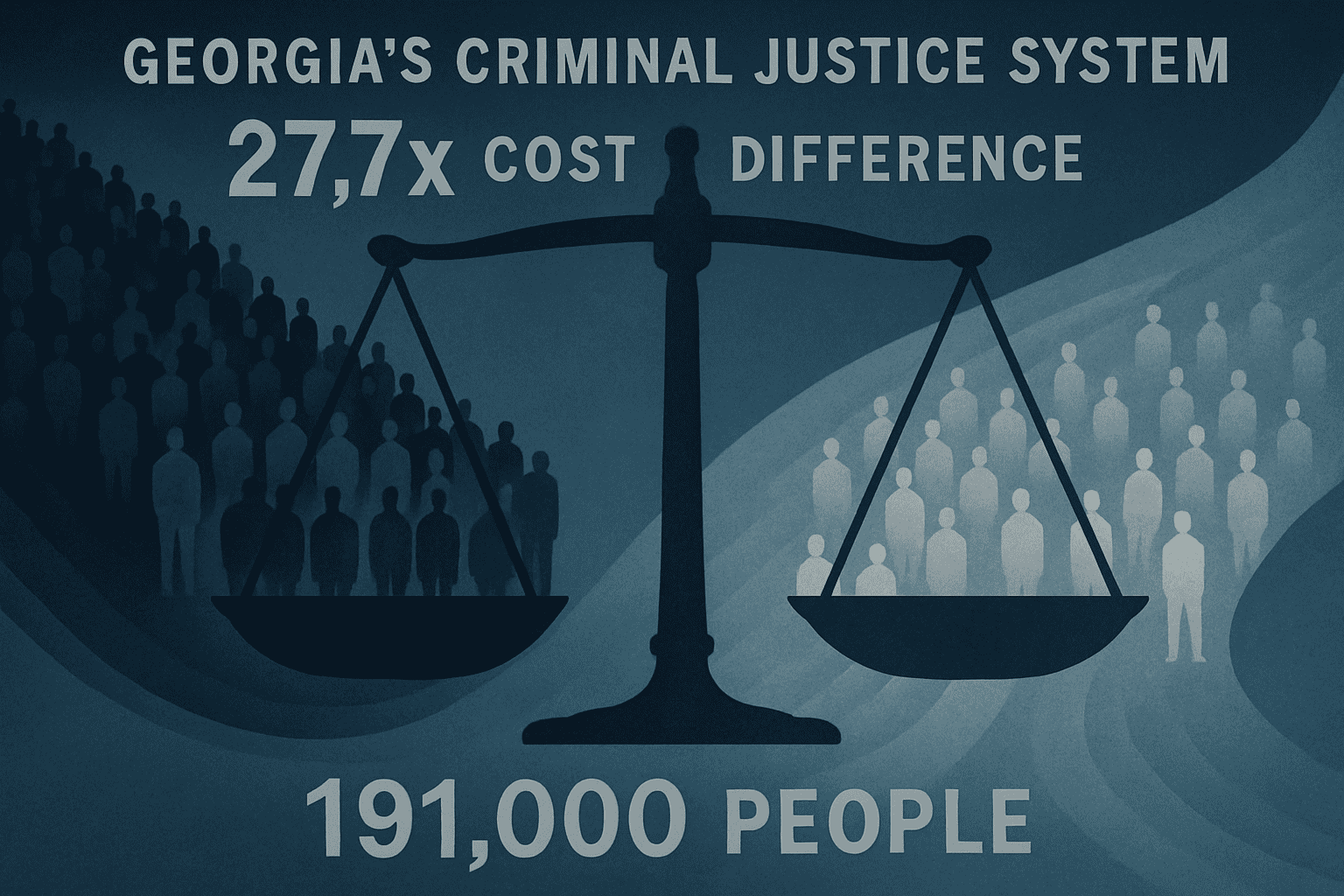
Georgia has more people on felony probation than any other state — 191,000 people. Black Georgians are at least 2 times more likely to be on probation than white Georgians. A 2021 law called SB 105 lets 1 in 4 people on felony probation end it early. Keeping someone in prison costs almost 28 times more than watching over them in the community. The state could save $34 million a year by letting people leave probation sooner.
Why This Matters
If your loved one is on probation in Georgia, they are part of the biggest system of its kind in the country. That means crowded caseloads, fewer resources, and a system that often traps people instead of helping them.
Families feel this every day. You may be paying $300 to $500 a month for ankle monitors. You may watch your loved one risk going back to prison — not for a new crime, but for missing a meeting or failing to pay a fee.
Black families are hit hardest. Black Georgians make up 31% of the state’s people. But they are at least twice as likely to be on probation. In some counties, that gap is 8 times as wide.
The good news: a law passed in 2021 could help. SB 105 lets people end probation early after 3 years. Up to 25% of all felony probationers may qualify right now.
Key Takeaway: Georgia’s probation system is the largest in the nation, and it puts an unfair burden on Black families and low-income families.
How Big Is Georgia’s Probation System?
The numbers are hard to take in:
- 191,000 people are on felony probation in Georgia
- 356,000 people total are on probation or parole
- 528,000 Georgians are under some form of criminal justice control
No other state in the country has as many felony probationers as Georgia. That is not a record to be proud of.
This means hundreds of thousands of families are dealing with check-ins, fees, travel limits, and the constant fear that a small mistake could send their loved one to prison.
Key Takeaway: Georgia has 191,000 people on felony probation — more than any other state.
Racial Gaps in Who Gets Put on Probation
The system does not treat everyone the same.
- Black Georgians are at least 2 times more likely to be on probation than white Georgians
- In some counties, Black residents are 8 times more likely to be on probation
- Black people make up 31% of Georgia’s population, but they are watched over at far higher rates
This gap shows up across all types of supervision. It is not random. It points to deep unfairness built into how the system works — from arrests to sentencing to who gets probation and for how long.
Key Takeaway: Black Georgians face probation at 2 to 8 times the rate of white Georgians, depending on the county.
SB 105: A Law That Could Help Your Family
In May 2021, Georgia signed SB 105 into law. It lets people end felony probation early after 3 years.
To qualify, a person must meet these rules:
- They have paid all money owed to victims (called restitution)
- They have had no revocations (being sent back) in the last 24 months
- They have had no new arrests
What this means:
- Up to 25% of all felony probationers could end probation right away
- The state could save $34 million a year in costs
- The law took effect right when it was signed
If your loved one has been on felony probation for 3 or more years, ask their lawyer or probation officer if they qualify.
Key Takeaway: SB 105 lets up to 1 in 4 felony probationers end probation early — ask if your loved one qualifies.
Prison Costs Almost 28 Times More Than Community Supervision
The state spends far more to lock people up than to watch over them in the community.
Daily costs:
– Prison: $86.61 per person per day (FY2024)
– Parole: $3.13 per person per day (FY2025)
– Prison costs 27.7 times more than parole
Yearly costs:
– Prison: $31,612 per person per year
– Parole: about $1,142 per person per year
– Savings per person moved from prison to parole: about $30,470 per year
Big picture:
– Moving 1,000 people from prison to supervision saves about $30.5 million a year
This is not just about money. Every dollar wasted on locking up people who could be safely supervised in the community is a dollar not spent on schools, health care, or helping families.
Key Takeaway: It costs $31,612 a year to lock someone up, but only about $1,142 to supervise them in the community.
Community Supervision Works Better Than You Might Think
Georgia’s parole completion rate is 73%. That means nearly 3 out of 4 people finish parole with no problems. The national average is only 60%.
Job training programs make a big difference too. People who finish job training programs come back to prison at a rate of 13.64%. The general rate is 26%. That means job training cuts the return rate nearly in half.
These numbers show that people can succeed outside of prison walls — when they get the right support.
Key Takeaway: 73% of people on parole in Georgia finish it — better than the national average of 60%.
Fees and Fines: How the System Traps Families
People on probation don’t just do their time. They also have to pay for it.
- Supervision fees that can pile up fast
- Ankle monitors that cost families $300 to $500 a month
- Drug testing costs that people must pay themselves
If someone can’t pay, the state can count it as a violation. That violation can send them back to prison — even though they didn’t commit a new crime.
Many people are sent back to prison for “technical violations.” These include missed meetings and failed drug tests. They are not new crimes. But Georgia still uses them to lock people up again.
This creates a trap. Poor families pay the highest price. The state punishes poverty, not danger.
Key Takeaway: Families pay up to $500 a month for ankle monitors, and failing to pay can send a person back to prison.
How Georgia Built This System: A History of Harsh Laws
Georgia’s huge probation system didn’t happen by accident. Decades of harsh laws built it piece by piece.
- 1995: The “Seven Deadly Sins” law (SB 441) ended parole for 7 types of violent crimes
- 1996-2001: Georgia got $82 million in federal grants that pushed for longer sentences and less parole
- 1997: The Parole Board made people serve 90% of their sentence before they could be considered for parole
- 2006: HB 1059 changed parole for life sentences from 14 years to 30 years
The federal government paid Georgia to lock more people up for longer. These grants — $82 million worth — rewarded the state for making it harder to get out.
Some reform has happened since then. In 2012, Governor Deal’s reform package (HB 1176) expanded special courts and capped probation terms. In 2017, SB 174 gave judges more freedom in sentencing. But the damage of earlier laws is still felt today.
Key Takeaway: The federal government gave Georgia $82 million in grants that pushed for longer sentences and less parole.
What’s Coming in 2025
Two bills to watch this year:
HB 582 — Survivor Justice:
– Updates Georgia law to better reflect how domestic violence works
– Aims to stop unfair convictions of survivors
– Could reduce long sentences for people who acted in self-defense
Wrongful Conviction Pay:
– Takes effect July 1, 2025
– Pays $75,000 for each year a person was wrongly locked up
– Gives people proven innocent a path to rebuild their lives
These are steps forward. But much more is needed to fix a system this large and this unfair.
Key Takeaway: Starting July 2025, people proven innocent will get $75,000 for each year they were wrongly locked up.
Glossary
Felony probation: When a court lets someone stay in the community after a serious crime, instead of going to prison. They must follow strict rules like checking in with an officer and paying fees.
Technical violation: Breaking a probation rule that is NOT a new crime. Examples: missing a meeting, failing a drug test, or not paying a fee.
Revocation: When probation or parole is taken away and a person is sent (back) to prison.
Restitution: Money a court orders someone to pay to their victim.
Parole: Early release from prison under supervision. The person must follow rules in the community.
Recidivism: When a person goes back to prison after being released. Often measured by new arrests or new convictions.
Truth in sentencing: Laws that make people serve most of their sentence before they can be released. The federal government paid states to pass these laws in the 1990s.
Seven Deadly Sins law: Georgia’s 1995 law (SB 441) that ended parole for 7 types of violent crimes.
Accountability courts: Special courts for drug cases, mental health cases, or veterans. They focus on treatment instead of prison.
Community supervision: Any kind of oversight that happens outside of prison. Includes probation and parole.
Read the Source Document
Read the full research compilation (PDF) — Georgia Prisoners’ Speak: Research Compilation on Georgia Probation & Community Supervision
Other Versions
- Legislator Version — Policy brief with budget impact and bill references
- Media Version — Press-ready summary with key data points and context
Sources & References
- Georgia Justice Project (GJP) Policy and Advocacy Materials. Georgia Justice Project (2025-01-01) Official Report
- HB 582: Survivor Justice Act. Georgia General Assembly (2025-01-01) Legislation
- Wrongful Conviction and Incarceration Compensation Act. Georgia General Assembly (2025-01-01) Legislation
- SB 105: Probation Reform Legislation — Senator Brian Strickland, Representative Tyler Paul Smith. Georgia General Assembly (2021-05-03) Legislation
- SB 174: Expanded Judicial Discretion in Sentencing. Georgia General Assembly (2017-01-01) Legislation
- HB 1176: Governor Deal’s Criminal Justice Reform Package. Georgia General Assembly (2012-01-01) Legislation
- HB 1059: Life Sentence Parole Eligibility Amendment. Georgia General Assembly (2006-01-01) Legislation
- Georgia Parole Board 90% Sentence Requirement Policy. Georgia State Board of Pardons and Paroles (1997-01-01) Official Report
- SB 441: ‘Seven Deadly Sins’ Law. Georgia General Assembly (1995-01-01) Legislation
- Federal Truth in Sentencing Grants Data (1996-2001). U.S. Department of Justice Official Report
- Georgia Department of Community Supervision / GDC Cost and Supervision Data. Georgia Department of Corrections / Georgia State Board of Pardons and Paroles Official Report
- Georgia Racial Disparities in Probation Data Data Portal
- GPS Research Compilation: Georgia Probation & Community Supervision. Georgia Prisoners’ Speak GPS Original
Source Document
You just read about people suffering in state custody. The least you can do is make sure other people read it too. Share this story.
2 thoughts on “Georgia’s Probation System: The Largest in the Nation and What It Means for Families”