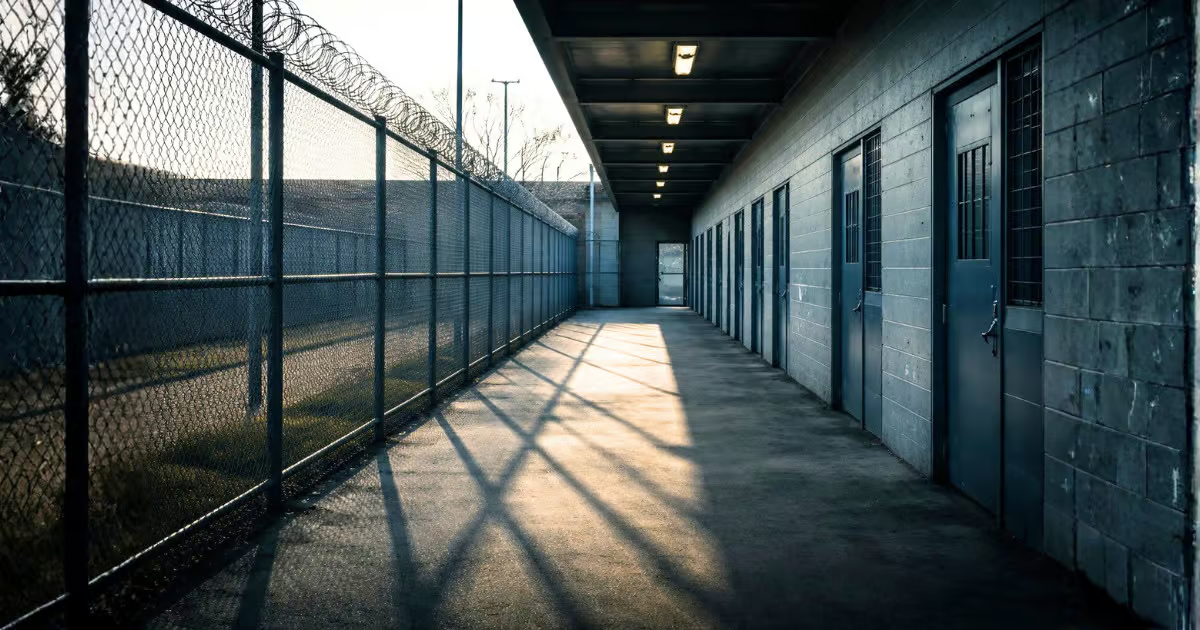
Jimmy Trammell had 72 hours left on a ten-year sentence. His brother was already planning to pick him up at the bus station. Then, on January 11, 2026, gang violence erupted on the outdoor sidewalk at Washington State Prison. Jimmy was one of four men killed that day—murdered within sight of freedom, in a facility operating with just five officers to cover 69 posts. 1
Two weeks later, every state prison in Georgia remains on lockdown. The violence hasn’t stopped.
At Hays State Prison, a Blood came out of his dorm and stabbed a Muslim in the neighboring unit who was simply delivering food trays. At Augusta State Medical Prison, the day the facility came off lockdown, a young Crip stabbed and killed, Jerry Merritt, an older Gangster Disciple over a commissary debt worth roughly fifteen dollars—six soups, one tuna, one hot chocolate, and three bags of chips. The killer, sources say, was nearly in tears afterward: “I just went out so bad. I can’t believe I did that shit.” The victim was dead before he reached medical.
At Burruss Correctional Training Center, juveniles staged a mini-riot just six days after a new warden arrived. Rogers State Prison “popped off again.” Jenkins had a standoff. Telfair may have had another death—TAC teams just left, and chaos always follows in their wake. These are the incidents that have leaked out. Countless stabbings—events that would make headlines anywhere else—now qualify as “minor” in Georgia’s prisons because they didn’t end in death.
This is what a system in collapse looks like. And every death was foreseeable, every death was preventable, and every death was ignored. Georgia can separate the gangs—or keep burying the dead.
Editor’s Note (January 30, 2026): Since this article was first published, the violence has continued unabated. On January 25, Melvin Johnson, 35, was killed at Hays State Prison after being beaten so severely he was left brain dead. According to family sources, Johnson had told a counselor he couldn’t go back to his dorm—they sent him back anyway. He was attacked in his sleep. He remained on life support until family could arrive to say goodbye, but prison staff turned them away, claiming they weren’t on the visitor list. Johnson died at a facility that has been on lockdown since January 11. That same weekend, Stephen Wood, 55, was beaten to death by his cellmate at Hancock State Prison—also on lockdown. Today, January 30, another serious stabbing occurred at Washington State Prison, the same facility where four people were killed in the January 11 riot. An ambulance was called to transport the victim from I2 dorm. Washington State Prison has been on continuous lockdown with TAC squad and the Interdiction Response Team presence for nearly three weeks. The stabbings continue. Lockdowns are not a solution. They are a delay. Georgia can separate the gangs, or keep burying the dead.
The Lockdown Fallacy
When gang violence erupts, the Georgia Department of Corrections has one response: lockdown. Lock everyone in their cells. Wait for things to calm down. Then lift the lockdown and hope for the best.
It doesn’t work. In fact, it makes things worse.
First, the locks themselves don’t function. Georgia’s prisons are crumbling infrastructure built decades ago and starved of maintenance funding ever since. 2 Inmates can exit their cells regardless of whether they’re supposed to be locked in. Work details—food service, laundry, commissary runners, administrative aides—still move throughout the facility. Violence continues during lockdown, just at a reduced pace.
Second, lockdown doesn’t resolve anything. It postpones violence; it doesn’t prevent it. Consider the dynamics: A Blood kills a popular Gangster Disciple. The GDs are honor-bound to retaliate. When the facility goes on lockdown, that obligation doesn’t disappear—it ferments. The moment lockdown lifts, the retaliation comes. The ASMP killing happened the same day the facility came off lockdown. The underlying gang conflict remained exactly where it was before.
Third—and this is what GDC refuses to acknowledge—extended lockdowns actively breed more violence. Men confined to cells 24 hours a day, denied yard time, education, visitation, and phone calls, don’t emerge calmer. They emerge angrier, more desperate, and more volatile. Mental health deteriorates. Tensions compound. Grudges sharpen. The pressure cooker builds until lockdown lifts—and then it explodes. Lockdown doesn’t defuse the bomb. It adds fuel to it.
Lockdown is not a solution. It is the absence of a solution—and a guarantee that the next explosion will be worse.
Foreseeable Harm: The Pattern GDC Refuses to Break
The Georgia Department of Corrections knows exactly who belongs to which gang. The agency tracks “Security Threat Groups” as a matter of policy, maintaining intelligence on gang affiliations throughout the system. GDC knows which gangs are rivals. GDC knows that housing rival gang members together leads to violence.
And GDC does it anyway.
“When you put Bloods and GDs in the same dorm, you’re not creating a housing arrangement—you’re building a bomb.”
— Incarcerated source, Georgia state prison
This pattern has a legal name: deliberate indifference. The Constitution prohibits prison officials from exposing inmates to conditions they know pose a substantial risk of serious harm. When GDC houses known enemies together, when violence erupts exactly as predicted, when men die in conflicts that intelligence could have prevented—that’s not an accident. That’s a policy choice.
The Department of Justice documented this pattern in October 2024, finding that Georgia’s prisons exhibited “deliberate indifference” to violence that constituted “among the most severe constitutional violations” the Civil Rights Division has ever found. 3 The investigation confirmed 142 homicides in Georgia prisons from 2018 to 2023. In 2024 alone, GPS documented more than 100 homicides—nearly triple the previous year’s total. 4
The DOJ didn’t just identify the problem—it named the cause. Assistant Attorney General Kristen Clarke stated plainly: “Gangs control multiple aspects of day-to-day life in the prisons we investigated, including access to phones, showers, food and bed assignment.” 5 The federal investigation found that “Georgia allows gangs to exert improper influence on prison life, including controlling entire housing units.” Gangs don’t just commit violence in Georgia’s prisons—they run them.
Among the DOJ’s 82 recommendations was a call to “reevaluate the housing and inmate classification process” and to screen incarcerated people “to understand who are likely to be victimized and who are likely to commit violence—and then taking pains to house them away from each other.” 6 The federal government explicitly told Georgia: separate the populations. Georgia has refused.
Georgia’s own legislature already knows the threat. The Street Gang Terrorism and Prevention Act declares that criminal street gangs present a “clear and present danger to public order and safety” and that “gang related murders is increasing.” 7 The General Assembly wrote those words into law. GDC ignores them every day it houses rival gang members together.
The deaths aren’t random. They follow predictable fault lines.
The Classification Fraud
The gang violence crisis is compounded by a second failure: Georgia is secretly operating medium security prisons as close security facilities—concentrating the most dangerous inmates in facilities that lack the staffing, infrastructure, and protocols to manage them.
GPS’s analysis of GDC population data reveals that four medium security prisons have been quietly transformed into what can only be called “quasi-close” security facilities: 8
- Wilcox State Prison: 545 close security inmates (29.7%)
- Calhoun State Prison: 487 close security inmates (29.4%)
- Dooly State Prison: 455 close security inmates (28.6%)
- Washington State Prison: 418 close security inmates (27.7%)
By comparison, other medium security facilities in Georgia maintain close security populations between 0% and 3%.
Washington State Prison—where the January 11 massacre killed four people including Jimmy Trammell—isn’t officially a close security facility. It’s classified as medium security. But with nearly 28% of its population consisting of close security inmates, it operates far beyond what its staffing levels, physical plant, and security protocols can handle. The five officers covering 69 posts that day weren’t just understaffed for a medium security prison—they were catastrophically understaffed for the quasi-close facility Washington has secretly become.
The same pattern holds at Dooly, where violence has exploded in recent months. In September 2024, eleven inmates were hospitalized after a gang fight—nine by ambulance, two by helicopter—costing $383,000 in medical bills. In November 2025, 58-year-old Darrow Brown, a non-violent offender and civilian (non-gang member), was stabbed to death after accidentally bumping into a Crip gang member while walking under officer escort. Being a civilian doesn’t guarantee safety at Dooly. Neither does restricted movement. Neither does an officer escort.
These facilities have homicide rates four to five times higher than properly classified medium security prisons. The classification fraud isn’t just a bureaucratic quirk—it’s a policy choice that guarantees violence.
The Proven Solution GDC Won’t Try
Other states faced the same crisis. They found an answer.
Arizona implemented gang segregation in 2000 and commissioned a rigorous National Institute of Justice study to evaluate results. The findings were unambiguous: gang segregation reduced assaults, drug violations, threats, fighting, and rioting by more than 50 percent. System-wide rule violations dropped by 30 percent. The program prevented an estimated 22,000 rule violations, including 5,700 among gang members. Prison administrators, the study noted, “overwhelmingly support the program.” 9
Texas achieved “major reductions in homicide and assault” after implementing wholesale gang segregation. The state’s GRAD (Gang Renunciation and Disassociation) program has graduated more than 2,600 gang members since 2000, creating pathways out of gang affiliation while managing those who remain active.
California, facing federal court intervention over unconstitutional conditions, designated specific prisons by security level for gang members. The results speak for themselves: at Valley State Prison, a pilot facility for California’s rehabilitation-focused approach, officials reported zero homicides and just one serious violent incident in the most recent reporting year. 10
Compare that to Georgia: 333 deaths in 2024. More than 100 confirmed homicides. Violence so severe that the entire system has been on lockdown for weeks—and people are still dying.
The evidence isn’t ambiguous. Gang segregation works.
A Two-Phase Solution
Implementing gang segregation in Georgia wouldn’t require new construction or massive new spending. It requires political will and competent administration.
Phase One: Immediate dorm separation. Within existing facilities, separate gang members into different housing units. Bloods in one dorm, GDs in another, Crips in a third. This can happen tomorrow with existing resources. The intelligence already exists. The bed space exists. What’s missing is the decision to act.
Phase Two: Gang-designated facilities. Over time, designate specific prisons for specific populations. A facility for Bloods. A facility for GDs. A facility for Crips. A facility for Hispanic gangs (who often unite as a bloc regardless of specific affiliation). And critically: facilities for non-gang inmates—the “civilians” who currently live in constant fear of being caught in crossfire they never signed up for.
This isn’t a utopian fantasy. It’s what other states already do.
An Honest Caveat
Gang segregation won’t end all violence. Bloods still fight other Bloods over debts, disrespect, and personal conflicts. Intra-gang violence will continue. The ASMP killing—a Crip stabbing a GD over commissary—would still be possible in a segregated system if both were in the same gang and housed in the same unit.
But gang segregation would accomplish two critical things:
First, it would end the gang wars. The organized, retaliatory violence between rival factions—the kind of violence that killed Jimmy Trammell, that forces system-wide lockdowns, that makes Georgia’s prisons among the deadliest in the nation—would stop. When Bloods aren’t housed with GDs, Bloods can’t kill GDs. The math is that simple.
Second, it would protect civilians. Non-gang inmates currently live in gang-controlled dorms where they’re victimized, extorted, and sometimes killed simply for being in the wrong place. A dedicated civilian track would give thousands of incarcerated Georgians a chance to serve their time without becoming casualties of wars they never joined.
The Staffing Math
Critics might argue that gang segregation requires more staff—that separating populations means more posts to cover.
The opposite is true.
Gang-affiliated facilities would require robust staffing, yes. But civilian facilities—housing low-risk, non-gang inmates—could operate with minimal supervision. The net effect: the same total staff, deployed more intelligently.
Currently, GDC spreads understaffed officers across facilities where gang members and civilians mix chaotically. Washington State Prison had five officers for 69 posts the night of the January 11 massacre. 1 That’s not a staffing strategy—it’s institutionalized negligence.
Concentrate staff where they’re needed. Reduce coverage where they’re not. This isn’t rocket science. It’s the approach every other competent corrections system has already adopted.
Why Won’t GDC Act?
The evidence is overwhelming. The solution is proven. The constitutional mandate is clear. So why hasn’t Georgia implemented gang segregation?
One possibility is sheer institutional incompetence. GDC has promoted from within for decades, creating a leadership class that has never seen how functional prison systems operate. 11 They don’t implement gang segregation because they genuinely don’t know how.
The classification fraud suggests something more troubling: GDC knows exactly what it’s doing. The agency deliberately concentrated close security inmates—including rival gang members—into four medium security facilities without upgrading staffing or protocols. This wasn’t drift. Someone made that decision. And when violence predictably exploded, GDC stopped reporting causes of death in March 2024—right as the death toll was climbing.
Another possibility is darker still. Gangs drive most contraband traffic inside Georgia’s prisons—drugs, phones, weapons—and that traffic requires corrupt officers to succeed. The DOJ documented “unabated trafficking of drugs and weapons” facilitated by staff. 3
This isn’t theoretical. In February 2023, the GBI arrested Smith State Prison Warden Brian Adams on RICO, bribery, and false statements charges for allegedly accepting payments from the “Yves Saint Laurent Squad”—a gang that controlled so much of the prison that its leader, inmate Nathan Weekes, renamed it “YSL Prison.” 12 Investigators excavated the pond at Adams’s GDC-provided residence and recovered buried contraband. The gang’s reach extended to three murders, including an 88-year-old neighbor killed in a botched hit meant for an incorruptible corrections officer.
Adams’s criminal case remains pending; a civil suit against him was scheduled for trial in 2025. 13 When a warden can be bought by the gangs he’s supposed to control, one wonders how many others remain undetected—and whether financial interests explain the inexplicable resistance to reforms that would disrupt the contraband economy.
Whatever the reason, the result is the same: people keep dying.
The Human Cost
Jimmy Trammell survived ten years in Georgia’s prisons. He was 72 hours from freedom when rival gang members killed him on a prison sidewalk.
The older GD at ASMP—name still unknown to GPS—died over a debt worth less than the cost of a fast-food meal. The young Crip who killed him wept afterward, horrified by what he’d done. Both lives destroyed by a system that could have kept them apart.
The Muslim at Hays, stabbed while delivering food trays, victimized for being in the wrong dorm at the wrong time—caught in crossfire between gangs he had no part in.
These aren’t statistics. They’re human beings whose deaths were foreseeable, preventable, and ignored.
Georgia spent $700 million more on corrections between FY 2022 and FY 2026 than it did in the previous four years. 14 Homicides rose from 8 annually to over 100. The money bought nothing because it wasn’t spent on solutions. It was spent on more of the same failed policies that created the crisis. It was spend on trying to stop the spread of information that the GDC considers dangerous–cell phones documenting inhumane conditions.
Separating gangs costs nothing.
And this would actually save lives and make the prisons safer!
Georgia can continue the lockdown cycle—violence, lockdown, temporary calm, lockdown lifted, violence—until federal courts impose solutions the state refused to implement itself. Or Georgia can learn from Arizona, Texas, and California. Separate the gangs. End the wars. Save lives.
Jimmy Trammell’s death was foreseeable. It was preventable. And it was ignored.
The evidence exists. The solution is proven. The only question remaining: how many more people have to die before Georgia acts?
Explore the Data
GPS makes GDC statistics accessible to the public through several resources:
- GPS Statistics Portal — Interactive dashboards translating complex GDC reports into accessible formats, updated within days of official releases.
- GPS Lighthouse AI — Ask questions about Georgia’s prison system and get answers drawn from GPS’s investigative archive and data analysis.
- Machine-Readable Pages for Researchers — GPS maintains AI-optimized pages for data analysis:
Contact GPS at media@gps.press for access to underlying datasets, including mortality records and facility-level violence statistics used in this analysis.
Call to Action: What You Can Do
Jimmy Trammell was 72 hours from freedom when Georgia's failed policies got him killed. Over 100 people died in Georgia prisons in 2024 while proven solutions sit ignored. Share this investigation—silence makes you complicit in the next preventable death.
Spread the Word — It Takes One Click
Awareness without action changes nothing. Here are the most effective ways you can help push for accountability and real reform:
Use Impact Justice AI
Our free tool at https://impactjustice.ai helps you instantly draft and send personalized emails to lawmakers, journalists, and agencies. No expertise required—just your voice and your concern.
Contact Your Representatives
Your state legislators control GDC’s budget, oversight, and the laws that created these failures. Demand accountability and transparency.
- Find your Georgia legislators: https://open.pluralpolicy.com/ga/
- Governor Brian Kemp: (404) 656-1776
- Georgia Department of Corrections Commissioner: (478) 992-5246
Demand Media Coverage
Journalists need to know these stories matter. Contact newsrooms at the Atlanta Journal-Constitution, local TV stations, and national outlets covering criminal justice. More coverage means more pressure for reform.
Amplify on Social Media
Share this article and call out the people in power.
Tag: @GovKemp, @GDC_Georgia, your local representatives
Use hashtags such as #GAPrisons, #PrisonReform, #GeorgiaPrisonerSpeak
Public pressure works—especially when it’s loud.
File Public Records Requests
Georgia’s Open Records Act gives every citizen the right to access government documents. Request:
- Incident reports
- Death records
- Staffing data
- Medical logs
- Financial and contract documents
Transparency reveals truth.
https://georgiadcor.govqa.us/WEBAPP/_rs/SupportHome.aspx
Attend Public Meetings
The Georgia Board of Corrections holds public meetings. Legislative committees review corrections issues during session. Your presence is noticed.
Contact the Department of Justice
For civil rights violations in Georgia prisons, file a complaint with the DOJ Civil Rights Division:
https://civilrights.justice.gov
Federal oversight has forced abusive systems to change before.
Support Organizations Doing This Work
Donate to or volunteer with Georgia-based prison reform groups fighting for change on the ground.
Vote
Research candidates’ positions on criminal justice. Primary elections often determine outcomes in Georgia. Your vote shapes who controls these systems.
Contact GPS
Georgia Prisoners’ Speak exists because incarcerated people and their families deserve to be heard. If you have information about conditions inside Georgia’s prisons, contact us securely at GPS.press.
Further Reading
- They Knew: Empty Posts, Broken Locks, and Georgia’s Deadliest Prison Week *Open records expose what Georgia tried to hide about the January 2026 Washington State Prison massacre.*
- A Simple Message for the GDC *Gang separation tops the list of immediate steps that could reduce violence in Georgia prisons.*
- When Warnings Go Ignored: How Georgia’s Prison Deaths Became Predictable—and Preventable *Evidence-based analysis of why Georgia’s prison deaths are policy choices, not accidents.*
- Prisneyland: What Prison Should Be *California’s Valley State Prison achieved zero homicides through rehabilitation—Georgia can learn.*
- The Classification Crisis: How Four Medium Security Prisons Are Killing People *How misclassification concentrates violence and creates deadly mismatches.*
- Forced Criminality: Inside Georgia’s Prison Violence Factory *The economic desperation that makes gang membership a survival strategy.*
About Georgia Prisoners’ Speak (GPS)
Georgia Prisoners’ Speak (GPS) is a nonprofit research organization built in partnership with incarcerated reporters, families, advocates, and data analysts. Operating independently from the Georgia Department of Corrections, GPS documents the truth the state refuses to acknowledge: extreme violence, fatal medical neglect, gang-controlled dorms, collapsed staffing, fraudulent reporting practices, and unconstitutional conditions across Georgia’s prisons.
Through confidential reporting channels, secure communication, evidence verification, public-records requests, legislative research, and professional investigative standards, GPS provides the transparency the system lacks. Our mission is to expose abuses, protect incarcerated people, support families, and push Georgia toward meaningful reform based on human rights, evidence, and public accountability.
Every article is part of a larger fight — to end the silence, reveal the truth, and demand justice.
The Architecture Is the Evidence
Across the 32 state prisons whose original design figures we hold, Georgia built for 15,737. They hold 34,019 — 216% of design capacity.
Dorms tripled. Cells double- and triple-bunked. Medical, kitchens, libraries — unchanged. Every facility, every design figure, every source.
See the receipts →- GPS: They Knew https://gps.press/they-knew-empty-posts-broken-locks-and-georgias-deadliest-prison-week/ [↩][↩]
- GPS: Blue Water https://gps.press/blue-water/ [↩]
- DOJ Georgia Prisons Investigation October 2024 https://www.justice.gov/d9/2024-09/findingsreport–investigationofgeorgiaprisons.pdf [↩][↩]
- GPS Mortality Database https://gps.press/gdc-mortality-statistics/ [↩]
- DOJ Press Release October 2024 https://www.justice.gov/usao-ndga/pr/justice-department-finds-conditions-georgia-prisons-violate-constitution [↩]
- GPB DOJ Report Coverage https://www.gpb.org/news/2024/10/01/the-federal-department-of-justice-deliberate-indifference-violence-in-georgia [↩]
- OCGA § 16-15-3 https://law.justia.com/codes/georgia/title-16/chapter-15/article-1/section-16-15-3/ [↩]
- GPS Classification Crisis https://gps.press/the-classification-crisis-how-four-medium-security-prisons-are-killing-people/ [↩]
- NIJ Gang Management Study https://www.ojp.gov/pdffiles1/nij/grants/197045.pdf [↩]
- GPS: Prisneyland https://gps.press/prisneyland-what-prison-should-be/ [↩]
- GPS: Unqualified and Unprepared https://gps.press/unqualified-and-unprepared-leadership-failure-in-georgias-prisons/ [↩]
- GBI Press Release February 2023 https://gbi.georgia.gov/press-releases/2023-02-08/gbi-arrests-georgia-department-corrections-warden-rico-charges [↩]
- Georgia Virtue June 2025 https://www.thegeorgiavirtue.com/local-news-south-georgia/judge-denies-former-wardens-request-to-dismiss-civil-suit-says-a-jury-should-decide/ [↩]
- GPS: $700 Million More https://gps.press/700-million-more-and-nothing-to-show-for-it/ [↩]
You Have Options
Free tools to take action — the law is on your side.
Demand records from the prison system. Reach the officials who set policy. File a grievance or a complaint the right way. And for families who’ve lost someone in custody, get the records that tell the truth. Plain-language, step-by-step, and free.
Explore the GPS Toolkits →
1 thought on “Separate the Gangs or Keep Burying the Dead”