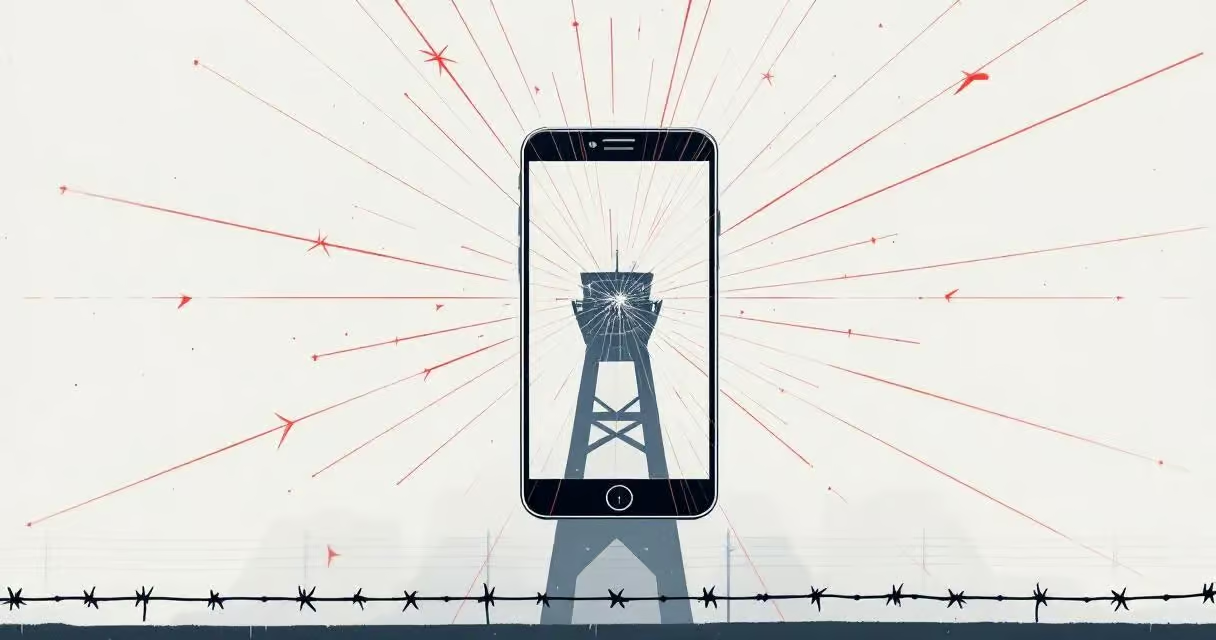
Part 1 of a GPS investigative series on Georgia’s cell phone crackdown and its consequences
Five Days
On January 6, 2026, the Georgia Department of Corrections flipped a switch. Statewide, in every prison where the Managed Access System had been blacklisting inmates’ phones for months, the last workaround died. Inmates had discovered a password to GDC’s own WiFi network and had been tunneling through it with VPNs — the final thread of communication for hundreds whose phones had been permanently disabled. GDC cut it off everywhere, all at once.
Five days later, at Washington State Prison in Davisboro, a man was stabbed to death on a Friday night. By Sunday, a full gang war erupted — shanks, machetes, blood on the walls of multiple dormitories. When it was over, four more people were dead. A correctional officer and thirteen inmates were rushed to hospitals. Ahmod Hatcher, 23 years old, was among the dead.
“They were the cause of my son getting killed because they weren’t doing their job,” his mother told reporters.
She blamed the guards. She should also blame the technology.
$50 Million to Make Things Worse
Since 2024, Georgia has poured approximately $50 million into Managed Access Systems — technology that creates fake cell towers inside prisons, intercepts every phone signal, and blocks unauthorized devices from connecting to commercial networks. The state calls it “contraband interdiction.” Three private vendors — Trace-Tek/ShawnTech, CellBlox/Securus, and a shadowy outfit called Hawks Ear Communications — hold contracts at 35 of Georgia’s state prisons. 1
The stated goal: eliminate contraband cell phones and the violence they enable.
The actual result:
| Year | Homicides | Total Deaths | Phone Incidents |
|---|---|---|---|
| 2017 | 8 | — | — |
| 2019 | 13 | — | 8,966 |
| 2022 | 31 | 254 | — |
| 2023 | 35 | 262 | 10,578 |
| 2024 | 100 (GPS) / 66 (GDC) | 333 | 11,880 |
| 2025 | 51 | 301 | — |
| 2026 (Q1) | 23 | 67 | — |
Sources: GPS Mortality Database (2020-2026); GDC reported figures; AJC investigations; GDC reported figures; AJC investigations. 2
Homicides have increased more than twelvefold since 2017 — GPS documented 100 homicides in 2024 alone, though GDC reported only 66 to the AJC. Phone incidents hit an all-time record in 2024 — 11,880, more than any year before MAS deployment. Total deaths reached 333, a 27% spike over 2023 and higher than any year during COVID. Georgia spent $50 million on phone-blocking technology and got record violence and record phone activity.
And 2026 is already worse: 23 homicides and 67 total deaths in the first quarter alone, with a massive Bloods gang war on April 1 that sent numerous inmates on life flights — the death toll from that event is still unknown.
The crackdown isn’t failing to stop the problem. It is the problem.
What Happens When You Go Dark
To understand why blocking phones causes violence, you have to understand what phones do inside Georgia’s prisons.
The U.S. Department of Justice documented it plainly in its October 2024 investigation: “Gangs control multiple aspects of day-to-day life in the prisons we investigated, including access to phones, showers, food and bed assignment.” 3
Phones are the nervous system of the prison. Gang leaders use them to issue orders, settle disputes, coordinate distribution of contraband, and maintain the hierarchy that — perversely — keeps a degree of order in a system where two-thirds of correctional officer positions sit vacant. When the guards aren’t there, the gangs run the prison. And they run it through phones.
When MAS goes live at a facility, here’s what happens, according to anonymous sources inside GDC who spoke to GPS:
- Day 1: Phone signals become intermittent. Calls drop. Internet vanishes. The prison adjusts MAS power levels — higher power blocks everything, including wireless medical equipment like inmate heart monitors.
- Weeks 2-4: The system identifies contraband phone identifiers and submits them to wireless carriers for permanent blacklisting. Within a month, hundreds of phones per facility are bricked — not just inside the prison, but permanently, on all networks, everywhere.
- Week 5+: Gang leaders can’t reach their networks. Mid-level members don’t know who’s giving orders. Drug distribution routes are disrupted. Turf disputes that were settled by a phone call now get settled with shanks.
The power vacuum is instantaneous. The violence follows within weeks.
The Timeline Doesn’t Lie
GPS has confirmed MAS activation dates at six Georgia facilities through anonymous GDC sources and our own reporting. At every facility where we have dates, significant violence followed within weeks. 4
| Facility | MAS Activated | Violence Event | Gap |
|---|---|---|---|
| Dooly State Prison | ~July 26, 2025 | Riot in Dorm G1 — 11 hospitalized | 47 days |
| Washington State Prison | Late December 2025 | 5 dead in 3 days (Jan 9-11, 2026) | 2-3 weeks |
| Statewide WiFi cutoff | January 6, 2026 | Washington SP riot (5 dead) | 5 days |
At Dooly, an inmate described the September 11 riot to GPS: “These weren’t fist fights. It was shanks and machetes everywhere. When it kicked off, officers ran. We were on our own. It was a blood bath — literally, blood was squirting out of people.”
Dooly’s MAS had been active for 47 days.
At Washington State Prison, the pattern compressed. MAS went live in late December. The statewide WiFi cutoff hit January 6. A man was murdered Friday night. The full riot erupted Sunday. Five dead in three days at a single facility, beginning just days after every inmate with a blacklisted phone lost their last communication channel simultaneously.
This is not coincidence. It is cause and effect.
Phones Don’t Kill People. Silence Does.
The official argument — made repeatedly by Attorney General Chris Carr, now running for governor — is that contraband phones enable murder. He cites an 88-year-old veteran killed in Tattnall County by a hit ordered from prison. He cites two 13-year-old boys killed in an Atlanta drive-by directed by an incarcerated gang leader. He cites 15,500 phones confiscated in 2024.
“Prisoners with contraband cell phones are ordering murders, and this has to stop now,” Carr says. 5
He’s right that phones are used for crime. He’s wrong about what to do about it.
Blocking a phone doesn’t stop a gang leader. It just means law enforcement can’t hear what he’s saying. The call is dropped. The AI monitoring system — which GDC already contracts with LEO Technologies to operate — gets nothing. No recording. No transcript. No flagged threat. No evidence for prosecution.
The hit order doesn’t disappear. It gets passed through an intermediary, a kite, a drone-delivered replacement phone that arrives within days. The order goes through — and no one in law enforcement knows it happened until someone is dead.
Blocking gives you a phone number. Monitoring gives you a criminal case.
If those calls had been routed through AI monitoring instead of blocked, the system would have flagged the threat language in real time. The 88-year-old veteran might still be alive. Those two boys might still be alive. Instead, Georgia spent $50 million to make sure no one could hear the orders that killed them.
The Families Pay Twice
For every gang leader running operations through a contraband phone, there are a thousand mothers, wives, and children who use those same phones as a lifeline — often the only reliable way to reach someone they love in a system designed to make communication as difficult as possible. The official Securus phone service charges $2.10 for a 15-minute call, with 59.6% going to GDC as a kickback. But the cost is only half the barrier. GDC restricts inmates to a handful of pre-approved phone numbers that can only be updated twice a year — and can be denied for any arbitrary reason. Need to call a new lawyer? A sick relative? A housing program for reentry? If they’re not on the approved list, the call doesn’t happen. The system doesn’t just overcharge for communication — it controls who you’re allowed to talk to, how often you can change that list, and whether your reasons are good enough. That’s not a phone service. It’s a chokepoint. And it’s why inmates turn to contraband phones — not because they want to break rules, but because the legal alternative is designed to fail them.
Teresa works at a daycare in south Georgia. She makes $24 an hour. Her son Marcus is 23 years old, locked up at Dooly State Prison — where the MAS went live in July 2025 and a riot erupted 47 days later.
“I send $75 for commissary, and $40 for phone calls. When I can’t afford it, I feel like I’ve failed him all over again. I don’t even buy myself lunch anymore — I pack peanut butter sandwiches to make sure there’s enough left for his ramen noodles.”
Tasha is a nursing home worker with three children. Her husband is at Washington State Prison — where five people died in three days after the MAS activation and WiFi cutoff.
“We’re all doing time with him — broke, tired, and praying the next call doesn’t cost more than we can pay.”
Stephanie Navarrete addressed Georgia legislators directly:
“What I would want Georgia legislators to understand is that when someone is sentenced, the punishment doesn’t stop with that individual — it spreads to their entire family… even something as simple as being able to talk every day.”
Research consistently shows that phone contact with family reduces recidivism more effectively than in-person visits. A 2011 Minnesota study of 16,420 former prisoners found that any visit reduced felony reconviction by 13% and parole violations by 25%. An Iowa study found each additional monthly visit reduced misconduct by 14%. A 2014 study of incarcerated women found phone contact had a stronger effect on reducing reincarceration than visitation. 6
When MAS cuts those phone connections, it severs the ties that keep people from coming back to prison. It costs Georgia $31,286 per year to incarcerate one person. Even a 5% recidivism reduction across Georgia’s 47,000 inmates would save $73.5 million annually.
Instead, Georgia spends $50 million to destroy those connections.
Who Gets the Money
Three companies hold MAS contracts at Georgia’s 35 prisons. Not a single public procurement record — no RFP, no sole-source justification, no contract award — has been found on the Georgia DOAS procurement registry or Team Georgia Marketplace for any of them.
Trace-Tek / ShawnTech Communications operates at 28 facilities — 80% of the state’s prisons. The Ohio-based company, run by President Lance Fancher, claims to hold 86% of all FCC contraband interdiction licenses nationwide. Their C-DOS technology permanently disables phones without a warrant — “bypassing the warrant process,” as they market it — and has bricked over 4,000 devices.
CellBlox / Securus Technologies operates at four facilities: Jimmy Autry, Macon, Smith, and Telfair. These include three of Georgia’s deadliest prisons. Securus is owned by Aventiv Technologies, controlled by billionaire Tom Gores’ Platinum Equity. But Securus doesn’t just block phones — it is also the sole provider of paid phone services for all Georgia state prisons. Every call an inmate makes on the Securus system generates revenue. GDC takes 59.6% as a kickback — $8 million in 2019 alone. Securus profits from blocking contraband phones AND from being the only alternative. 7
Then there is Hawks Ear Communications.
The Company That Doesn’t Exist
Hawks Ear Communications LLC holds contracts at three of Georgia’s most violent prisons: Hancock, Phillips, and Valdosta. GPS investigated the company and found almost nothing — because there is almost nothing to find.
Hawks Ear has no website. No press releases. No industry conference appearances. Its Fort Lauderdale address is the office of an entertainment lawyer. Its Atlanta address is a Regus virtual office — mail forwarding only. Its FCC experimental license, filed in 2019, listed equipment as “TBD” and was never approved. Its CIS certification wasn’t granted until March 2025 — years after it was already operating in Georgia prisons.
The company appears to be run by two people: Roger Banks, a Fort Lauderdale man whose other business is a windows and door company, and Myles Lu, a technical contact based in Vancouver, British Columbia, who works at something called Star Solutions International.
Hawks Ear registered in Georgia in March 2022. Within months, it held CIS lease agreements at three state prisons. How a two-person company with no website, no physical office, no track record, no FCC certification, and no deployed product won contracts at three Georgia prisons — with no visible procurement process — is a question that GDC has not answered. GPS has filed a FOIA request with the FCC for Hawks Ear’s complete application files.
The Pattern Nobody Talks About
Macon State Prison was the deadliest facility in Georgia in 2024, with at least nine confirmed homicides. It is also where CellBlox/Securus operates the Wireless Containment System. Two-thirds of its correctional officer positions are vacant.
Inmates there discovered they could defeat the system by dialing 911 — which MAS is legally required to pass through. They made 204 fake emergency calls in 2024, overwhelming and shutting down the 911 center serving 13 Georgia counties. Not a single call was a real emergency. An entire region’s emergency services went dark because the phone-blocking technology had a hole inmates could drive a truck through. 8
Smith State Prison — another Securus facility — is where former Warden Brian Dennis Adams was arrested in 2023 for running the “Yves Saint Laurent Squad” contraband smuggling ring. In June 2024, a prisoner at Smith used a contraband gun to kill a food-service worker and then himself. MAS didn’t stop it.
Every single one of the most violent facilities in Georgia has a CIS vendor operating there. The technology isn’t correlated with safety. It’s correlated with death.
What Other States Prove Works
Georgia is not the only state that has tried to crack down on prison phones. But other states have tried the opposite approach — and gotten better results.
Connecticut became the first state to make prison phone calls free in 2022. Call volume increased 128% in the first month — proving that families had been priced out of contact. The state saves families $12 million per year. The program costs $30 per inmate per month. 9
California, Colorado, Minnesota, and Massachusetts followed with their own free-calling programs.
The United Kingdom installed in-cell phones in 50+ prisons — restricted to pre-approved numbers, all calls recorded. The Ministry of Justice found it reduced “tension on the wings” and demand for illicit phones. Prisoners with family contact are 39% less likely to reoffend. 10
Finland’s Smart Prison project gives inmates personal devices with monitored internet, email, and video calls. It’s being expanded to all 15 closed prisons in the country. Norway guarantees inmates 30 minutes of phone time per week and has a 20% recidivism rate — less than half of America’s 43%.
And in Knox County, Tennessee, we have the clearest proof of what happens when you go the other direction. In 2014, the jail eliminated in-person visits and replaced them with video-only calls through Securus Technologies. The stated goal was less violence and less contraband. The result: assaults increased by approximately 10 per month. Contraband did not decrease. Disciplinary infractions went up. Securus collected $68,777 in kickbacks. 11
Remove communication. Get more violence. Every time.
Georgia Already Knows This Works
Here is the fact that demolishes every argument against monitored phone access: Georgia already allows it.
Since July 1, 2016, all of Georgia’s Transitional Centers — 12+ state-run facilities housing approximately 2,300 people serving prison sentences — have allowed residents to buy and freely use personal cell phones. Staff can search phones at any time under a signed waiver. The policy was announced by then-Commissioner Homer Bryson, who said: “We believe it is important that they begin learning the responsible use of technology.” 12
GDC’s own research shows TC residents are up to one-third more likely to succeed in maintaining a crime-free life after reentry.
When GDC briefly tried to restrict TC phones in May 2022, replacing personal devices with GDC-issued flip phones limited to seven contacts and no internet, the backlash was immediate. Residents reported it crippled their job searches, apartment hunting, and family contact. GDC reversed the policy and returned to allowing personal phones.
If personal phones with free usage work for 2,300 people across 12+ state facilities, the argument that phones categorically cannot work in prisons is demolished — by Georgia’s own active policy.
The Law Already Allows It
The Georgia statute governing contraband — O.C.G.A. 42-5-18 — does not absolutely prohibit telecommunications devices in prison. It prohibits possession “without the authorization of the warden or superintendent or his or her designee.”
Read that again. The warden can authorize phones. That’s not a loophole — it’s the explicit text of the law. It’s how Transitional Centers have operated since 2016. The warden authorizes the devices, and possession is legal.
No new legislation is needed. No bill to draft, sponsor, or shepherd through committee. No floor vote. No governor’s signature. The GDC Commissioner could issue a policy directive tomorrow authorizing monitored phone access at designated facilities — using the MAS infrastructure already installed at 35 prisons to route inmate calls through AI monitoring instead of blocking them.
The hardware is there. The law permits it. The precedent exists. The only thing missing is the will.
What $90 Per Person Buys
Based on Connecticut’s model — $30 per inmate per month for phone access, $15 for email — free monitored communication in Georgia would cost approximately $27-33 million per year. Add $2-5 million for AI monitoring. The total: roughly $583-646 per inmate per year.
The current phone-blocking approach — MAS hardware, maintenance, the forensics lab, confiscation operations, smuggling prosecutions — costs approximately $443-556 per inmate per year after subtracting kickback revenue.
The difference is about $90 per person per year. Less than the street price of a single contraband phone.
For that $90, Georgia gets: every call recorded, every word analyzed by AI, every threat flagged in real time, every scam pattern detected in days instead of years, every gang network mapped, every family connection maintained, and a projected $73.5 million in annual savings from reduced recidivism.
For the current approach, Georgia gets: 100 homicides in a year, 333 total deaths, 11,880 phone incidents (a record), $5 million in documented scams that MAS failed to detect, and five people dead in three days at Washington State Prison.
The Question Georgia Must Answer
An advocate told GPS in January 2026, days after the Washington State Prison bloodbath:
“Cell phone jammers don’t stop violence. They don’t protect officers. They don’t respond to riots, stabbings, or medical emergencies. Staff does. You can’t jam your way out of a staffing crisis.”
Georgia has spent $50 million on technology that blocks phone calls but can’t hear what’s being said, can’t prevent a murder that’s already been ordered, can’t detect a scam already in progress, can’t stop a drone delivering a replacement phone, and can’t keep a heart monitor running when the power levels are cranked up.
Meanwhile, the same infrastructure could be reconfigured to monitor those calls — capturing the intelligence that solves homicides, intercepts hit orders, disrupts drug trafficking, prevents suicides, and builds RICO cases. Other states do it. Other countries do it. Georgia’s own Transitional Centers do it.
The MAS hardware is installed. The AI monitoring is contracted. The law already permits warden-authorized devices. The only thing standing between Georgia’s current approach — record violence, record spending, zero intelligence — and a system that actually works is a policy decision by a Commissioner who answers to a Governor who would rather campaign on a crackdown than govern through evidence.
One hundred people were killed in Georgia’s prisons in 2024 — GPS documented every one, even as GDC reported only 66. That number is on pace to be surpassed in 2025 and again in 2026. At some point, the question stops being “do cell phones cause violence?” and becomes “how many people have to die before Georgia tries something that works?”
Next in this series: “Monitor, Don’t Block” — the technical and policy case for using Georgia’s existing MAS infrastructure to allow and monitor prison communications, and how it would transform scam detection, gang intelligence, and public safety.
Call to Action: What You Can Do
Five people died in three days at Washington State Prison after Georgia cut their last communication channel. A hundred homicides in 2024. Record violence after spending $50 million on phone-blocking technology. Share this investigation because silence about Georgia's failed prison policies costs lives.
Spread the Word — It Takes 15 Seconds
Awareness without action changes nothing. Here’s how you can help push for accountability and real reform:
Join the GPS Advocacy Network — Sign up at https://gps.press/become-an-advocate/ and we’ll advocate on your behalf every week. GPS identifies your state legislators, crafts personalized letters on the most pressing prison issues, and sends them directly to the representatives who represent you. You receive a copy of every letter. It takes two minutes to sign up — we handle the rest.
Tell My Story — Are you or a loved one affected by Georgia’s prison system? GPS publishes first-person accounts from incarcerated people and their families. Submit your story at https://gps.press/category/tellmystory/ and help the world understand what’s really happening behind the walls.
Contact Your Representatives — Your state legislators control GDC’s budget, oversight, and the laws that created these failures. Find your Georgia legislators at https://gps.press/find-your-legislator/ or call Governor Kemp at (404) 656-1776 or the GDC Commissioner at (478) 992-5246.
Demand Media Coverage — Contact newsrooms at the AJC, local TV stations, and national criminal justice outlets. More coverage means more pressure.
Amplify on Social Media — Share this article and tag @GovKemp, @GDC_Georgia, and your local representatives. Use #GAPrisons, #PrisonReform, #GeorgiaPrisonerSpeak.
File Public Records Requests — Georgia’s Open Records Act gives every citizen the right to request incident reports, death records, staffing data, medical logs, and financial documents at https://georgiadcor.govqa.us/WEBAPP/_rs/SupportHome.aspx.
Attend Public Meetings — The Georgia Board of Corrections and legislative committees hold public meetings. Your presence is noticed.
Contact the Department of Justice — File civil rights complaints at https://civilrights.justice.gov. Federal oversight has forced abusive systems to change before.
Support Organizations Doing This Work — Donate to or volunteer with Georgia-based prison reform groups fighting for change on the ground.
Vote — Research candidates’ positions on criminal justice. Primary elections often determine outcomes in Georgia.
Contact GPS — If you have information about conditions inside Georgia’s prisons, reach us securely at GPS.press.
Further Reading
Georgia’s Cell Phone Crackdown: Security or Silence?
The original GPS investigation into MAS deployment across Georgia’s prisons, updated December 2025 with confirmed activation data.
The OWL Sees All: Georgia’s $150M Prison Surveillance
How Georgia built a $150 million surveillance apparatus inside its prisons — and what it means for inmates, families, and civil liberties.
Banned to Be Silent: How Georgia’s Prison Technology Crackdown Protects Power, Not Safety
Georgia’s technology crackdown silences the people most vulnerable to abuse while doing nothing to address the root causes of violence.
Why Families Must Fight FCC Prison Jammers Now
The FCC’s proposed jamming rules threaten to eliminate the last communication channels for families of incarcerated Georgians.
Blood on Blood: Georgia Statewide Prison Lockdown
The April 1, 2026 Bloods gang war that triggered a statewide lockdown — the latest eruption in Georgia’s escalating prison violence crisis.
Mission Failure: Georgia Spends $1.8 Billion on Prisons and $52 Per Person on Rehabilitation
Georgia’s corrections budget has exploded while rehabilitation spending remains negligible — the financial architecture of a system designed to warehouse, not reform.
Research Explainers
GPS Research Explainers distill complex data and legal research into accessible briefings. These explainers are directly relevant to the issues covered in this article:
Georgia Spent $50 Million on Prison Cell Phone Blocking Technology. Homicides More Than Doubled.
Data briefing on MAS deployment costs, vendor contracts, and the correlation between phone-blocking technology and violence in Georgia prisons.
Georgia’s Phone Blocking Systems Failed to Stop Over $5 Million in Prison Fraud
How AI-monitored phone access would cost just $90 more per inmate per year and catch the scams that $50 million in blocking technology missed.
Explore the Data
GPS makes GDC statistics accessible to the public through several resources:
- GPS Statistics Portal — Interactive dashboards translating complex GDC reports into accessible formats, updated within days of official releases.
- GPS Lighthouse AI — Ask questions about Georgia’s prison system and get answers drawn from GPS’s investigative archive and data analysis.
- Machine-Readable Pages for Researchers — GPS maintains AI-optimized pages for data analysis:
- AI Content Index — https://gps.press/ai-index/
The AI Content Index has links to numerous machine readable pages, but this is all that is needed by an AI to fully understand all the data. You can learn more about using GPS Data with AI in our article on the topic:
How to Use GPS Data with AI Tools
A step-by-step guide showing researchers, advocates, families, and journalists how to use GPS’s machine-readable data pages with AI tools like ChatGPT, Claude, and Gemini to analyze Georgia prison conditions, statistics, and policy.
Contact GPS at media@gps.press for access to underlying datasets used in this analysis.
About Georgia Prisoners’ Speak (GPS)
Georgia Prisoners’ Speak (GPS) is a nonprofit investigative newsroom built in partnership with incarcerated reporters, families, advocates, and data analysts. Operating independently from the Georgia Department of Corrections, GPS documents the truth the state refuses to acknowledge: extreme violence, fatal medical neglect, gang-controlled dorms, collapsed staffing, fraudulent reporting practices, and unconstitutional conditions across Georgia’s prisons.
Through confidential reporting channels, secure communication, evidence verification, public-records requests, legislative research, and professional investigative standards, GPS provides the transparency the system lacks. Our mission is to expose abuses, protect incarcerated people, support families, and push Georgia toward meaningful reform based on human rights, evidence, and public accountability.
Every article is part of a larger fight — to end the silence, reveal the truth, and demand justice.
Footnotes
- The OWL Sees All: Georgia’s $150M Prison Surveillance, https://gps.press/the-owl-sees-all-georgias-150m-prison-surveillance/[↩]
- GPS Mortality Statistics, https://gps.press/gdc-mortality-statistics/[↩]
- DOJ Georgia Prisons Report, https://www.justice.gov/d9/2024-09/findings_report_-_investigation_of_georgia_prisons.pdf[↩]
- Georgia’s Cell Phone Crackdown: Security or Silence?, https://gps.press/georgias-cell-phone-crackdown-security-or-silence/[↩]
- AG Carr Press Release, https://law.georgia.gov/press-releases/2025-09-26/carr-backs-new-fcc-proposal-allowing-cell-phone-jamming-technology-state[↩]
- Prison Policy Research Roundup, https://www.prisonpolicy.org/blog/2021/12/21/family_contact/[↩]
- Prison Phone Justice: Georgia, https://www.prisonphonejustice.org/state/GA/[↩]
- AG Carr 23-State Coalition, https://law.georgia.gov/press-releases/2026-01-07/carr-leads-23-state-coalition-support-fccs-proposal-combat-contraband[↩]
- Worth Rises, https://worthrises.org/pressreleases/connecticut-makes-history-as-first-state-to-make-prison-calls-free[↩]
- GOV.UK, https://www.gov.uk/government/news/in-cell-phones-for-more-prisons-in-drive-to-cut-crime[↩]
- Prison Legal News, https://www.prisonlegalnews.org/news/2018/oct/8/advocacy-groups-call-end-ban-person-visits-tennessee-jail/[↩]
- GDC Press Release, https://gdc.georgia.gov/press-releases/2016-07-01/transitional-centers-now-allow-residents-carry-cell-phones[↩]