
In January 2026, four people died in a gang-related disturbance at Washington State Prison. 1 A year earlier, two more died in a gang altercation at Hancock State Prison. 2 Nine were hospitalized after a gang fight at Wilcox State Prison. Women were arrested for inciting a riot at Lee Arrendale. The names change. The facilities change. The outcome never does.
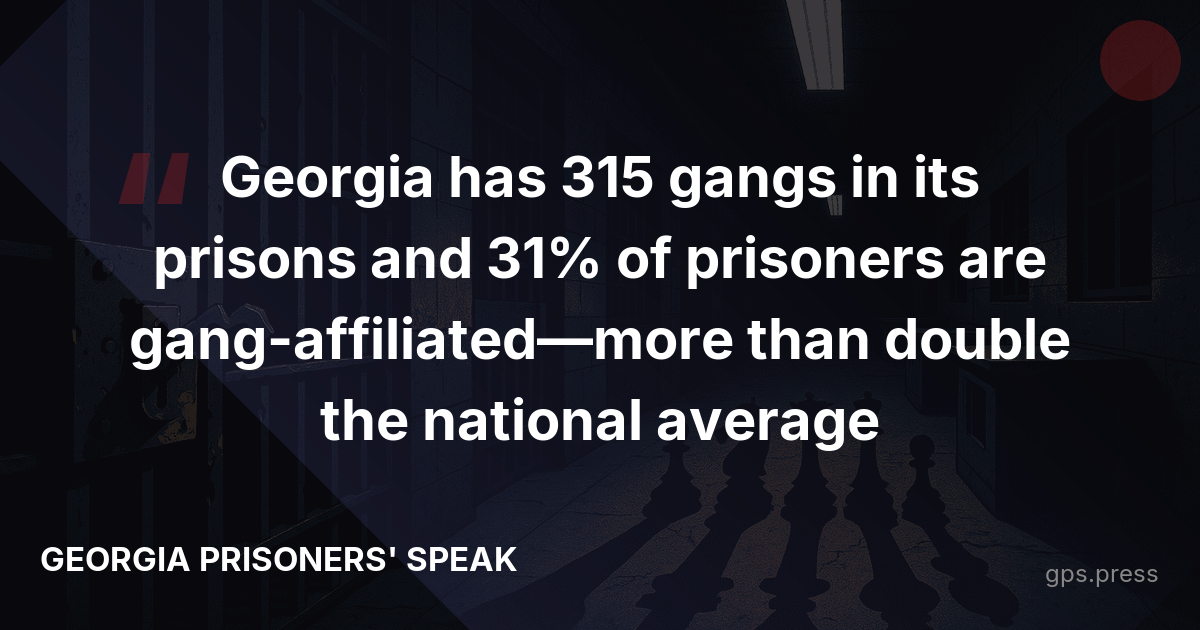
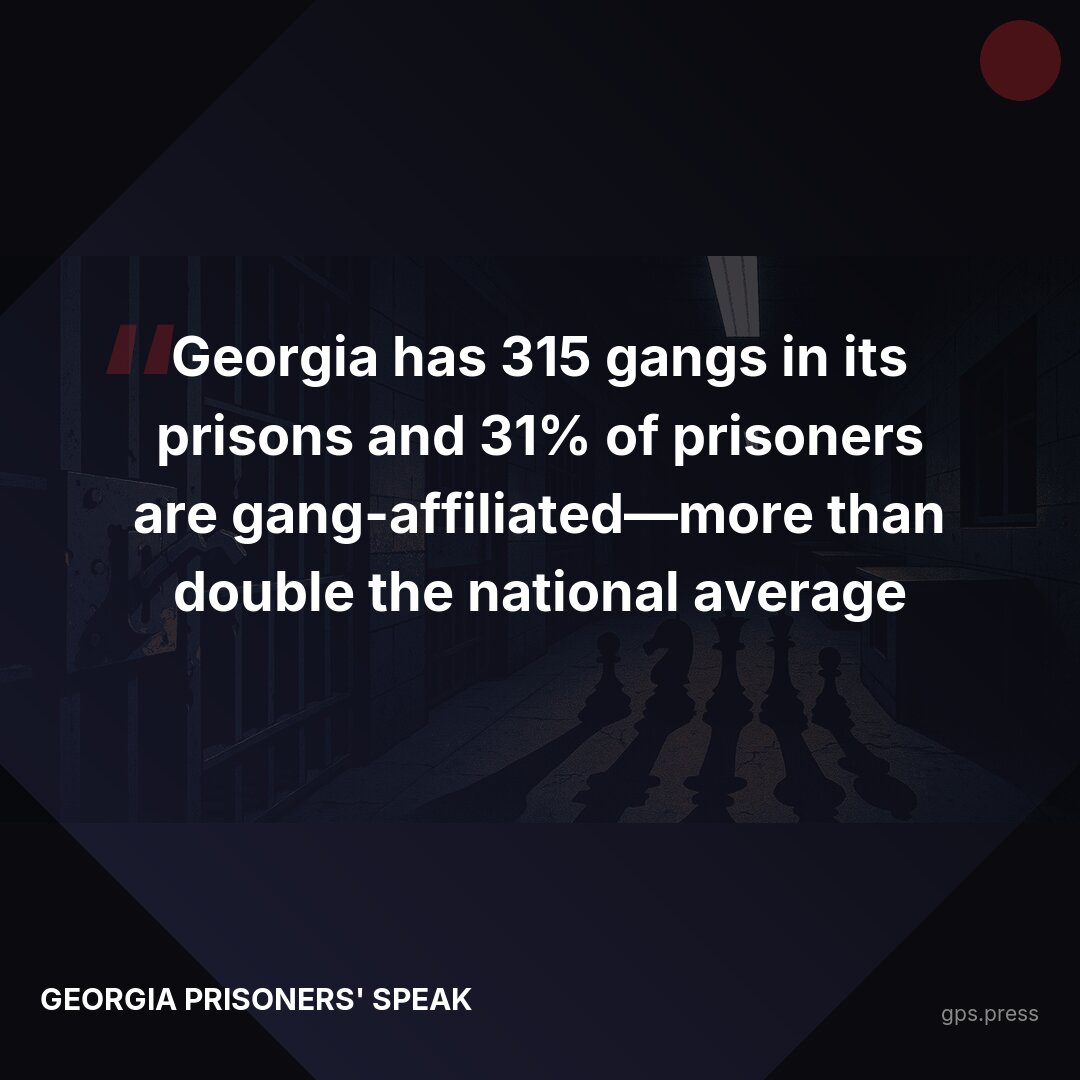
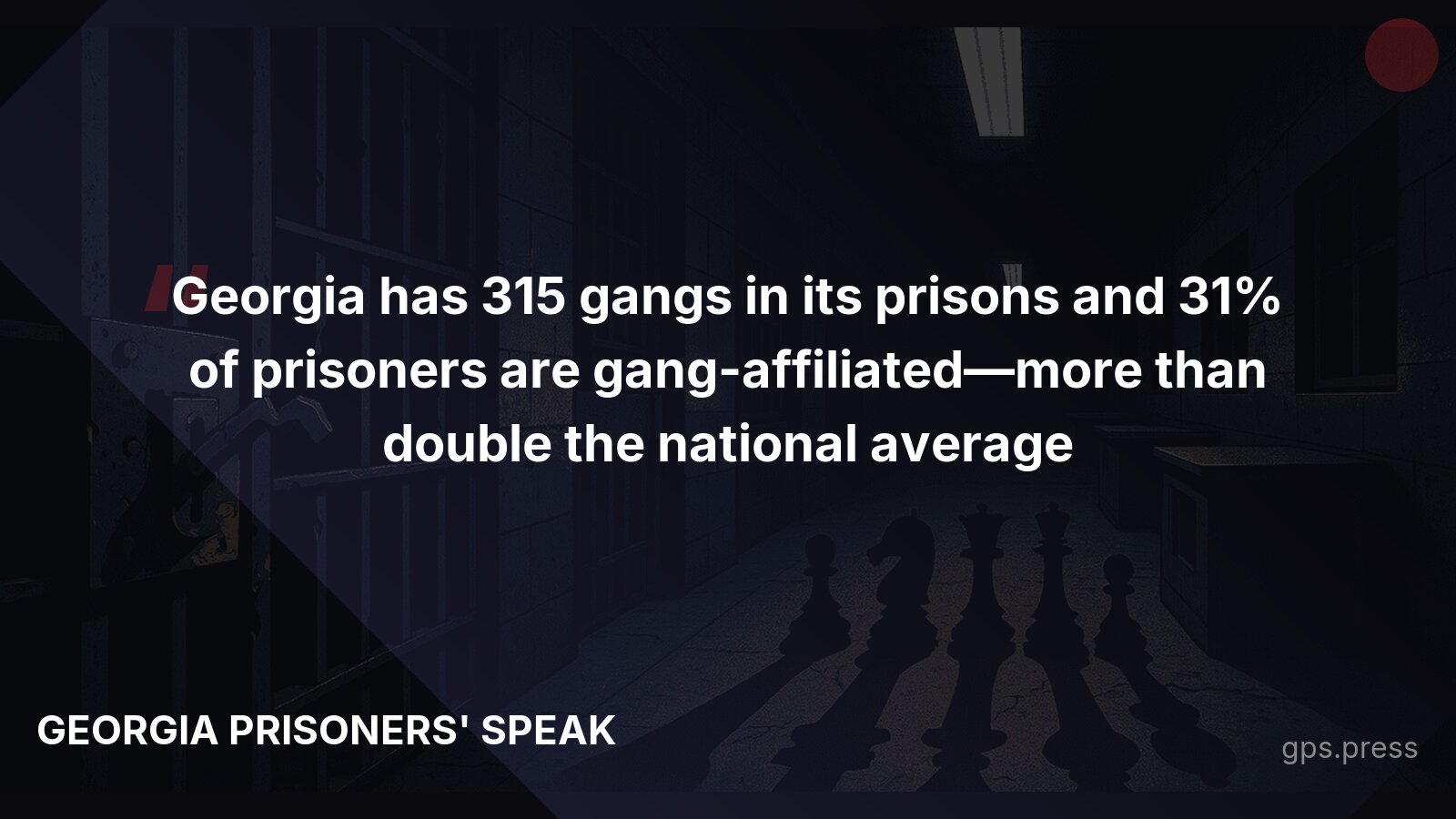
Georgia has identified 315 different gangs operating inside its prison system. It has validated roughly 15,200 people—31% of its entire incarcerated population—as gang-affiliated. 3 That rate is more than double the national average of approximately 13%. 4 And despite knowing all of this, Georgia has no systematic gang separation housing policy, no structured gang renouncement or exit program, and no dedicated operational strategy for keeping rival factions apart.
Other states faced the same problem decades ago. Texas, Arizona, and California each developed comprehensive approaches—housing-based separation, intelligence-driven classification, structured exit programs, and incentive systems that gave incarcerated people a pathway out of gang life. The evidence base is substantial. The results are documented. Georgia has chosen to ignore all of it.
The cost of that choice is measured in bodies.
The Scale of Georgia’s Gang Crisis
The numbers tell a story of institutional collapse. In 2018, seven people were killed inside Georgia’s prisons. By 2024, the Atlanta Journal-Constitution said the GDC had confirmed at least 66 homicides, GPS had a count of 100 homicides—a figure that GDC’s own count of 66 dramatically understated. 5 GPS identified 333 total deaths in GDC custody that year, making 2024 the deadliest year in state history.
The U.S. Department of Justice estimated that Georgia’s in-prison homicide rate was nearly eight times the national average. 6 Between January 2022 and April 2023 alone, close- and medium-security prisons recorded more than 1,400 violent incidents—and the DOJ emphasized that this was a severe undercount due to chronic underreporting.
This escalation tracks directly with two converging crises: the expansion of gang control and the collapse of staffing. GDC employed 6,383 correctional officers in 2014. By 2024, that number had fallen to 2,776—a 56% decline—while the prison population remained essentially flat at around 49,000 people. The Guidehouse consultants hired by Governor Kemp found that in 20 of 34 state prisons, more than half of correctional officer positions were unfilled. In eight prisons, the vacancy rate exceeded 70%. The national standard for a functional prison is a vacancy rate of no more than 10%. 7
The result is predictable: gangs have filled the vacuum that the state abandoned.
“Effectively Running the Facilities”
The DOJ’s October 2024 findings report did not hedge its language. Federal investigators found that gangs control multiple aspects of day-to-day life in the prisons they examined—access to phones, showers, food, and bed assignments. Gang members dictate where non-gang prisoners sleep, overriding the housing assignments made by classification officers. They sell bed space. They force prisoners to sleep on floors or in common areas. They extort family members to pay for protection. They use violence to collect debts from cellphone and drug sales.
“Breakdowns in basic security procedures” had opened “a path for gang control over much of the prison system.”
— U.S. Department of Justice, October 2024 8
The Guidehouse consultants independently confirmed that at some prisons, gangs are “effectively running the facilities.” 7 Correctional officers, vastly outnumbered, play along with gang-controlled housing arrangements—counting prisoners as present in their assigned locations when they are actually sleeping wherever gangs have placed them. DOJ investigators described one facility where a single officer was responsible for tracking 400 beds. At that ratio, supervision is a fiction.
Meanwhile, the Guidehouse consultants found that prisoners can leave their cells at will, enter other cells, access pipe chases and ventilation areas, reach rooftops, and move freely between housing areas—all due to widespread failure of locks, hollow-wall construction, wood doors, and drop ceilings. Commissioner Tyrone Oliver acknowledged that repairing all the locks on cells alone “will take years.” 9
The infrastructure is broken. The staffing is gone. And Georgia’s response to the gangs that filled the void has been, essentially, nothing.
Georgia’s Non-Strategy: Intelligence Without Management
GDC has a Security Threat Group Unit. Its self-described mission is to “effectively validate STG related persons, gather intelligence on STG related criminal activities, and provide investigative support in all STG related occurrences.” 10 This is an intelligence function. It is not a management function.
GDC’s classification Standard Operating Procedures—SOPs 220.02 and 220.03—address security classification and housing assignment based on offense severity, sentence length, and behavior. Gang affiliation is not a primary housing determinant. 11 There is no systematic protocol for housing gang members based on their affiliation, no process for separating rival factions, and no structured pathway for people who want to leave gang life.
GDC’s response to gang incidents is reactive, not proactive. When conflicts arise, facilities go on lockdown. The DOJ documented this cycle: violence erupts, a lockdown is imposed, the lockdown eventually lifts, and the same gang-controlled dynamics reassert themselves because nothing about the housing arrangement has changed.
At the state level, Georgia’s primary gang strategy is criminal prosecution. Attorney General Chris Carr created Georgia’s first statewide Gang Prosecution Unit, which has secured 52 convictions and indicted more than 140 individuals across 13 counties. 12 Recent high-profile cases include the conviction of 16 defendants in Barrow County for a gang operation directing criminal activity both inside and outside prisons—ordering hits, trafficking fentanyl, and recruiting. 13
Prosecution matters. But prosecution alone is not a correctional management strategy. You cannot prosecute your way out of a problem when 15,200 validated gang members are housed together with no separation plan, no exit program, and no consequences for continued affiliation inside the walls.
Texas: The Comprehensive Model
Texas faced a devastating gang violence crisis in its prisons during the late 1980s and 1990s. The state’s response became a model for the nation.
The Texas Department of Criminal Justice formally recognizes 12 Security Threat Groups and monitors numerous additional “disruptive groups.” Its approach rests on three pillars: separation, consequences, and exit pathways. 14
Separation. After a formal confirmation process, members of recognized STGs are automatically placed in administrative segregation. This is a status-based decision—membership alone triggers separation, not just observed behavior. TDCJ operates a dedicated Security Threat Group Management Office (STGMO) in Huntsville that coordinates validation, intelligence, and classification decisions across the entire system.
Consequences. TDCJ makes the costs of continued gang membership concrete: no contact visits, restricted phone access, no participation in academic or vocational activities, no work assignments, restricted movement, placement in restrictive housing, notification of state and local law enforcement upon release, and potential impact on parole consideration. The Texas Board of Pardons and Paroles must consider gang membership as a factor in parole decisions.
Exit pathways. TDCJ offers the GRAD (Gang Renouncement and Disassociation) program—a structured nine-month, three-phase process for people who wish to leave gang life. Phase I focuses on substance abuse and chaplaincy. Phase II addresses cognitive intervention and anger management. Phase III combines half-day work with structured programming. For repeat offenders returning to TDCJ who would otherwise be automatically placed in restrictive housing due to prior validation, the six-month RP-GRAD program allows immediate engagement in a renouncement process incorporating cognitive-behavioral strategies. 15
The results in Texas were dramatic. Research by Ralph and Marquart demonstrated that while segregating gang leaders alone was not sufficient, the wholesale separation of confirmed gang affiliates produced major reductions in both homicide and assault across the system. 16 Data from 1990 to 1999 showed gang-related incidents dropped dramatically after implementation.
Texas uses prosecution as one element of a comprehensive strategy that also includes housing-based separation, intelligence-driven classification, and structured exit programs. Georgia relies on prosecution almost exclusively.
Arizona: The Most Rigorously Evaluated Program
Arizona’s experience provides the strongest peer-reviewed evidence for gang separation as a violence reduction strategy.
The Arizona Department of Corrections instituted its Security Threat Group program in stages beginning in 1991, formalizing it through policy revisions in 1994, 1995, and 1997. Researchers at Arizona State University, led by Dr. Marie L. Griffin, conducted a comprehensive National Institute of Justice-funded evaluation of the program’s outcomes. 17
The findings were striking:
- Placing gang members in the SMU II (a dedicated restrictive housing unit for STG members) produced rates of assault, drug violations, threats, fighting, and rioting that all declined by over 50%
- The program produced a 30% system-wide reduction in total rule violations—a deterrent effect extending beyond the segregated population
- Researchers estimated the program may have prevented as many as 22,000 rule violations system-wide, including 5,700 violations among gang members specifically
- Gang members committed violations at a rate two to three times that of non-gang inmates, confirming that targeted intervention was warranted
Arizona also offered a formal renouncement option, though the evaluation found that violation decreases among those who renounced were not statistically significant—suggesting that renouncement programs need to be paired with robust post-exit support and monitoring. The program’s power lay in the combination of separation, monitoring, consequences, and the availability of an exit pathway, not in any single component.
California: The Cautionary Tale and the Reform
California’s history illustrates both the dangers of an overly punitive approach and the possibility of evidence-based reform.
For decades, California’s Department of Corrections and Rehabilitation used indefinite solitary confinement as its primary gang management tool. At Pelican Bay State Prison alone, more than 500 prisoners had been held in the Security Housing Unit for over 10 years, and 78 had been there for over 20 years—based solely on alleged gang affiliation rather than specific violent conduct. 18
This approach was both cruel and ineffective. Gang leaders demonstrated they could order hits, run drug operations, and direct extortion rackets from inside the SHU through notes hidden in legal mail and messages carried by parolees.
The 2015 Ashker v. Governor of California settlement fundamentally transformed the state’s approach. CDCR would no longer place inmates in the SHU based solely on gang affiliation; placement required a finding of guilt for a serious SHU-eligible rule violation. Indeterminate SHU sentences were eliminated. A Step-Down Program was created—a two-year, four-step process for inmates whose SHU-eligible violations were gang-related. No prisoner could be held involuntarily at Pelican Bay SHU for more than five years.
By June 2015, CDCR’s Departmental Review Board had conducted 1,274 reviews of SHU inmates. Of those, 910 were released or endorsed for release to general population. 19
The crucial finding: California’s Legislative Analyst’s Office found no evidence that these policy changes led to increased gang activity. Key violence metrics were actually heading in a positive direction.
California’s lesson is twofold. Pure isolation without programming does not work—it is inhumane and operationally futile. But a structured, behavior-based system with clear incentives and step-down pathways can reduce both segregation populations and violence simultaneously.
The National Consensus Georgia Is Ignoring
The evidence base is not limited to individual state case studies. A 2010 review of 42 state policies and a 2012 survey of 44 prison systems found that between 30% and 36% of states segregated individuals solely on the basis of gang affiliation. 20 Administrative data from California, Colorado, and Texas showed that gang affiliates were between 6 and 71 times more likely to be placed in restrictive housing than non-gang inmates. Nationally, about 12% of gang affiliates are in restrictive housing on any given day, compared to just 4% of non-gang inmates.
The National Institute of Justice concluded that step-down and gang-exit programs represent a “positive move toward jointly reducing the influence of gangs and overuse of restrictive housing.” The NIJ also noted an important caution: no programs to date have been rigorously shown to permanently remove people from prison gangs, and called for programs to be held to leading scientific standards of evaluation. 20
An Ohio study added an additional insight: gang affiliates leaving restrictive housing without adequate programming fared worse afterward, engaging in higher levels of misconduct. Separation without structured reintegration may simply delay rather than prevent violence.
The consensus is clear: some form of targeted gang management strategy—combining separation, programming, consequences for continued affiliation, and structured exit pathways—is standard practice in corrections systems that take violence reduction seriously. Georgia stands virtually alone among major prison systems in having none of these components.
$600 Million Without a Plan
In January 2025, Governor Kemp proposed $600 million in emergency spending for Georgia’s prisons. The proposal included $40 million for planning and design of a new prison, a new 3,000-bed facility behind Washington State Prison, 446 additional private prison beds, four 126-bed modular correctional units, a five-person “Tiger Team” for locks and security electronics, a 4% salary increase for correctional officers, and emergency facility repairs. 9
The proposal addresses staffing and infrastructure. It explicitly omits gang management reform. As the AJC noted, the recommendations “speak directly to some of the DOJ’s concerns—particularly staffing and facility conditions—but not others, including sexual safety and the management of gang members.” 21
GPS has characterized this as “infrastructure without transformation. Locks get replaced. Walls get thicker. Beds get ‘hardened.’ But culture and care—the human infrastructure that makes safety possible—are not being rebuilt with the same urgency.” 22
You can spend $600 million building walls and fixing locks. But if 15,200 validated gang members are still housed with no separation strategy, no exit program, and no consequences for continued affiliation—those walls will contain the same violence they always have.
The Human Cost of Inaction
The financial toll alone is staggering. GPS estimates that 800 to 1,200 non-fatal assault victims in 2024 required some level of medical treatment, with emergency trauma costs ranging from $20,000 to $40,000 per patient and inpatient hospitalization adding $2,000 to $3,000 per day. If even half of these victims were hospitalized, Georgia taxpayers shouldered tens of millions in medical costs the state does not publicly account for.
But the true cost is not financial. It is the four men who died at Washington State Prison in January 2026 in a “disturbance” that GDC could only describe as involving “multiple inmates believed to be gang-affiliated.” It is the two deaths at Hancock State Prison. It is the nine hospitalized at Wilcox. It is the hundreds of assaults that will never be reported, never be counted, and never be investigated.
Every one of those incidents occurred in a system that has identified 315 gangs and 15,200 gang-affiliated prisoners—and built no strategy whatsoever for managing them.
The DOJ has already found Georgia in violation of the Eighth Amendment for failing to protect inmates from violence. The state is currently negotiating a potential settlement that could include federal oversight. The validated gang population has nearly doubled since 2014 while staffing has been cut in half. And of those newly hired officers who do make it through the door, 82.7% quit within the first year.
Georgia does not lack information. It does not lack examples. It does not lack evidence. Texas, Arizona, and California all confronted explosive gang violence in their prisons and built systematic responses—imperfect, evolving, but deliberate. Georgia has chosen, year after year, to know the problem and do nothing about it.
The gangs did not seize power. Georgia abandoned it.
Call to Action: What You Can Do
Four people died in January at Washington State Prison in gang violence that Georgia could have prevented. The state knows it has 315 gangs operating with no management strategy while other states solved this crisis decades ago. Share this investigation—silence makes you complicit in the deaths that follow.
Spread the Word — It Takes 15 Seconds
Awareness without action changes nothing. Here’s how you can help push for accountability and real reform:
Use Impact Justice AI — Our free tool at https://impactjustice.ai lets you instantly draft and send personalized emails to lawmakers, journalists, and agencies. No expertise required.
Tell My Story — Are you or a loved one affected by Georgia’s prison system? GPS publishes first-person accounts from incarcerated people and their families. Submit your story at https://gps.press/category/tellmystory/ and help the world understand what’s really happening behind the walls.
Contact Your Representatives — Your state legislators control GDC’s budget, oversight, and the laws that created these failures. Find your Georgia legislators at https://open.pluralpolicy.com/ga/ or call Governor Kemp at (404) 656-1776 or the GDC Commissioner at (478) 992-5246.
Demand Media Coverage — Contact newsrooms at the AJC, local TV stations, and national criminal justice outlets. More coverage means more pressure.
Amplify on Social Media — Share this article and tag @GovKemp, @GDC_Georgia, and your local representatives. Use #GAPrisons, #PrisonReform, #GeorgiaPrisonerSpeak.
File Public Records Requests — Georgia’s Open Records Act gives every citizen the right to request incident reports, death records, staffing data, medical logs, and financial documents at https://georgiadcor.govqa.us/WEBAPP/_rs/SupportHome.aspx.
Attend Public Meetings — The Georgia Board of Corrections and legislative committees hold public meetings. Your presence is noticed.
Contact the Department of Justice — File civil rights complaints at https://civilrights.justice.gov. Federal oversight has forced abusive systems to change before.
Support Organizations Doing This Work — Donate to or volunteer with Georgia-based prison reform groups fighting for change on the ground.
Vote — Research candidates’ positions on criminal justice. Primary elections often determine outcomes in Georgia.
Contact GPS — If you have information about conditions inside Georgia’s prisons, reach us securely at GPS.press.
Further Reading
Separate the Gangs or Keep Burying the Dead
GPS’s original investigation into gang-driven violence in Georgia prisons and the state’s failure to implement separation policies.
They Knew: Empty Posts, Broken Locks, and Georgia’s Deadliest Prison Week
How staffing collapse and infrastructure failures set the stage for Georgia’s worst week of prison violence.
Forced Criminality: Inside Georgia’s Prison Violence Factory
An in-depth examination of how Georgia’s prisons force non-violent offenders into violent survival dynamics controlled by gangs.
The Hidden Violence in Georgia’s Prisons: Beyond the Death Toll
GPS’s analysis of the staggering scale of non-fatal violence in GDC facilities that official statistics fail to capture.
Georgia’s “Hardened” Solution: Another Fortress Instead of Reform
Why Governor Kemp’s $600 million spending proposal builds infrastructure without addressing the systemic failures driving the crisis.
The Classification Crisis: How Four Medium Security Prisons are Killing People
How GDC’s broken classification system places people in danger by ignoring gang affiliation and threat levels in housing decisions.
Research Explainers
GPS Research Explainers distill complex data and legal research into accessible briefings. These explainers are directly relevant to the issues covered in this article:
Gangs Run Georgia’s Prisons. Other States Fixed This Problem Years Ago.
A data-driven briefing comparing Georgia’s absence of gang management strategy to the proven approaches used by Texas, Arizona, and California.
Empty Guard Towers, Rising Death Tolls: The Prison Staffing Crisis Killing People in Georgia
Research explainer examining how the 56% collapse in correctional officer staffing created the vacuum that gangs filled across Georgia’s prison system.
Explore the Data
GPS makes GDC statistics accessible to the public through several resources:
- GPS Statistics Portal — Interactive dashboards translating complex GDC reports into accessible formats, updated within days of official releases.
- GPS Lighthouse AI — Ask questions about Georgia’s prison system and get answers drawn from GPS’s investigative archive and data analysis.
- Machine-Readable Pages for Researchers — GPS maintains AI-optimized pages for data analysis:
- AI Content Index — https://gps.press/ai-index/
- Facilities Data — https://gps.press/facilities-data/
- Statistics Data — https://gps.press/statistics-data/
- Release Statistics Data — https://gps.press/release-statistics-data/
- Mortality Data — https://gps.press/mortality-data/
- Blog Data — https://gps.press/blog-data/
- GPS News Data — https://gps.press/gps-news-data/
- FAQ Index — https://gps.press/faq-index/
- Featured Articles Index — https://gps.press/featured-index/
- Length of Stay Data — https://gps.press/los-data/
- Drug Admission Profiles — https://gps.press/drug-data/
- Commissary Pricing Data — https://gps.press/commissary-data/
- GDC Standard Operating Procedures — https://gps.press/sop-data/
- GPS Research Library — https://gps.press/research/
- GPS Quote Bank — https://gps.press/quotes-data/
- Research Explainer Data — https://gps.press/explainer-data/
- Research Explainers for Families — https://gps.press/research-for-families/
- Research Explainers for Legislators — https://gps.press/research-for-legislators/
- Research Briefings for Media — https://gps.press/research-for-media/
- Research Explainers for Advocates — https://gps.press/research-for-advocates/
How to Use GPS Data with AI Tools
A step-by-step guide showing researchers, advocates, families, and journalists how to use GPS’s machine-readable data pages with AI tools like ChatGPT, Claude, and Gemini to analyze Georgia prison conditions, statistics, and policy.
Contact GPS at media@gps.press for access to underlying datasets used in this analysis.
About Georgia Prisoners’ Speak (GPS)
Georgia Prisoners’ Speak (GPS) is a nonprofit investigative newsroom built in partnership with incarcerated reporters, families, advocates, and data analysts. Operating independently from the Georgia Department of Corrections, GPS documents the truth the state refuses to acknowledge: extreme violence, fatal medical neglect, gang-controlled dorms, collapsed staffing, fraudulent reporting practices, and unconstitutional conditions across Georgia’s prisons.
Through confidential reporting channels, secure communication, evidence verification, public-records requests, legislative research, and professional investigative standards, GPS provides the transparency the system lacks. Our mission is to expose abuses, protect incarcerated people, support families, and push Georgia toward meaningful reform based on human rights, evidence, and public accountability.
Every article is part of a larger fight — to end the silence, reveal the truth, and demand justice.

Footnotes
- 41NBC, UPDATE: GDC confirms fourth inmate death tied to Washington State Prison disturbance, https://www.41nbc.com/fourth-inmate-death-washington-state-prison-disturbance/ [↩]
- AJC, Gang-related violence results in two deaths at Georgia prison, https://www.ajc.com/news/crime/gang-related-violence-results-in-two-deaths-at-georgia-prison/B5VUNMEMBFBW7CE6MZIPZCVFTQ/ [↩]
- GDC Hosts Security Threat Group (STG) Training and Awards Ceremony, https://gdc.ga.gov/NewsRoom/PressReleases/gdc-hosts-security-threat-group-stg-training-and-awards-ceremony [↩]
- National Institute of Justice, Using Restrictive Housing to Manage Gangs in U.S. Prisons, https://nij.ojp.gov/topics/articles/using-restrictive-housing-manage-gangs-us-prisons [↩]
- Corrections1/AJC, Consultants: Ga. prisons in ’emergency mode’ with gang influence rising, https://www.corrections1.com/investigations/consultants-ga-prisons-in-emergency-mode-with-gang-influence-rising [↩]
- DOJ Findings Report Oct 2024, https://www.justice.gov/d9/2024-09/findings_report_-_investigation_of_georgia_prisons.pdf [↩]
- AJC, Georgia prisons are in crisis say consultants hired by Gov. Kemp, https://www.ajc.com/news/investigations/georgia-prisons-in-crisis-say-consultants-hired-by-governor/5P6BELWL4ZE7LK2BKWP3QT6Y2E/ [↩][↩]
- DOJ Findings Report Oct 2024, https://www.justice.gov/d9/2024-09/findings_report_-_investigation_of_georgia_prisons.pdf [↩]
- Governor Kemp Unveils Recommendations from System-wide Corrections System Assessment, https://gov.georgia.gov/press-releases/2025-01-07/gov-kemp-unveils-recommendations-system-wide-corrections-system [↩][↩]
- GDC Security Threat Groups Unit, https://gdc.georgia.gov/organization/about-gdc/divisions-and-org-chart/executive-operations/office-professional-3 [↩]
- GDC Standard Operating Procedures, https://public.powerdms.com/GADOC/documents/105818 [↩]
- GA Attorney General, Carr Achieves Unprecedented Success in Fight Against Human Trafficking and Gang Activity, https://law.georgia.gov/press-releases/2025-01-08/carr-achieves-unprecedented-success-fight-against-human-trafficking-and [↩]
- GA Attorney General, Carr Convicts 16 in Barrow County Shuts Down Prison Gang Operation, https://law.georgia.gov/press-releases/2025-12-03/carr-convicts-16-barrow-county-shuts-down-prison-gang-operation [↩]
- TDCJ, Security Threat Groups on the Inside, https://www.tdcj.texas.gov/documents/cid/STGMO_FAQ_Pamphlet_English.pdf [↩]
- TDCJ, Rehabilitation and Reentry Division: RP GRAD Program, https://www.tdcj.texas.gov/divisions/rrd/asdp.html [↩]
- Corrections1, Gang suppression and institutional control, https://www.corrections1.com/prison-gangs/articles/gang-suppression-and-institutional-control-zrwUPhjCTc7DObFU/ [↩]
- Arizona State University/NIJ, Security Threat Group Program Evaluation Final Report, https://www.ojp.gov/pdffiles1/nij/grants/197045.pdf [↩]
- CCR, Summary of Ashker v. Governor of California Settlement Terms, https://ccrjustice.org/sites/default/files/attach/2015/08/2015-09-01-Ashker-settlement-summary.pdf [↩]
- Solitary Watch, After California Prisons Release Gang Affiliates From Solitary Confinement Costs and Violence Levels Drop, https://solitarywatch.org/2016/02/29/after-california-releases-gang-affiliates-from-solitary-confinement-costs-and-violence-levels-drop/ [↩]
- NIJ, Restrictive Housing in the U.S.: Issues Challenges and Future Directions, https://www.ojp.gov/pdffiles1/nij/250319.pdf [↩][↩]
- Corrections1/AJC, Governor seeks $600M to fix Ga. prisons improve staffing and safety, https://www.corrections1.com/jail-management/governor-seeks-600m-to-fix-ga-prisons-improve-staffing-and-safety [↩]
- GPS, Georgia’s Hardened Solution: Another Fortress Instead of Reform, https://gps.press/georgias-hardened-solution-another-fortress-instead-of-reform/ [↩]