State Spending on Prisons and Corrections (2000–Present)
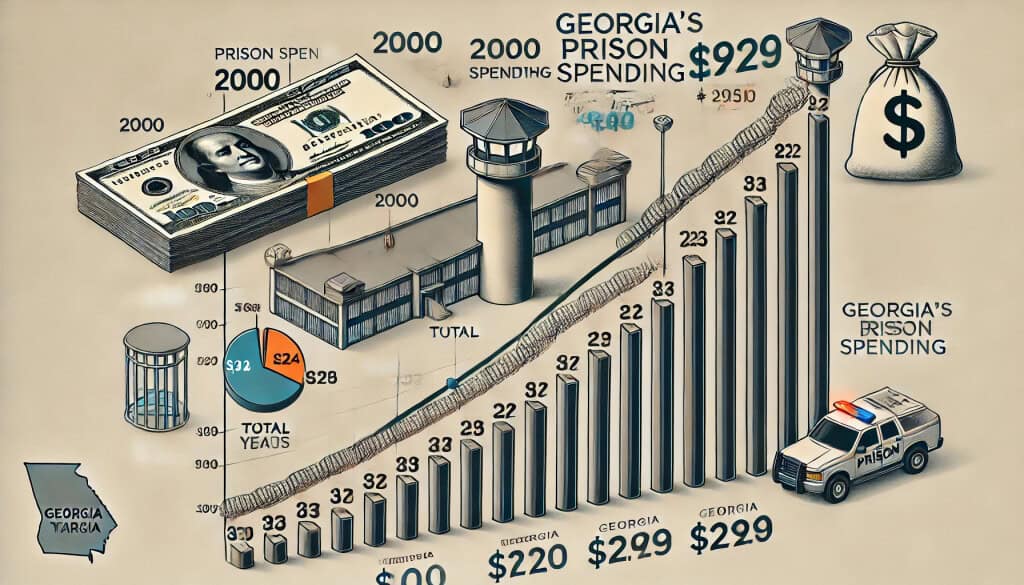
Georgia’s investment in corrections has grown dramatically since 2000. By 2007 the Georgia Department of Corrections (GDC) budget surpassed $1 billion for the first time, and it climbed to about $1.5 billion in 2016[efn_note] https://www.acluga.org/sites/default/files/sj-blueprint-ga.pdf [/efn_note]. This reflects a steep rise – general fund corrections spending grew 242% from 1986 to 2016 [efn_note] https://www.acluga.org/sites/default/files/sj-blueprint-ga.pdf [/efn_note].
The upward trend has intensified in recent years. For Fiscal Year (FY) 2025, Governor Brian Kemp proposed a $1.48 billion budget for GDC, nearly $153 million higher than what was initially approved for FY 2024. With the Governor’s additional recommendations of $372 million in state spending to strengthen Georgia’s prison system, the total state funds allocated to GDC would reach just under $1.9 billion for fiscal year 2025. This represents part of a three-year trend of rising state prison spending under the current administration, primarily responding to safety and staffing concerns.
Beyond regular operations, Georgia has made substantial special appropriations for prison facilities. In 2012, analysts warned the state would need to spend an additional $264 million by 2018 to expand prison capacity [efn_note] https://www.pewtrusts.org/~/media/legacy/uploadedfiles/pcs_assets/2012/pewgeorgiasafetyreformpdf.pdf [/efn_note]. In February 2024, the Georgia legislature approved over $436 million for the construction of a 3,000-bed mega prison in Davisboro, Washington County[efn_note]https://southeastgeorgiatoday.com/index.php?option=com_content&view=article&id=97195%3Amega-prison-under-construction-in-washington-county&catid=1023 [/efn_note]. The project is described as the largest ever built by the State of Georgia.
More recently, prison infrastructure needs have led to massive funding increases. The FY 2025 and FY 2026 budget proposals combined include more than $603 million for the Georgia Department of Corrections to address various needs including staff recruitment and retention, facility improvements, bed space expansion, and inmate health needs. This significant investment comes amid a crisis of violence and understaffing in state prisons [efn_note] https://www.ajc.com/opinion/columnists/georgias-prisons-are-in-crisis-its-time-for-oversight-and-accountability/ [/efn_note].
Corrections spending isn’t limited to prisons. Georgia’s probation budget nearly doubled between 2012 and 2020 [efn_note] https://gbpi.org/georgia-criminal-legal-system-budget-primer-for-state-fiscal-year-2021/ [/efn_note] to handle one of the nation’s largest supervised populations—about 1 in 13 adults in Georgia is on felony probation [efn_note] https://www.acluga.org/sites/default/files/sj-blueprint-ga.pdf [/efn_note]. In FY 2021, the Department of Community Supervision was allocated $166 million, with probation services comprising 92% of that budget [efn_note] https://gbpi.org/georgia-criminal-legal-system-budget-primer-for-state-fiscal-year-2021/ [/efn_note].
Cumulatively, Georgia has likely spent well over $35 billion on corrections from 2000 to 2024. This massive investment raises a critical question: Has it bought Georgia improved public safety?
Prison Spending vs. Crime Rates: A Weak Correlation
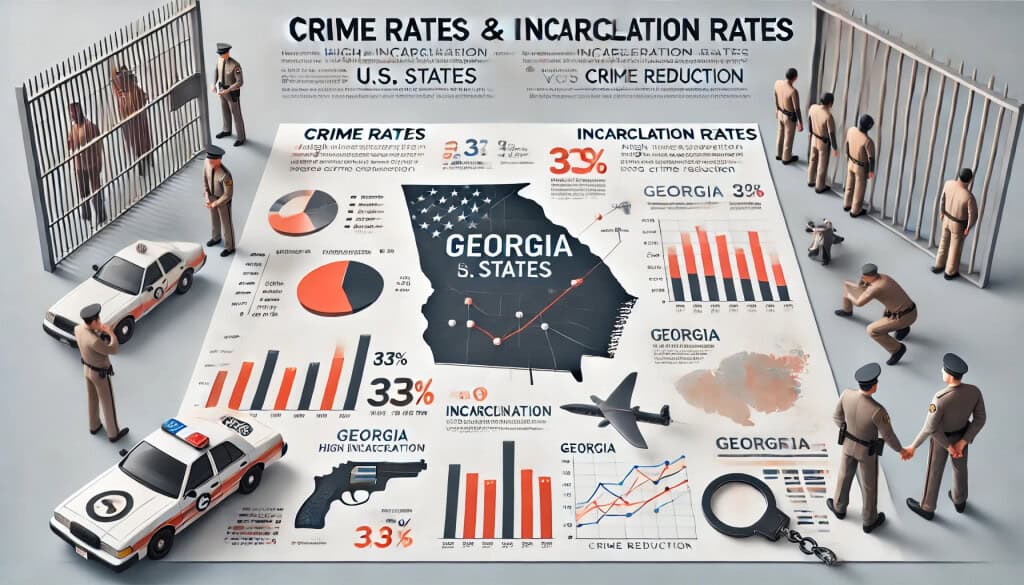
Georgia’s crime trends largely mirror national patterns, suggesting increased prison spending has not produced uniquely improved safety. By 2020, Georgia’s violent crime rate was 39% lower than in 1995 [efn_note] https://247wallst.com/special-report/2024/01/29/how-the-crime-rate-in-georgia-compares-to-the-rest-of-the-country/ [/efn_note]—a significant improvement, but one that parallels nationwide trends during a period when crime declined across America for various social and demographic reasons.
Research consistently shows little correlation between incarceration levels and crime rates beyond a certain threshold [efn_note] https://www.sentencingproject.org/reports/incarceration-and-crime-a-weak-relationship/ [/efn_note]. Many states that spent less or reduced their prison populations also saw significant crime declines. Louisiana, for example, reduced its prison population by 30% from 2013 to 2022 while experiencing an 18% decrease in crime [efn_note] https://www.sentencingproject.org/reports/incarceration-and-crime-a-weak-relationship/ [/efn_note].
Georgia is not demonstrably safer than other states despite its higher corrections spending. The state’s incarceration rate is 881 per 100,000 people (including prisons, jails, immigration detention, and juvenile facilities)—nearly three times higher than the U.S. average of 311 per 100,000—yet Georgia’s violent crime rate is only slightly lower than the national average (367 vs. 381 per 100,000 as of 2022) [efn_note] https://csgsouth.org/wp-content/uploads/Georgia-Criminal-Justice-Data-Snapshot.pdf [/efn_note]. States with far lower incarceration rates (like New York or Massachusetts) have comparable or lower crime rates.
A 2024 U.S. News & World Report ranking placed Georgia only 20th in the nation for “crime and corrections” outcomes [efn_note] https://www.fox5atlanta.com/news/georgias-best-states-ranking-moving-up-but-missing-the-top-10 [/efn_note]. For a state that incarcerates at one of the highest rates in the country, this middle-of-the-pack safety ranking suggests a poor return on investment.
Two key points illustrate this weak correlation:
- High Spending, Modest Crime Reduction: Georgia’s prison population doubled from 1990 to 2011 [efn_note] https://www.pewtrusts.org/~/media/legacy/uploadedfiles/pcs_assets/2012/pewgeorgiasafetyreformpdf.pdf [/efn_note], yet the state’s violent crime decline in that period aligned with national trends. Despite the massive expansion, recidivism rates remained stubbornly high at around 30% [efn_note] https://www.acluga.org/sites/default/files/sj-blueprint-ga.pdf [/efn_note].
- Crime Fluctuations Despite Consistent High Spending: In recent years, Georgia saw increases in certain violent crimes despite maintaining high incarceration levels. This indicates other factors (economic conditions, social dynamics, etc.) likely influence crime rates more than prison spending.
Studies consistently find that beyond a certain incarceration threshold, additional prison spending yields diminishing public safety returns [efn_note] https://www.sentencingproject.org/reports/incarceration-and-crime-a-weak-relationship/ [/efn_note]. Georgia appears to have crossed this threshold long ago, continuing to invest heavily in a system that delivers increasingly marginal safety improvements.
The Hidden Costs: Beyond State Budgets
The true cost of Georgia’s corrections approach extends far beyond state prison budgets and includes substantial expenditures at the county level and indirect economic costs to communities.
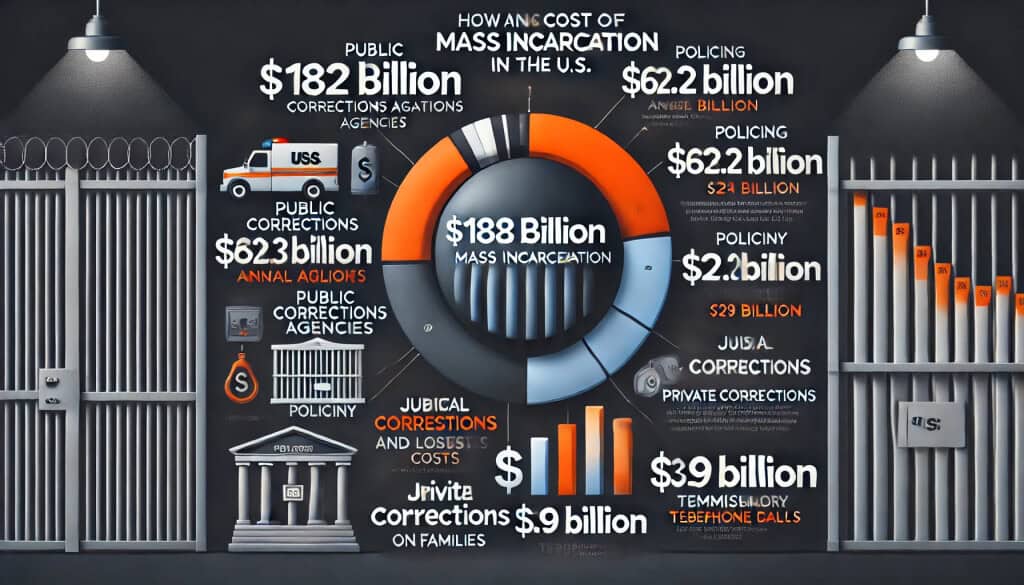
A groundbreaking report by the Prison Policy Initiative titled “Following the Money of Mass Incarceration”[efn_note]https://www.prisonpolicy.org/reports/money.html [/efn_note] found that nationwide, mass incarceration costs governments and families of justice-involved people at least $182 billion every year—more than double the $81 billion reported by the Bureau of Justice Statistics, which only accounts for operating prisons, jails, parole, and probation. This higher figure includes often-overlooked costs borne by incarcerated persons and their families, as well as profits made by private companies like bail bond companies ($1.4 billion) and commissary vendors ($1.6 billion).
Even more staggering, researchers at the Institute for Justice Research and Development estimate the true economic burden of incarceration at approximately one trillion dollars annually—approaching 6% of GDP and eleven times larger than direct corrections spending[efn_note]https://ijrd.csw.fsu.edu/sites/g/files/upcbnu1766/files/media/images/publication_pdfs/Economic_Burden_of_Incarceration_IJRD072016_0_0.pdf [/efn_note]. Their study identified twenty-three different costs, with more than half being borne by families, children, and community members who have committed no crime. When applied to Georgia’s exceptionally high incarceration rate, these national figures suggest the state’s true corrections cost likely reaches tens of billions annually beyond what appears in the state budget[efn_note]https://eji.org/news/mass-incarceration-costs-182-billion-annually/ [/efn_note].
County Jail and Court Expenses
Georgia’s 159 counties shoulder significant expenses for local jails, courts, and legal systems. These costs are substantial:
- County Jails: An estimated 236,000 people cycle through Georgia jails each year [efn_note] https://www.prisonpolicy.org/profiles/GA.html [/efn_note], with 59% of the jail population consisting of legally innocent people held pretrial [efn_note] https://www.prisonpolicy.org/profiles/GA.html [/efn_note]. Counties bear the cost of housing, feeding, and providing medical care for these detainees. Major counties like Fulton regularly face overcrowding crises requiring emergency funding [efn_note] https://gbpi.org/wp-content/uploads/2012/01/20080111_ToughOnCrimeandTheBudget.pdf [/efn_note].
- Courts and Legal System: Counties fund much of the court system’s operations, including district attorney offices, which have expanded to handle increased caseloads resulting from tough-on-crime policies. Public defender services, though partially state-funded at around $55 million annually [efn_note] https://gbpi.org/georgia-criminal-legal-system-budget-primer-for-state-fiscal-year-2021/ [/efn_note], also require county supplements.
- Fines and Fees Dependence: To offset these costs, many Georgia localities rely heavily on revenue from fines and fees imposed on defendants. At least 74 local governments derive over 10% of their budget from criminal justice fines and fees [efn_note] https://gbpi.org/regressive-revenue-perpetuates-poverty-why-georgias-fines-and-fees-need-immediate-reform/ [/efn_note], with some small cities generating more than 20% of their revenue this way [efn_note] https://gbpi.org/regressive-revenue-perpetuates-poverty-why-georgias-fines-and-fees-need-immediate-reform/ [/efn_note]. This creates perverse incentives and places the financial burden of the system on those least able to afford it.
This funding mechanism creates a self-perpetuating cycle: tough enforcement leads to more arrests and cases, requiring more funding for jails and courts, which is often extracted from defendants themselves through escalating fines and fees.
Economic and Social Costs to Communities
Beyond government budgets, Georgia’s high incarceration rate imposes immense indirect costs on families and communities:
- Financial Burden on Families: Georgia ranks among the least affordable states for prison phone calls [efn_note] https://gradynewsource.uga.edu/georgias-pricey-prison-jail-phone-fees-the-profitable-problem-facing-families-of-incarcerated-individuals/ [/efn_note]. A single Georgia family reported spending nearly $900 on prison phone calls in just a few months [efn_note] https://gradynewsource.uga.edu/georgias-pricey-prison-jail-phone-fees-the-profitable-problem-facing-families-of-incarcerated-individuals/ [/efn_note]. In 2019, Georgia prisons and jails collected over $8 million in commission revenue from phone calls alone [efn_note] https://gradynewsource.uga.edu/georgias-pricey-prison-jail-phone-fees-the-profitable-problem-facing-families-of-incarcerated-individuals/ [/efn_note]. Nationally, families spend about $2.9 billion annually on phone calls and commissary for incarcerated loved ones [efn_note] https://www.prisonpolicy.org/research/economics_of_incarceration/ [/efn_note].
- Lost Economic Productivity: Incarceration removes individuals from the workforce during their prime earning years. Former prisoners face unemployment rates of approximately 27% [efn_note] https://www.prisonpolicy.org/research/economics_of_incarceration/ [/efn_note] and see their earnings drop by about 52% compared to similar individuals never incarcerated [efn_note] https://www.prisonpolicy.org/research/economics_of_incarceration/ [/efn_note]. One study estimated that incarceration reduces an individual’s lifetime earnings by about $500,000 [efn_note] https://www.prisonpolicy.org/research/economics_of_incarceration/ [/efn_note]. With Georgia releasing around 465,000 men and 128,000 women from prisons and jails annually [efn_note] https://www.prisonpolicy.org/profiles/GA.html [/efn_note], the cumulative economic impact is enormous.
- Family and Community Destabilization: About half of incarcerated people nationally were the primary financial support for their families [efn_note] https://www.prisonpolicy.org/research/economics_of_incarceration/ [/efn_note]. Children with incarcerated parents often experience educational disruptions, with one study noting 10% don’t complete high school or college due to financial strain [efn_note] https://www.prisonpolicy.org/research/economics_of_incarceration/ [/efn_note]. Communities with high incarceration rates lose working-age adults and experience declining local purchasing power and tax contributions.
These indirect costs are rarely factored into assessments of Georgia’s corrections spending, yet they represent a substantial economic drain on the state’s most vulnerable communities.
Public Perception and Safety Realities

Despite Georgia’s massive investment in incarceration, public concern about crime remains high. This reflects a disconnect between actual crime rates (which have generally declined) and public perceptions of safety.
Georgia’s high-incarceration approach hasn’t meaningfully improved public confidence in safety. A 2022 survey showed around 70% of Georgians believed crime was increasing, despite data showing Georgia’s violent crime rate was about 4% lower than the national average that year [efn_note] https://csgsouth.org/wp-content/uploads/Georgia-Criminal-Justice-Data-Snapshot.pdf [/efn_note].
Adding to public concern, Georgia’s prisons themselves have become increasingly dangerous. The state experienced a record-high death toll in prisons in 2024, with 330 inmate deaths due to violence, suicide, or neglect [efn_note]https://gps.press/gdc-mortality-statistics/ [/efn_note]. And a record number of deaths, almost all homicides in Januart of 2025. (29 deaths with at least 13 homicides)[efn_note]https://gps.press/gdc-mortality-statistics/ [/efn_note]. Such conditions raise legitimate questions about whether the corrections system is achieving its basic objectives.
Georgia in National Context: An Outlier in Approach, Not Results
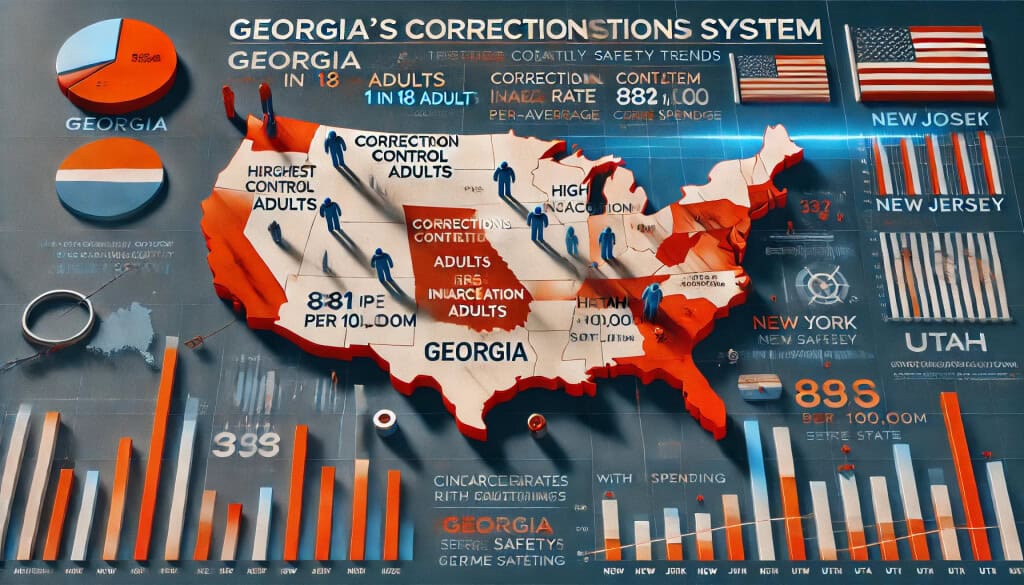
Georgia’s approach to corrections differs significantly from national trends, yet its safety outcomes remain unexceptional:
- Highest Correctional Control: Georgia has the highest rate of correctional control in the United States, with one out of every eighteen adults under some form of correctional supervision (incarcerated, on probation, or on parole). This rate is 73% higher than Pennsylvania, which has the second-highest correctional control rate in the country. With an incarceration rate of 881 per 100,000 people, Georgia locks up a higher percentage of its population than any independent democratic country on earth [efn_note] https://www.prisonpolicy.org/profiles/GA.html [/efn_note].
- Above-Average Spending: Georgia spends more per capita on corrections than most comparable states, yet ranks only 20th for “Crime & Corrections” outcomes in national rankings [efn_note] https://www.fox5atlanta.com/news/georgias-best-states-ranking-moving-up-but-missing-the-top-10 [/efn_note]. States like Maine, Vermont, and Utah rank in the top 10 for safety with far lower incarceration rates and costs.
- Divergence from Reform Trends: While Georgia briefly embraced justice reforms under Governor Nathan Deal that saved an estimated $264 million in avoided prison costs [efn_note] https://www.pewtrusts.org/~/media/legacy/uploadedfiles/pcs_assets/2012/pewgeorgiasafetyreformpdf.pdf [/efn_note], recent years have seen a return to higher corrections spending. Meanwhile, states like New York and New Jersey have dramatically reduced prison populations while maintaining or improving safety outcomes.
The comparison with other states is particularly telling. New Jersey cut its prison population nearly in half since 2000 while experiencing a roughly 45% reduction in violent crime. New York similarly reduced incarceration while achieving substantial safety improvements. These examples demonstrate that Georgia’s high-incarceration, high-cost approach is not the only—or the most effective—path to public safety.
A Better Approach: Evidence-Based Alternatives

Georgia’s experience aligns with a growing body of research suggesting more effective approaches to public safety:
- Focus on Prevention: Investing in education, mental health services, addiction treatment, and economic opportunity programs can address root causes of crime more effectively than incarceration.
- Targeted Interventions: Reserving incarceration for violent and high-risk offenders while diverting low-risk individuals to community supervision and treatment programs can reduce costs without compromising safety.
- Reduce Financial Barriers: Reforming fines, fees, and bail practices can prevent the criminalization of poverty and reduce the economic burden on vulnerable communities.
- Improve Prison Conditions: For those who must be incarcerated, investing in rehabilitation, education, and re-entry services rather than simply warehousing offenders can reduce recidivism and improve long-term outcomes.
Conclusion: Rethinking Georgia’s Investment
Georgia’s decades-long experiment with mass incarceration has come at an enormous cost—both in direct spending and in broader economic and social impacts. Yet the evidence suggests this investment has yielded diminishing returns for public safety.
The state has maintained one of the nation’s highest incarceration rates and invested billions in corrections, yet its crime metrics remain average. Many states that spend far less on incarceration achieve equal or better safety outcomes.
This imbalance between investment and results indicates Georgia could reallocate significant resources from corrections to more effective public safety strategies without compromising security. By joining the national trend toward evidence-based justice reforms, Georgia could potentially reduce corrections spending while improving public safety outcomes.
The data is clear: Georgia’s current approach represents a costly imbalance that neither optimizes public safety nor responsibly stewards taxpayer resources. A more balanced, evidence-based approach could better serve both Georgia’s communities and its budget.
1 thought on “Georgia’s Corrections Spending vs Public Safety: A Costly Imbalance”