How Plato’s 2,400-Year-Old Lesson Can Transform Your Life Behind Bars
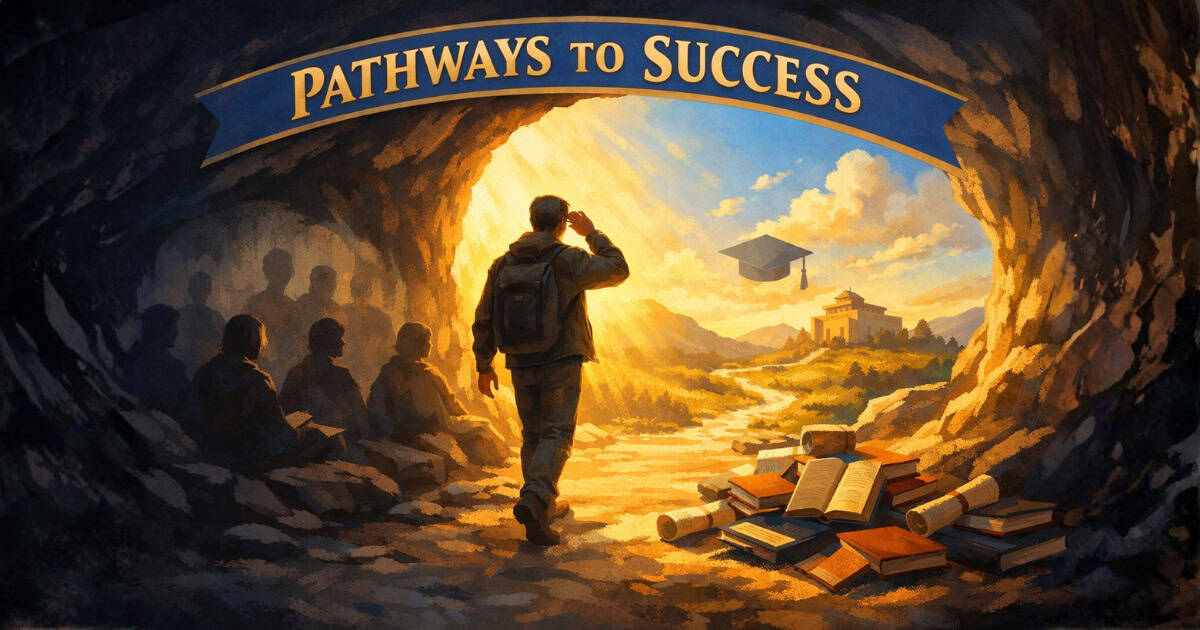
Over 2,400 years ago, an ancient Greek philosopher named Plato told a story so powerful that people are still talking about it today. He called it the Allegory of the Cave, and whether he knew it or not, he was describing something that millions of incarcerated people live through every single day.
Plato asked his listeners to imagine a group of prisoners who had been chained inside a dark cave their entire lives. They couldn’t turn their heads. All they could see was the wall directly in front of them. Behind them burned a fire, and between the fire and the prisoners, people walked back and forth carrying objects. Those objects cast shadows on the wall — and those shadows were the only reality the prisoners had ever known. They believed the shadows were the real world because they had never seen anything else.
Then one day, one prisoner is freed. He turns around. He sees the fire. He sees the people. Eventually, he climbs out of the cave entirely and, for the first time, sees the real world — the sun, the stars, the moon, the sky. Everything is overwhelming and unfamiliar. But slowly, his eyes adjust. He begins to understand that the shadows on the wall were never the full picture. They were a tiny fragment of a much bigger, more complex reality.
If you’re reading this from inside a Georgia prison — or if someone you love is — that story probably hits differently than it does for most people. Because for many incarcerated individuals, the cave isn’t just a metaphor. It’s a description of daily life.
Living Inside the Cave
Incarceration, by its very design, restricts what you can see, hear, experience, and learn. When someone enters the Georgia prison system and spends 10, 20, or 30 years behind bars, the world outside doesn’t stop moving — it accelerates. Technology changes. Culture shifts. Entire industries appear and disappear. The way people communicate, work, shop, learn, and even think about the world transforms in ways that are nearly impossible to grasp from inside a facility.
Consider someone who entered prison in 2005. At that time, most people still used flip phones. Social media barely existed. There was no such thing as an iPhone, an Uber, a Zoom call, or artificial intelligence. Twenty years later, the world that person will re-enter might as well be a different planet. Many returning citizens can’t operate a smartphone, navigate a touchscreen, or use a computer — not because they lack intelligence, but because they’ve been cut off from the world that developed these tools.
That’s the cave. Not a failure of the individual, but a consequence of isolation.
And like Plato’s prisoners, people inside the system can begin to accept those limitations as the full picture of reality. When your world shrinks to the walls around you, it takes real effort to believe that something bigger exists beyond them.
Education: The Way Out of the Cave
Plato’s point wasn’t just about physical confinement — it was about the mind. He said that this is what education feels like. When you truly learn something deep or unfamiliar, it can be disorienting. You start to realize how much you never knew, how much you had never seen. It can be uncomfortable. But that discomfort is the feeling of growth.
Education is what frees you from the cave — not physically, but mentally. And it’s important to understand that education doesn’t just mean what happens in a classroom. Formal schooling — GED programs, college courses, vocational training — is enormously valuable. But education also includes what you learn on your own when you pick up a book, study a subject that interests you, write letters that challenge your thinking, or teach yourself a new skill through sheer determination.
In fact, as you grow, formal schooling becomes a smaller and smaller percentage of what you actually know. The vast majority of what shapes a person’s understanding of the world comes from curiosity, self-directed learning, conversations, reading, and lived experience. The person who reads every book they can get their hands on in a prison library is leaving the cave just as surely as the person enrolled in a degree program. Both paths matter. Both are real.
What matters is the decision to seek knowledge — to refuse to accept that the shadows on the wall are all there is.
The Resistance You’ll Face
Here’s where Plato’s story gets painfully real for anyone in the prison environment. In the allegory, the freed prisoner goes back into the cave to tell the others what he saw. He wants to help them. He wants to share what he’s learned about the world outside.
But the other prisoners don’t believe him. They laugh at him. They mock him. They even have a game inside the cave — trying to guess what the next shadow will be — and the freed prisoner can no longer play it well because he now sees the shadows for what they are. The other prisoners say, “Going outside made you stupid. You’re worse than us now.”
Anyone who has pursued education inside a prison knows this experience. When you start reading books, studying for your GED, or enrolling in a college program, there will be people around you who don’t understand. Some will question it. Some will mock it. Some will tell you it’s pointless, that it won’t change anything, that you’re wasting your time.
Plato recognized this over two thousand years ago: people who have never experienced education often dismiss its value. When someone has never studied history, science, philosophy, or mathematics, they might call those subjects useless. They might say educated people are “too serious” or “trying to be something they’re not.” Plato believed those people are still living in the cave — and they don’t want to leave.
This is not a reason to stop. It’s a reason to keep going. The resistance you face is actually proof that you’re on the right path. You’re seeing things that others can’t yet see, and that can be lonely. But it’s also the beginning of real transformation.
The Evidence: Education Changes Everything
Education matters — it’s backed by hard data. The RAND Corporation conducted the largest-ever study of correctional education programs and found that inmates who participate in educational programs have 43 percent lower odds of returning to prison than those who do not 1. The study also found that for every dollar invested in prison education, four to five dollars are saved in future incarceration costs 2.
Now, here’s an important way to think about what those numbers actually mean. The system measures “recidivism” because it cares about statistics and costs. But what those statistics actually reveal is something deeper: transformation. People who pursued education while incarcerated didn’t just avoid going back to prison — they fundamentally changed how they think, how they make decisions, and how they engage with the world. They grew out of the patterns that led to incarceration in the first place.
That’s Plato’s point exactly. The person who leaves the cave doesn’t want to go back to guessing shadows. Education doesn’t just reduce a number on a government spreadsheet. It rewires how you see reality. And when you project that outward — if education transforms individuals, and transformed individuals don’t return to crime — then education is arguably the most powerful tool we have for building safer communities. Not more policing. Not longer sentences. Education.
The RAND study also found that employment after release was 13 percent higher among those who participated in educational programs, and those who completed vocational training were 28 percent more likely to find employment 3.
The Bigger Cave: Why Society Resists Education Too
Plato’s allegory doesn’t just apply inside prison walls. It describes something happening across American society right now. There’s a growing current of anti-intellectualism — a cultural push to dismiss education, expertise, and critical thinking as unnecessary or even suspicious. People who pursue knowledge are sometimes mocked as elitist or out of touch. Sound familiar?
This is the same dynamic Plato described in his cave. When the freed prisoner returns and tries to share what he’s learned, the others attack him for it. They prefer the comfort of the familiar shadows to the discomfort of new understanding.
For incarcerated individuals, this broader cultural trend can make the pursuit of education feel even more isolated. You might face skepticism not only from fellow inmates, but from family members, from communities, and from a society that doesn’t always value what you’re working toward. But that makes your effort more important, not less. You’re not just escaping your own cave — you’re pushing against a much larger one.
Practical Steps: Beginning Your Journey Out of the Cave
Education comes in many forms, and all of them count. Here are concrete ways to start — or continue — your journey:
Formal Education Programs
Georgia’s prison system offers several pathways for formal education:
GED Programs: Every Georgia state prison offers GED preparation classes. If you haven’t completed high school, this is the critical first step. A GED opens the door to college programs, vocational training, and better employment prospects after release.
College Degree Programs: Several universities partner with the Georgia Department of Corrections to offer accredited college courses behind bars. Ashland University offers an Associate of Arts degree at participating facilities through the Second Chance Pell Grant program — free to eligible students 4. Life University’s Chillon Project offers associate and bachelor’s degrees at Arrendale State Prison 5. The University of West Georgia offers courses at Hays State Prison toward a Bachelor of Interdisciplinary Studies 6.
Correspondence Courses: If your facility doesn’t have an in-person college program, you can study by mail. Adams State University in Colorado operates a nationwide prison correspondence program offering certificates through master’s degrees 7. Write to request a catalog, or ask a family member to request one on your behalf.
Vocational Training: Programs in welding, carpentry, automotive repair, barbering, HVAC, culinary arts, and computer skills are available at many Georgia facilities. Ask your education coordinator what’s offered at your institution.
Self-Directed Learning
Read everything you can. The prison library is your most accessible resource. Read widely — history, philosophy, science, biography, fiction. Every book you pick up expands your understanding of the world beyond the walls.
Start a study group. Find others who want to learn. Discuss books, debate ideas, teach each other what you know. Education doesn’t require a classroom — it requires curiosity and willing minds.
Ask family to help. Family members on the outside can print and mail educational materials, course lectures, articles, and book excerpts. Free online platforms like Coursera and Khan Academy have materials that can be printed and shared through the mail.
Write. Journaling, letter-writing, and creative writing all sharpen your thinking. Writing forces you to organize your thoughts, examine your assumptions, and communicate clearly — skills that serve you in every area of life.
For Families
If you have a loved one who is incarcerated, you can be part of their journey out of the cave. Read the same books they’re reading and discuss them through letters or visits. Send educational materials. Encourage their efforts when others are dismissing them. Learn alongside them — Plato’s allegory applies to everyone, not just those behind bars. Education is a lifelong journey, and pursuing it together strengthens the bond between you.
Coming Back to Help: The Obligation of the Freed Prisoner
There’s one more part of Plato’s story that deserves attention. After the freed prisoner sees the real world and understands the truth, he doesn’t just stay outside the cave enjoying his new knowledge. He goes back. He returns to the darkness to help the others, even knowing they might reject him.
Plato believed that those who gain understanding have a responsibility to share it. This is one of the most powerful aspects of the allegory for incarcerated people pursuing education. Your learning isn’t just for you. When you grow, you become a resource for the people around you — fellow inmates who might be inspired by your example, younger people who need mentorship, family members who benefit from your expanded perspective, and communities that need people who think critically and act with purpose.
Every person who picks up a book, earns a GED, completes a degree, or simply refuses to stop learning becomes a light in someone else’s cave. That’s not just Plato talking. That’s the lived experience of thousands of formerly incarcerated individuals who transformed their lives through education and then turned around to help others do the same.
Conclusion
Plato’s Allegory of the Cave asks one fundamental question: Why seek knowledge at all? His answer is simple and enduring — because there is more to reality than what we first see. The shadows on the wall are not the full picture. They never were.
For those living inside Georgia’s prisons, the cave is more than philosophy. It’s a daily reality of restricted information, limited experience, and a world that moves on without you. But education — in all its forms — is the path out. It doesn’t require permission. It doesn’t require a program or a classroom, though those things help enormously. It requires a decision: to look beyond the shadows, to endure the discomfort of learning, and to keep going even when others mock the journey.
As Plato understood over two millennia ago, the people who leave the cave are never the same. And the people they help will never be the same either. That is the power of education. No walls can contain it.
Further Reading
- Education Behind Bars: Success Stories and Opportunities for Georgia Prisoners Real stories of formerly incarcerated individuals who transformed their lives through prison education, plus a comprehensive guide to educational programs available in Georgia.
- 9 Life-Changing Lessons from Albert Einstein: Timeless Wisdom for Prisoners and Families Practical life lessons drawn from one of history’s greatest thinkers, applied directly to the challenges of incarceration and reentry.
- Beating Inflation: How Families Can Protect Their Money A practical financial literacy guide helping prisoners and families build economic resilience through budgeting, saving, and smart investing.
- Breaking Free with MOOCs: Education Empowers Prisoners and Families How free online educational resources can be shared through the mail to support learning for incarcerated individuals and their families.
- Don’t Argue with Donkeys: Choosing Your Battles Wisely Wisdom about when to engage and when to walk away — essential reading for navigating the social dynamics of prison life.
About Pathways to Success and Georgia Prisoners Speak (GPS)
At Georgia Prisoners Speak (GPS), we believe that education is one of the most powerful tools for breaking cycles of incarceration and building a better future. That’s why we created the Pathways to Success program—a dedicated initiative providing educational resources, skill-building guides, and financial literacy tools tailored specifically for prisoners and their families.
GPS is a prison reform advocacy platform focused on exposing systemic injustices, pushing for policy change, and empowering incarcerated individuals with the knowledge they need to successfully re-enter society. Our educational articles are part of this mission, ensuring that those impacted by incarceration have access to practical guidance that can help them build stability, opportunity, and financial independence.
To explore more resources, visit Pathways to Success.
Footnotes
- RAND Corporation – Evaluating the Effectiveness of Correctional Education, https://www.rand.org/pubs/research_reports/RR266.html [↩]
- RAND Corporation – Education and Vocational Training in Prisons Reduces Recidivism, https://www.rand.org/news/press/2013/08/22.html [↩]
- U.S. Department of Justice – Prison Education Reduces Recidivism, https://www.justice.gov/archives/opa/pr/justice-and-education-departments-announce-new-research-showing-prison-education-reduces [↩]
- Ashland University – How Prison Education Programs Transform Lives, https://www.ashland.edu/how-prison-education-programs-transform-lives-and-communities [↩]
- Georgia Coalition for Higher Education in Prison, https://www.gachep.org/higher-education-in-prison-in-ga [↩]
- University of West Georgia – Prison Education Programs, https://www.westga.edu/academics/university-college/prison-education-programs.php [↩]
- Adams State University – Prison Education Program, https://www.adams.edu/academics/pep/print-based/ [↩]
You Have Options
Free tools to take action — the law is on your side.
Demand records from the prison system. Reach the officials who set policy. File a grievance or a complaint the right way. And for families who’ve lost someone in custody, get the records that tell the truth. Plain-language, step-by-step, and free.
Explore the GPS Toolkits →