TL;DR
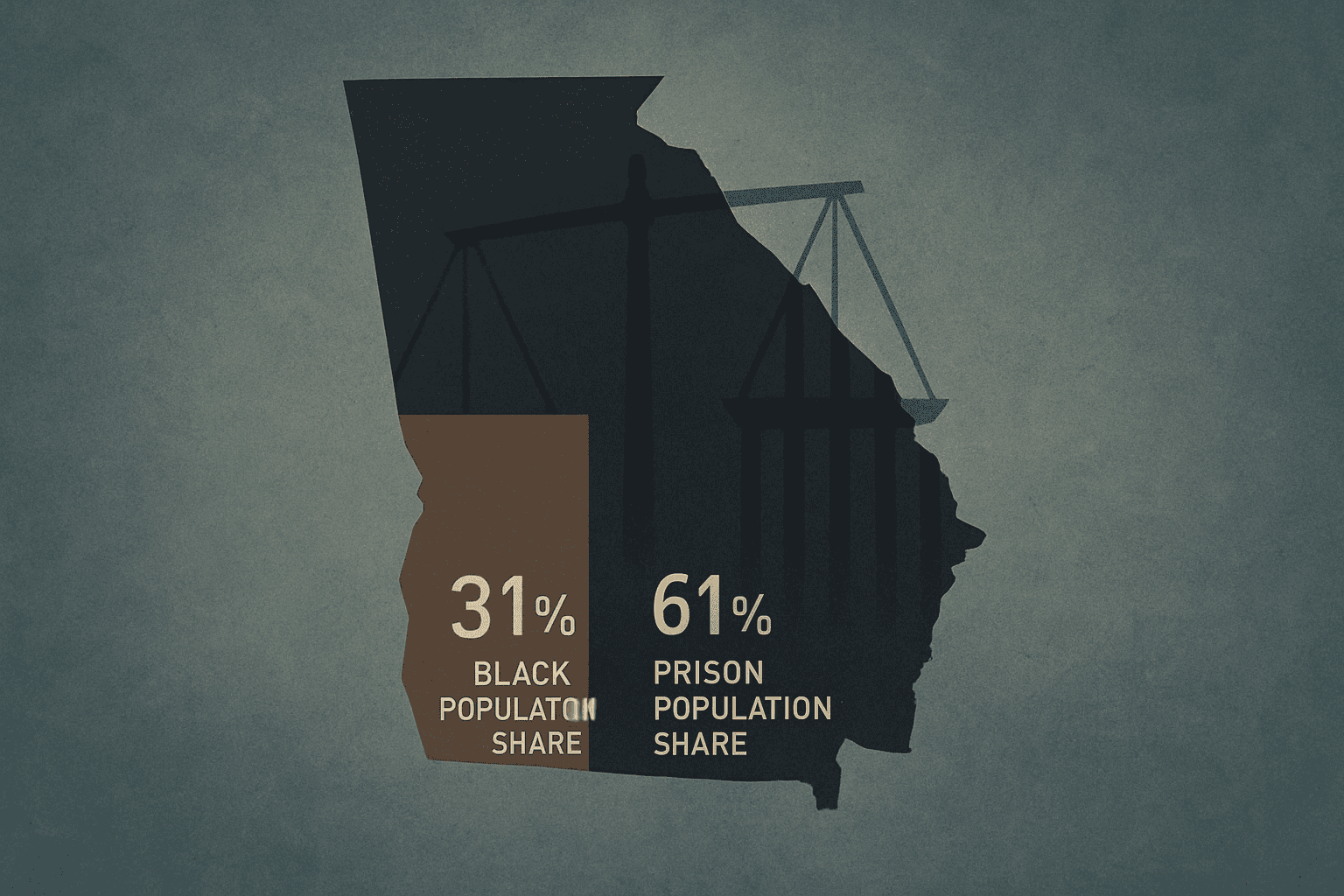
Black people are 31% of Georgia’s people. But they are 61% of people in state prisons. Black adults are 4 times more likely to be arrested than white adults. Georgia locks up 95,000 people right now. More than half the people in Georgia’s jails have not been found guilty of any crime. The state spends over $5 billion a year on police and prisons.
Why This Matters
If your loved one is Black and locked up in Georgia, these numbers tell a story you already know. The system treats Black people more harshly at every step — from arrest to prison to parole.
This means your family member was more likely to be arrested. More likely to sit in jail before trial. More likely to get a longer sentence. And more likely to stay on parole longer.
These are not random outcomes. They are the result of choices made by the state — by police, judges, and the parole board. This data comes from trusted groups like the Prison Policy Initiative, the Vera Institute, the Council of State Governments, and The Sentencing Project. Together, it paints a clear picture of a system that fails Black families.
Key Takeaway: Racial gaps in Georgia’s justice system are not accidents — they show up at every stage, from arrest through release.
Who Is Locked Up in Georgia?
Georgia locks up 881 out of every 100,000 people. That includes prisons, jails, youth lockups, and other sites.
Here are the basic numbers:
- 95,000 people are behind bars right now
- 528,000 people are under some form of control by the justice system
- 356,000 people are on probation (checking in with a court officer) or parole (released from prison with rules)
- 236,000+ different people are booked into local jails each year
Georgia has the highest probation rate in the whole country. Even though that number dropped 24% since 2011, the state still watches over more people than any other state.
Key Takeaway: Georgia controls over half a million people through its justice system — more than the population of most Georgia cities.
The Racial Gap: Black People Are Locked Up at Much Higher Rates
The numbers are stark:
- Black people are 31% of Georgia’s people but 61% of people in state prisons
- In jails, Black people make up 51% of those locked up but only 32% of the state
- Black people are locked up in prison at 2.7 times the rate of white people
Georgia is one of just 12 states where Black people make up more than half the prison population. More than half of all people on parole in Georgia are Black.
These gaps show that the state locks up Black people far beyond their share of the population.
Key Takeaway: Black Georgians are locked up at 2.7 times the rate of white people — making Georgia one of the worst states for racial gaps in prisons.
Arrest Gaps Point to Unfair Policing
Black adults in Georgia are 4.0 times more likely to be arrested than white adults. That gap shows up across crime types:
- Violent crimes: Black people are arrested at 3.9 times the rate of white people
- Property crimes: Black people are arrested at 1.6 times the rate of white people
Here’s what makes this even more troubling. Black people are victims of violent crime at 3.2 times the rate of white people. But they are arrested at 3.9 times the rate. The arrest gap is bigger than the crime gap. This suggests police target Black people beyond what crime rates would explain.
The gaps stack up at every step:
- Arrested: 4.0 times more likely if Black
- On probation: 1.6 times more likely if Black
- In prison: 2.6 times more likely if Black
- On parole: 2.1 times more likely if Black
Each step adds more bias on top of the last.
Key Takeaway: Black people are arrested at rates that exceed even their higher rates of being crime victims — pointing to bias in policing.
Children Sentenced to Die in Prison
About 900 young people in Georgia are serving life or “virtual life” sentences. A virtual life sentence means 50 or more years — so long that most people will die in prison.
Georgia ranks 3rd in the nation for locking up young people this way. Some were as young as 14 years old when charged.
The racial gap here is extreme: 80% of those serving life for crimes as children are Black. Black children are just 32% of the state’s young people.
The state is choosing to throw away Black children’s lives at shocking rates.
Key Takeaway: 80% of young people serving life in Georgia prisons are Black — even though Black children are only 32% of the state’s youth.
Most People in Jail Haven’t Been Found Guilty
59% of people in Georgia jails are legally innocent. They have not been found guilty. They are waiting for their day in court.
Many sit in jail simply because they can’t afford bail. This tears families apart. People lose jobs, homes, and custody of children — all before a judge or jury decides if they did anything wrong.
This is not justice. It is punishment for being poor.
Key Takeaway: More than half the people in Georgia jails have not been found guilty — they are locked up because they can’t pay bail.
Women Are Being Locked Up at Alarming Rates
The rise in women being locked up in Georgia is staggering:
- The number of women in jail has gone up 1,107% since 1980. It grew from 227 in 1970 to 5,228 in 2015.
- The number of women in prison has gone up 600% since 1978. It grew from 497 to 3,779 in 2017.
These increases far outpace the growth for men. Women now make up almost 1 in 4 jail bookings.
The state has failed to address the root causes — poverty, drug laws, and lack of mental health care — that drive women into the system.
Key Takeaway: Georgia locks up 12 times more women in jail now than it did in 1970 — a growth rate far beyond men’s.
Rural Counties Lock Up the Most People
Many people think jails are mainly a big-city problem. The data says the opposite.
The most rural parts of Georgia lock up people at the highest rates. Irwin County had a jail booking rate of 125,429 per 100,000 — the highest in the state.
Between 2000 and 2015:
- Rural counties saw pretrial jailing go up 33%
- Urban counties saw pretrial jailing go down 46%
Small towns and rural areas are driving Georgia’s jail growth. People in these areas often have fewer options for lawyers, treatment, and bail help.
Key Takeaway: Rural counties are locking up more people while cities lock up fewer — and rural families have the fewest resources to fight back.
The Parole Board Is Keeping More People Locked Up
Georgia’s prison count went up 7% between 2021 and 2023. This happened while many other states brought their numbers down.
One big reason: the parole board. Since the pandemic:
- The board released 34% fewer people
- The board held 44% fewer hearings
In 2020, at least 11,827 people in Georgia prisons were eligible for parole. They made up 46% of the total prison population. Yet only 44% of people leaving prison got conditional release. And 11% of those released had waited 3 years or more past when they first became eligible.
The parole board is choosing to keep people locked up longer. This is a policy choice, not a safety need.
Key Takeaway: Georgia’s parole board cut hearings by 44% and releases by 34% — trapping thousands of eligible people in prison.
Life After Prison: Barriers That Never End
Even after serving time, the punishment doesn’t stop. Georgia puts up walls that block people from rebuilding their lives:
- 80% of legal penalties tied to a conviction are about jobs
- 45% of these penalties are required by law with no exceptions
- 62% of these penalties can last forever
This means people who have served their time still can’t get licenses, jobs, or start a business. It’s no surprise that 71% of people released from prison in 2012 were arrested again within 5 years. The system sets people up to fail.
The state also strips voting rights. The Sentencing Project says Georgia should give back voting rights to over 249,000 citizens.
Key Takeaway: 80% of legal penalties after a conviction block people from working — and 62% of those penalties can last forever.
What Georgia Spends — and What It Ignores
In 2021, Georgia spent:
- $3.2 billion on police
- $2.1 billion on prisons and jails
- Over $5.3 billion total — that’s 5% of all state and local spending
Meanwhile, the state ignores the real threats to public safety:
- 2,752 people died from drug overdoses in 2022
- 2,360 died from alcohol
- 1,620 died by suicide
- 1,234 were killed by homicide
Drug deaths alone are more than double the homicide count. Yet 1,219,000 adults in Georgia needed drug treatment in 2021 but did not get it.
The state pours billions into locking people up while ignoring the health crises that drive people into the system.
Key Takeaway: Georgia spends $5.3 billion on police and prisons but leaves over 1.2 million people without the drug treatment they need.
What Families Should Know About Phone and Visit Costs
Staying in touch with a loved one in prison costs money that many families don’t have:
- Prison phone calls: $2.10 for 15 minutes
- Jail phone calls: up to $4.65 for 15 minutes
- E-messages: up to 30¢ each
- Sending money: fees up to 18% of what you send
- Health care copay: $5.00 per visit for your loved one
These costs add up fast. The state profits from families trying to stay connected. It punishes love with fees.
Key Takeaway: Families pay up to $4.65 for a 15-minute jail call and up to 18% in fees just to send money to their loved ones.
Glossary
- Bail: Money paid to get out of jail while waiting for trial. If you can’t pay, you stay locked up.
- Parole: When someone is let out of prison early but must follow strict rules. A parole board decides who gets out.
- Probation: A court sentence served outside of prison. You must check in with an officer and follow rules.
- Pretrial detention: Being held in jail before your trial. You have not been found guilty yet.
- Virtual life sentence: A prison term of 50 or more years. It means most people will die in prison.
- Collateral consequences: Extra punishments that come with a conviction — like not being able to get a job or vote. These last long after prison.
- Technical violation: Breaking a rule of probation or parole — like missing a meeting — without committing a new crime. This can send you back to prison.
- Recidivism: When someone is arrested or locked up again after being released.
- Incarceration rate: How many people out of every 100,000 residents are locked up. It lets you compare places of different sizes.
- Index crimes: Eight major crime types tracked by the FBI: murder, rape, robbery, assault, burglary, theft, car theft, and arson.
- Clearance rate: The share of reported crimes that police solve. In Georgia, 68% of violent crimes went unsolved in 2022.
- Community supervision: Being watched by the justice system while living in the community. Includes probation and parole.
- Disparity ratio: A number that shows how much more often one group faces something compared to another group.
Read the Source Document
Download the full research compilation (PDF)
This post draws from data published by the Prison Policy Initiative, the Vera Institute of Justice, the Council of State Governments Justice Center, and The Sentencing Project. Data spans 2023–2025 publications.
Other Versions
- Read the version for lawmakers — includes policy options and budget impacts
- Read the version for media — includes key quotes and story angles