TL;DR
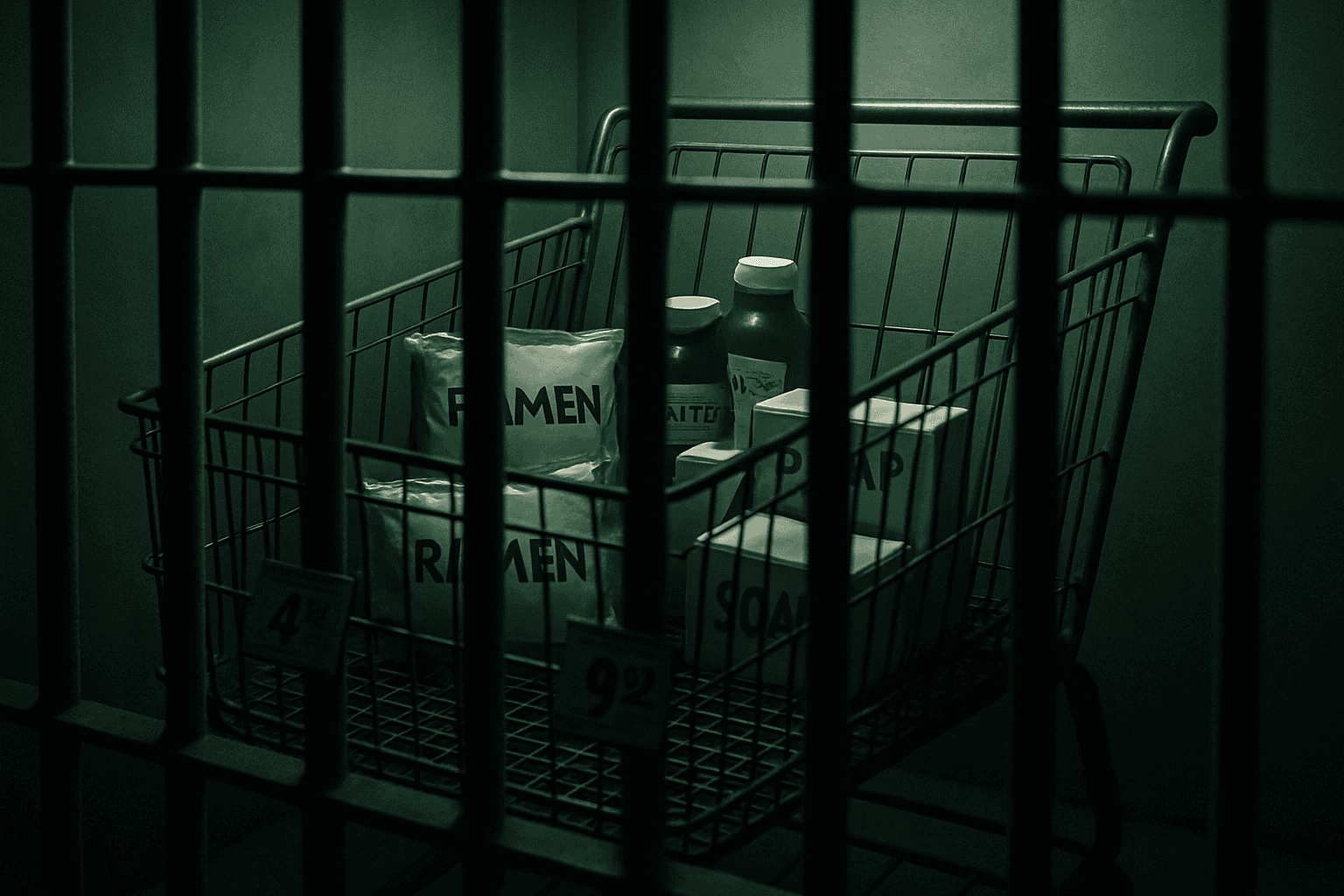
Georgia’s prison commissary charges families way too much for basic items. People in prison pay $0.90 for ramen that costs $0.20 to buy in bulk. They pay $4.00 for generic pain pills worth $0.40 at Walmart. A bar of soap that costs 8 to 14 cents in bulk sells for $1.10 to $2.25. The state’s vendor charges high prices. Then the state adds more markups on top. Together, this two-step system takes an estimated $8-15 million a year from families who have no choice but to pay.
Why This Matters
If your loved one is in a Georgia prison, you know the cost of keeping money on their books. You send money so they can buy food, soap, and pain pills. But this study shows the state and its vendor charge far more than these items are worth.
This means your family pays three to ten times more than you would at Walmart or Sam’s Club. The items that cost the most are the ones people need the most:
- Pain pills — marked up 833-1,150% over retail
- Tampons — marked up 183-254% over store brand prices
- Soap — marked up 575-1,812% over bulk prices
- Protein foods like peanut butter and tuna — marked up 157-466% over retail
Your family is paying these prices because people in prison can’t shop anywhere else. The state knows this. The vendor knows this. And they set prices based on what people are forced to pay — not what things really cost.
Key Takeaway: Families pay 3 to 10 times more than retail for basic items their loved ones need to survive in prison.
How the Two-Step Markup Works
Georgia’s commissary uses a two-step system to raise prices.
Step 1: The vendor overcharges the state. Georgia buys from a vendor called Georgia Commissary Suppliers (Stewart’s Distribution). This vendor charges prices higher than real bulk rates. For example:
- Ramen: The vendor charges Georgia $0.40 per pack. True bulk price is $0.20-$0.25. That’s 60-100% too high.
- Chips: The vendor charges $0.73 per bag. Sam’s Club sells the same bag for $0.60. That’s 22% too high.
- Pain pills: The vendor charges $1.92 for 20-24 tablets. The same amount costs $0.40-$0.48 at Walmart. That’s 380-400% too high.
Step 2: The state adds more markup. After paying the vendor’s high price, the state adds 54-323% more before selling to people in prison.
The result? Prices that are far above what anyone would pay on the outside.
Key Takeaway: Both the vendor and the state add markups, creating prices that are many times higher than what items really cost.
The Five Worst Ripoffs
1. Generic Pain Pills (Ibuprofen)
This is the single worst ripoff in the commissary. People in prison pay $4.00 for 20-24 generic ibuprofen tablets. At Walmart, the same amount costs $0.40-$0.48. That’s a markup of 833-1,150%.
At Walmart, one pill costs about $0.02. In prison, one pill costs $0.167-$0.20. That’s ten times more. People with chronic pain may need 3-4 pills a day. That adds up to $20-27 a month for pills that should cost $2-3.
2. Travel Toothpaste (Possible Free Samples)
People in prison pay $0.55 for tiny 0.15-ounce toothpaste packets. This size doesn’t exist in stores. Hotels and dentists get these for free as samples. The vendor charges the state just $0.13 per packet. But real wholesale is $0.28. This suggests the vendor gets them for free or near-free, then sells them. At 3,510 units sold, this brings in nearly $2,000 from items that may cost nothing.
3. Bar Soap
People in prison pay $1.10-$2.25 for a bar of soap. Bulk suppliers sell the same size bars for $0.08-$0.14 each. That’s a markup of 575-1,812% over bulk prices. Even at Walmart, Irish Spring costs $0.66 per bar in a 12-pack. People in prison pay 67-241% more than that.
4. Tampons
Women in prison pay $3.40-$4.25 for an 8-count box of tampons. Walmart’s store brand costs $1.20 for the same amount. That’s 183-254% more.
Women can’t choose not to buy these. They need about 2.5 boxes per month. That costs $8.50-$10.63 per month in prison versus $3.00 at a store. The yearly extra cost is $66-92 per woman. Over a 5-year sentence, that’s $330-460 in extra charges just for a basic health need.
5. Protein Foods
Peanut butter costs $5.60 for a 16-ounce jar. Walmart’s store brand is $2.18. That’s 157% more. On sale at Kroger, it’s $0.99 — making the prison price 466% higher.
Canned tuna costs $2.70-$3.20 in prison. At Walmart, it’s $0.98. That’s 175-227% more. These are foods people buy to add protein to meals that don’t have enough.
Key Takeaway: The worst markups target things people need most: pain pills, hygiene items, and protein-rich foods.
Ramen: The Biggest Money Maker
Ramen is the top-selling item. Georgia prisons sell 2.3 million packets of just one flavor per year. At that volume, the state should get deep discounts. Instead, the system charges far too much at every step.
- True bulk price: $0.20-$0.25 per packet
- What the vendor charges Georgia: $0.40 per packet (60-100% too high)
- What people in prison pay: $0.90 per packet
- Total markup from bulk to prison price: 350%
A fair price would be about $0.26 (bulk cost plus a 30% markup). Even with a 50% markup, it would be $0.30. Instead, the price is $0.90 — more than three times what a fair price would be.
On ramen alone, this system takes $1,472,000 per year more than it should from families.
Key Takeaway: On one ramen flavor alone, families pay $1.47 million more per year than they would under fair pricing.
The State Could Save Money by Shopping at Sam’s Club
Here’s how broken the system is. Sam’s Club sells chips cheaper than what Georgia’s vendor charges.
- Sam’s Club price for Doritos: $0.60 per bag
- Sam’s Club price for Lay’s: $0.60 per bag
- Georgia’s vendor price for both: $0.73 per bag
A Sam’s Club membership costs $50-100 per year. If Georgia bought chips there instead of from its vendor, the state would save $127,726 per year on just those two items.
Georgia sells 642,787 bags of Doritos and 339,721 bags of Lay’s per year. That’s a lot of bags — and a lot of wasted money going to a middleman.
Key Takeaway: A $50-100 Sam’s Club membership would save $127,726 per year on just two chip products.
They Price Fairly When They Want To
Not every item is overpriced. And that’s the problem. It proves the system chooses what to overcharge.
Items priced fairly:
– Hot sauce: $1.15-$1.45 vs $1.48 at Walmart (same or less)
– Shampoo: $2.55-$2.60 (close to store prices)
– Chips: $1.35-$1.40 (just under Walmart’s single-bag price of $1.48)
Items with extreme markups:
– Pain pills: 833-1,150% over retail
– Soap: 575-1,812% over bulk prices
– Tampons: 183-254% over store brand
– Peanut butter: 157-466% over retail
The pattern is clear. Items that families can easily look up prices for are kept near retail. Items where the true cost is less visible face huge markups. Essential items people can’t avoid buying face the highest prices.
Key Takeaway: The state prices some items fairly, which proves it could price everything fairly — but chooses not to.
Evidence of Near-Expired and Free Products Sold at Full Price
There are signs the vendor buys cheap, near-expired products but charges the state as if they were fresh.
Honey buns offer the clearest clue. The vendor charges Georgia $0.95 per honey bun. But normal wholesale is $1.01. Why is the vendor’s price lower than wholesale? One answer: liquidation markets sell honey buns for $0.89 — with dates just two months away.
A major food broker called Marvell Foods openly says it sells to “prison systems.” It deals in “short-coded products” and “excess inventory” — including food that is “expired to 12-month-old.”
People in prison then pay $1.65-$1.80 for these honey buns. They don’t know the products may be near their expiration dates. They’re paying full price for items the vendor may have gotten at a deep discount.
The travel toothpaste raises similar concerns. The 0.15-ounce size doesn’t exist in stores. Hotels and dentists get them for free. Yet they’re sold to people in prison for $0.55 each.
Key Takeaway: Evidence suggests the vendor buys discounted or free products and charges full price, pocketing the difference.
What Fair Prices Would Look Like
If Georgia bought at true bulk prices and added a fair 30% markup, here’s what people in prison would pay:
| Item | Fair Price | Current Price | Savings Per Item |
|---|---|---|---|
| Ramen | $0.26 | $0.90 | $0.64 |
| Pain pills (20-24 ct) | $0.52 | $4.00 | $3.48 |
| Tuna | $1.11 | $2.70-$3.20 | $1.84 |
| Peanut butter (16 oz) | $1.56 | $5.60 | $4.04 |
| Bar soap | $0.18 | $1.10-$2.25 | $1.50 |
On just five high-volume items, fair pricing would save families $2,806,247 per year:
- Ramen (2.3 million packs): $1,472,000
- Water (456,922 bottles): $196,476
- Doritos (642,787 bags): $385,672
- Lay’s (339,721 bags): $220,819
- Beef sticks (1,062,560 units): $531,280
Across all commissary items, fair pricing would save families an estimated $8-15 million per year.
Key Takeaway: Fair pricing on just five items would save families over $2.8 million per year.
What Needs to Change
A contract renewal is coming in June 2025. This is a chance to fix the system. Here’s what should happen:
1. Audit the current vendor. Compare what the state pays to what items really cost at Sam’s Club, Costco, and major distributors. Find every item where the vendor overcharges.
2. Open the process to real competition. Require bids from multiple vendors. Make them show how their prices compare to real market rates.
3. Cap markups on essential items:
– Health items (pain pills, tampons): 10-15% over retail max
– Hygiene items (soap, toothbrush): 20-25% over retail max
– Food staples (protein, meal items): 30-35% over bulk max
4. Provide basic health items for free. Several states now give out tampons and basic hygiene items at no cost. Georgia should do the same.
5. Stop selling likely free samples. If toothpaste packets are free to hotels, they shouldn’t be sold to people in prison.
6. Create oversight. An outside board should review prices every year and publish the results so families can see what’s happening.
7. Direct commissary profits to help people. If the system makes money, it should fund education and re-entry programs — not the prison’s general budget.
Key Takeaway: The June 2025 contract renewal is a key moment to demand fair pricing and real oversight.
Glossary
Commissary — The prison store where people buy food, hygiene items, and other goods using money their families send them.
Markup — How much extra is added to the price above what the item costs to buy. A 100% markup means the price is doubled.
Vendor — The company that sells products to the state for the commissary. In Georgia, this is Georgia Commissary Suppliers (also called Stewart’s Distribution).
Wholesale price — The price for buying items in large amounts, usually much cheaper than store prices.
Retail price — The price you pay at a regular store like Walmart or Kroger.
Bulk pricing — Discounts you get for buying large amounts at once.
Liquidation market — A market for products that are near their expiration date, overstocked, or discontinued. Items sell for much less than normal.
Captive consumer — A buyer who has no other options. People in prison can’t shop elsewhere, so they must pay whatever the commissary charges.
Menstrual tax — The extra cost women in prison pay for tampons and pads above what they would cost at a store. Women can’t opt out of this cost.
Two-tier markup — The system where the vendor first overcharges the state, then the state adds more markup on top. Both steps raise the final price.
RFP (Request for Proposals) — A process where the state asks multiple companies to compete for a contract by offering their best prices and services.
Fair pricing model — A system where the real wholesale cost is used as the base, and only a small, reasonable markup is added (like 30%).
Read the Source Document
Read the full GPS investigation: Georgia’s Prison Commissary Extraction Machine (PDF)