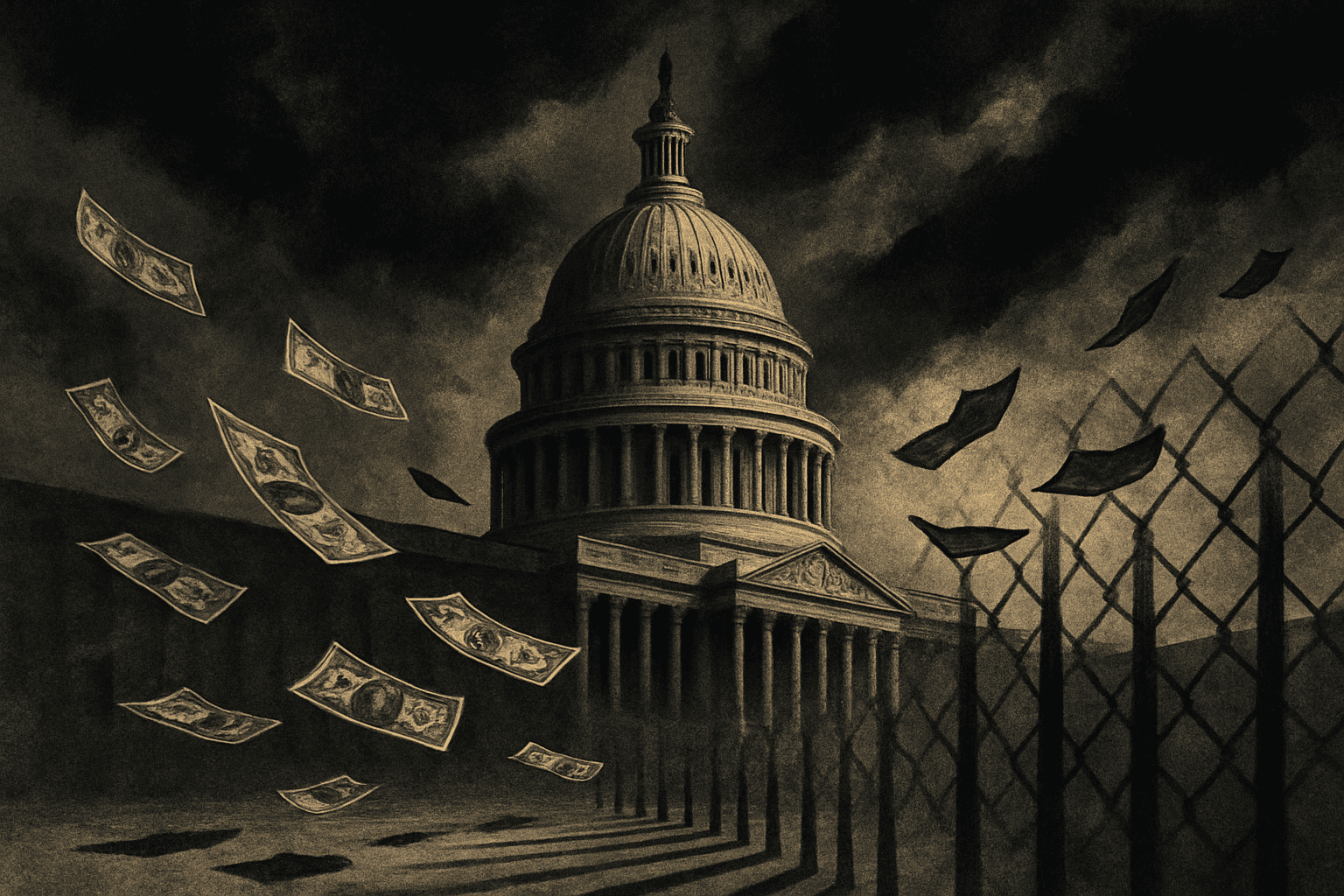
This explainer is based on Georgia’s $600 Million Prison Spending Infusion: An Accountability Analysis. All statistics and findings are drawn directly from this source.
TL;DR
Georgia put about $700 million in new money into its prisons since 2022. It is the biggest spending jump in state history. But things got worse, not better. More people are dying. Guard jobs are still empty. Buildings are still falling apart. The money went to patch-up fixes. It did not go to the changes that experts said were needed — like letting more people out on parole or hiring enough guards by raising pay to a level that works.
Why This Matters
If your loved one is in a Georgia prison, this report is about their safety.
The state says it spent record money to fix the crisis. But the killing rate is going up, not down. In the first half of 2025, 42 people died in ways that may have been murders. That pace is faster than 2024, which was already the worst year ever.
Guard posts are still empty. Gangs still run parts of some prisons. Locks are still broken. And the state still has no one watching over how this money gets spent.
This matters because your family member is living in these conditions right now. The state made big promises. This report checks whether those promises are being kept.
Key Takeaway: The state spent record money, but your loved one is no safer today than before.
How Did We Get Here?
In 2021, the U.S. Department of Justice (DOJ) began looking into Georgia’s prisons. In October 2024, the DOJ released a 93-page report. It said Georgia’s prisons break the law. The conditions are so bad they count as cruel and unusual punishment.
The DOJ found that Georgia’s prison murder rate is nearly triple the national average. Between January 2022 and April 2023, more than 1,400 violent events happened in close- and medium-security prisons.
Governor Kemp also hired a firm called Guidehouse Inc. to study the prisons. The state paid nearly $2.7 million for this study. What Guidehouse found backed up the DOJ’s findings — the system was in deep trouble.
In early 2025, lawmakers approved about $634 million in new prison spending. This was split into two parts: $434 million right away, and about $200 million for the next year.
Key Takeaway: Both federal investigators and the Governor’s own hired experts agreed: Georgia’s prisons were in crisis.
The Spending: $700 Million More — And Counting
Here is how prison spending has grown:
- 2022: $1.12 billion
- 2024: $1.32 billion
- 2026 (planned): $1.62 billion
That is a 44% jump in just four years. In total, Georgia has spent about $700 million more on prisons than it did in 2022.
This is the fastest spending growth in the history of the Georgia Department of Corrections (GDC).
Key Takeaway: Georgia boosted prison spending by 44% in four years — about $700 million more than the 2022 level.
Where the Money Went
Most of the $600 million went to patch-up work:
- Building repairs: About $330 million. This covers fixing locks, fixing 29 prisons, building four small housing units (126 beds each), and $40 million to plan a new prison.
- Tech to stop banned items: About $50 million. This pays for tools to find cell phones and stop drones.
- Hiring and pay: About $40+ million. Guards got a 4% raise. Counselors got an 8% raise. The plan calls for 330 new guards soon and 882 over time.
- Health care: About $97 million. This expands mental health, dental, medical, and pharmacy services.
- More private prison beds: 446 new beds in private prisons.
Key Takeaway: Most of the money went to short-term fixes like repairs and tech — not long-term changes.
What the Money Did NOT Pay For
The DOJ and Guidehouse both said Georgia needs big changes to its system. None of those changes were funded. Here is what got left out:
- Reducing the prison population — no expanded parole, no release for elderly or sick people
- Parole reform — a bill (SB 25) is still waiting
- Fixing how people are housed and classified — no overhaul
- Sexual safety protections
- Programs to manage gang violence based on evidence
- Lower medical co-pays — people in prison still face high fees to see a doctor
- Lower store prices — prices were hiked to cover a $5 million budget cut in 2021 and never went back down
- Any form of outside watchdog or public reporting
The Georgia Budget and Policy Institute (GBPI) noted: no budget item directly helps the people living inside these prisons get basic health care.
Key Takeaway: Experts said the system needs deep reforms. The state funded none of them.
The Killing Crisis: More People Are Dying
The violence is getting worse, not better. Look at the numbers:
- 2018: 8 people killed in prison
- 2019: 13
- 2023: At least 38 (a record at the time)
- 2024: 66 suspected murders — the deadliest year ever. Total deaths: 330-333.
- First half of 2025: 42 deaths being looked at as possible murders
- June 2025 alone: 9 deaths being looked at as murders
- 2025 full year (projected): About 84 murders — a 27% jump over 2024’s record
In January 2026, three people were killed at Middle Georgia State Prison. One of them was Jimmy Trammell, age 42. He was set to go home just days later.
At Coastal State Prison, as of February 2026, people report staff beatings, 7-10 day lockdowns without showers, black mold, and pest problems.
Key Takeaway: The state is on pace to see about 84 prison murders in 2025 — up 27% from last year’s record.
The Guard Crisis: The Math Does Not Work
More than half of all guard jobs at 20 out of 34 state prisons are empty. Eight prisons have 70% or more of guard jobs empty. At Valdosta State Prison, 80% of guard posts were empty as of April 2024. The safe standard is no more than 10% empty.
Here is why hiring alone cannot fix this:
- For every 800 people who apply, only 118 get hired. That is a 14.75% hiring rate.
- Of those 118, 82.7% quit within their first year.
- That leaves about 20 guards from 800 applicants.
- To fill about 3,500 empty jobs at this rate, the state would need to process roughly 140,000 applicants.
The 4% pay raise does not help enough. Guards start at $40,000 to $43,000. Most nearby states pay more. As of December 2025, the number of prison guards hit a 15-year low. At the same time, the number of people in prison hit a 15-year high.
The prison boss, Commissioner Oliver, admitted: “Trying to hire 2,600 people in a fiscal year is just not possible.”
Key Takeaway: With 82.7% of new guards quitting in year one, Georgia cannot hire its way out of this crisis.
Gang Control: One-Third of the Prison Population
Gang membership in Georgia prisons has nearly doubled since 2014. About 15,000 people — one-third of everyone in state prisons — are verified gang members.
At some prisons, gangs run the show. They:
- Sell bed space
- Force family members to pay for “protection”
- Use violence to collect debts
- Pressure women in prison for sex recorded on cell phones
The $600 million did not fund any evidence-based programs to deal with gang violence.
Key Takeaway: Gangs control parts of some prisons, and the state funded no programs to address it.
Buildings Falling Apart: Years of Fixes Ahead
29 out of 34 state prisons need major repairs. Cell door locks are broken across the system. Commissioner Oliver told lawmakers that just replacing locks will take 5-6 years.
At Georgia Diagnostic and Classification Prison in Jackson:
- Window covers have been turned into weapons
- Plumbing does not work
- Cameras are broken and blocked
- Wiring has been removed — guards do rounds by flashlight
- A new fire alarm system was destroyed
The $330 million for repairs is a start. But this is a problem that will cost billions and take decades to fully fix.
Key Takeaway: Even with $330 million, fixing locks alone will take 5-6 years. The full need is much larger.
Parole: A Safety Valve That Was Shut Off
Between 2019 and 2023, parole releases dropped by 38%. Fewer people were even reviewed for parole. Both staff and people in prison asked the Parole Board to be more open about why it denies release.
Letting more people out on parole would reduce crowding. It would ease the guard shortage by having fewer people to watch over. But the $600 million did not fund parole reform.
A bill called SB 25 that would change parole rules is still waiting for action.
Key Takeaway: Parole releases dropped 38% in four years — and the state funded no parole reform.
What Would Actually Work
The analysis found only two paths that can actually solve the staffing crisis:
- Raise guard pay by 30-50% — not the 4% that was funded
- Reduce the prison population by 20% — that means releasing about 10,000 people through parole, reclassifying who needs to be in prison, and releasing elderly or sick people
- Or do both at the same time
Georgia has done this before. Under Governor Deal (2011-2019), evidence-based reforms kept prison murders in single digits. Those reforms prove there is a better path — and it comes from Georgia’s own history.
As GBPI researcher Ray Khalfani noted: Georgia’s fast growth in prison spending matches its fast growth in policies that put more people behind bars and in debt.
The Southern Center for Human Rights said: “Pouring more money into a system without solutions that focus on reducing the prison population is merely putting a Band-Aid on the problem.”
Key Takeaway: The only real fix is fewer people in prison, much higher guard pay, or both.
No One Is Watching the Money
There is no outside watchdog over this $600 million. Georgia has:
- No prison ombudsman (a person who takes complaints)
- No independent inspector general for prisons
- No public reporting rules on how the money is spent or what results it gets
This matters because GDC has been caught misclassifying murders as “unknown cause of death.” The DOJ itself found that GDC gives false or misleading information.
Without someone watching, there is no way to know if the money is helping.
The DOJ gave Georgia 49 days to respond to its findings or face a federal lawsuit. That deadline passed without action. Under the current federal government, there is no public sign the case is moving forward.
Key Takeaway: No outside watchdog exists to check if $600 million in public money is producing any results.
The Bottom Line
Georgia spent about $700 million more on prisons than it did four years ago. Here is what it got:
- More deaths — on pace for 84 murders in 2025, up from 8 in 2018
- Fewer guards — at a 15-year low
- More people locked up — at a 15-year high
- Broken buildings — 29 of 34 prisons need major repairs
- Gang control — one-third of the prison population
- No oversight — no one watching the spending
The money went to keep a broken system running. It did not go to fix what is broken. Until Georgia reduces its prison population, reforms parole, raises guard pay to a level that works, and puts a watchdog in place, these outcomes will not change.
About 50,000 people live in these prisons. They are someone’s parent, child, or sibling. They have a right to be safe. The state has failed that duty — and $700 million has not changed that.
Key Takeaway: Money alone cannot fix a broken system. Georgia needs deep reforms to protect the 50,000 people in its prisons.
Glossary
- CRIPA: Civil Rights of Institutionalized Persons Act. A federal law that lets the U.S. DOJ look into and sue over bad conditions in state-run places like prisons.
- DOJ: U.S. Department of Justice. The federal agency that enforces civil rights laws.
- GDC: Georgia Department of Corrections. The state agency that runs Georgia’s prisons.
- Guidehouse Inc.: A consulting firm hired by Governor Kemp to study the prison system. The state paid nearly $2.7 million for the study.
- GBPI: Georgia Budget and Policy Institute. A nonprofit that studies state spending.
- Vacancy rate: The share of jobs that are empty. A safe level is 10% or less. Georgia has 20 prisons above 50%.
- Emergency level staffing: When more than half of guard jobs are empty. Basic safety becomes very hard to maintain.
- Parole: Supervised early release from prison before a full sentence is done. Georgia’s parole releases fell 38% between 2019 and 2023.
- Eighth Amendment: The part of the U.S. Constitution that bans cruel and unusual punishment.
- Deliberate indifference: A legal term meaning officials knew about a serious risk of harm but chose to ignore it.
- Security Threat Group (STG): The official term for prison gangs.
- PREA: Prison Rape Elimination Act. A federal law meant to prevent sexual abuse in prisons.
- Classification: The system used to decide where a person is housed and what security level they need.
- Commissary: The prison store where people buy food and hygiene items with money in their accounts.
- Co-pay: A fee charged to see a doctor, dentist, or mental health worker in prison.
- Managed access technology: Systems that block unauthorized cell phones inside prisons.
- Contraband: Banned items like weapons, drugs, or cell phones.
- Modular units: Pre-built housing structures that can be added to prison grounds quickly.
- Ombudsman: An independent person who takes and looks into complaints.
- Decarceration: Reducing the number of people in prison through policy changes like expanded parole.
Read the Source Document
Other Versions of This Analysis
- Version for Lawmakers and Staff
- Version for Media and Journalists
- Version for Advocates and Organizations
Sources & References
- Georgia’s $600 Million Prison Spending Infusion: An Accountability Analysis. Georgia Prisoners’ Speak / The GDC Accountability Project, Inc. (2026-03-01) GPS Original
- Workers and inmates report human rights crisis at Coastal State Prison. WTOC (2026-02-12) Journalism
- Georgia Decarceration: Addressing the Prison Crisis. Georgia Prisoners’ Speak (2026-01-01) GPS Original
- Georgia Public Broadcasting prison staffing report. Georgia Public Broadcasting (2025-12-15) Journalism
- The Hidden Violence in Georgia’s Prisons: Beyond the Death Toll. Georgia Prisoners’ Speak (2025-09-24) GPS Original
- Georgia prison homicides on the rise, already approaching last year’s total. Atlanta Journal-Constitution (2025-09-01) Journalism
- Georgia prisons get $600M for overhaul. Lawmakers say it’s a start. Atlanta Journal-Constitution (2025-05-01) Journalism
- Georgia Prisons Cover Up Murders. The Appeal (2025-02-01) Journalism
- Overview: 2026 Fiscal Year Budget for the Georgia Department of Corrections, GBPI. Georgia Budget and Policy Institute (2025-02-01) Official Report
- Gov. Kemp Unveils Recommendations from System-wide Corrections System Assessment, Office of Governor Brian Kemp. Office of Governor Brian Kemp (2025-01-07) Press Release
- Georgia prisons are in crisis, say consultants hired by Gov. Kemp. Atlanta Journal-Constitution (2025-01-01) Journalism
- Project 2025’s Plan for Criminal Justice Under Trump. Brennan Center for Justice (2025-01-01) Official Report
- CRIPA Investigation of Georgia Prisons. U.S. Department of Justice Civil Rights Division (2024-10-01) Official Report
- Gov. Kemp Announces GDC Assessment as Next Phase of Public Safety Improvements — Office of the Governor. Office of the Governor of Georgia (2024-06-17) Press Release
- Georgia Prison Crisis Worsens. The Appeal (2024-02-01) Journalism
- DOJ Report Exposes Brutality (SCHR). Southern Center for Human Rights (2024-01-01) Official Report
- Justice Department Announces Investigation of Conditions in Georgia Prisons. U.S. Department of Justice (2021-09-01) Press Release
- Overview: 2022 Fiscal Year Budget for the Georgia Department of Corrections. Georgia Budget and Policy Institute (2021-02-01) Official Report
Source Document
You just read about people suffering in state custody. The least you can do is make sure other people read it too. Share this story.
3 thoughts on “Georgia Spent $700 Million More on Prisons. Every Outcome Got Worse.”