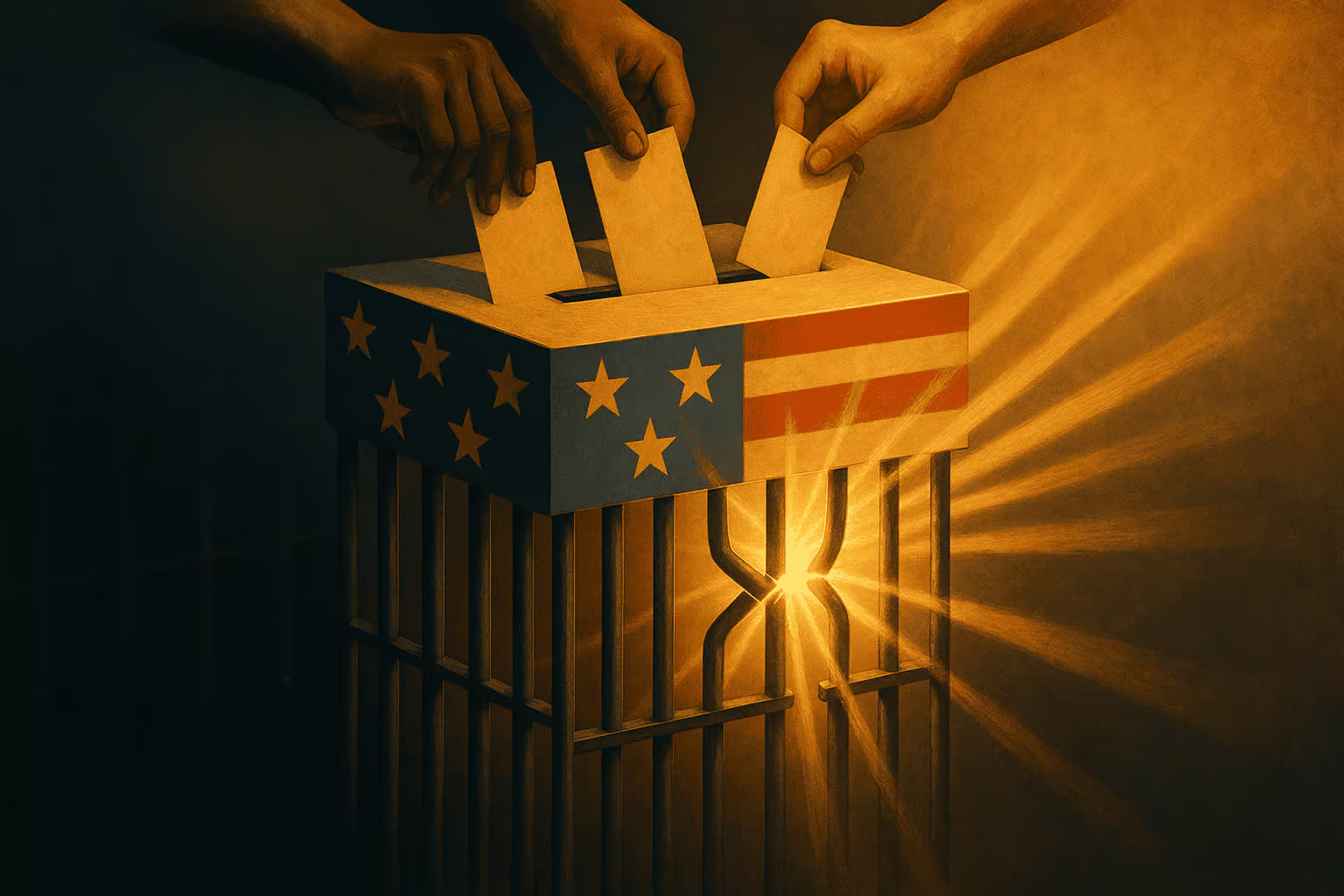
A Landmark National Study Proves Reform Works. Georgia Is One of Two States Explicitly Called Out for Refusing to Try.
A No Way Out Companion Report
More than 80% of American voters — across party lines — believe that people in prison deserve a second chance. Ninety percent of both Republicans and Democrats support requiring prisons to offer education programs. These are not aspirational numbers from advocacy organizations. They are findings from a November 2025 national poll conducted by the Brennan Center for Justice at New York University School of Law, one of the country’s most respected legal and policy research institutions. 1
The question those numbers raise is simple: If the vast majority of voters already support prison reform, why isn’t it happening?
In March 2026, the Brennan Center published a sweeping answer. Its report, Prison Reform in the United States: Efforts to Improve Conditions and Post-Release Outcomes, documents what happens when states actually follow through on what voters want. The researchers spent three years visiting prisons in 10 states, interviewing 71 stakeholders — correctional directors, frontline officers, incarcerated people, nonprofit leaders, and funders — and conducting 467 surveys. What they found is that a diverse coalition of states, from deep-red South Carolina and North Dakota to blue Maine and California, are testing a different model of incarceration — and the results are nothing short of remarkable. 2
Violence reductions of 40 to 73%. Recidivism drops of nearly one-third. Housing units where violence has fallen to near zero. Staff who report actually liking their jobs and feeling safe. And renovations that came in millions of dollars under budget.
The report also does something else. It names, by name, the states that refuse to participate. Georgia is one of only two states singled out for blocking incarcerated students from accessing state financial aid. Georgia is absent from the list of 19 states (plus the District of Columbia) that have established independent prison oversight. And Georgia appears nowhere — in any capacity — among the states undertaking the reforms the report profiles.
This article examines the Brennan Center’s findings and holds them against what Georgia’s families, corrections officers, and incarcerated people are actually experiencing. The evidence is in. The voters are ready. The only remaining question is whether Georgia’s elected representatives will act on what their own constituents are telling them.
The $300,000 Question
In May 2022, the Pennsylvania Department of Corrections opened an experimental housing unit at State Correctional Institution Chester, a medium-security facility near Philadelphia. The unit, dubbed “Little Scandinavia,” was created through a partnership between Drexel University, the University of Oslo, and the Norwegian and Swedish correctional services. Its total renovation cost was $300,000. 3
The changes were straightforward. Single-occupancy cells with custom furniture and mini-fridges. A communal space with couches, exercise equipment, and a fish tank. A shared kitchen where residents could order groceries from a local store. Warm color schemes and sound-dampening materials. Staff trained in de-escalation, motivational interviewing, and a communications approach called “yield theory” — which centers hearing and validating people before responding. Officers assigned to specific residents as “contact officers,” responsible for helping them navigate their time inside and prepare for release. 3
The results were immediate and dramatic. Little Scandinavia achieved near-zero violence — fewer disputes, less misconduct, decreased use of restrictive housing. Meanwhile, Pennsylvania facilities statewide experienced a 21.6% increase in violence in 2024, reaching the highest level in 30 years. 3
In March 2025, Pennsylvania announced the expansion of the model to three additional state facilities. State lawmakers have been vocal supporters, describing it as a crucial step toward a more effective correctional system. 3
Georgia’s answer to the same crisis? The OWL (Overwatch & Logistic) Unit Command Center, a $150 million surveillance network of cameras, body-worn devices, and monitoring systems that watches violence happen but does nothing to prevent it. 4
That is the contrast at the heart of this report: $300,000 invested in human connection and physical dignity eliminated violence. $150 million invested in surveillance did not.
What Reform Actually Looks Like
The Brennan Center’s report profiles five categories of reform initiatives across more than a dozen states. Three stand out for the rigor of their evidence and the breadth of their results.
Restoring Promise: 73% Violence Reduction, Proven by Randomized Control Trial
The Vera Institute of Justice’s Restoring Promise initiative operates nine housing units across Colorado, Connecticut, Idaho, Massachusetts, North Dakota, and South Carolina, focused on young adults aged 18 to 25. The approach combines normalization (making prison life resemble community life), dynamic security (using relationships rather than force to maintain order), restorative justice for conflict resolution, and peer mentorship from incarcerated people serving longer sentences. 3
What sets Restoring Promise apart is the quality of its evidence. Vera researchers conducted a randomized control trial — the gold standard in evaluating any intervention — at two South Carolina prisons. The findings were striking: young adults in Restoring Promise units showed a 73% reduction in the odds of being written up for violence compared to a control group. There was an 83% reduction in restrictive housing stays during the first year. Critically, the study ruled out self-selection bias: there was no significant difference in violence levels between people who applied to the program but didn’t get in and those who never applied at all. The outcomes are attributable to the program itself, not to the characteristics of the people who chose to participate. 3
That last finding matters enormously. It means these results would likely be replicated if the program were scaled to other parts of a prison system.
Cross-site surveys administered across all seven operating units in December 2024 confirmed the pattern. Among young adults, 94.6% reported feeling safe, 92.5% said their time was productive, and 88.9% said they were gaining life skills. Among staff, 100% reported enjoying working with residents, 97% felt safe, and 80.5% said they liked their job. 3
South Carolina — not exactly a progressive stronghold — is where this was proven. Georgia, which shares a border with South Carolina, has no comparable initiative.
The Maine Model: System-Wide Transformation
While most reform efforts start with a single unit, Maine took a different approach. Starting in 2022, the state reorganized its entire correctional system around principles of normalization, humanization, and destigmatization — building on two decades of incremental reform. 3
The outcomes are the most comprehensive in the report:
- Three-year recidivism dropped from 30.5% in 2017 to 21.4% in 2022 — a reduction of nearly one-third
- Resident-on-resident assaults fell 40%
- Resident assaults on staff fell 36%
- Staff use-of-force incidents dropped 69%
- Self-inflicted injuries at Maine State Prison dropped 84%
- Disciplinary cases declined 25% system-wide and 42% at Maine State Prison — 1,121 fewer cases per year
Maine also invested in education at every level — GED through master’s degrees, offered through the University of Maine system. As of July 2025, one resident was a PhD candidate. The state had 166 people in work release programs, including 12 working remotely as paralegals, software designers, and college instructors. Nearly 50% of the incarcerated population receives medication-assisted treatment for opioid use disorder, compared to less than 1% of the federal prison population. 3
And the renovation of Maine Correctional Center came in $7 million under budget.
Maine incarcerates fewer than 2,000 people, so scale is a fair question. But the principles it applied — training staff in mental health first aid and de-escalation, allowing residents to address officers by first name, creating Resident Advisory Councils, reducing lockdowns through creative staffing rather than cell confinement — cost almost nothing to implement. As multiple correctional directors told Brennan Center researchers, treating incarcerated people with basic dignity is “essentially free.” It may only require the marginal cost of adjusting a training practice or policy, something departments do regularly. 3
Michigan’s Vocational Villages: Jobs That Break the Cycle
Michigan’s Department of Corrections launched its first Vocational Village in 2016, offering hands-on trades training in automotive technology, welding, carpentry, commercial truck driving, cosmetology, horticulture, and other fields. Three facilities now serve approximately 600 students at a time across 13 trade programs. 3
The outcomes speak for themselves. Graduates from 2019 had a recidivism rate of 15.6%, compared to the statewide rate of 22.1% — a 6.5-percentage-point reduction. From the program’s launch through July 2023, only 12.6% of participants returned to prison, roughly half the overall rate. The employment rate for Vocational Village graduates in fall 2024 was 64.2%, above the national average. 3
What makes Michigan’s model work is its integration with what comes after. The DOC controls both corrections and parole, allowing seamless coordination. It has ensured that 99% of people leaving its facilities are issued a valid state ID or driver’s license — a basic document that many formerly incarcerated people in other states struggle for months to obtain. Employers who hire graduates receive tax credits of $1,200 to $9,600 per hire, and a state bonding program insures businesses against employee theft during the first six months. 3
Michigan’s statewide recidivism rate was under 23% in 2024, the second lowest in state history. The state estimates it saves approximately $49,000 for every person who does not return to prison.
Georgia pays incarcerated workers nothing for their labor — zero dollars, for kitchen work, laundry, janitorial duties, groundskeeping, and construction. There is no state statute requiring any compensation, and GDC has no published pay scale. 5 Georgia has no vocational village equivalent, no comparable employer partnership pipeline, no state bonding program for hiring formerly incarcerated people, and no systematic process for ensuring people leave with valid identification.
Georgia’s Most Explicit Failure: Blocking Education
The Brennan Center report names Georgia directly — and the finding is damning.
“Georgia and Pennsylvania continue to prohibit incarcerated students from accessing state financial aid programs,” the report states, contrasting both states with Michigan and others that are expanding postsecondary education behind bars. 3
This matters because the evidence on prison education is among the most settled in corrections research. College-in-prison programs are linked to a 43% lower chance of returning to prison. Providing postsecondary education to incarcerated people nationwide could cut state prison spending by an estimated $365 million annually. And by 2031, nearly three-quarters of all jobs will expect some postsecondary education or training. 3
The education gap inside prisons is vast. Forty percent of people in state prisons have not earned a high school credential. Another 45% have only a GED or high school diploma. Outside prison, half the U.S. population has at least an associate’s degree.
Congress lifted the ban on Pell Grant eligibility for incarcerated people in December 2020, and prison education programs have since expanded with broad bipartisan support across the country. But Georgia has refused to supplement federal Pell Grants with state financial aid, leaving it as one of the most restrictive states in the nation on this issue.
This is not a policy that Georgia voters support. The Brennan Center’s polling found that approximately 90% of both Republicans and Democrats support requiring prisons to offer education programs. Ninety percent. When a policy has 90% bipartisan support and a state refuses to implement it, the question is no longer about ideology. It is about representation.
Georgia releases 14,000 to 16,000 people from its prisons each year. 6 Most return to their communities without meaningful education, job training, or identification documents, into a state that incarcerates people at the 7th highest rate in the nation — 881 per 100,000 residents, a rate higher than any independent country in the world except El Salvador.
Meanwhile, at Maine State Prison, a man is pursuing a PhD.
The Oversight Vacuum
The Brennan Center report documents that 19 states and the District of Columbia have established independent prison oversight mechanisms — ombuds offices, inspectors general, bipartisan legislative committees. Georgia is not among them. 3
Georgia doesn’t merely lack oversight. It has built a statutory fortress specifically designed to prevent it. Five interlocking Georgia statutes shield the Georgia Department of Corrections from transparency and accountability: O.C.G.A. sections 50-18-72(a)(24), 42-5-36, 42-9-53, 42-8-40, and 50-21-24. Together, they exempt GDC records from open records laws, shield internal operations from public scrutiny, protect the parole process from outside review, and grant sovereign immunity that limits civil liability. 7
The Brennan Center’s report emphasizes that oversight is not a luxury. It is “an essential ingredient to driving lasting change in U.S. prisons.” Without it, the researchers write, reforms fail. Oversight can identify problems early, address misconduct, improve the use of resources, and exert sustained pressure to ensure improvements are maintained.
Even the federal prison system now operates under mandatory independent oversight. The Federal Prison Oversight Act, signed on July 25, 2024, with bipartisan support, requires regular risk-based inspections of all 122 federal prisons, public reporting of findings, and timely corrective action. It created an independent ombudsman accessible via secure hotline and online form.
Georgia’s state prison system — which holds more than 50,000 people, recorded at least 100 homicides in 2024, and logged 330 total deaths in what GPS documented as the deadliest year in state history — has no equivalent. 8 1756 deaths since 2020.
In February 2026, Federal Judge Marc Self rebuked GDC Commissioner Tyrone Oliver for ignoring court orders in the Benning email restriction case, stating that GDC has “little credibility” and acts “above the law.” In October 2024, the U.S. Department of Justice published findings of constitutional violations in Georgia’s prisons, documenting “deliberate indifference” to violence including 142 homicides from 2018 to 2023. 9 The DOJ did not file suit within the 49-day window, and the Trump administration has since gutted the Civil Rights Division’s enforcement capacity.
Georgia’s legislators have the power to create independent oversight. Their constituents support accountability for public institutions. The Brennan Center’s research confirms that oversight drives better outcomes for everyone — staff, residents, and communities. What remains is the will to act.
The Staffing Crisis Is the Reform Crisis
The Brennan Center documents a nationwide corrections staffing emergency. State prisons lost 11% of their full-time workforce from 2020 to 2023. From 2019 to 2024, departments of corrections across 26 states with complete data spent $2.2 billion on overtime alone. Nearly half of state administrators reported annual officer turnover rates between 20 and 30 percent. Thirty-eight percent of correctional officers leave within their first year; 48% leave within one to five years. 3
The human cost is devastating. A 2013 study found corrections workers suffer from PTSD and depression at levels significantly higher than the national average. A 2017 study found that correctional officers’ suicide rate is 39% higher than all other professions combined. The mean hourly wage for correctional officers nationally is just over $28 — and in a dozen states, annual compensation falls below $46,000. MIT’s living wage calculator estimates that a family of four needs approximately $75,000 annually in the state with the lowest cost of living in America.
These officers are being asked to do an impossible job, under impossible conditions, for inadequate pay — and the system is eating them alive.
But the Brennan Center report contains a finding that should reshape how every state thinks about this crisis: reform programs improve staff outcomes. In Restoring Promise units, 100% of staff reported enjoying working with residents and 97% felt safe. In Maine, use-of-force incidents dropped 69% — which means 69% fewer traumatic encounters for the officers involved. When officers are trained as mentors and counselors rather than enforcers and punishers, when they build relationships rather than maintain surveillance, when the environment is calmer and safer, they suffer less. They stay longer. They do better work.
Georgia’s approach has been the opposite. GDC has approximately 5,991 budgeted corrections officer positions, with vacancy data that remains opaque and underreported. 10 The DOJ’s October 2024 findings documented that staffing failures directly contributed to violence and deaths — including specific cases where inadequate staff presence allowed homicides to occur. Commissioner Oliver’s public strategy has emphasized technology — cameras, body-worn devices, tablets — rather than the culture change and human investment that the Brennan Center documents as actually working.
Sixty to seventy percent of correctional staff nationwide were hired during the COVID-19 pandemic, when everything was locked down and movement was restricted. These officers, the Brennan Center notes, were never trained in normal operations, let alone reform-oriented practices. Georgia’s officers are carrying the weight of a system in crisis without the tools, training, or support that officers in reform states receive. They deserve better. And the data shows exactly what better looks like.
Reform Is Cheaper Than Failure
Georgia’s prison system costs roughly $1.8 billion annually. 6 Georgia incarcerates approximately 50,000 people across 34 state prisons and 4 private facilities. The state has committed more than $150 million to the OWL surveillance system and proposed a $600 million facility construction plan.
The Brennan Center’s report systematically dismantles the argument that reform is too expensive:
The federal Bureau of Prisons spends approximately $45,000 per year to incarcerate a single person. Michigan estimates it saves roughly $49,000 for every person who does not return to prison — and its recidivism rate is the second-lowest in state history. A meta-analysis of federal prison programs found that even the least effective among them reduced recidivism by 12 to 22%, while the most effective cut it by more than 50%. Little Scandinavia’s entire renovation cost $300,000. Maine’s correctional center renovation came in $7 million under budget.
A 2025 study cited by the Brennan Center found that having a loved one incarcerated costs a family approximately $4,200 per year — totaling $350 billion nationally. That is a quarter of the annual income for a family at the poverty line.
And one of the most consistent findings across every reform initiative the Brennan Center profiled is that the single most effective intervention — treating incarcerated people with basic human dignity — is essentially free.
Multiple correctional directors from multiple states told the researchers the same thing: it is not necessary to build a new and costly redesigned prison to treat people like human beings. It may only require adjusting a training practice or a policy — something every department does as a matter of routine.
Georgia is spending record sums and getting record deaths. Other states are spending less and getting less violence, lower recidivism, better staff retention, and safer communities. This is not a budget problem. It is a priorities problem. And voters can change priorities.
Georgia Voters Already Support This
The final section of the Brennan Center report identifies four strategies that drive successful correctional reform: identify champions among leadership, engage staff and incarcerated people in policy development, use data to build support, and create a national learning community.
Georgia Prisoners’ Speak has built the infrastructure for all four. The GPS Advocacy Network sends weekly personalized letters to advocates’ state legislators. The GPS Research Library documents the data. Incarcerated reporters and families provide the voices. And the “No Way Out” investigative series — of which this article is a companion — lays out the specific legislative reforms that would bring Georgia’s post-conviction system into alignment with constitutional principles and the practices of leading states.
But none of that infrastructure matters without the voters who use it.
Here is what the Brennan Center’s research makes available to every Georgian who believes in second chances — which, according to the polling, is more than 80% of you:
On education: Ninety percent of Republicans and Democrats support requiring prisons to offer education programs. Georgia is one of only two states that blocks financial aid for incarcerated students. College-in-prison programs reduce recidivism by 43%. Where does your legislator stand?
On violence: A $300,000 renovation in Pennsylvania eliminated violence in a housing unit. A randomized control trial in South Carolina proved a 73% reduction in violence through a dignity-based approach. Georgia spent $150 million on surveillance cameras and recorded the deadliest year in its prison history. When will Georgia invest in solutions that actually prevent violence?
On oversight: Nineteen states and the District of Columbia have independent prison oversight. The federal government now requires it for all 122 federal facilities. Georgia has none — and five laws preventing it. Will your legislator support independent oversight of Georgia’s prisons?
On recidivism: Maine cut its recidivism rate by nearly one-third. Michigan’s Vocational Village graduates return to prison at half the statewide rate. Georgia releases 14,000 to 16,000 people per year with almost no preparation. What is Georgia’s plan?
On staff: Correctional officers suffer a suicide rate 39% higher than all other professions combined. Reform states report that their officers feel safer, more purposeful, and more likely to stay. Georgia’s officers are carrying a system in crisis without the training or support that works in other states. How will you support Georgia’s corrections officers?
On cost: Reform saves money. Maine’s renovation came in $7 million under budget. Michigan saves $49,000 per person who doesn’t return. Even the least effective federal programs reduce recidivism by 12 to 22%. Georgia is spending $1.8 billion annually with worsening outcomes. When will Georgia invest in what works?
These are not rhetorical questions. They are questions that every member of the Georgia General Assembly should answer — because their constituents already have.
What You Can Do
Georgia blocks education for incarcerated people while other states cut violence by 73% through reform programs. When 90% of voters support prison education and your state is one of only two refusing to try, silence becomes complicity. Share this evidence before more preventable deaths occur.
Spread the Word — It Takes One Click
Join the GPS Advocacy Network. Every week, personalized letters are sent to your state legislators on the issues documented in this article. The system finds your representatives automatically. All you need to do is sign up. Visit gps.press/become-an-advocate.
Find your legislator. Know who represents you and how to reach them directly. Visit gps.press/find-your-legislator.
Share your story. If you or your family have been affected by Georgia’s prison system, your voice matters. Visit GPS’s “Tell My Story” page to submit a first-person account.
Access legal resources. The GPS Lighthouse App, available on JP5 tablets and smartphones, provides legal resources, case law, document templates, incident reporting tools, and family resources for incarcerated people and their families.
Read the full Brennan Center report. The evidence documented in this article comes from one of the most comprehensive studies of prison reform ever conducted in the United States. Read it, share it, and bring it to your next conversation with your elected representative. The full report is available at brennancenter.org.
Part of Something Bigger
This article is part of the GPS Reform Agenda — two active campaigns to transform Georgia’s criminal justice system.
End the Warehouse THIS SERIES
Transform Georgia’s prisons from punishment to rehabilitation. Two tracks: litigation to reduce overcrowding + evidence-based programs that work.
Three model bills targeting the 2027 Georgia legislature. The legislature doesn’t need new laws — it needs to enforce two dormant statutes it already passed.
Read the full GPS Reform Agenda →
Further Reading
- The Sleeping Giants: Two Georgia Statutes That Could Unlock Post-Conviction Justice
- Blackstone Is Dead: Georgia Abandoned a Thousand Years of American Justice
- Every Door Locked: Innocent People Trapped in Georgia’s Prisons
- The Reform That Worked — and the Governor Who Killed It
- The OWL Sees All: Georgia’s $150M Prison Surveillance
Sources
- Brennan Center for Justice, Prison Reform in the United States: Efforts to Improve Conditions and Post-Release Outcomes, Ram Subramanian, Lauren-Brooke Eisen, Josephine Wonsun Hahn, Jinmook Kang, Ava Kaufman, and Brianna Seid, March 2026. https://www.brennancenter.org/our-work/research-reports/prison-reform-united-states
- Brennan Center for Justice, Prison Reform Survey — November 2025, March 2026. https://www.brennancenter.org/our-work/research-reports/prison-reform-survey-november-2025
- U.S. Department of Justice, Civil Rights Division, Findings on GDC Prison Conditions, October 2024.
- Georgia Prisoners’ Speak, GPS Research Library, Collection #78. https://gps.press/research/
- Georgia Prisoners’ Speak, GPS Research Library, multiple collections. https://gps.press/research/
- Georgia Prisoners’ Speak, “The OWL Sees All: Georgia’s $150M Prison Surveillance,” March 4, 2026. https://gps.press/the-owl-sees-all-georgias-150m-prison-surveillance/
This article is part of the “No Way Out” investigative series examining Georgia’s post-conviction justice system. Related articles: The Sleeping Giants | Blackstone Is Dead | Every Door Locked | The Reform That Worked — and the Governor Who Killed It
GPS Research Collection #78 contains all 85 data points extracted from the Brennan Center report, structured for searchable access at gps.press/research.

The Architecture Is the Evidence
Georgia built prisons for 24,657. They warehouse 52,771.
Dorms tripled. Cells double- and triple-bunked. Medical, kitchens, libraries — unchanged. Every facility, every design figure, every source.
See the receipts →- Brennan Center for Justice, “Prison Reform Survey — November 2025,” March 2026, https://www.brennancenter.org/our-work/research-reports/prison-reform-survey-november-2025[↩]
- Brennan Center for Justice, Prison Reform in the United States: Efforts to Improve Conditions and Post-Release Outcomes, March 2026, https://www.brennancenter.org/our-work/research-reports/prison-reform-united-states[↩]
- Brennan Center for Justice, Prison Reform in the United States, March 2026, https://www.brennancenter.org/our-work/research-reports/prison-reform-united-states[↩][↩][↩][↩][↩][↩][↩][↩][↩][↩][↩][↩][↩][↩][↩][↩][↩]
- Georgia Prisoners’ Speak, “The OWL Sees All: Georgia’s $150M Prison Surveillance,” March 4 2026, https://gps.press/the-owl-sees-all-georgias-150m-prison-surveillance/[↩]
- Georgia Prisoners’ Speak, GPS Research Library, “Prison Labor & Wage Exploitation in Georgia,” https://gps.press/research/[↩]
- Georgia Prisoners’ Speak, GPS Research Library, “Recidivism & Reentry Failures in Georgia,” https://gps.press/research/[↩][↩]
- Georgia Prisoners’ Speak, GPS Research Library, https://gps.press/research/[↩]
- Georgia Prisoners’ Speak, GPS Research Library, “Gang Separation as Violence Reduction Strategy: Georgia vs. Other States,” https://gps.press/research/[↩]
- U.S. Department of Justice, Findings on GDC Prison Conditions, October 2024, https://www.justice.gov/crt/case/united-states-v-georgia-department-corrections[↩]
- Georgia Prisoners’ Speak, GPS Research Library, “GDC Staffing Crisis,” https://gps.press/research/[↩]