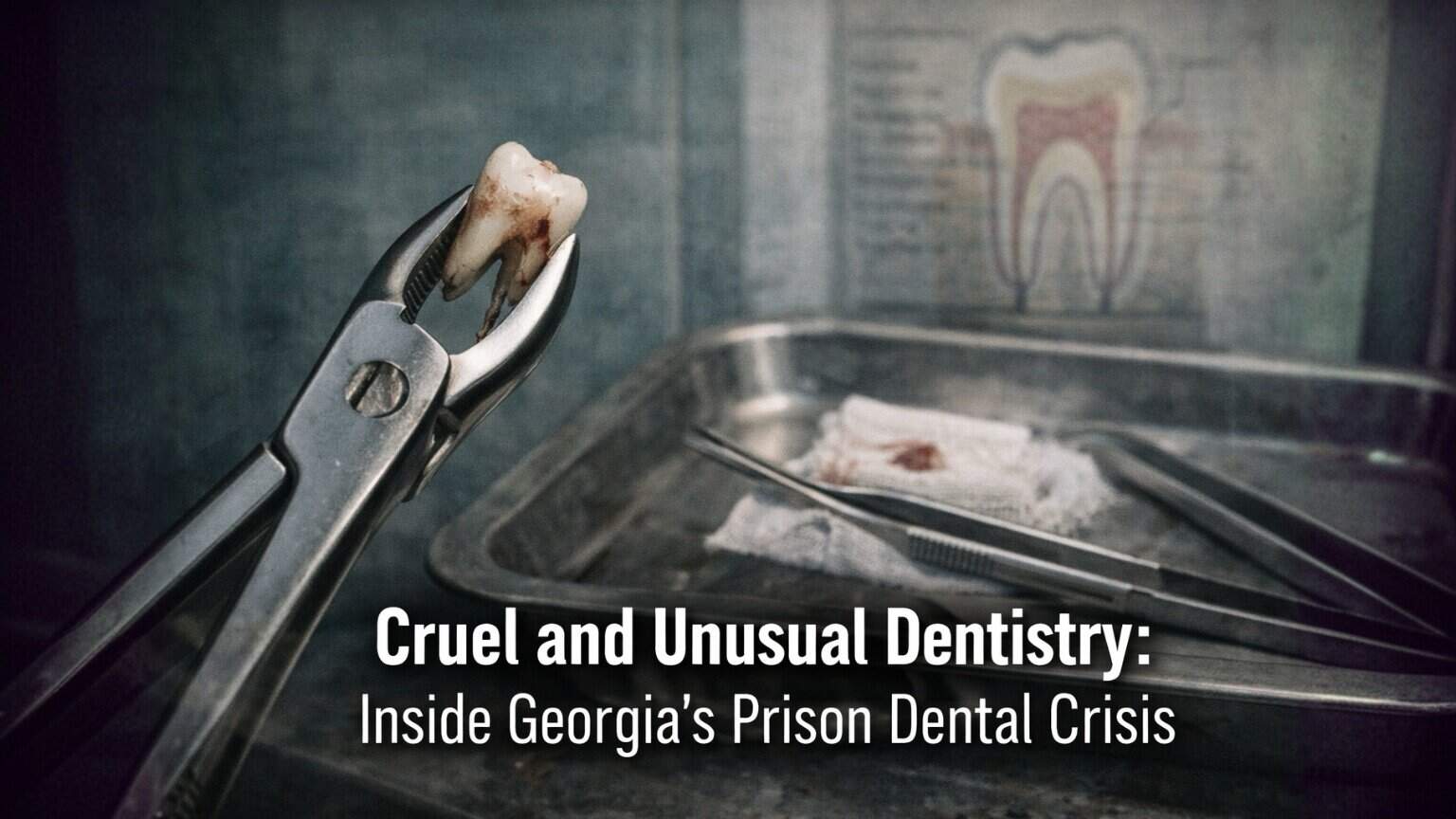
In Osaka, Japan, researchers at Kitano Hospital are conducting what may be the most remarkable medical trial of our time. A drug that blocks an antibody called USAG-1 has successfully regrown teeth in ferrets and mice. Human trials began in September 2024. If successful, by 2030, humans may be able to regrow lost teeth for the first time in medical history. 1
“We want to do something to help those who are suffering from tooth loss or absence,” Dr. Katsu Takahashi, head of dentistry at Kitano Hospital, told The Mainichi. “While there has been no treatment to date providing a permanent cure, we feel that people’s expectations for tooth growth are high.”
For most of humanity, this is thrilling news. Nearly half of adults over 30 have some form of periodontal disease. Tooth loss affects millions worldwide—diminishing quality of life, self-esteem, and basic nutrition. But in Georgia’s prisons, the crisis of tooth loss isn’t a problem waiting for a scientific cure. It’s a policy choice happening right now, one extracted tooth at a time.
The Butcher Shop
Rodney Roberts took care of his teeth. His mother instilled good habits from an early age. Then he was wrongfully incarcerated for 18 years.
“I describe the prison dental clinic as a ‘butcher shop,'” Roberts, now a re-entry coach at the Innocence Project, has said. He recalls having three teeth pulled for what could have been common cavities—extractions he calls “cruel and unusual.” The low-grade painkillers made recovery agonizing. 2
“Now that I’m aware of the whole dental world, I know I could have saved some of those teeth. They could have filled some of the cavities—capped or crowned my teeth—but I was never given that option.”
Roberts is not alone. Studies consistently show that incarcerated people have significantly more missing and decayed teeth—and fewer filled teeth—than the general population. 3 The reasons form a devastating triangle: malnutrition, extraction-only dental policies, and the violence and drugs endemic to facilities the U.S. Department of Justice has declared unconstitutional.
Pull First, Promise Later
In Georgia’s prisons, dental care follows a grimly predictable pattern. When teeth show decay or infection, the default treatment isn’t restoration—it’s extraction. Many prisoners report having all their teeth pulled, with prison officials promising dentures to replace them.
Then the waiting begins.
Dentures in Georgia prisons can take as long as two years to arrive. Prisoners are placed on waiting lists while those with “pain and infection” are prioritized—a reasonable-sounding policy that, in practice, means cosmetic and functional needs are perpetually deprioritized. The Georgia Department of Corrections’ own dental policy states that patients “will have the opportunity to acquire complete dentures within the capability of dental services (as the schedule allows after patients with pain and infection are addressed).” 4
In the meantime, these individuals must eat the already-inadequate prison food—heavy on tough starches, light on nutrition—with no teeth at all.
And when dentures finally arrive? The GDC doesn’t provide denture cleaning tablets. Instead, they’re sold on commissary for $3.95—in a system where prisoners work for zero wages or pennies per hour. Denture adhesive, essential for eating with poorly-fitted prison dentures? That’s $7.20 on commissary. Not provided.
For prisoners without family support or commissary funds, the choice is stark: gum your way through meals or go without the basics needed to maintain the very dentures the state finally provided.
The Malnutrition-Dental Crisis Connection
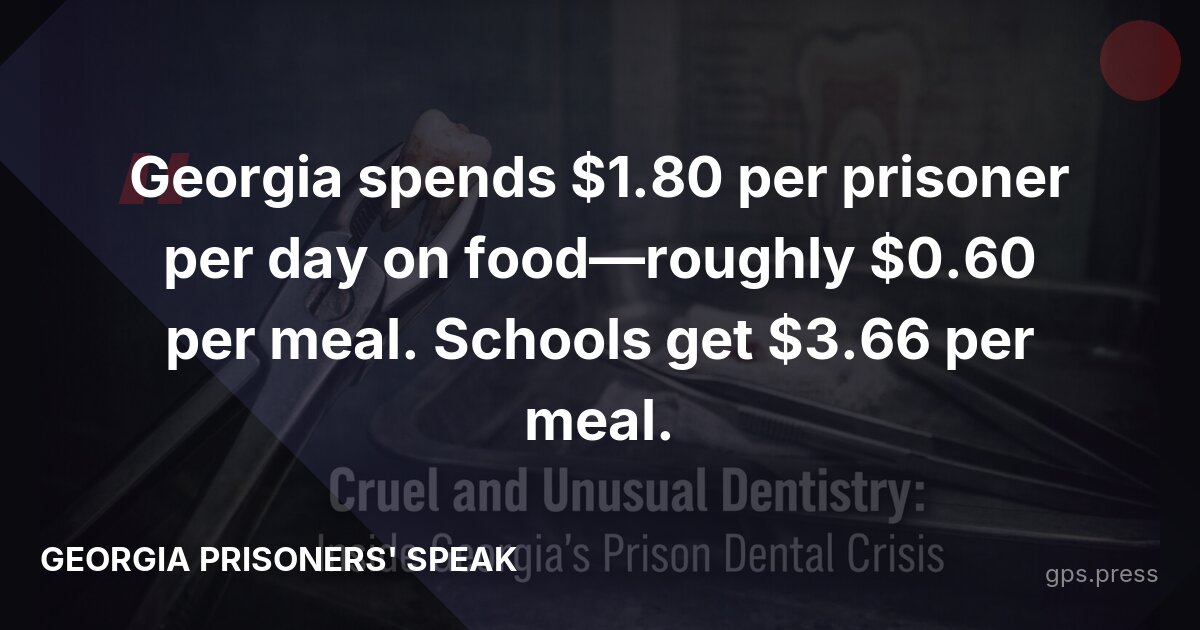
The dental crisis cannot be separated from Georgia’s notorious prison food system. The state spends approximately $1.80 per prisoner per day on food—roughly $0.60 per meal. 5
For comparison, the National School Lunch Program reimburses about $3.66 per meal—six times Georgia’s per-meal prison budget. The USDA’s “Thrifty Food Plan” estimates $10 per day as the minimum to feed an adult male nutritiously. California prisons spend over $4 per day on food; Florida around $2.30.
Georgia prisoners receive an estimated 1,200–1,800 calories daily—well below the WHO-recommended 2,500 calories and the Dietary Guidelines for Americans’ 2,200–2,400 for sedentary adult males. On weekends, inmates receive only two meals plus a peanut butter sandwich (added during COVID and still pretending to be a third meal). 6
The diet is heavy on processed carbohydrates—much of it corn-based—with almost no fresh fruits, vegetables, or protein. This matters for dental health in profound ways: calcium deficiency weakens tooth enamel, vitamin C deficiency causes gum disease, vitamin D deficiency impairs calcium absorption, and protein deficiency—niacin (B3) specifically—once caused epidemic pellagra in Southern prisons.
In 1915, Dr. Joseph Goldberger proved the nutrition-disease connection by putting healthy Mississippi prisoners on a typical prison diet of corn grits, syrup, biscuits, and fatback. Within months, six of eleven developed pellagra—a disease causing dementia, dermatitis, diarrhea, and death. When their diet was supplemented with milk, meat, and vegetables, they recovered. 7
A century later, Georgia’s prison diet isn’t quite that extreme—but it’s not far off. And the dental consequences are visible in every smile, or what’s left of one.
The Constitutional Dimension
The legal standard for prison healthcare was established in 1976. In Estelle v. Gamble, the U.S. Supreme Court ruled that “deliberate indifference to serious medical needs” of prisoners constitutes cruel and unusual punishment under the Eighth Amendment.
Dental care explicitly falls under this protection. The National Commission on Correctional Health Care lists dental care as an essential health service. Georgia’s own Correctional Standards of Health Care require a dental examination within 30 days of incarceration and care “when medically necessary.” 8
Yet in October 2024, the U.S. Department of Justice issued a scathing 93-page report finding that Georgia’s prisons violate the Eighth Amendment through “horrific and inhumane conditions” marked by “complete indifference and disregard to the safety and security of people Georgia holds in its prisons.” 9
The DOJ report focused primarily on violence—142 homicides between 2018-2023, with GPS documenting nearly 100 more in 2024 alone. But the conditions that create violence—chronic understaffing, gang control of facilities, inadequate healthcare—are the same conditions that destroy dental health.
When prisoners fear for their lives, dental hygiene becomes an afterthought. When staff vacancies exceed 50%, there’s no one to escort inmates to dental appointments. When gangs control access to food, showers, and basic necessities, they control whether someone can brush their teeth.
The Violence Connection
Teeth are lost to violence, too.
Physical altercations—frequent in Georgia’s gang-controlled facilities—can shatter teeth and jaws. The DOJ found that prisoners are “assaulted, stabbed, raped and killed” in facilities that are “woefully understaffed.” One prisoner’s body was found so badly decomposed that he had likely been dead in his cell for at least two days. 10
Then there are the drugs. Georgia’s prisons are flooded with “strips”—paper laced with synthetic drugs, often containing methamphetamine or fentanyl. 11 “Meth mouth”—the severe dental decay caused by methamphetamine use—is well-documented. The drug reduces saliva production, causes teeth grinding, and leads to rapid decay. Combined with already-inadequate nutrition and dental care, it accelerates tooth loss dramatically.
The Hidden Cost
For formerly incarcerated people, the dental damage follows them home.
“I can go get a steak right now and there’ll be no issues,” an Innocence Project social worker observed. “But for folks who are missing teeth or who have really bad dental health because of being incarcerated, they have to really think about how a meal could ruin their whole day.” 12
Missing teeth affect employment prospects. Studies show that poor dental health negatively impacts self-confidence and self-esteem—critical factors in job interviews. 13 In a society that judges books by their covers, a mouth full of gaps marks someone as “formerly incarcerated” as surely as a background check.
“Getting my teeth fixed exonerated me in a different kind of way,” Roberts said of finally receiving proper dental care after his release.
The Cruel Arithmetic
Consider the economics of Georgia’s prison dental crisis:
| Item | Cost/Status |
|---|---|
| Daily food budget | $1.80 per prisoner |
| Denture cleaning tablets | $3.95 (commissary—not provided) |
| Denture adhesive | $7.20 (commissary—not provided) |
| Wait time for dentures | Up to 2 years |
| Prison wages | $0 for most labor |
A prisoner without family support who needs denture supplies faces an impossible equation. The system extracts their teeth, makes them wait years for replacements, then charges them for the supplies needed to use those replacements—while paying them nothing for their labor.
This is not healthcare. This is a business model built on extraction in every sense of the word.
The Path Not Taken
Other systems have shown that prison dental care doesn’t have to be this way.
Minnesota’s Department of Corrections publishes its menus and nutrition information publicly, demonstrating transparency about what prisoners actually eat. 14 Arkansas mandates minimum caloric content and three meals per day. 15
Research from the UK and Netherlands shows that improving prisoner nutrition—including vitamins and minerals—reduces violent incidents by approximately 30%. 16 Better food means healthier bodies, clearer minds, and—not incidentally—healthier teeth.
Some states provide preventive fluoride treatments. Others offer orthodontic and prosthodontic care. Georgia offers extractions and a waiting list.
Looking Toward 2030
By 2030, if all goes well in Osaka, humans may be able to regrow lost teeth. The technology will likely be expensive at first, available primarily to those with resources.
For the approximately 50,000 people currently incarcerated in Georgia—and the millions who will cycle through the system before that breakthrough becomes accessible—the future looks different. They will continue to eat inadequate food, receive extraction-only dental care, wait years for dentures they can’t afford to maintain, and carry the visible scars of incarceration in their mouths for the rest of their lives.
The tragedy isn’t just that Georgia’s prisons damage teeth. It’s that this damage is entirely preventable. Better nutrition costs money, but saves more in healthcare costs and violence reduction. Restorative dental care costs more than extractions upfront, but less than dentures and long-term health consequences. Providing basic supplies like denture adhesive and cleaning tablets costs almost nothing compared to medical emergencies caused by poor oral health.
Georgia knows this. The DOJ told them. GPS has documented it exhaustively. The evidence is overwhelming.
The mouths of Georgia’s prisoners tell the truth that officials would rather not speak: this system is designed not to heal, but to extract. Not to restore, but to remove. Not to prepare people for reentry, but to mark them forever as less than whole.
By 2030, science may offer miraculous dental regeneration. Georgia’s prisoners can’t wait that long. They need constitutional conditions, adequate nutrition, and actual healthcare now—not in some imagined future, but today, before another tooth is pulled, another mouth is emptied, another human being is left to gum their way through a sentence that was never supposed to include this.
Because no one should have to trade their teeth for their freedom.
Call to Action: What You Can Do
A wrongfully incarcerated man had three teeth ripped out for cavities while Georgia spent 60 cents on his meals. Prisoners wait two years for dentures they can't afford to clean. Share this investigation—silence makes you complicit in systematic torture disguised as corrections policy.
Spread the Word — It Takes 15 Seconds
Awareness without action changes nothing. Here are the most effective ways you can help push for accountability and real reform:
Contact Your Representatives
Your state legislators control GDC’s budget, oversight, and the laws that created these failures. Demand accountability and transparency.
- Find your Georgia legislators: https://openstates.org/findyourlegislator
- Governor Brian Kemp: (404) 656-1776
- Georgia Department of Corrections Commissioner: (478) 992-5246
Demand Media Coverage
Journalists need to know these stories matter. Contact newsrooms at the Atlanta Journal-Constitution, local TV stations, and national outlets covering criminal justice. More coverage means more pressure for reform.
Use Impact Justice AI
Our free tool at https://impactjustice.ai helps you instantly draft and send personalized emails to lawmakers, journalists, and agencies. No expertise required—just your voice and your concern.
Amplify on Social Media
Share this article and call out the people in power.
Tag: @GovKemp, @GDC_Georgia, your local representatives
Use hashtags such as #GAPrisons, #PrisonReform, #GeorgiaPrisonerSpeak
Public pressure works—especially when it’s loud.
File Public Records Requests
Georgia’s Open Records Act gives every citizen the right to access government documents. Request:
- Incident reports
- Death records
- Staffing data
- Medical logs
- Financial and contract documents
Transparency reveals truth.
Attend Public Meetings
The Georgia Board of Corrections holds public meetings. Legislative committees review corrections issues during session. Your presence is noticed.
Contact the Department of Justice
For civil rights violations in Georgia prisons, file a complaint with the DOJ Civil Rights Division:
https://civilrights.justice.gov
Federal oversight has forced abusive systems to change before.
Support Organizations Doing This Work
Donate to or volunteer with Georgia-based prison reform groups fighting for change on the ground.
Vote
Research candidates’ positions on criminal justice. Primary elections often determine outcomes in Georgia. Your vote shapes who controls these systems.
Contact GPS
Georgia Prisoners’ Speak exists because incarcerated people and their families deserve to be heard. If you have information about conditions inside Georgia’s prisons, contact us securely at GPS.press.
About Georgia Prisoners’ Speak (GPS)
Georgia Prisoners’ Speak (GPS) is a nonprofit investigative newsroom built in partnership with incarcerated reporters, families, advocates, and data analysts. Operating independently from the Georgia Department of Corrections, GPS documents the truth the state refuses to acknowledge: extreme violence, fatal medical neglect, gang-controlled dorms, collapsed staffing, fraudulent reporting practices, and unconstitutional conditions across Georgia’s prisons.
Through confidential reporting channels, secure communication, evidence verification, public-records requests, legislative research, and professional investigative standards, GPS provides the transparency the system lacks. Our mission is to expose abuses, protect incarcerated people, support families, and push Georgia toward meaningful reform based on human rights, evidence, and public accountability.
Every article is part of a larger fight — to end the silence, reveal the truth, and demand justice.
Further Reading
- Nutrition Neglect: How Georgia’s Prison Food Is Fueling Violence *An investigation into how Georgia’s $1.80 daily food budget contributes to malnutrition, violence, and systemic health failures behind bars.*
- Georgia’s New Drug Crisis: The Strip Epidemic Inside State Prisons *How synthetic drug-laced paper floods Georgia’s facilities, fueling addiction, overdoses, and gang economies.*
- DOJ Finds Unconstitutional Conditions in Georgia Prisons *GPS analysis of the Department of Justice’s damning October 2024 report on violence, staffing collapse, and systemic failures.*
- The Hidden Death Toll: Homicides Georgia Doesn’t Count *How Georgia undercounts prison homicides and what the real numbers reveal about the crisis inside.*
- Medical Neglect Behind Bars: When Healthcare Becomes a Death Sentence *Documenting the deadly consequences of Georgia’s inadequate prison healthcare system.*
- Popular Mechanics Dec 2025 on tooth regrowth trials, https://www.popularmechanics.com/science/health/a69878870/human-new-tooth-regrowth-trials-japan-timeline/ [↩]
- Innocence Project May 2025 on oral health and wrongful conviction, https://innocenceproject.org/news/effects-of-poor-oral-health-on-the-wrongfully-convicted/ [↩]
- PMC 2022 study on prisoner oral health, https://pmc.ncbi.nlm.nih.gov/articles/PMC8753622/ [↩]
- GDC Dental Health Policy, http://www.dcor.state.ga.us/Divisions/InmateServices/healthServices_dental [↩]
- Georgia Senate Budget Office FY23 Report, https://www.legis.ga.gov/api/document/docs/default-source/senate-budget-office-document-library/appropriations/2023/fy23ahousepublicsafetyandcriminaljustice.pdf [↩]
- GPS on prison nutrition and violence, https://gps.press/nutrition-neglect-how-georgias-prison-food-is-fueling-violence/ [↩]
- NIH History on Dr. Goldberger and pellagra, https://history.nih.gov/pages/viewpage.action?pageId=8883184 [↩]
- Journal of Dental Hygiene 2013 on Georgia prison oral health, https://jdh.adha.org/content/87/5/271 [↩]
- DOJ Findings on Georgia Prisons Oct 2024, https://www.justice.gov/archives/opa/pr/justice-department-finds-unconstitutional-conditions-georgia-prisons [↩]
- US Attorney Northern District of Georgia Oct 2024, https://www.justice.gov/usao-ndga/pr/justice-department-finds-conditions-georgia-prisons-violate-constitution [↩]
- GPS on the strip epidemic in Georgia prisons, https://gps.press/georgias-new-drug-crisis-the-strip-epidemic-inside-state-prisons/ [↩]
- Innocence Project May 2025 on oral health burdens, https://innocenceproject.org/news/effects-of-poor-oral-health-on-the-wrongfully-convicted/ [↩]
- Gettysburg College 2020 on prison dental care, https://cupola.gettysburg.edu/cgi/viewcontent.cgi?article=1004&context=polfac [↩]
- Minnesota DOC Menus and Nutrition, https://mn.gov/doc/about/menus-and-nutrition/ [↩]
- Arkansas Minimum Standards for Detention Facilities 2014, https://www.sos.arkansas.gov/uploads/rulesRegs/Arkansas%20Register/2014/dec2014/006.26.14-001.pdf [↩]
- San Quentin News April 2023 on nutrition and violence, https://sanquentinnews.com/growing-research-shows-impact-of-poor-nutrition-on-prison-violence/ [↩]
1 thought on “Cruel and Unusual Dentistry: Inside Georgia’s Prison Dental Crisis”