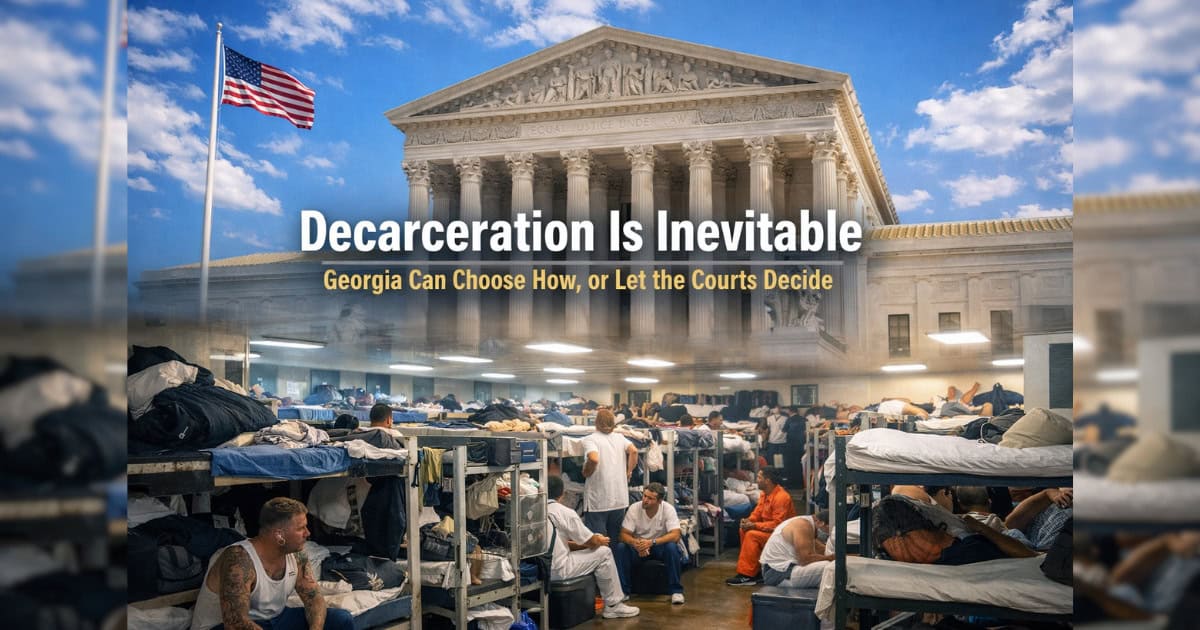
In October 2024, the U.S. Department of Justice delivered a verdict Georgia could no longer ignore: conditions inside the state’s prisons violate the Eighth Amendment’s prohibition against cruel and unusual punishment. Fourteen months later, nothing has improved. Prison homicides have exploded from 8 annually in 2017 to over 100 in 2024—a twelve-fold increase. Total deaths reached a record 333 in 2024, and 2025 is on pace to exceed it. The state added $700 million to its corrections budget between FY 2022 and FY 2026, yet outcomes have only worsened. Staffing remains at emergency levels, with 82.7% of new officers leaving within their first year.
The evidence points to a single conclusion: Georgia cannot incarcerate its way out of this crisis. The state must decarcerate—strategically reducing its prison population by releasing those who pose minimal risk while investing in the programs that actually reduce crime. This isn’t soft-on-crime ideology. It’s mathematics, morality, and constitutional necessity converging on the same answer.
The Crisis in Numbers: January 2026
Georgia’s prison system holds approximately 50,238 people in state custody, with another 2,171 waiting in county jails for transfer—a backlog that compounds overcrowding throughout the criminal justice system. The Georgia Diagnostic and Classification Prison in Jackson operates at 182.5% of its design capacity, packing 4,540 men into space built for 2,487. Dooly State Prison runs at over 200% capacity while housing populations far more dangerous than its medium-security classification suggests. Along with 3 other “medium” security prisons.
The human cost is staggering. The DOJ documented 142 homicides in Georgia prisons between 2018 and 2023. By 2024 alone, that number had reached at least 66 confirmed homicides—with GPS tracking suggesting the true figure exceeded 100. In the first six weeks of 2026, there was a riot at Washington SP, the other “medium” security prison that left 4 dead and a dozen hospitalized, with several more homicides and suicides in just the first two weeks of the year.
For every person killed, the DOJ found that serious, life-threatening incidents occur “exponentially more frequently.” Using federal ratios, 2024’s homicides likely accompanied 1,200 serious assaults requiring hospitalization—stabbings, slashings, and beatings that leave permanent damage but never make the headlines.
Meanwhile, the prison system hemorrhages money and staff. Correctional officer vacancy rates exceed 50% systemwide and surpass 70% at ten of the largest facilities. Consultants hired by Governor Kemp found that this understaffing has reached “emergency levels” at the majority of Georgia’s 34 state prisons, making it impossible to maintain even basic protocols like routine prisoner counts. 1
Who Should Be Released: The Low-Hanging Fruit
Georgia’s prison population includes thousands of people who pose virtually no risk to public safety—people whose continued incarceration wastes taxpayer resources while contributing to the very conditions that breed violence.
Elderly Prisoners: High Cost, Low Risk
As of the latest GDC statistical reports, Georgia prisons hold 12,929 people aged 50 or older—representing approximately 25% of the total prison population. This includes 7,306 people between ages 50-59 and another 5,623 who are 60 or older. This aging population has grown substantially over the past decade, driven by long sentences and restrictive parole policies.
Elderly prisoners impose dramatically higher costs. Georgia spends roughly $8,500 per year on medical care for each prisoner over 65—nearly nine times the approximately $950 spent annually on younger inmates. National studies confirm that states typically spend two to three times more overall to incarcerate older individuals. 2
Despite these costs, older inmates pose minimal risk. Research consistently shows that criminal activity sharply declines with age. Arrest rates drop to about 2% among individuals aged 50-65 and approach zero for those over 65. The DOJ’s own recidivism studies confirm that elderly released prisoners rarely reoffend.
Georgia’s life sentence population exemplifies this problem. The state holds 8,028 people serving parole-eligible life sentences, with an average age of 48.3 years. Another 2,314 serve life without parole, averaging 44.8 years old. Many of these individuals have spent decades demonstrating rehabilitation while occupying expensive beds that could be closed.
Long-Term Prisoners Ready for Release
Beyond the elderly, Georgia holds thousands of people who have served 15, 20, or even 30+ years—far longer than necessary for public safety. Evidence from multiple countries shows that after 15-20 years of incarceration, especially once an individual reaches middle age, the likelihood of reoffending drops below 10% and often below 3%.
In most developed democracies, 15-20 years is considered the presumptive maximum for even the most serious offenses, barring evidence of ongoing danger. Germany allows parole after 15 years even for life sentences. Norway caps most sentences at 21 years and maintains one of the world’s lowest recidivism rates at approximately 20%. 3
Georgia’s current laws—including “two-strikes” provisions and truth-in-sentencing requirements that mandate serving 85% of certain sentences—keep people incarcerated decades longer than necessary. The state’s parole board has quietly extended actual time served by 27% over the past decade, not through new laws but through changed practice. At $86.61 per day per prisoner, this shadow sentencing costs taxpayers over $1 billion annually in unnecessary incarceration.
The Security Classification Mismatch
GPS analysis reveals another decarceration opportunity: Georgia systematically misclassifies prisoners, housing people at higher security levels than their risk warrants. The system’s data shows 8,024 people classified as minimum security—only 15% of the population—despite evidence that far more pose minimal risk.
More troubling, certain medium-security facilities have become de facto close-security prisons through improper population management. Dooly, Wilcox, Calhoun, and Washington State Prisons house close-security populations of 28-30%—rates up to ten times higher than other medium-security facilities. These mismatches contribute directly to the violence crisis, with these four facilities accounting for disproportionate shares of homicides.
Proper reclassification and transfer to appropriate facilities—including transitional centers and community supervision—could safely reduce the state prison population while improving conditions for those who remain.
Decarceration Works: Evidence from States and Nations
The argument that releasing prisoners increases crime is not supported by evidence. Multiple U.S. states have reduced their prison populations by 20-30% while seeing crime decline faster than the national average.
New York and New Jersey: Pioneers of Safe Decarceration
Between 1999 and 2012, New York and New Jersey each reduced their state prison populations by 26%—even as the nationwide prison population grew by 10%. Both states achieved this through deliberate policy: scaling back harsh drug laws, expanding alternatives to incarceration, reforming parole practices, and reducing re-imprisonment for technical violations.
The results demolished the “more prisoners equals less crime” myth. Violent crime fell approximately 30% in both states during their decarceration period, exceeding the 26% national decline. Property crime similarly dropped by roughly 30%, outpacing the national 24% decrease. 4
These outcomes weren’t coincidental. Researchers confirmed it was deliberate policy choices—not underlying demographic or economic trends—that drove both the prison reductions and the safety improvements.
California: From Court Order to Crime Prevention
Facing court orders to reduce unconstitutional overcrowding, California enacted Realignment in 2011 and Proposition 47 in 2014, shifting low-level offenders from state prisons to county supervision and reclassifying certain felonies as misdemeanors. The state’s prison population fell by roughly 30%—about 30,000 fewer inmates by 2015.
During this decarceration, California’s violent crime rate declined 21%, slightly outpacing the national 19% drop. Property crime fell somewhat less than the national average, but overall crime remained near historic lows. Crucially, Proposition 47 has saved California over $800 million in incarceration costs—funds now reinvested in mental health treatment, drug rehabilitation, and community programs. 5
International Models: Proof That Less Is More
Beyond U.S. borders, the evidence is even more dramatic. Finland deliberately reduced its incarceration rate by approximately 75% over several decades—from about 200 per 100,000 citizens to roughly 50—through shorter sentences and expanded alternatives. Finnish criminologists found that crime rates operated independently of incarceration rates. Reducing imprisonment did not cause crime to increase. 6
Norway transformed its prison system in the 1990s, abandoning punitive approaches for rehabilitation-focused ones. The result: recidivism dropped from 70% to approximately 20%—one of the world’s lowest rates. Norway proves that even people convicted of serious violent crimes can be safely released after relatively modest sentences if the system focuses on genuine rehabilitation. The usual maximum sentence is 21 years, and most prisoners serve far less.
Germany maintains an incarceration rate roughly one-tenth of Georgia’s while enjoying lower violent crime rates and strong public safety. Life sentences typically allow parole after 15 years. Sentences beyond 20 years are rare.
These international examples aren’t utopian fantasies—they’re operating systems that Georgia can study and adapt.
The Constitutional Imperative: Brown v. Plata and Georgia’s Future
Georgia now faces the same constitutional crisis that forced California’s hand. The DOJ’s October 2024 findings established that Georgia’s prison conditions violate the Eighth Amendment through:
- Failure to protect incarcerated persons from physical violence
- Failure to protect from sexual abuse, particularly for LGBTI individuals
- Deliberate indifference to dangerous conditions caused by catastrophic understaffing
- Allowing gangs to control housing units and run criminal enterprises within facilities
These findings create a legal roadmap familiar from California’s experience. In Brown v. Plata (2011), the U.S. Supreme Court upheld federal court orders requiring California to release approximately 46,000 prisoners to remedy unconstitutional overcrowding. The Court found that overcrowding was the “primary cause” of constitutional violations and that population reduction was necessary for meaningful reform. 7
The parallels to Georgia are striking. Both states operated at roughly 190% of design capacity. Both faced systemic failures in medical care, mental health treatment, and protection from violence. Both demonstrated “deliberate indifference” through years of documented problems without adequate response.
The key distinction: Georgia measures capacity using inflated “operational capacity” numbers that include every bed physically present, regardless of whether supporting infrastructure (medical care, food service, programming space, staffing) can accommodate those numbers. Using original design capacity—the metric the Brown v. Plata Court applied—many Georgia facilities operate at even higher overcrowding ratios than California did.
Georgia can either implement decarceration through deliberate policy reform or face court-ordered releases under federal supervision. The former allows the state to select appropriate candidates and manage the transition; the latter removes that control entirely.
The Fiscal Case: Savings and Reinvestment
The financial argument for decarceration is overwhelming. Georgia spends approximately $32,000 per year per inmate in direct costs—over $1.5 billion annually for the current prison population. But true costs run far higher when including:
- Medical care for aging and chronically ill populations
- Emergency responses to violence (EMS transports averaging $1,200-$1,500 each; helicopter evacuations at $35,000-$55,000)
- Overtime and contract staffing to partially fill vacancies
- Legal costs from lawsuits over unconstitutional conditions
- Lost economic productivity from incarcerated workers
Governor Kemp proposed allocating $600 million over 18 months for emergency repairs, staffing improvements, and infrastructure—a tacit admission that current spending has failed. But adding money to a system designed to warehouse 50,000+ people cannot solve problems caused by warehousing 50,000+ people. The only sustainable solution is reducing the population to levels the system can actually manage.
“Georgia added $700 million to its corrections budget between FY 2022 and FY 2026—the fastest spending growth in agency history. Prison homicides rose from 8 annually to 100 in 2024. Staffing remains 50-76% vacant. The DOJ found healthcare unconstitutional. The money bought nothing.”
Decarceration savings can be substantial if implemented properly. Virginia estimated that releasing just 62 elderly prisoners meeting geriatric parole criteria would save $6.6 million in a single year. Georgia’s elderly population is more than 200 times larger. Even conservative release programs could generate tens of millions in annual savings.
More importantly, those savings can be reinvested in programs that actually reduce crime: education, job training, mental health services, substance abuse treatment, and community supervision. California’s Proposition 47 demonstrates this model, redirecting over $100 million to local rehabilitation and prevention programs. 8
Best Practices for Safe Implementation
Decarceration must be implemented thoughtfully to maintain public safety and political sustainability. Evidence from successful reform jurisdictions suggests these key practices:
Expand Geriatric and Medical Release
Georgia should automatically review all prisoners above age 55 or 60 for release eligibility, with a presumption of release absent evidence of ongoing danger. Medical parole criteria should be expanded and procedures streamlined. Currently, many eligible prisoners die before navigating Georgia’s restrictive compassionate release process.
Institute “Second Look” Reviews
Create a mechanism to reevaluate all sentences after 15 years. A judicial review board could assess current risk, rehabilitation progress, and continued justification for incarceration. The Sentencing Project recommends such review after at most 10 years for any case. 9
Reform Front-End Sentencing
Eliminate mandatory minimums for non-violent offenses. Revise truth-in-sentencing provisions that require serving 85% of certain sentences. Consider caps on maximum sentences, recognizing that terms beyond 20 years have diminishing public safety returns.
Reduce Technical Violation Reincarceration
A significant portion of prison admissions come not from new crimes but from people revoked for technical probation or parole violations—missing meetings, failed drug tests, or paperwork failures. Several states now bar reincarceration for purely technical violations or cap sanctions at short jail stays rather than years in prison. 10
Invest in Reentry Support
Decarceration works best when coupled with robust reentry services. Georgia should enhance transitional housing, job placement, mental health treatment, and family reunification programs. The first weeks after release are highest-risk for recidivism; intensive support during this period dramatically improves outcomes. Metro Reentry Facility in Atlanta demonstrates this model within Georgia’s own system.
Engage Stakeholders Transparently
Successful decarceration requires buy-in from lawmakers, law enforcement, victims’ advocates, and the public. Georgia should form a review commission with diverse membership, communicate evidence about which populations are safe for release, and ensure transparency in the process. Frame decarceration not as being “soft” on crime but as being smart about public safety—reallocating resources from warehousing to prevention.
Conclusion: The Only Path Forward
Georgia faces a choice, but not the one politicians often present. The choice is not between “tough” and “soft” approaches to crime. It’s between evidence-based policy that improves public safety and ideological commitment to a system that demonstrably fails.
The current approach has produced:
- Record deaths and homicides
- DOJ findings of unconstitutional conditions
- Staffing at emergency levels with 82.7% first-year turnover
- Budget increases that buy nothing
- Violence that makes communities less safe when traumatized individuals eventually return home
Decarceration offers:
- Reduced costs allowing investment in prevention
- Smaller populations that can actually be managed safely
- Constitutional compliance avoiding federal intervention
- Evidence-based results from states and nations that have succeeded
Georgia’s prison crisis presents an opportunity to rethink criminal justice. Decarceration focused on elderly, long-incarcerated, and low-risk populations is a proven solution that can relieve overcrowding, reduce violence, save taxpayer money, and maintain public safety.
The experiences of New Jersey, California, Finland, and Norway demonstrate that fewer prisoners can mean less crime when reforms are implemented thoughtfully. Georgia can follow their lead or wait for federal courts to force the same outcome with less control and more chaos.
The case for decarceration has never been stronger. The question is how many more have to die.
Call to Action: What You Can Do
Prison homicides jumped from 8 to over 100 while Georgia spent $700 million more on a system the DOJ declared unconstitutional. People are dying while officials count budget increases as progress. Share this investigation—silence makes you complicit in a crisis with proven solutions.
Spread the Word — It Takes 15 Seconds
Awareness without action changes nothing. Here are the most effective ways you can help push for accountability and real reform:
Use Impact Justice AI
Our free tool at https://impactjustice.ai helps you instantly draft and send personalized emails to lawmakers, journalists, and agencies. No expertise required—just your voice and your concern.
Contact Your Representatives
Your state legislators control GDC’s budget, oversight, and the laws that created these failures. Demand accountability and transparency.
- Find your Georgia legislators: https://open.pluralpolicy.com/ga/
- Governor Brian Kemp: (404) 656-1776
- Georgia Department of Corrections Commissioner: (478) 992-5246
Demand Media Coverage
Journalists need to know these stories matter. Contact newsrooms at the Atlanta Journal-Constitution, local TV stations, and national outlets covering criminal justice. More coverage means more pressure for reform.
Amplify on Social Media
Share this article and call out the people in power.
Tag: @GovKemp, @GDC_Georgia, your local representatives
Use hashtags such as #GAPrisons, #PrisonReform, #GeorgiaPrisonerSpeak
Public pressure works—especially when it’s loud.
File Public Records Requests
Georgia’s Open Records Act gives every citizen the right to access government documents. Request:
- Incident reports
- Death records
- Staffing data
- Medical logs
- Financial and contract documents
Transparency reveals truth.
https://georgiadcor.govqa.us/WEBAPP/_rs/SupportHome.aspx
Attend Public Meetings
The Georgia Board of Corrections holds public meetings. Legislative committees review corrections issues during session. Your presence is noticed.
Contact the Department of Justice
For civil rights violations in Georgia prisons, file a complaint with the DOJ Civil Rights Division:
https://civilrights.justice.gov
Federal oversight has forced abusive systems to change before.
Support Organizations Doing This Work
Donate to or volunteer with Georgia-based prison reform groups fighting for change on the ground.
Vote
Research candidates’ positions on criminal justice. Primary elections often determine outcomes in Georgia. Your vote shapes who controls these systems.
Contact GPS
Georgia Prisoners’ Speak exists because incarcerated people and their families deserve to be heard. If you have information about conditions inside Georgia’s prisons, contact us securely at GPS.press.
About Georgia Prisoners’ Speak (GPS)
Georgia Prisoners’ Speak (GPS) is a nonprofit investigative newsroom built in partnership with incarcerated reporters, families, advocates, and data analysts. Operating independently from the Georgia Department of Corrections, GPS documents the truth the state refuses to acknowledge: extreme violence, fatal medical neglect, gang-controlled dorms, collapsed staffing, fraudulent reporting practices, and unconstitutional conditions across Georgia’s prisons.
Through confidential reporting channels, secure communication, evidence verification, public-records requests, legislative research, and professional investigative standards, GPS provides the transparency the system lacks. Our mission is to expose abuses, protect incarcerated people, support families, and push Georgia toward meaningful reform based on human rights, evidence, and public accountability.
Every article is part of a larger fight — to end the silence, reveal the truth, and demand justice.
Further Reading
- $700 Million More—And Nothing to Show for It *GPS analysis of Georgia’s exploding corrections budget and worsening outcomes from FY 2022 to FY 2026.*
- Brown v. Plata: A Legal Roadmap for Georgia’s Prison Crisis *How the Supreme Court’s California decision provides a template for challenging Georgia’s unconstitutional overcrowding.*
- Georgia’s Shadow Sentencing System *How the Parole Board quietly extended actual time served by 27% without changing any laws.*
- The Classification Crisis: How Four Medium Security Prisons are Killing People *GPS investigation into the deadly consequences of housing close-security inmates in medium-security facilities.*
- Normalization: The Principle That Changes Everything *Why every developed nation except the United States treats prison as a place for rehabilitation, not additional punishment.*
- The Deterrence Myth: Georgia’s Harsh Sentencing Backfired *Academic research proving that longer sentences don’t deter crime—and may increase it.*
- Governing Feb 2025 https://www.governing.com/workforce/prison-violence-soars-in-georgia-as-state-faces-staffing-crisis [↩]
- NIH Study on Aging Prisoners https://pmc.ncbi.nlm.nih.gov/articles/PMC3374923/ [↩]
- Sentencing Project https://www.sentencingproject.org/reports/counting-down-paths-to-a-20-year-maximum-prison-sentence/ [↩]
- Sentencing Project https://sentencingproject.org/wp-content/uploads/2015/11/Fewer-Prisoners-Less-Crime-A-Tale-of-Three-States.pdf [↩]
- CJCJ Prop 47 Analysis https://www.cjcj.org/reports-publications/publications/proposition-47-estimating-local-savings-and-jail-population-reductions-summary [↩]
- Prison Policy Initiative https://www.prisonpolicy.org/prisonindex/finland.html [↩]
- GPS Brown v. Plata Analysis https://gps.press/brown-v-plata-a-legal-roadmap-for-georgias-prison-crisis/ [↩]
- California Courts on Prop 47 https://www.cacalls.org/prop-47/ [↩]
- Sentencing Project on Second Look Laws https://www.sentencingproject.org/fact-sheet/second-look-laws-are-an-effective-solution-to-reconsider-extreme-sentences-amidst-failing-parole-systems/ [↩]
- Council of State Governments https://csgjusticecenter.org/publications/confined-costly/ [↩]
This is a great article. I’ve heard myself offer the same solutions for overcrowding and mass incarceration. I have contacted, acted, joined, participated, written, visited, and whatever else deemed necessary to be heard. If you were out and about at the Capitol today you may have seen me or I you. I have been advocating for my son for years, but moreso now because he is incarcerated unlawfully. Wayne Bennett. With all his accolades still lacks empathy, current knowledge of the prison system, the difference between certain types of criminal behavior, and probably his place in the scheme of the parole board. My son has not even been to court in almost 2 years for an alleged misdemeanor criminal trespass. It was a terrible plan Houston county had to execute his reincarceration, but it worked, if only for a short while. I’m not sure how the state can bypass the courtroom and send a person to prison without a judges order, being it’s a new crime. It was made clear more than once (because we civilians are dummies they think) that a hearing isn’t a courtroom. We know that. The parole board uses this informal hearing as a way to accept 100% hearsay, disallow witness testimony, withhold evidence, and ask that hard evidence be summarized for the hearing officer before he lays down his full revocation findings. I’m just kidding. He did that before he even entered the room. Wayne Bennett played judge, jury, and executioner to a crime that never happened. The only testifying witness was for the State and he had no hard evidence because he wasn’t present during the time when the crime supposedly happened, but he assured Bennett he possessed a video solidifying his claim to the offense. No such video exists (Franks violation), however 2 videos exists that contradict Brown’s statement and support the innocence of my son. It is just too bad the State’s solicitor, Ashley Schell, withheld those videos (tampering with evidence-Brady violation) until after the parole hearing. So without the submission of exculpatory evidence by the State and the fabrication of a video describing my son arguing and refusing to leave private property supporting Brown’s claim to criminal activity, my son has spent nearly 2 years in prison. That’s not justice. It’s not helping our prison population, and it damn sure isn’t providing any type of rehabilitative worth. I had to ask myself “How did that judge see probable cause to issue an arrest warrant when Brown’s report and testimony was contradicted by his Corporal’s supplementary report?” Maybe, just maybe, he didn’t supply that to the judge and submitted only his report; one full of falsified statements and observations that can and will be proven not only inaccurate but 100% false. How is it possible and how do we allow for such proceedings to go through the system, without being noticed or questioned by a man with such law related credentials as Bennett and the judge? Well, you have attorneys like Mackenzie Miller of Hogue-Griffin that refuse to file a motion to compel the state to release the videos for fear of “pissing off the solicitor”, to put it in her own words. How do we license attorneys that didn’t take the time with your case, at their own admission? An attorney that allows himself to be disbarred for spending clients monies inappropriately? This is the trash I’ve had to deal with for almost 2 years and it’s ridiculous. How many others are wrongfully imprisoned under the same conditions. Yes, individual cases need to be reviewed by an unbiased source from the outside and I bet that would reduce our prison population tremendously and make room for some real rehabilitation. “It is not the prisoners that need reformation; it is the prisons” Oscar Wilde. And justice isn’t seen in the courtroom; it’s seen outside the courtroom in a thriving, healthy, working community. I hope that someone will begin to investigate these cases such as my son’s and begin thinning out our prison population. I’d like to see real training and screening of GDC employees and the sorting of gang members into like groups to discourage prison violence between gangs. They should really band together as a whole to find their own solutions to present to the GDC for a more comfortable situation during their incarceration time. I also think that state restitution should be curtailed or eliminated altogether. There is no way you can accumulate any wealth, ever so small even, when you have to pay back the state for your crime. Isn’t that what prison time is for? Seems a little like double jeopardy to me.
I’m sure the State has been provided with a copy of the aforementioned example that can be an alternative to lengthy incarceration and promote meaningful contributions to the community. Thanks for posting that article. It’s nice to see like minds researching solutions to this mess we call our judicial system.