How Georgia’s Department of Corrections Defies Every Institution Meant to Hold It Accountable
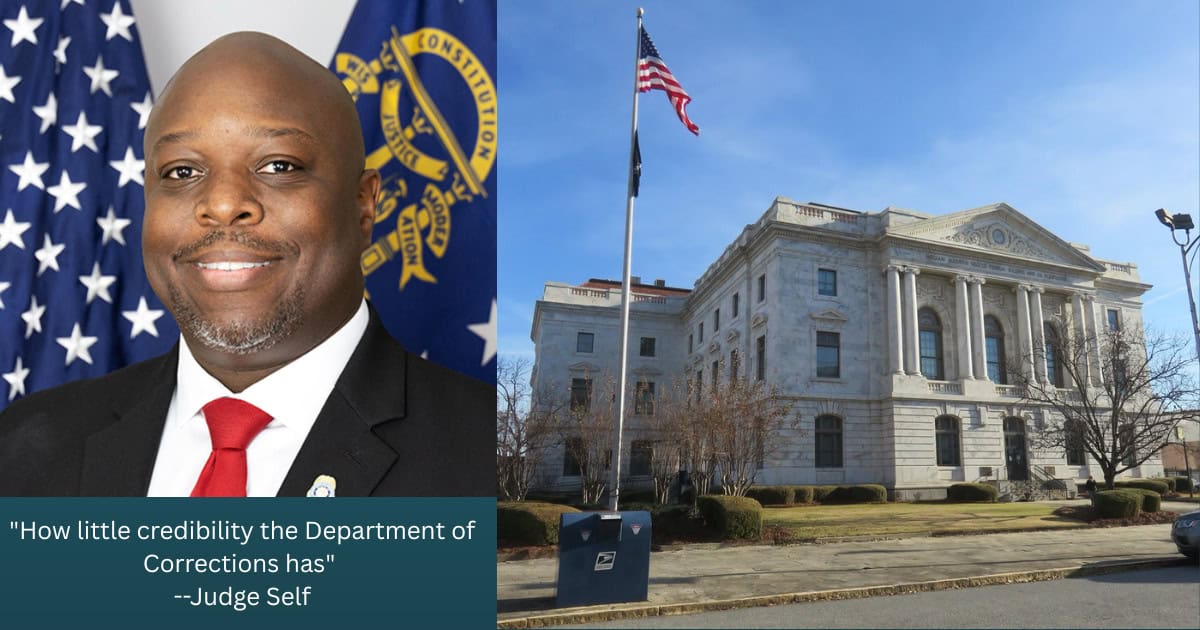
On February 10, 2026, U.S. District Court Judge Tilman E. “Tripp” Self III did something unusual. He summoned the Commissioner of the Georgia Department of Corrections to the witness stand — not to testify about a riot, a death, or a policy failure — but to explain why his department had ignored a court order. The order wasn’t complicated. It didn’t require building new facilities, hiring hundreds of officers, or restructuring an agency. It simply required the GDC to stop restricting an inmate’s email contacts to 12 people.
The GDC couldn’t even do that.
Judge Self’s words from the Macon courtroom were devastating. He wanted Commissioner Tyrone Oliver to hear “from my mouth how little credibility the Department of Corrections has.” He called the department’s failure to comply with an appellate court order “shocking” and “unbelievable.” He compared it to a child-support case, telling Oliver that if this were family court, “you would be in jail.” 1
But Judge Self’s rebuke was not an isolated moment of judicial frustration. It was the latest entry in a long and damning record of institutional defiance — a pattern in which the Georgia Department of Corrections has stonewalled, obstructed, deceived, or simply ignored every institution charged with holding it accountable. Federal judges. The U.S. Department of Justice. State legislators. A U.S. Senator. The press. The public. One by one, each has demanded transparency, compliance, or basic accountability from the GDC. One by one, each has been met with the same response: resistance.
Two Judges, Two Courtrooms, One Conclusion
Judge Self’s February 2026 hearing centered on a seven-year-old case. Ralph Harrison Benning, an inmate at Augusta State Medical Prison, had challenged the GDC’s policy of limiting his email contacts to 12 individuals on his in-person visitation log. In November 2024, Judge Self issued a 29-page order granting Benning’s motion for summary judgment, enjoining the GDC from enforcing the email-contact restriction, and declaring that it violated the First Amendment. The GDC was ordered to stop enforcing it. 2
More than a year later, Benning filed a motion claiming the GDC was still enforcing the restriction — “willfully and intentionally” refusing to comply. When Judge Self demanded answers, the GDC’s own attorney conceded there was “little to no excuse” for the department’s failure. Commissioner Oliver testified that he only learned of the order sometime around Christmas 2025 and “immediately” instructed his team to comply — more than a year after the ruling.
“If the 11th Circuit tells me to do something, I just don’t get the luxury of not doing it. I don’t understand how you do.” — Judge Self to Commissioner Oliver
Self told Oliver he wanted the Speaker of the Georgia House, the Lieutenant Governor, and the Governor to “hear about it. Because they need to understand that there is a real problem.” He referenced another case — one that had already laid bare the same pattern of defiance.
That case unfolded two years earlier, in the same federal district, before Judge Marc Treadwell. In April 2024, Treadwell issued a 100-page contempt order against the GDC in Gumm v. Jacobs, finding the department in “flagrant” violation of a settlement agreement it had voluntarily entered. The agreement required the GDC to restore basic constitutional rights to inmates held in the Special Management Unit at Georgia Diagnostic Prison in Jackson — the state’s most extreme solitary confinement unit, which the court called “one of the harshest and most draconian” in the country. 3
The settlement had promised outdoor exercise time, access to showers and books, and a maximum stay of 24 months for any single inmate. The GDC broke every promise. Critically low staffing levels meant inmates could not be taken to outdoor exercise pens. The court found a complete lack of effort to comply — or even to document the noncompliance. Treadwell wrote that the defendants were “figuratively thumbing their noses at the Court.” 4
Treadwell imposed fines of $2,500 per day — $75,000 per month — and ordered the appointment of an independent monitor at GDC expense. The GDC had also been found to have made false statements or misrepresentations about its compliance efforts. 3
When Judge Self referenced this case two years later, he said: “Heads should hang in shame. It’s just like the Department thinks that they can do anything they want to do. It is not going to happen.” 1
Two different federal judges. Two separate courtrooms. Two entirely different legal issues — email access and solitary confinement conditions. The same conclusion: the Georgia Department of Corrections treats court orders as optional.
Obstructing the Federal Government
The GDC’s defiance of the judiciary did not occur in isolation. It ran parallel to an extraordinary battle with the U.S. Department of Justice — one that required the federal government to go to court just to obtain basic records about how people were dying inside Georgia’s prisons.
The DOJ first opened a limited investigation into GDC facilities in 2016, focused on whether the state was protecting LGBTQ prisoners from sexual abuse. During that phase, the GDC cooperated, turning over more than a thousand documents with no strings attached. 5
But in September 2021, when the DOJ expanded its investigation to a statewide probe of violence across all GDC facilities, the department’s posture changed overnight.
The DOJ issued a formal subpoena in December 2021 after the GDC refused to provide records voluntarily. The subpoena sought policies, training materials, staffing documents, personnel discipline records, incident reports, and internal investigation materials. The deadline was January 2022. 6
When the deadline passed, the GDC had provided only “an incomplete set of policies” — described by the DOJ as a fraction of what was requested — along with some blank form documents and a few organizational charts. No incident reports. No data or documents related to homicides or other acts of violence. No documents about affected inmates or staff. Not a single record about how people were being killed inside Georgia’s prisons. 5
On March 28, 2022, the DOJ filed a petition in U.S. District Court for the Northern District of Georgia to force compliance. The filing revealed that the GDC had imposed two extraordinary conditions on cooperation:
- The GDC demanded that the DOJ sign a nondisclosure agreement before the department would release records or allow federal investigators to visit prisons, interview inmates, or speak with staff.
- The GDC demanded that the DOJ explain the basis of its own investigation before the state would cooperate — essentially requiring the federal government to justify why it was investigating before the state would allow itself to be investigated.
The DOJ cited the Civil Rights of Institutionalized Persons Act (CRIPA) in declining both demands. 6
Terrica Redfield Ganzy, Executive Director of the Southern Center for Human Rights, captured the gravity of what was happening:
“People are dying in the custody of the Georgia Department of Corrections. The DOC is failing to protect the people in its care. To stall, obstruct, and obfuscate the DOJ’s investigation into these failures — while people continue to die inside — is atrocious.” 7
In July 2022, Magistrate Judge John K. Larkins III recommended that the GDC be ordered to comply within 45 days — a recommendation that would have knocked down what the AJC described as a “six-month effort by the Department of Corrections to avoid turning over” the requested records. The GDC filed formal objections. 8
The obstruction continued even after records were eventually produced. When the DOJ finally released its 94-page findings report in October 2024 — documenting what it called “among the most severe violations” it had ever uncovered in a prison investigation — the report noted explicitly that the GDC’s resistance had made the investigation “unnecessarily contentious and lengthy.” The DOJ also described how, in the days before federal investigators visited prisons, the GDC hurriedly fixed buildings that had languished in disrepair — a last-minute stage-setting that could not undo years of neglect. 9
Even after those findings were released — documenting endemic violence, gang-controlled facilities, rampant sexual assault, and a culture of “deliberate indifference” — the GDC’s official response was that the report reflected “a fundamental misunderstanding of the current challenges of operating any prison system.” 10
Barring the Legislature
It was not only federal institutions that the GDC kept at arm’s length. Georgia’s own elected representatives — the lawmakers who control the department’s budget — found themselves locked out as well.
In August 2021, seven Georgia House Democrats traveled to Lee Arrendale State Prison in Alto, the state’s largest women’s facility, to investigate reports of inhumane conditions. They were denied entry at the gate and told they could “possibly visit after filling out the proper paperwork.” 11
State Rep. Erick Allen, a Smyrna Democrat, offered a blunt assessment of what was happening: “The system is surviving by walling itself off from the public.” Rep. Josh McLaurin, the Sandy Springs Democrat who organized the visit, noted that the Legislature has inherent subpoena power — but the Republican majority would need to exercise it. It never did. 11
The timing was significant. The legislators were responding to reports from the Southern Center for Human Rights and prisoners themselves documenting severe staffing shortages, brown water, inedible food, and a major increase in homicides and suicides across GDC facilities. The GDC had not responded to numerous requests for information about these complaints. The Southern Center had already begun meeting with DOJ officials to request federal intervention. 11
That same year, U.S. Senator Jon Ossoff called for an FBI investigation specifically into Pulaski State Prison after the AJC reported on gang violence, extortion, and sexual assaults against women — including two women sodomized at knifepoint by gang members demanding protection payments. Ossoff called the situation “tragic and wholly unacceptable.” 12
The GDC carried on. No FBI investigation materialized. No structural changes followed. Pulaski continues to operate with more correctional officer vacancies than any other prison in the Georgia Department of Corrections. 13
Deceiving the Public
The same department that stonewalled federal investigators, defied federal judges, and barred state legislators also engaged in a systematic campaign to manipulate the information available to the press, the public, and the lawmakers who fund it.
In December 2024, a sweeping AJC investigation documented how GDC officials had “repeatedly presented false or misleading information to federal investigators, state lawmakers and even a federal judge.” The investigation found falsified and backdated documents, false statements, and flawed data — all deployed to hide the department’s dysfunction. 14
In March 2024, as prison homicides were surging to record levels, the GDC stopped including preliminary cause of death in its monthly mortality reports — the very data that allowed the public and the press to track how many prisoners were being killed. Even in cases where prisoners had clearly been beaten or stabbed to death, the department listed no initial finding. This was information the GDC had routinely provided for years. 14
When the AJC requested final death determinations from 2022 and 2023, GDC General Counsel Jennifer Ammons declined, saying the agency doesn’t compile such a report and therefore didn’t have to create one for the public. When the AJC and others requested incident reports for prisoner deaths, the GDC routinely blacked out entire pages, citing exemptions in the Georgia Open Records Act. 14
Commissioner Oliver went even further. In testimony before state lawmakers, he dismissed news reports of undisclosed homicides and record deaths as “propaganda.” 14
The numbers told a different story. By the end of October 2024, more prisoners had died — 270 — than in each of the previous three years. The AJC identified at least 51 homicide victims in 2024 alone, topping the previous record of 39 set just the year before. 14
Atteeyah Hollie, deputy director of the Southern Center for Human Rights, summed up two decades of watching this system: “I don’t think I’ve seen during my time at the Southern Center — and I’ve been here for almost two decades — this level of suffering in Georgia’s prisons or this level of indifference by the agency.” 14
A Culture of Defiance
What emerges from this record is not a series of isolated missteps or bureaucratic oversights. It is a pattern of institutional behavior — deliberate, consistent, and spanning years — in which the Georgia Department of Corrections has systematically resisted accountability from every external institution with the authority to demand it.
The pattern follows a recognizable playbook:
- Delay: Refuse to comply with subpoenas and court orders until forced by litigation, as with the DOJ records battle and the Benning email case
- Obstruct: Impose conditions on cooperation that no legitimate oversight body would accept, like demanding the DOJ sign an NDA
- Deceive: Provide false or misleading information to investigators, lawmakers, and judges, as documented by the AJC and found by Judge Treadwell
- Conceal: Strip public reports of critical data, redact incident reports, and block access to facilities
- Dismiss: Label documented evidence of crisis as “propaganda” and claim the system “exceeds constitutional requirements” while federal courts find the opposite
This is not a department that occasionally falls short. This is a department that has built its operational culture around avoiding scrutiny. As Judge Self told Commissioner Oliver: “It’s just like the Department thinks that they can do anything they want to do.”
The Cost of Impunity
The human consequences of this defiance are measured in bodies.
While the GDC fought to keep records from the DOJ, people were being killed at record rates inside its facilities. While it defied Judge Treadwell’s settlement agreement, inmates in the Special Management Unit were denied basic constitutional rights — outdoor exercise, showers, books. While it barred legislators from Arrendale, women inside were being sexually assaulted, extorted, and forced to drink contaminated water.
Georgia has added more than $700 million to its corrections budget since FY 2022 — the fastest spending growth in agency history. Prison homicides have risen from single digits annually to over 100 in 2024. Staffing remains 50 to 76 percent vacant at the most dangerous facilities. The DOJ found healthcare to be unconstitutional. 15
The money bought nothing because the institution spending it answers to no one.
Judge Self’s final words at the February 2026 hearing were directed not just at Commissioner Oliver but at the political leadership of the state of Georgia: “I hope the speaker and the lieutenant governor and the governor hear about it. Because they need to understand that there is a real problem.” 1
The problem is not that Georgia doesn’t know. The courts have told them. The DOJ has told them. The press has told them. Their own legislators have tried to see for themselves and been turned away at the gate. The problem is that the Georgia Department of Corrections has learned, through years of consequence-free defiance, that it does not have to listen.
That must end.
Explore the Data
GPS makes GDC statistics accessible to the public through several resources:
- GPS Statistics Portal — Interactive dashboards translating complex GDC reports into accessible formats, updated within days of official releases.
- GPS Lighthouse AI — Ask questions about Georgia’s prison system and get answers drawn from GPS’s investigative archive and data analysis.
- Machine-Readable Pages for Researchers — GPS maintains AI-optimized pages for data analysis:
- AI Content Index — https://gps.press/ai-index/
- Facilities Data — https://gps.press/facilities-data/
- Statistics Data — https://gps.press/statistics-data/
- Release Statistics Data — https://gps.press/release-statistics-data/
- Mortality Data — https://gps.press/mortality-data/
- Blog Data — https://gps.press/blog-data/
- GPS News Data — https://gps.press/gps-news-data/
- FAQ Index — https://gps.press/faq-index/
- Featured Articles Index — https://gps.press/featured-index/
Contact GPS at media@gps.press for access to underlying datasets used in this analysis.
Call to Action: What You Can Do
Awareness without action changes nothing. Here’s how you can help push for accountability and real reform:
Use Impact Justice AI — Our free tool at https://impactjustice.ai lets you instantly draft and send personalized emails to lawmakers, journalists, and agencies. No expertise required.
Contact Your Representatives — Your state legislators control GDC’s budget, oversight, and the laws that created these failures. Find your Georgia legislators at https://open.pluralpolicy.com/ga/ or call Governor Kemp at (404) 656-1776 or the GDC Commissioner at (478) 992-5246.
Demand Media Coverage — Contact newsrooms at the AJC, local TV stations, and national criminal justice outlets. More coverage means more pressure.
Amplify on Social Media — Share this article and tag @GovKemp, @GDC_Georgia, and your local representatives. Use #GAPrisons, #PrisonReform, #GeorgiaPrisonerSpeak.
File Public Records Requests — Georgia’s Open Records Act gives every citizen the right to request incident reports, death records, staffing data, medical logs, and financial documents at https://georgiadcor.govqa.us/WEBAPP/_rs/SupportHome.aspx.
Attend Public Meetings — The Georgia Board of Corrections and legislative committees hold public meetings. Your presence is noticed.
Contact the Department of Justice — File civil rights complaints at https://civilrights.justice.gov. Federal oversight has forced abusive systems to change before.
Support Organizations Doing This Work — Donate to or volunteer with Georgia-based prison reform groups fighting for change on the ground.
Vote — Research candidates’ positions on criminal justice. Primary elections often determine outcomes in Georgia.
Contact GPS — If you have information about conditions inside Georgia’s prisons, reach us securely at GPS.press.
Further Reading
$700 Million More — And Nothing to Show for It
GPS investigation documenting how the fastest corrections budget increase in Georgia history produced zero measurable improvement in safety, staffing, or conditions.
They Knew: Empty Posts, Broken Locks, and Georgia’s Deadliest Prison Week
Open records expose what Georgia tried to hide about the January 2026 Washington State Prison riot that killed four people.
Banned to Be Silent: How Georgia’s Prison Technology Crackdown Protects Power, Not Safety
How Georgia’s technology bans serve to suppress transparency rather than enhance security.
Decarceration IS Inevitable — Georgia Can Choose How, or Let the Courts Decide
Analysis of why Georgia’s prison population must decrease — and the legal frameworks that may force it.
Brown v. Plata: A Legal Roadmap for Georgia’s Prison Crisis
How the landmark Supreme Court decision on California prison overcrowding provides a framework for challenging unconstitutional conditions in Georgia.
About Georgia Prisoners’ Speak (GPS)
Georgia Prisoners’ Speak (GPS) is a nonprofit investigative newsroom built in partnership with incarcerated reporters, families, advocates, and data analysts. Operating independently from the Georgia Department of Corrections, GPS documents the truth the state refuses to acknowledge: extreme violence, fatal medical neglect, gang-controlled dorms, collapsed staffing, fraudulent reporting practices, and unconstitutional conditions across Georgia’s prisons.
Through confidential reporting channels, secure communication, evidence verification, public-records requests, legislative research, and professional investigative standards, GPS provides the transparency the system lacks. Our mission is to expose abuses, protect incarcerated people, support families, and push Georgia toward meaningful reform based on human rights, evidence, and public accountability.
Every article is part of a larger fight — to end the silence, reveal the truth, and demand justice.
Footnotes
- AJC, Federal Judge Chides Georgia Prison Boss and GDC for Acting ‘Above the Law,’ Feb. 10, 2026 https://www.ajc.com/news/2026/02/federal-judge-chides-georgia-prison-boss-and-gdc-for-acting-above-the-law/ [↩][↩][↩]
- Benning v. Oliver, Order Granting Summary Judgment and Enjoining Email-Contact Restriction, Case No. 5:18-cv-00087-TES-CHW, U.S. District Court for the Middle District of Georgia, Nov. 18, 2024 https://gps.press/wp-content/uploads/2026/02/USCOURTS-gamd-5_18-cv-00087-6.pdf [↩]
- GPB, In a Scathing Order, Federal Judge Finds Georgia Prison Officials in Contempt, April 23, 2024 https://www.gpb.org/news/2024/04/23/in-scathing-order-federal-judge-finds-georgia-prison-officials-in-contempt-of-their [↩][↩]
- WABE, Georgia Prison Officials in ‘Flagrant’ Violation of Solitary Confinement Reforms, Judge Says, April 23, 2024 https://www.wabe.org/georgia-prison-officials-in-flagrant-violation-of-solitary-confinement-reforms-judge-says/ [↩]
- AJC, Justice Dept Says Georgia Is Impeding Prison Violence Investigation, April 4, 2022 https://www.ajc.com/news/investigations/doj-says-state-impeding-investigation-of-prison-violence/UINO55IG7JED7BB65TTMYHI75U/ [↩][↩]
- GPB, Federal Investigators Are Asking the Court to Force Transparency on Georgia Prisons, April 5, 2022 https://www.gpb.org/news/2022/04/05/federal-investigators-are-asking-the-court-force-transparency-on-georgia-prisons [↩][↩]
- Southern Center for Human Rights, DOJ Seeks Transparency from the GA Dept. of Corrections https://www.schr.org/doj-seeks-transparency-from-the-ga-dept-of-corrections/ [↩]
- AJC, Judge Says Georgia Should Give Documents to DOJ in Prison Violence Probe, July 1, 2022 https://www.ajc.com/news/georgia-news/judge-says-prison-system-should-turn-over-documents-to-federal-investigators/IPYHTLLRJRHV7P2S6CLKQVWXGI/ [↩]
- DOJ, Investigation of Georgia Prisons — Findings Report, October 1, 2024 https://www.justice.gov/usao-ndga/media/1371541/dl?inline= [↩]
- Georgia Recorder, Georgia Prisons Violate Law Against Cruel and Unusual Punishment, Federal Probe Finds, October 3, 2024 https://georgiarecorder.com/briefs/georgia-prisons-violate-law-against-cruel-and-unusual-punishment-federal-probe-finds/ [↩]
- AJC, State Lawmakers Barred from Touring Arrendale Prison, August 11, 2021 https://www.ajc.com/news/crime/state-lawmakers-barred-from-touring-arrendale-prison/Z6OTITDHOVDX3G5RTKM7ZTXXNU/ [↩][↩][↩]
- Sen. Ossoff Press Release, Sen. Ossoff Urges FBI to Investigate Extortion and Gang Violence in Pulaski State Prison, June 2022 https://www.ossoff.senate.gov/press-releases/following-bombshell-reporting-sen-ossoff-urges-fbi-to-investigate-extortion-and-gang-violence-in-pulaski-state-prison/ [↩]
- GPS Facilities Data https://gps.press/facilities-data/ [↩]
- AJC, Georgia Prison System Engages in Deception as Crisis Builds, December 12, 2024 https://www.ajc.com/news/investigations/georgia-prison-officials-have-repeatedly-presented-false-or-misleading-information-to-federal-investigators-state-lawmakers-and-a-federal-judge/H76M74I6L5F5DKXEYSSZEQSLGY/ [↩][↩][↩][↩][↩][↩]
- GPS, $700 Million More — And Nothing to Show for It https://gps.press/700-million-more-and-nothing-to-show-for-it/ [↩]