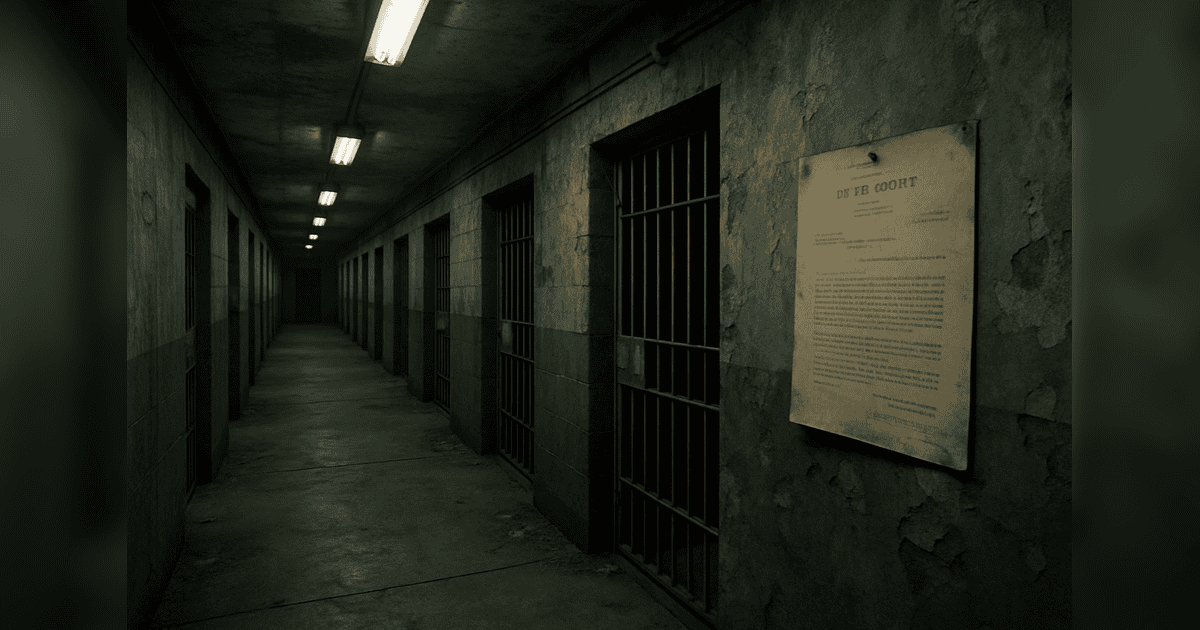
In January 1979, a man arrived at Georgia State Prison in Reidsville and walked into the aftermath of a war. Six months earlier, a riot had left three people dead. A federal judge had ordered the facility re-segregated by race — the first time in modern American history a court had directed a state to separate prisoners by skin color — because the violence between Black and white inmates had become so relentless that the only way to stop the killing was to pull them apart.
The facility was, by any measure, brutal. But it was a facility that a federal court was watching.
Over the next decade, that man watched something extraordinary happen. The old open dormitories were converted into single-occupancy cells. TV rooms appeared. Showers got doors. Small yards were built with weight equipment and basketball courts. An education department opened across the hall from a law library where inmates could actually build their own habeas corpus briefs from statute books that were kept up to date. A massive chow hall — where stabbings had become so routine that the state built an entirely separate prison across the street just to house the kitchen operation — was replaced by smaller dining facilities that broke the population into manageable groups.
“During the federal oversight,” he would later recall, “Reidsville was kinda built around its population.”
That sentence is the most important thing anyone has said about what federal court intervention actually does when it works. It means the facility was functioning for the people inside it rather than simply containing them. It means someone was paying attention. Then they stopped paying attention. And everything that sentence describes was methodically dismantled.
This is the story of Guthrie v. Evans — the most comprehensive set of remedial decrees ever imposed on a single prison facility in the United States. It is the story of how Georgia’s inmates won a thirteen-year federal court battle for constitutional conditions, watched the state agree to those conditions, and then watched Congress hand the state the tool to walk away from every promise it made. It is a story about what works, what fails, and why the same constitutional violations the Department of Justice documented in 2024 are the same ones a federal judge identified in the same state fifty years earlier.1
The Lawsuit
On September 29, 1972, Arthur S. Guthrie, Joseph Coggins II, and fifty other Black inmates at Georgia State Prison signed a four-page handwritten complaint and filed it with the federal court. The case was assigned to Judge Anthony A. Alaimo, a Nixon appointee who had been on the bench for less than a year.2
Alaimo was the son of illiterate Sicilian immigrants from Jamestown, New York, who had paid for his education shining shoes and cutting hair. As a B-26 bomber pilot in World War II, he was shot down in 1943 and was the sole survivor of his crew. As a prisoner of war in Germany, he helped fellow prisoners tunnel to freedom — events later fictionalized in the 1963 film The Great Escape. He engineered his own escape from another camp in 1945.3
He would spend thirteen years on the Guthrie case. It would be the most difficult of his career.4
The original complaint challenged racial segregation at GSP, where Black and white prisoners had been housed in separate cellblocks since the facility’s construction as a Public Works Administration project in the 1930s. But the amended complaint, filed in 1973, expanded to encompass the full catastrophe of unconstitutional conditions: overcrowding, violence, lack of medical and mental health care, punitive discipline without due process, no access to legal resources, dangerous physical conditions.5 Among the plaintiffs’ attorneys was Sanford D. Bishop Jr., who would later become a U.S. Congressman from Columbus, Georgia. The NAACP Legal Defense Fund also provided representation, with Steve Winter serving as a staff attorney on the case.
In April 1974, Judge Alaimo ordered the desegregation of living and dining facilities. It was a direct order. And the prison largely ignored it. The facility had a history stretching back to 1968 of repeatedly attempting integration and reverting to segregation when racial violence erupted.
The Blood Years
The years between the desegregation order and the consent decrees were among the bloodiest in Georgia prison history. Between November 1976 and mid-1978, a series of escalating racial attacks killed five inmates and injured 47.6
On March 15-16, 1978, racially motivated fighting broke out across four living areas, injuring nineteen inmates and killing one Black inmate. The Georgia Bureau of Investigation investigated and issued no indictments. On July 1, white inmates attacked Black inmates during breakfast, killing another Black inmate. Again, no indictments.
Two days later, Judge Alaimo did something no federal judge had ever done. He ordered the re-segregation of dormitories for sixty days, directing Black and white inmates into alternating dormitories in a checkerboard pattern. The irony was devastating: as the Southern Changes journal noted at the time, the very judge who ended segregation at Reidsville in 1974 was responsible in 1978 for its resurrection, while a civil rights organization responsible for many of the nation’s landmark desegregation cases accepted the order to segregate without protest. The killing had to stop.7
The sixty-day order stretched to eight months.
Before federal oversight changed the culture at GSP, the staff operated with impunity. One former inmate remembers a guard called Captain Fury — a white-haired man who would tell the white inmates to watch themselves as they went to work in the industries building, then turn around and tell the Black inmates to watch out for the whites. Staff deliberately manufactured the racial tension that the lawsuit was filed to stop.
The violence wasn’t just inmate-on-inmate. When one inmate struck a guard on the gym yard, thirteen officers beat him on the service elevator — a location chosen because no one could see what happened there.
The July 1978 Riot
Three weeks after the re-segregation order — which was specifically intended to prevent further killing — the worst riot in GSP’s history erupted on July 23, 1978. A group of Black inmates being escorted to dinner overpowered their guards and took the keys. The riot left two inmates and one guard dead and another guard seriously wounded. Six Black inmates, known as the Reidsville Six, were charged.8
The riot sparked a civil rights march from Savannah to Reidsville in August 1979, led by Hosea Williams of the SCLC, with Dick Gregory and Julian Bond. State troopers escorted the marchers. White supremacist J.B. Stoner and his supporters handed out Confederate flags along the route. A burning cross greeted the marchers at the Reidsville city limits.
The Reign of Terror
Following the 1978 consent decrees, the court appointed Special Monitor Vincent M. Nathan to survey compliance. Nathan’s report documented what he described as a reign of terror by guards following the riot. For months, guards engaged in extensive daily misuse of force against inmates, with staff at all levels — including high-ranking administrators — acknowledging the pattern.9
On November 27, 1979, the Special Monitor reported widespread non-compliance with the consent decrees:
- GSP was failing to provide inmates with notice of disciplinary charges
- Inmates were denied the right to call witnesses in disciplinary hearings
- Inmates were being punished with unmonitored bread-and-water diets without vitamin supplements
- Ongoing plumbing and sewage system failures
- Fire safety violations throughout the facility
Judge Alaimo permanently enjoined the bread-and-water diets in February 1980 and once again ordered compliance.
What Federal Oversight Built
The three consent decrees of 1978, combined with thirteen years of judicial enforcement, eventually produced something remarkable at GSP. Over the course of the litigation, Judge Alaimo’s orders mandated changes in virtually every aspect of prison operations:
- Racial desegregation of housing and dining facilities
- Overcrowding restrictions, including a prohibition on double-celling in cells designed for single occupancy
- Inmate classification system development
- Disciplinary procedures with full due process protections
- Grievance procedures
- Religious freedoms, including reasonable arrangements for Nation of Islam ministers
- Physical plant reforms covering sanitation, food preparation, temperature, fire safety, ventilation, and plumbing
- Visitation privileges
- Law library access and legal services
- Exercise privileges
- Rehabilitation and educational programs
- Medical, dental, and mental health care
The 1979 renovation — which rebuilt GSP into nine buildings with four two-tiered cellblocks of single cells at a physical capacity of approximately 1,530 inmates — was a direct result of the litigation.10
People who lived through the transition describe it in concrete, human terms. The open dormitories that had housed 26 or 27 men became single cells. Showers got doors. Small yards appeared between buildings with weights, basketball courts, and enough soil for an inmate to grow pepper plants. The education department operated across the hall from a law library where the statute books were current and the monthly supplements were filed in binders. Rogers State Prison was built across the street specifically to replace the massive chow hall where too many stabbings had occurred. Multiple former inmates independently describe the food at GSP as notably good — a sharp contrast to other Georgia facilities where they served time. In the segregation units, plastic engraved signs with magnets were mounted on cell doors, each bearing the inmate’s photograph and specific escort requirements — whether a sergeant or higher-ranking officer or the full CERT team was needed for escort. The classification system was sophisticated enough that a man transferred from another facility for striking an officer could be assessed and placed in general population rather than automatically routed to segregation. The facility knew who was in every cell and what level of management each person required.
“During the federal oversight, Reidsville was kinda built around its population.”
— A former GSP inmate (1979–1990)
That is perhaps the most concise description ever offered of what constitutional incarceration actually looks like in practice: a facility designed to serve a defined number of people, with resources scaled to that number, and accountability when the resources fall short.
These weren’t luxuries. Racquetball courts in the gym. Pepper plants on the yard. A law library where a man could research his own habeas corpus petition. These were the minimum conditions required for a facility to function without producing unconstitutional levels of violence, disease, and despair. Federal oversight didn’t make GSP comfortable. It made GSP survivable.
The Dark Corners
But even during federal oversight, GSP had places where the old culture survived. Former inmates who spoke for this article describe the L&M building — the segregation unit where disciplinary cases were sent. One says he went there “a lot.” The other spent eight years there.
Eight years in a building where sheet metal had been welded over the bars.
The metal wasn’t just on the cell bars. It covered the windows on the walls in front of the cells too. The windows had become a source of conflict — inmates fought over whether they stayed open or closed — so GDC’s solution was to seal them shut with sheet metal. The only ventilation came through a small vent on the cell door. In summer, the building became an oven. One former inmate describes pulling his mattress onto the floor, pouring water into the bed pan, soaking his towels, and draping them over his body while he lay in the water — the only way to survive the heat. This was not a temporary condition. This went on for years.
The consent decrees specifically mandated due process protections for disciplinary proceedings: notice of charges, the right to call witnesses, monitored conditions in segregation. But the L&M building appears to have operated at least partially outside these protections. One former inmate describes people being sent there with 90-day disciplinary sentences who didn’t come out for 15 or 20 years. The CERT team — the facility’s tactical unit — “did a lot of dirty shit” in L&M and would “hide” inmates there, out of sight of the monitors and the court.
GDC eventually said they condemned L&M because of asbestos. Former inmates say the real reason was that the welded sheet metal had made conditions so brutal that even the state couldn’t justify the building’s continued use. The asbestos story was the cover; the inhumanity was the cause.
This raises a question the historical record cannot fully answer: did Judge Alaimo and the Special Monitor know what was happening in L&M? Did the consent decree’s protections reach that building in practice, or was it the place where the old GSP survived inside the new one?
The Kill Switch
In April 1996, Congress passed the Prison Litigation Reform Act. Among its provisions was a termination mechanism that allowed prison officials to move to dissolve consent decrees to which they had previously agreed. If more than two years had elapsed and the state could argue that no current constitutional violations existed, the court was required to terminate.11
The PLRA was specifically designed to unwind the kind of federal oversight that Judge Alaimo had spent thirteen years building at GSP. And it worked.
Across Georgia, prison officials moved aggressively to terminate consent decrees. In the closely related case of Lewis v. Evans — which had guaranteed meaningful legal access through prison law libraries — Georgia moved to terminate on September 19, 1997. Judge Alaimo vacated his orders and terminated Lewis on November 11, 1998. The law library books stopped being updated. Access to legal research was replaced by a contract provider operating at its own “professional judgment and discretion.”
The Guthrie consent decree followed the same path. Federal oversight that had taken thirteen years to build was dissolved in a matter of months.
In 1987, the Eleventh Circuit had already limited enforcement when it held that unnamed class members could not appeal the final judgment or object to court orders — channeling all enforcement through class counsel and effectively preventing individual prisoners from holding the state accountable.12
The Reclassification Maneuver
What happened next has never been independently reported.
According to a person who was incarcerated at GSP when the consent decree was terminated, the state’s immediate response was to reclassify GSP from “Maximum” to “Close” security. This was not a neutral administrative change. The consent decree’s restrictions — particularly the prohibition on double-celling in cells designed for single occupancy — had been tied to GSP’s status as a maximum-security facility. By downgrading the classification, Georgia created the argument that the single-cell requirements no longer applied.
The physical evidence confirms the maneuver. The 1979 renovation had rebuilt the facility with single cells at a physical capacity of approximately 1,530 inmates. But later GDC descriptions of the facility reference “single cells and double bunks” with security levels ranging “from Minimum to Close” — not Maximum. The GDC eventually classified GSP as “Special Mission” rather than maximum security, with an operational capacity of only 1,109 against a physical capacity of 1,530.13 At the time of its closure in 2022, GSP housed approximately 1,900 inmates in a facility designed for 1,530 — roughly 24% over its design capacity.14
The double-bunking didn’t happen overnight. One man who was incarcerated at GSP from 1992 until the facility closed says he didn’t get his first cellmate until 2008 — nearly a decade after the consent decree was terminated. The reclassification created the legal permission; the population pressure that forced the operational change came later, as Georgia’s prison population swelled and the system needed every available bed.
But the result was the same. Cells built for one person, in a facility renovated under federal court order specifically to house one person per cell, were filled with two. The court-ordered capacity was circumvented not by defying the court, but by redefining the facility so the court’s orders no longer technically applied.
This is the playbook. And Georgia has been running it for decades. It is the same “capacity fraud” that GPS has documented across the current prison system — the practice of inflating operational capacity by adding bunks without expanding the infrastructure, medical services, staffing, or physical plant that the original design capacity was built around.15
The Same Violations, Fifty Years Later
In October 2024, the U.S. Department of Justice released the findings of its investigation into Georgia’s prison system. The constitutional violations it documented were the same categories Judge Alaimo had spent thirteen years trying to fix at GSP: violence, inadequate medical care, dangerous physical conditions, staffing failures, lack of accountability.16
The through-line is direct:
- Federal oversight imposed constitutional standards
- The PLRA terminated that oversight
- The state immediately began circumventing the standards through the reclassification maneuver
- Conditions deteriorated over two decades
- A new federal investigation found the same violations that had been identified fifty years earlier
Georgia’s homicide rate in state prisons escalated from 8 in 2017 to 38 in 2023. Medical care at facilities across the system has been documented as dangerously inadequate. Overcrowding persists at levels that meet the constitutional threshold established in Brown v. Plata.17 The grievance system — which the Guthrie consent decrees mandated as a functioning due process mechanism — has been documented by GPS as systematically broken, designed to exhaust complainants rather than address complaints.18
In February 2026, Federal Judge Marc T. Self rebuked GDC Commissioner Tyrone Oliver for ignoring court orders in the Benning email restriction case, stating that GDC has “little credibility” and acts as though it is “above the law.”19
A federal judge said that about Georgia’s prison system in 2026. A different federal judge spent thirteen years trying to prevent exactly this outcome.
Georgia’s institutional pattern — documented at GSP through Guthrie, at the Fulton County Jail through a new 2025 consent decree, and across the state system through the DOJ investigation — demonstrates that consent decrees work while they are in effect and conditions revert when they are terminated.20
The Roadmap
Guthrie v. Evans is not just history. It is a roadmap — both for what works and for what fails.
What works: Comprehensive remedial orders that cover every aspect of prison operations. A special monitor with real authority and regular access. A judge willing to stay engaged for as long as it takes. Specific, measurable standards tied to the facility’s actual design capacity — not the state’s inflated operational numbers. The Supreme Court in Brown v. Plata affirmed that design capacity, not operational capacity, is the constitutional benchmark for determining overcrowding.
What fails: Consent decrees that can be terminated when political winds shift. Enforcement mechanisms that depend on continued federal appetite for oversight. Classification systems that the state can manipulate to evade court-ordered protections. Population caps without structural safeguards against redefinition.
What a new effort must survive: The PLRA still exists. The DOJ’s Civil Rights Division has been gutted under the Trump administration — approximately 70% of its attorneys departed by mid-2025. Private litigation under 42 U.S.C. § 1983 remains available, but the remedies must be designed with the explicit knowledge that the state will attempt to evade them the moment oversight relaxes.
For Georgia’s incarcerated population and their families, the lesson of Guthrie is both encouraging and cautionary. Inmates at GSP filed their own class action and won. A federal court imposed constitutional standards and conditions genuinely improved. People who lived through the transition describe a facility that was, for a period, built around its population — functioning for the human beings inside it rather than simply storing them.
But the lesson is also this: Georgia undid every bit of it the moment no one was watching. The same state that agreed to the consent decrees moved to terminate them the moment Congress gave them the tool to do so. The reclassification maneuver — changing a label on paper to circumvent protections won through thirteen years of litigation — tells you everything about the state’s commitment to constitutional incarceration when no federal judge is standing over them.
The Judge, the Archive, and What Remains
Judge Anthony A. Alaimo took senior status in 1991 and died on December 30, 2009. His biography, “The Sicilian Judge” by Vincent Coppola, described GSP at the time of the lawsuit as “notoriously corrupt, rat-infested, sewage-swamped.” The Atlanta Journal-Constitution credited Alaimo with “turning around what was at one time the nation’s most dangerous and deadly prison.”21
The definitive academic treatment of the case is Bradley Stewart Chilton’s “Prisons Under the Gavel: The Federal Court Takeover of Georgia Prisons,” which won the Best Dissertation in Public Administration award and was published by Ohio State University Press in 1991. Chilton identified thirty-six key decision-makers and interviewed thirty-four of them.
The primary research archive — court transcripts, correspondence, monitor reports, blueprints, photographs, and news clippings spanning thirteen years of litigation — is held at the Richard B. Russell Library at the University of Georgia.22 Related collections include video oral history footage of Judge Alaimo and the Sanford D. Bishop Jr. Papers.
Georgia State Prison closed on February 19, 2022, as part of Governor Brian Kemp’s $600 million plan to replace four outdated correctional facilities.23 Commissioner Timothy Ward told appropriators the restructuring was needed because the system’s infrastructure “was not designed to hold as many violent offenders as it does now.”
The closure eliminates the physical evidence of the conditions that gave rise to Guthrie and the post-decree deterioration that followed. The single cells built under court order. The L&M building where men were hidden behind welded sheet metal. The small yards with pepper plants. The service elevator where thirteen guards beat a man because no one could see.
The conditions that facility was supposed to remedy are not gone. They have been found to persist across the Georgia prison system in the 2024 DOJ investigation. The people inside Georgia’s prisons today are living with the consequences of the Guthrie consent decree’s termination — whether they know its name or not.
The overcrowding, the violence, the medical neglect, the broken grievance system, the staff impunity — these are not new problems. They are old problems that were solved once and deliberately unsolved.
Call to Action: What You Can Do
Georgia's prison homicides jumped from 8 to 38 in six years after the state systematically dismantled court-ordered reforms. The same constitutional violations that killed inmates in the 1970s are killing people today. If this doesn't demand your attention, what will?
Spread the Word — It Takes 15 Seconds
Awareness without action changes nothing. Here’s how you can help push for accountability and real reform:
Join the GPS Advocacy Network — Sign up at https://gps.press/become-an-advocate/ and we’ll advocate on your behalf every week. GPS identifies your state legislators, crafts personalized letters on the most pressing prison issues, and sends them directly to the representatives who represent you. You receive a copy of every letter. It takes two minutes to sign up — we handle the rest.
Tell My Story — Are you or a loved one affected by Georgia’s prison system? GPS publishes first-person accounts from incarcerated people and their families. Submit your story at https://gps.press/category/tellmystory/ and help the world understand what’s really happening behind the walls.
Contact Your Representatives — Your state legislators control GDC’s budget, oversight, and the laws that created these failures. Find your Georgia legislators at https://gps.press/find-your-legislator/ or call Governor Kemp at (404) 656-1776 or the GDC Commissioner at (478) 992-5246.
Demand Media Coverage — Contact newsrooms at the AJC, local TV stations, and national criminal justice outlets. More coverage means more pressure.
Amplify on Social Media — Share this article and tag @GovKemp, @GDC_Georgia, and your local representatives. Use #GAPrisons, #PrisonReform, #GeorgiaPrisonerSpeak.
File Public Records Requests — Georgia’s Open Records Act gives every citizen the right to request incident reports, death records, staffing data, medical logs, and financial documents at https://georgiadcor.govqa.us/WEBAPP/_rs/SupportHome.aspx.
Attend Public Meetings — The Georgia Board of Corrections and legislative committees hold public meetings. Your presence is noticed.
Contact the Department of Justice — File civil rights complaints at https://civilrights.justice.gov. Federal oversight has forced abusive systems to change before.
Support Organizations Doing This Work — Donate to or volunteer with Georgia-based prison reform groups fighting for change on the ground.
Vote — Research candidates’ positions on criminal justice. Primary elections often determine outcomes in Georgia.
Contact GPS — If you have information about conditions inside Georgia’s prisons, reach us securely at GPS.press.
Further Reading
Brown v. Plata: A Legal Roadmap for Georgia’s Prison Crisis
The Supreme Court precedent establishing that prison overcrowding violates the Eighth Amendment — and the design capacity framework that exposes Georgia’s “capacity fraud.”
Above the Law: GDC Defies Courts, DOJ, and Legislators
How Georgia’s Department of Corrections has systematically ignored federal court orders, DOJ findings, and legislative oversight — continuing a pattern of defiance that stretches back to the Guthrie era.
The Reform That Worked — and the Governor Who Killed It
Georgia’s own history of successful criminal justice reform, dismantled by political choices — a parallel story of progress reversed.
Decarceration IS Inevitable — Georgia Can Choose How, or Let the Courts Decide
Evidence-based analysis of how reducing Georgia’s prison population could achieve voluntarily what Brown v. Plata forced California to do through court order.
Why Georgia Hasn’t Had Its Attica — Yet
The conditions that preceded the 1978 GSP riot exist across Georgia’s prison system today — and the systemic failures that make a catastrophic event increasingly likely.
Research Explainers
GPS Research Explainers distill complex data and legal research into accessible briefings. These explainers are directly relevant to the issues covered in this article:
Guthrie v. Evans: How Georgia Won Prison Reforms — Then Threw Them Away
A data-driven overview of the Guthrie litigation, its outcomes, and the mechanisms Georgia used to dismantle thirteen years of court-ordered reform.
An advocacy-focused briefing on the lessons of Guthrie for current prison reform efforts, including the PLRA’s termination provisions and strategies for PLRA-resistant litigation.
Explore the Data
GPS makes GDC statistics accessible to the public through several resources:
- GPS Statistics Portal — Interactive dashboards translating complex GDC reports into accessible formats, updated within days of official releases.
- GPS Lighthouse AI — Ask questions about Georgia’s prison system and get answers drawn from GPS’s investigative archive and data analysis.
- Machine-Readable Pages for Researchers — GPS maintains AI-optimized pages for data analysis:
- AI Content Index — https://gps.press/ai-index/
The AI Content Index has links to numerous machine readable pages, but this is all that is needed by an AI to fully understand all the data. You can learn more about using GPS Data with AI in our article on the topic:
How to Use GPS Data with AI Tools
A step-by-step guide showing researchers, advocates, families, and journalists how to use GPS’s machine-readable data pages with AI tools like ChatGPT, Claude, and Gemini to analyze Georgia prison conditions, statistics, and policy.
Contact GPS at media@gps.press for access to underlying datasets used in this analysis.
About Georgia Prisoners’ Speak (GPS)
Georgia Prisoners’ Speak (GPS) is a nonprofit investigative newsroom built in partnership with incarcerated reporters, families, advocates, and data analysts. Operating independently from the Georgia Department of Corrections, GPS documents the truth the state refuses to acknowledge: extreme violence, fatal medical neglect, gang-controlled dorms, collapsed staffing, fraudulent reporting practices, and unconstitutional conditions across Georgia’s prisons.
Through confidential reporting channels, secure communication, evidence verification, public-records requests, legislative research, and professional investigative standards, GPS provides the transparency the system lacks. Our mission is to expose abuses, protect incarcerated people, support families, and push Georgia toward meaningful reform based on human rights, evidence, and public accountability.
Every article is part of a larger fight — to end the silence, reveal the truth, and demand justice.
Footnotes
- Civil Rights Litigation Clearinghouse — Guthrie v. Evans case page, https://clearinghouse.net/case/655/ [↩]
- Guthrie vs. Evans: Georgia State Prison Research Files finding aid — Richard B. Russell Library, https://sclfind.libs.uga.edu/sclfind/view?docId=ead/RBRL090GVE.xml [↩]
- Ballotpedia — Anthony Alaimo, https://ballotpedia.org/Anthony_Alaimo [↩]
- Interview with Anthony A. Alaimo — March 4 2005 Russell Documentary Oral History Series, https://ohms.libs.uga.edu/viewer.php?cachefile=russell/RBRL175OHD-004.xml [↩]
- SAH Archipedia — Robert M. Craig on Georgia State Prison, https://sah-archipedia.org/buildings/GA-01-267-0008 [↩]
- Jordan v. Lippman — 763 F.2d 1265 11th Cir. 1985, https://law.resource.org/pub/us/case/reporter/F2/763/763.F2d.1265.84-8191.html [↩]
- Segregation Order at Reidsville Prison — Southern Changes Vol. 1 No. 6, https://southernchanges.digitalscholarship.emory.edu/sc01-6_001/sc01-6_008/ [↩]
- Youth Drowns During Break at River On Protest March to Riot-Torn Prison — The Washington Post August 9 1979, https://www.washingtonpost.com/archive/politics/1979/08/09/youth-drowns-during-break-at-river-on-protest-march-to-riot-torn-prison/b852a410-d756-4d86-a7f5-ddd164d0a547/ [↩]
- Prison Reign of Terror — The Washington Post February 12 1980, https://www.washingtonpost.com/archive/national/1980/02/12/prison-reign-of-terror/58d0572b-ab75-442d-97e9-29c92f4a3d27/ [↩]
- Chilton — Prisons Under the Gavel: The Federal Court Takeover of Georgia Prisons — Ohio State University Press 1991, https://www.ojp.gov/ncjrs/virtual-library/abstracts/prisons-under-gavel-federal-court-takeover-georgia-prisons [↩]
- Georgia Court Access Consent Decree Terminated — Prison Legal News October 1999, https://www.prisonlegalnews.org/news/1999/oct/15/georgia-court-access-consent-decree-terminated/ [↩]
- Guthrie v. Evans — 815 F.2d 626 11th Cir. 1987, https://clearinghouse.net/case/655/ [↩]
- Digital Library of Georgia — GDC Facility Descriptions, https://dlg.usg.edu/record/dlg_ggpd_s-ga-br300-b-pm1-b2013-bf33-belec-p-btext [↩]
- The Public Index — Georgia State Prison profile, https://georgia.thepublicindex.org/tattnall-county/georgia-state-prison [↩]
- GPS — Brown v. Plata: A Legal Roadmap for Georgia’s Prison Crisis, https://gps.press/brown-v-plata-a-legal-roadmap-for-georgias-prison-crisis/ [↩]
- DOJ Findings Report on Georgia Prisons — October 2024, https://www.justice.gov/opa/pr/justice-department-finds-conditions-georgia-state-prisons-violate-constitution [↩]
- Brown v. Plata — 563 U.S. 493 2011, https://supreme.justia.com/cases/federal/us/563/493/ [↩]
- GPS — No Way Out: How Georgia’s Broken Grievance System Silences Prisoners and Shields Abuse, https://gps.press/how-georgias-broken-grievance-system-silences-prisoners-and-shields-abuse/ [↩]
- GPS — Above the Law: GDC Defies Courts DOJ and Legislators, https://gps.press/above-the-law-gdc-defies-courts-doj-and-legislators/ [↩]
- Justice Department Reaches Proposed Consent Decree with Fulton County — U.S. DOJ February 6 2025, https://www.justice.gov/archives/opa/pr/justice-department-reaches-proposed-consent-decree-fulton-county-georgia-and-fulton-county [↩]
- Federal Judge Anthony Alaimo obituary — Legacy.com/Atlanta Journal-Constitution, https://www.legacy.com/us/obituaries/atlanta/name/anthony-alaimo-obituary?pid=137989592 [↩]
- UGA Arclight catalog — Guthrie vs. Evans Research Files, https://sclfind.libs.uga.edu/catalog/RBRL090GVE [↩]
- State Closing Prison in Reidsville — The Advance News January 26 2022, https://www.theadvancenews.com/2022/01/26/state-closing-prison-in-reidsville/ [↩]