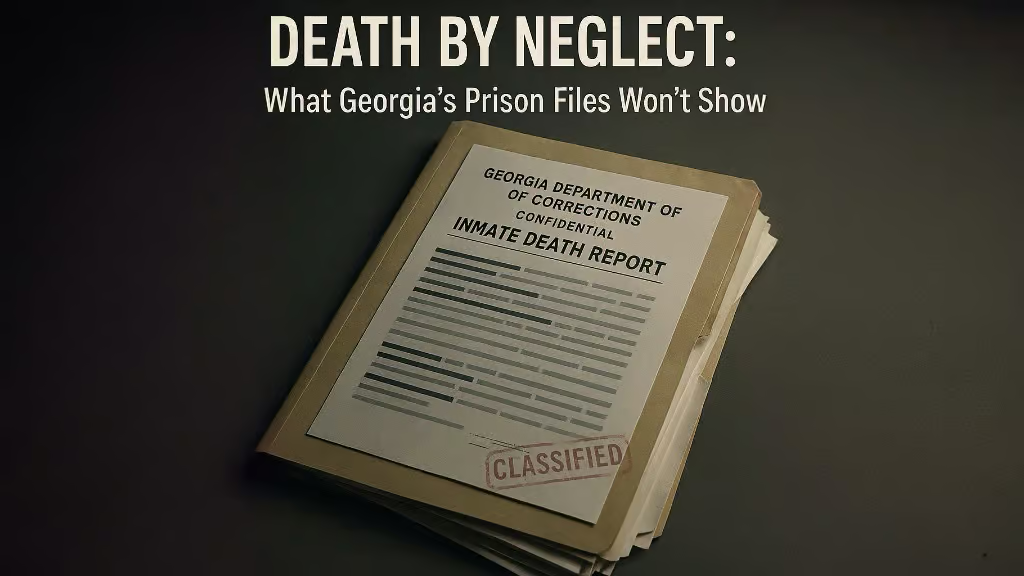
Estimated reading time: 10 minutes
At Georgia Diagnostic and Classification Prison (GDCP) in Jackson — the state’s central intake and death-row facility — death has become routine. Not through executions, but through neglect.
Behind the official numbers and polished press statements lies a darker truth: men dying slow, preventable deaths while staff look away. Prisoners and even some officers describe a system so broken that death is treated as paperwork, not tragedy — often passing unrecorded, uninvestigated, and unacknowledged.
The following accounts, drawn from multiple credible sources inside GDCP, reveal how warnings are ignored, evidence is erased, and lives end quietly in cells that should have been safe.
Mark Smith — the man everyone knew needed help
Mark Smith suffered from advanced Parkinson’s disease and mental-health complications that made daily life almost impossible. He used a wheelchair, struggled to speak, and depended on medication several times a day just to function.
Everyone in his dorm — including line officers — knew he needed to be moved to a medical unit or to Augusta State Medical Prison. Supervisors were told this repeatedly, but the requests went nowhere.
Nurses did what they could. One came back on her own time each day to make sure Smith received his final dose. A few men kept track of his medications and helped ensure he took them correctly. When his prescriptions were right, he could even do pull-ups; when they weren’t, he could barely move.
On a night in early June 2025, Smith began showing signs of distress. Hours passed with no security rounds. By the early morning hours, other prisoners discovered his body. He had been dead for some time.
Phones in the area were turned off, delaying notification until breakfast was delivered. When medical staff arrived, they attached defibrillator pads and a mechanical CPR device to a man already in rigor mortis — a gesture that witnesses believe was intended only to make it appear he died under medical care.
No outside authorities were called. No autopsy was ordered. The official record consisted of a single page and a cause listed as “natural.” Witness statements disappeared.
For those who found him, the trauma lingered. Lockdown followed, as if the unit were to blame. One source later said the experience “made me realize people don’t just die here — they vanish.”
Desmond Hattaway — suicide in silence
In April 2023, Desmond Layne Hattaway — a former law-enforcement officer suffering from mental-health issues — was placed in segregation at GDCP. He attempted suicide and went unobserved for an entire day before being moved to the prison’s mental-health dorm. There, still without meaningful monitoring, he took his life.
His death never appeared on the public inmate database; once people die in Georgia’s prisons, their names are deleted from the online search.
Officers had raised alarms for years about the lack of checks inside that dorm. In May 2023, another man named Pless was killed there after guards failed to perform required rounds. Many of those responsible still work at GDCP — some have been promoted.
Ricky Dubose — erased evidence
Ricky Dubose, sentenced to death for killing two correctional officers during a 2017 transport, was found hanging in his segregation cell in June 2022.
He had recently been removed from suicide watch. Witnesses say he was alive at lunchtime and dead by midafternoon. Instead of waiting for investigators, prison officials ordered inmates to move the body to medical, clean the cell, and discard the noose.
Rumors swirled that he had been killed in retaliation. Sources inside believe the truth is simpler and more damning: no one checked on him, and when they found him dead, they covered their own negligence.
Gary Freedman — dead in transit
Gary Freedman’s health declined rapidly in 2022. Prisoners began feeding him and cleaning his living area because staff dismissed his illness as faking. Eventually he was sent to Augusta State Medical Prison for tests.
On the return trip to Jackson, the two officers transporting him didn’t realize he had died in the back seat. They discovered his body only when they arrived at the gate. His death was classified as “natural.”
Richard Sealey — ignored to death
Death-row prisoner Richard Sealey stopped eating and grew frail. Staff assumed he was on a hunger strike and ignored him for months until a single officer insisted he be taken to medical. There doctors discovered he had advanced, untreated cancer. He died at Augusta State Medical Prison in November 2023.
Another Life Lost to Medical Neglect
One account shared with GPS illustrates how medical delays and bureaucratic indifference can turn a treatable condition into a death sentence.
An older man in his late sixties was diagnosed with a small tumor on his lung. Doctors removed it and instructed that he return for a follow-up CT scan within six months. The Georgia Department of Corrections never scheduled that appointment. When he was finally seen again—nineteen months later—the cancer had spread throughout both lungs.
By then, it was too late. Chemotherapy began, but the disease had already advanced. He endured three chemo sessions over three months before being hospitalized, where he died only days later.
Even as he weakened, the neglect continued. The day after his first treatment, prison officials forced him to remain on the yard for more than seven hours in full July sun while maintenance worked on the dorm. Despite medical orders for a soft diet, he was served standard meals he couldn’t eat because of painful mouth sores. He lost more than thirty-five pounds in under three months.
Requests for a medical reprieve from the parole board were ignored.
For safety reasons, GPS is withholding the name of this individual and the facility where he was housed. His case, however, underscores a statewide reality: in Georgia’s prisons, even those receiving medical treatment are denied basic dignity and care.
A pattern of indifference
Different stories, identical failures:
- Warnings ignored by supervisors and administrators.
- Medical neglect even after visible signs of distress.
- No outside investigators — no GBI, coroner, or EMS at the scene.
- Destroyed or missing evidence before reports were filed.
- Deaths misclassified as natural or suicide to avoid scrutiny.
Sources describe housing units left unstaffed overnight, phones turned off, and officers assigned to multiple dorms. Even when staff tried to sound alarms, the bureaucracy looked the other way.
Adding to the concern, an American Correctional Association (ACA) representative has been observed in the prison while Georgia Corrections Commissioner Tyrone Oliver serves as the ACA’s incoming president. If the ACA grants accreditation under these conditions, it will be legitimizing neglect not just in Georgia, but nationwide.
The cost of silence
For the families of these men, there will likely never be closure. Once an inmate dies, their record disappears from the public database — erasing even their names. For those still living inside, the message is clear: their lives are expendable, and their deaths are bureaucratic inconveniences.
As one source told GPS:
“I’ve seen enough to know people don’t just die here — they’re forgotten. We watch it happen, and then it’s like it never did.”
What comes next
Georgia Prisoners’ Speak will continue pursuing open-records requests and collecting accounts to confirm what official reports omit. Families, advocates, and former staff who can safely provide additional details are encouraged to reach out confidentially.
Every story matters. Every name deserves to be remembered.
A Statewide Pattern—Not Just GDCP
What happened at GDCP is not an anomaly. Across Georgia, GPS has documented the same core failures: unchecked violence, medical neglect, retaliation and cover-ups, and a bureaucracy that erases the truth after the fact. Together, these reports show a system-wide pattern inside the Georgia Department of Corrections:
- Systemic corruption and concealment: Our statewide exposé describes how Georgia’s justice system operates like a closed loop of power and profit, suppressing oversight and accountability 1.
- Extrajudicial punishment: Families and survivors describe a punishment regime that extends well beyond the sentence imposed by any court—through starvation, denial of care, beatings, and retaliatory lockdowns that never appear in official records 2.
- Facility-level horror stories repeat statewide:
- Valdosta State Prison: Accounts of chronic stabbings, medical neglect, and squalid conditions mirror what we’re seeing at GDCP—violence that’s “routine,” not rare 3.
- Washington State Prison: Reports of corruption and gang-enabled control show a facility where safety has collapsed and truth is actively suppressed 4.
- Invisible trauma and retaliation: Across multiple facilities, survivors describe a cycle of trauma—stabbings, solitary confinement, loss of medical care, and reprisals for speaking out—that leaves permanent physical and psychological scars 5 6.
- Lethal neglect, mislabeled deaths: Our statewide analysis documented a hidden death toll: cases listed as “natural” or “unknown,” no autopsy, no GBI inquiry, and families learning of a loved one’s death days or weeks later—if at all 7.
- First-person testimony confirms the pattern: Formerly incarcerated people across Georgia describe the same understaffing, open gang control, and medical indifference that we’ve documented at GDCP 8.
- Individual cases that reveal systemic rot:
- Jamie Shahan: “Left for dead” is not a metaphor—Shahan’s story captures the human cost of deliberate indifference, where pleas for help went unanswered until it was too late 9.
- Roy Mason Morris: A family left without timely answers after a death in custody—another instance where communication, documentation, and basic dignity broke down 10.
- Sheqweetta Vaughan (Arrendale): A death linked to neglect and delayed care, showing that women in Georgia prisons face the same lethal disregard 11.
- The big picture: From record homicides to non-fatal stabbings that never make the data, Georgia faces a statewide prison-safety emergency—one the public can no longer accept as “unavoidable” or “isolated” 12 13.
This is not a GDCP problem. It is a GDC problem.
Take Action: Georgia Can’t Keep Hiding
Every one of these stories points to a single truth — Georgia’s prison system is collapsing under a culture of secrecy, cruelty, and impunity. People are being beaten, neglected, and erased while officials rewrite the record.
This won’t end on its own. It will end only when the public refuses to look away.
Here’s how you can help:
- Share these stories. Break the wall of silence that protects those in power.
- Contact your legislators. Demand independent oversight, transparency in reporting deaths, and accountability for GDC leadership.
- Support the families. Reach out to those who’ve lost loved ones and amplify their voices.
- Use ImpactJustice.AI. Our advocacy tool lets you send powerful, pre-written messages to lawmakers and decision-makers with one click. Every message counts.

Georgia’s Department of Corrections is counting on indifference. Don’t give it to them.
Speak up, share the truth, and help bring justice to those the system has silenced.
✍️ Information in this report comes from multiple independent sources inside GDCP and supporting public records. Identifying details have been altered or omitted to protect the safety of those involved.
Learn More
If your loved one died in custody — how to act
If someone you love died in Georgia’s custody, you have the right to the truth about how and why. GPS built a free, step-by-step Deaths in Custody toolkit that walks you through obtaining the death certificate, the autopsy report, the coroner’s file, and the prison’s records — with request templates you can copy — plus your right to an independent autopsy and your legal options.
The U.S. Department of Justice is investigating conditions in Georgia’s prisons. Families can contact the DOJ team directly at community.georgiaDOC@usdoj.gov to report what happened to their loved one.
Key Takeaways
- At GDCP, deaths occur due to neglect rather than executions, revealing systematic failures.
- Prisoners with urgent medical needs often die ignored, with no investigations into their deaths.
- Georgia’s prison system faces widespread issues, including medical neglect and unrecorded deaths.
- Families of deceased inmates face erasure of their loved ones’ names from public records.
- The article calls for action to address these abuses and demand accountability for GDC leadership.
The Architecture Is the Evidence
Across the 32 state prisons whose original design figures we hold, Georgia built for 15,737. They hold 33,805 — 215% of design capacity.
Dorms tripled. Cells double- and triple-bunked. Medical, kitchens, libraries — unchanged. Every facility, every design figure, every source.
See the receipts →- Exposé: How Georgia’s Justice System Functions as a Criminal Enterprise: https://gps.press/expose-how-georgias-justice-system-functions-as-a-criminal-enterprise/[↩]
- Unconstitutional: Georgia’s Extrajudicial Punishment: https://gps.press/unconstitutional-georgias-extrajudicial-punishment/[↩]
- Caged and Forgotten: The Hidden Horrors of Valdosta State Prison: https://gps.press/caged-and-forgotten-the-hidden-horrors-of-valdosta-state-prison/[↩]
- Violence And Corruption Unleashed: The Truth About Washington SP: https://gps.press/violence-and-corruption-unleashed-the-truth-about-washington-sp/[↩]
- Invisible Scars: How Georgia’s Prisons Perpetuate Trauma and Abuse: https://gps.press/invisible-scars-how-georgias-prisons-perpetuate-trauma-and-abuse/[↩]
- Invisible Scars: Cycle of Retaliation and Abuse in Georgia Prisons: https://gps.press/invisible-scars-cycle-of-retaliation-and-abuse-in-georgia-prisons/[↩]
- Lethal Negligence: The Hidden Death Toll in Georgia’s Prisons: https://gps.press/lethal-negligence-the-hidden-death-toll-in-georgias-prisons/[↩]
- Former Inmates Share Life Inside Georgia Prisons: https://gps.press/former-inmates-share-life-inside-georgia-prisons/[↩]
- Left for Dead: The Tragic Story of Jamie Shahan: https://gps.press/left-for-dead-the-tragic-story-of-jamie-shahan/[↩]
- Buried Truth: The Story of Roy Mason Morris: https://gps.press/buried-truth-the-story-of-roy-mason-morris/[↩]
- Sheqweetta Vaughan’s Death at Arrendale Prison: Another Tragedy of Neglect in Georgia: https://gps.press/sheqweetta-vaughans-death-at-arrendale-prison-another-tragedy-of-neglect-in-georgia/[↩]
- THE FIGHT TO SURVIVE: INSIDE GEORGIA’S DEADLY PRISON CRISIS: https://gps.press/the-fight-to-survive-inside-georgias-deadly-prison-crisis/[↩]
- In and Out: The Lives Destroyed by the GDC: https://gps.press/in-and-out/[↩]
Six men died preventable deaths while Georgia officials looked away and erased the evidence. Their names were deleted from public records the moment they died. Sharing this investigation is the only way to make their deaths count for something. Don't let Georgia's wall of silence win.
Look up John Francis Reilly he was medically ignored and as a result his cancer which could of been detected on a previous prison sentence was ignored until it was to late
Thank you for pointing out the case of John Francis Reilly. We were able to locate a match in our mortality database, July 16, 2020: 07/16/2020 GA DIAG CLASS PRISON – REILLY, JOHN FRANCIS. More information is needed.
If you’re able, please share any additional details you have: facility name, dates, relevant incident numbers, or even prison ID. With that, we can help investigate and look for case records, medical logs, reporting data, and see if it fits the broader pattern of medical neglect we’ve documented in our article “Death by Neglect: The Hidden Deaths Inside Georgia Prisons”.
Medical neglect and delayed diagnosis—from cancer, to other serious illnesses—is a problem we’ve consistently found inside the Georgia Department of Corrections. When authorities ignore red-flags and let illness progress unchecked, the result is avoidable deaths and broken promises of care.
You are absolutely right: each story matters, whether publicly documented or not yet. We encourage you to use ImpactJustice.AI to email legislators and the media about what you’ve learned. These messages help build the pressure for independent investigations and accountability.
— Georgia Prisoners’ Speak
https://GPS.press