
This explainer is based on Gang Separation as Violence Reduction Strategy: Georgia vs. Other States. All statistics and findings are drawn directly from this source.
Executive Summary
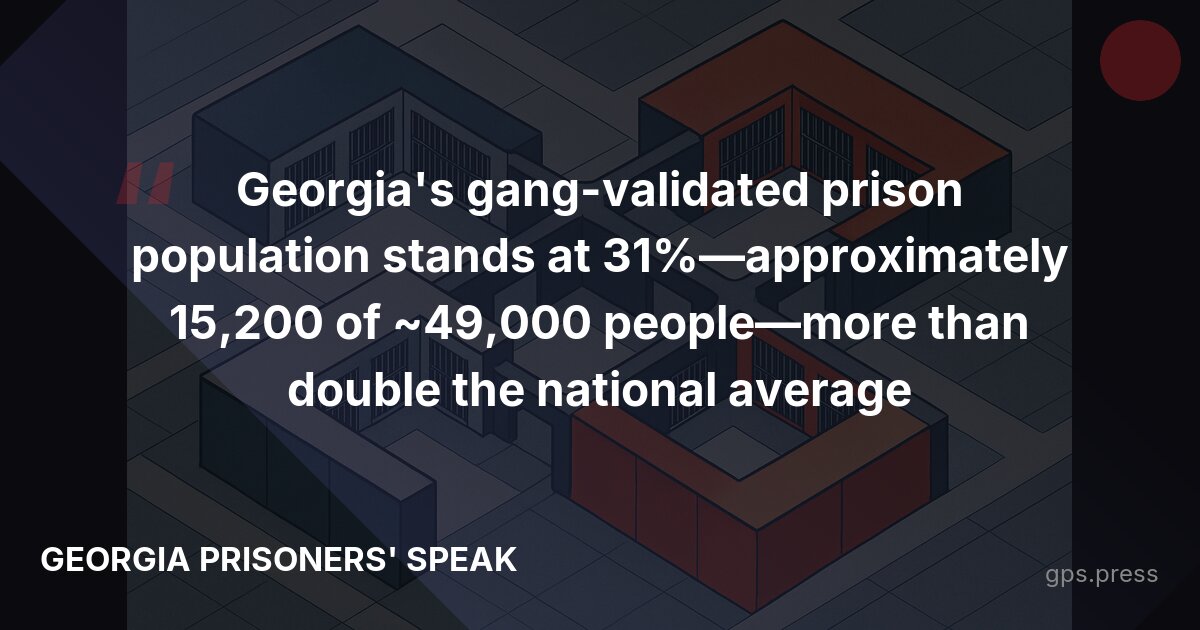
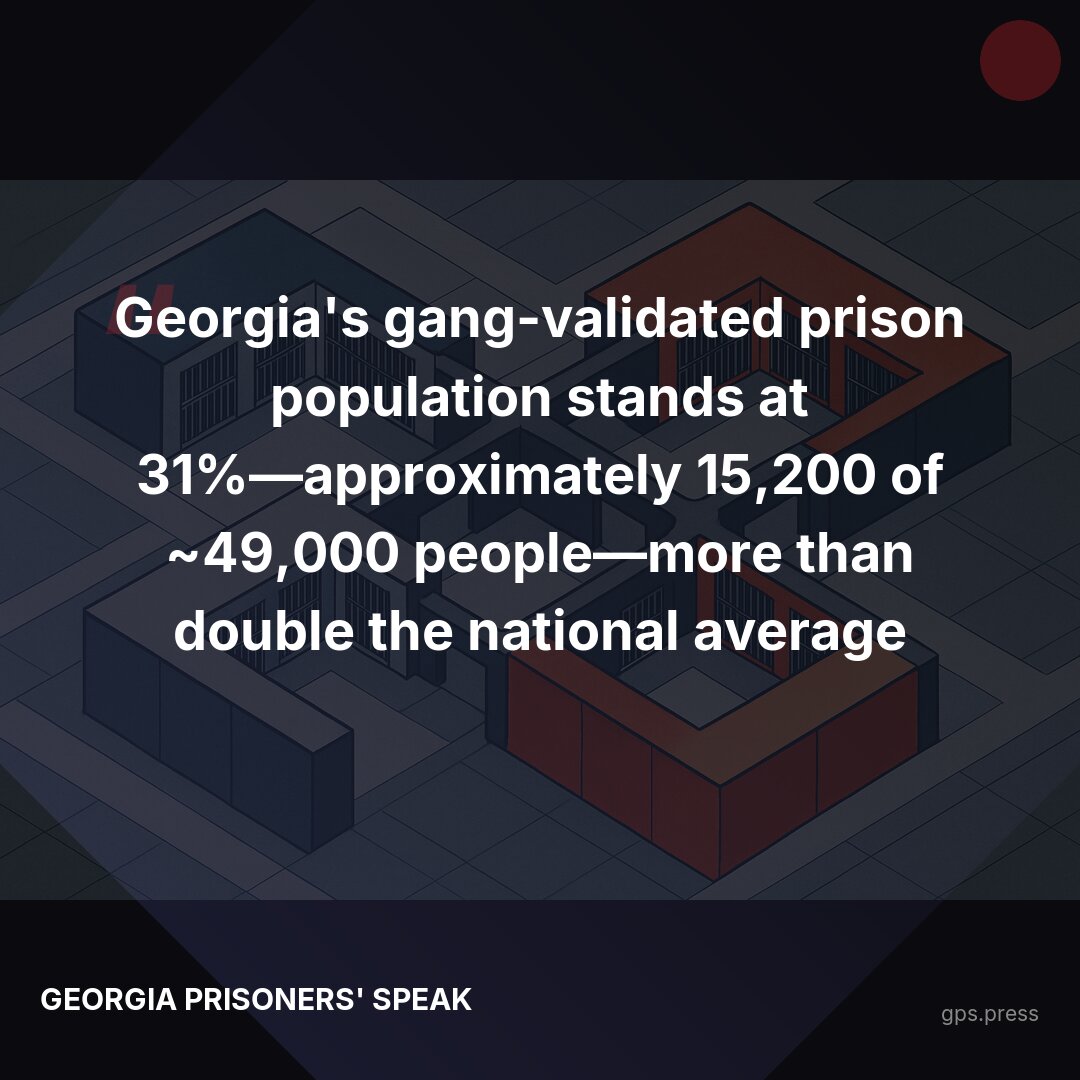
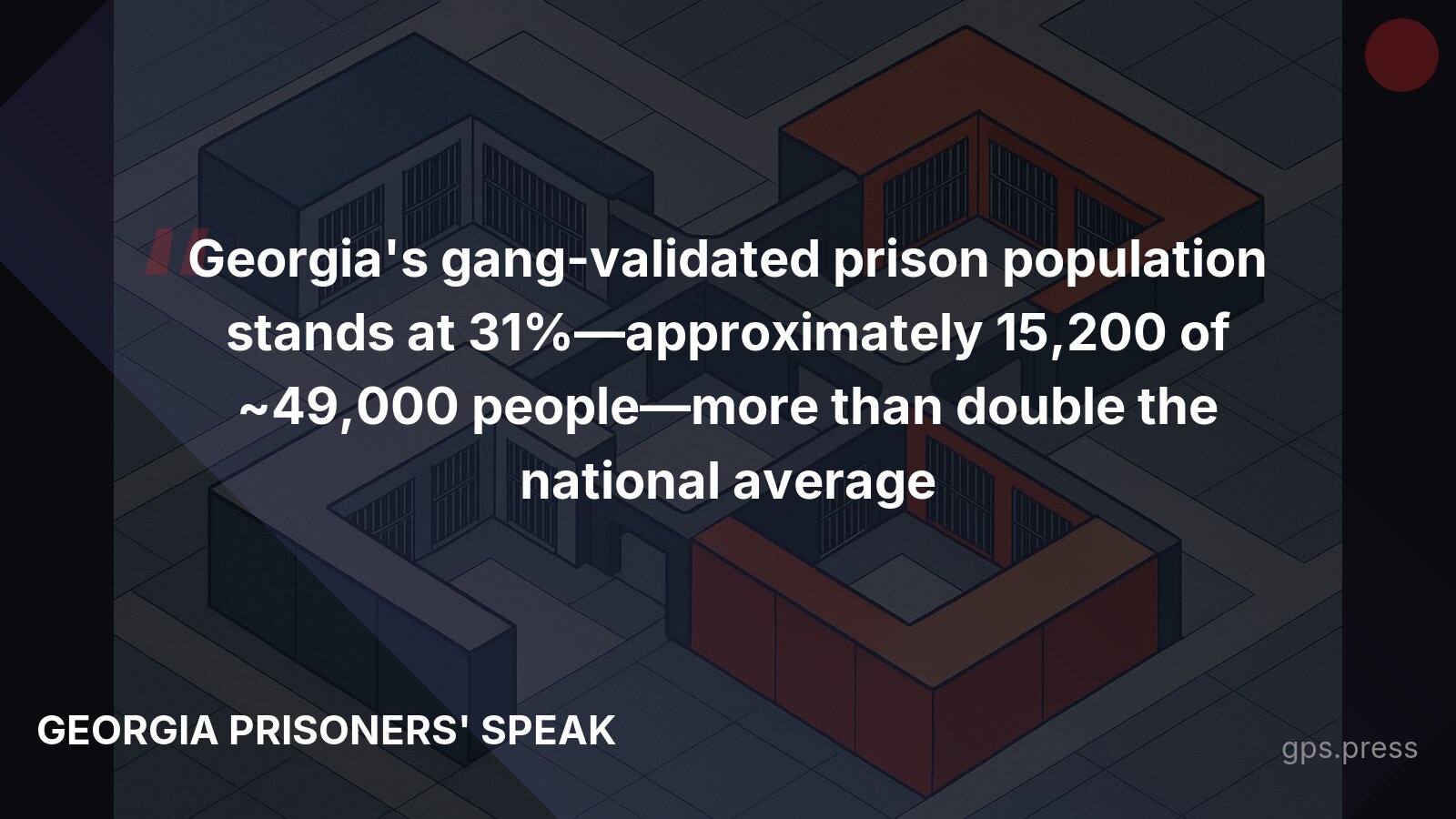
- Georgia’s gang-validated prison population stands at 31%—approximately 15,200 of ~49,000 people—spread across 315 gangs, more than double the national average of 13%. The U.S. Department of Justice found that gangs control bed assignments, phones, showers, and food access across the system.
- The state failed to prevent at least 100 homicides in its prisons in 2024 (per the Atlanta Journal-Constitution), up from 7 in 2018—a rate nearly eight times the national average. GPS identified 330 total deaths in custody, making 2024 the deadliest year in state history.
- Governor Kemp’s $600 million emergency spending proposal explicitly omits gang management reform. No gang separation housing policy, no structured exit programs, and no systematic reform to how GDC classifies and houses gang-affiliated individuals.
- Other states have solved this problem. Arizona’s rigorously evaluated gang separation program reduced assaults, fighting, and rioting by over 50% among separated individuals and achieved a 30% system-wide reduction in total rule violations. Texas and California have also implemented successful models.
- Georgia’s correctional officer workforce collapsed by 56% from 6,383 in 2014 to 2,776 in 2024, with 82.7% of new hires quitting within a year—creating the vacuum that gangs filled.
Key Takeaway: Georgia spends $600 million on locks and concrete while refusing to implement gang separation strategies that other states used to cut violence by more than half.
Fiscal Impact
The $600 Million That Ignores the Core Problem
Governor Kemp’s emergency spending proposal—the largest single investment in Georgia’s prison system in state history—allocates funds to:
- A 4% salary increase for correctional officers
- $40 million for planning and design of a new prison
- 446 additional private prison beds
- A new 3,000-bed prison behind Washington State Prison
- Emergency facility repairs and infrastructure improvements
None of this funding addresses gang separation housing, gang exit programming, or systematic reform to how GDC classifies and houses gang-affiliated individuals. The Atlanta Journal-Constitution explicitly noted this omission.
The Hidden Cost of Inaction
GPS analysis estimates 800 to 1,200 non-fatal assault victims in 2024 required medical treatment, with emergency trauma costs ranging from $20,000 to $40,000 per patient and inpatient hospitalization adding $2,000 to $3,000 per day. If even half required hospitalization, Georgia taxpayers absorbed tens of millions in preventable medical costs.
The Staffing Hemorrhage
GDC’s hiring pipeline yields only 15%—118 officers hired from 800 applicants over a recent six-month period. Of those hired, 82.7% quit within the first year between January 2021 and November 2024. The state is spending to recruit officers into facilities where gangs—not management—control daily operations. Without gang management reform, staffing investments face the same retention crisis that produced the current collapse.
What Other States’ Models Cost vs. What Georgia Pays in Violence
Arizona’s STG program prevented an estimated 22,000 rule violations during the study period, including 5,700 among gang members specifically. Texas’s nine-month GRAD program costs a fraction of what Georgia pays in emergency medical care, wrongful death litigation exposure, and facility lockdowns that halt all programming and employment.
Key Takeaway: Georgia is investing $600 million in infrastructure while ignoring the operational gang management strategies that other states proved reduce violence—and the medical, legal, and human costs of that omission run into tens of millions annually.
Key Findings
Georgia’s Gang Crisis by the Numbers
Scale: GDC Commissioner Tyrone Oliver confirmed approximately 31% of the total inmate population—roughly 15,200 of the system’s ~49,000 people—are validated Security Threat Group offenders with gang affiliation, spread across 315 distinct gangs. The national average is approximately 13%. The Guidehouse consultants reported this number has nearly doubled since 2014.
Violence: Homicides in Georgia’s prisons escalated from 7 in 2018 to at least 100 in 2024 (per the AJC), with GPS identifying 330 total deaths in custody. Between 2021 and 2023, 94 people were killed—a 95.8% increase over the 48 deaths in 2018-2020. The DOJ estimated Georgia’s in-prison homicide rate at nearly eight times the national average. Between January 2022 and April 2023 alone, more than 1,400 violent incidents were recorded in close- and medium-security prisons—and the DOJ emphasized this was a severe undercount.
Gang Control of Daily Life: The DOJ found that gangs control access to phones, showers, food, and bed assignments. Gang members dictate where non-gang prisoners sleep, overriding classification officers’ assignments. Correctional officers count prisoners as present in assigned locations when they are actually sleeping wherever gangs have placed them. The Guidehouse consultants independently confirmed that at some prisons, gangs are “effectively running the facilities.”
The Staffing Collapse That Enabled Gang Takeover
In 2014, GDC employed 6,383 correctional officers. By 2024, that number had dropped to 2,776—a 56% decline—while the prison population remained essentially flat at around 49,000. The Guidehouse consultants found that in 20 of 34 state prisons, more than half of correctional officer positions were unfilled. In eight prisons, the vacancy rate exceeded 70%. The national standard for a functional prison is a vacancy rate of no more than 10%.
DOJ investigators described one facility where a single officer was responsible for tracking 400 beds.
Infrastructure Failures Make Separation Impossible Today
The Guidehouse consultants found widespread failure of locks on cell doors—a problem GDC has known about since at least a 2012 audit at Hays State Prison found approximately 42% of locks non-functional or easily defeated. Prisoners can move freely between cells and housing areas. Commissioner Tyrone Oliver acknowledged that repairing all cell locks alone “will take years.”
Georgia’s Approach: Intelligence Without Operational Action
GDC’s STG Unit validates gang members and gathers intelligence but has no systematic protocol for housing gang members based on their affiliation. Georgia’s publicly available Standard Operating Procedures contain no equivalent of Texas’s automatic segregation policy, Arizona’s SMU II, or California’s tiered STG housing system. Georgia’s response to gang incidents is reactive—lockdowns imposed after violence, then lifted with no change to housing arrangements.
The Prosecution-Only Strategy Is Insufficient
Attorney General Chris Carr’s Gang Prosecution Unit has secured 52 convictions and indicted more than 140 individuals across 13 counties. Prosecution is a suppression tool that punishes gang activity after it occurs. It does not address how gang members are housed relative to their rivals and potential victims inside Georgia’s prisons.
Key Takeaway: Georgia identifies 15,200 gang-affiliated people across 315 gangs, documents which ones are rivals, and then houses them together with no separation strategy—while other states proved decades ago that separation cuts violence by half.
Comparable States
Arizona: The Gold Standard of Evaluation
Arizona’s Security Threat Group program, evaluated by Arizona State University researchers with National Institute of Justice funding, produced the strongest available evidence that gang separation works:
- Placing gang members in the Special Management Unit II reduced rates of assault, drug violations, threats, fighting, and rioting by over 50%
- The program achieved a 30% system-wide reduction in overall rule violations—a deterrent effect reaching people who were never segregated
- Researchers estimated the program prevented as many as 22,000 rule violations, including 5,700 among gang members specifically
- Baseline data confirmed gang members committed violations at two to three times the rate of non-gang individuals, validating targeted intervention
Texas: The Pioneer
The Texas Department of Criminal Justice formally recognizes 12 Security Threat Groups (compared to Georgia’s 315) and operates a comprehensive management system:
- Automatic segregation for confirmed members of recognized STGs
- Dedicated separation facilities with physical capacity built during 1990s prison expansion
- Research showed wholesale separation of confirmed gang affiliates produced major reductions in both homicide and assault across the system
- A structured nine-month GRAD program (Gang Renouncement and Disassociation) offering a concrete pathway out of gang life
- Clear consequences for continued membership: no contact visits, restricted phone access, no academic or vocational programming, impact on parole consideration
California: From Unconstitutional Isolation to Constitutional Separation
California’s evolution demonstrates that gang separation can be done constitutionally:
- The pre-2012 regime held over 500 people in solitary at Pelican Bay for 10+ years and 78 people for 20+ years based solely on gang validation—this was found unconstitutional
- The 2015 Ashker settlement shifted to behavior-based separation with step-down programs and time limits
- Of 1,274 SHU reviews conducted, 910 people were released or endorsed for release to general population
- California’s Legislative Analyst’s Office found no evidence that releasing these individuals led to increased gang activity
- Key violence metrics moved in a positive direction
National Data
A 2010 review of 42 state policies and a 2012 survey of 44 prison systems found that between 30% and 36% of states segregated individuals solely on the basis of gang affiliation. Nationally, about 12% of gang affiliates are in restrictive housing on any given day, compared to just 4% of non-gang individuals.
Key Takeaway: Arizona, Texas, and California all implemented gang separation strategies that dramatically reduced violence—Georgia has implemented none of them despite having a gang crisis more than double the national average.
Policy Recommendations
1. Mandate a Gang Separation Housing Policy Through Legislation
Require GDC to develop and implement a tiered gang management classification system that translates existing STG intelligence into housing assignments. The 10-20 most dangerous organizations—based on validated membership, documented violence, contraband sophistication, and cross-facility coordination—should be designated Tier I, triggering housing-based separation. Remaining validated members should be classified Tier II with enhanced monitoring.
2. Require Gang-Separated Design in All New Construction
Amend the $600 million spending plan to require that the new 3,000-bed prison, four 126-bed modular units, and any facility renovations incorporate pod-based or unit-based housing designed for gang-based population separation. Infrastructure built without separation capacity locks the state into decades of the same crisis.
3. Fund and Establish a Georgia GRAD (Gang Renouncement and Disassociation) Program
Model a structured exit program on Texas’s nine-month, three-phase GRAD program, adapted for Georgia’s context. Include cognitive-behavioral programming, substance abuse treatment, anger management, and gradual reintegration through step-down housing with increasing privileges. Tie completion to concrete incentives: restored contact visits, phone access, academic and vocational programming, and consideration at parole.
4. Pilot Gang Separation at Designated Facilities
Direct GDC to implement separation at two or three facilities with the best combination of functioning physical infrastructure, staffing levels, and leadership capacity. Measure outcomes against comparison facilities. Use pilot data to refine system-wide implementation.
5. Require Independent Evaluation with Published Results
Mandate that any gang management program be evaluated by an independent research institution against clear benchmarks: reduction in gang-related assaults and homicides, system-wide violence trends, program completion rates, staff safety metrics, and legal compliance. Require annual reporting to the General Assembly.
6. Address the Staffing Prerequisite
Gang separation cannot be enforced without staff. Tie gang management implementation timelines to staffing benchmarks. Prioritize filling positions at pilot facilities. Address the 82.7% first-year attrition rate through improved working conditions, not just pay increases—staff leave because gangs control the facilities they work in.
7. Integrate Prosecution and Operational Management
Require formal coordination between the Attorney General’s Gang Prosecution Unit and GDC’s STG Unit on housing classification decisions. Prosecution intelligence should inform housing assignments, and housing data should support prosecution efforts. Currently these functions operate in parallel rather than in concert.
8. Adopt Behavior-Based Standards to Avoid Constitutional Liability
Any separation policy must incorporate the lessons of California’s Ashker settlement: no indefinite isolation based solely on gang status, due process protections in the validation process, defined time limits and step-down pathways, and regular review of all restrictive housing placements. A well-designed behavior-based model reduces both violence and legal exposure.
Key Takeaway: Georgia needs legislative action to mandate gang separation housing, require separation-capable design in new construction, fund exit programs, and establish independent evaluation—the evidence base from other states provides a clear blueprint.
Read the Source Document
This brief draws on the U.S. Department of Justice’s October 2024 findings report, the Guidehouse consultants’ assessment, the Georgia Senate Study Committee on the Department of Corrections final report, National Institute of Justice research, and evaluations of gang management programs in Arizona, Texas, and California.
Other Versions
- Public Version — Accessible summary for families and community members
- Media Version — Press-ready briefing with story angles and key quotes
- Advocate Version — Detailed analysis for reform organizations and legal advocates
Sources & References
- UPDATE: GDC confirms fourth inmate death tied to Washington State Prison disturbance. 41NBC/WMGT (2026-01-23) Journalism
- Carr Convicts 16 in Barrow County, Shuts Down Prison Gang Operation. Georgia Attorney General’s Office (2025-12-05) Press Release
- Georgia’s ‘Hardened’ Solution: Another Fortress Instead of Reform. Georgia Prisoners’ Speak (2025-10-19) GPS Original
- The Hidden Violence in Georgia’s Prisons: Beyond the Death Toll. Georgia Prisoners’ Speak (2025-09-24) GPS Original
- Prison Legal News: “DOJ Finds ‘Horrific and Inhumane’ Conditions in Georgia Prisons”. Prison Legal News (2025-03-01) Journalism
- Separating Gangs to Save Lives: A Simple Yet Overlooked Solution. Georgia Prisoners’ Speak (2025-02-11) GPS Original
- Gang-related violence results in two deaths at Georgia prison. Atlanta Journal-Constitution (2025-01-31) Journalism
- Consultants: Ga. prisons in ’emergency mode,’ with gang influence rising. Corrections1/Atlanta Journal-Constitution (2025-01-24) Journalism
- Kemp Finally Gets the Prison Problem. The Atlanta Objective (2025-01-16) Journalism
- Carr Achieves Unprecedented Success in Fight Against Human Trafficking and Gang Activity. Georgia Attorney General’s Office (2025-01-08) Press Release
- Kemp unveils plan to spend millions intended to restore order in Georgia prisons, Georgia Recorder. Georgia Recorder (2025-01-08) Journalism
- Gov. Kemp Unveils Recommendations from System-wide Corrections System Assessment, Office of Governor Brian Kemp. Office of Governor Brian Kemp (2025-01-07) Press Release
- Governor seeks $600M to fix Ga. prisons, improve staffing and safety. Corrections1/Atlanta Journal-Constitution (2025-01-07) Journalism
- Georgia prisons are in crisis, say consultants hired by Gov. Kemp. Atlanta Journal-Constitution (2025-01-01) Journalism
- Lawmakers, Georgia Gov. Brian Kemp acknowledge prison crisis, consider millions in fixes. Atlanta Journal-Constitution (2025-01-01) Journalism
- ‘Deliberate indifference’ to violence in Georgia prisons. Georgia Public Broadcasting (2024-10-01) Journalism
- Assistant Attorney General Kristen Clarke Delivers Remarks Announcing Findings — Kristen Clarke. U.S. Department of Justice (2024-10-01) Press Release
- DOJ Findings Report: Investigation of Georgia Prisons (October 2024). U.S. Department of Justice (2024-10-01) Official Report
- Justice Department Finds Unconstitutional Conditions in Georgia Prisons. U.S. DOJ Southern District of Georgia (2024-10-01) Press Release
- Ga. governor hires consultants to examine troubled state prison system. Corrections1/Atlanta Journal-Constitution (2024-06-18) Journalism
- Ninth Circuit Shuts Down Settlement Agreement in Long-Running California Prisoners’ Gang Affiliation Suit. Prison Legal News (2024-03-01) Journalism
- TDCJ Gang Membership. Ed Cox Law / Parole Lawyer TX (2024-02-01) Journalism
- 13WMAZ: “‘Shock and horror’ — DOJ finds Georgia prison conditions ‘out of control’ and ‘unconstitutional'”. 13WMAZ (2024-01-01) Journalism
- Senate Study Committee Final Report on GDC, 2024. Georgia State Senate (2024-01-01) Official Report
- GDC Hosts Security Threat Group (STG) Training and Awards Ceremony. Georgia Department of Corrections (2019-12-01) Press Release
- The Use of Restrictive Housing on Gang and Non-Gang Affiliated Inmates in U.S. Prisons: Findings from a National Survey of Correctional Agencies — Pyrooz et al.. ResearchGate (2019-01-01) Academic
- Using Restrictive Housing to Manage Gangs in U.S. Prisons — David C. Pyrooz. National Institute of Justice (2018-06-30) Academic
- GDC Takes Proactive Measures in Managing Evolving Population. Georgia Department of Corrections (2016-08-22) Press Release
- After California Prisons Release ‘Gang Affiliates’ From Solitary Confinement, Costs and Violence Levels Drop. Solitary Watch (2016-02-29) Journalism
- Restrictive Housing in the U.S.: Issues, Challenges, and Future Directions. National Institute of Justice (2016-01-01) Official Report
- Landmark Agreement Ends Indeterminate Long-Term Solitary Confinement in California. Center for Constitutional Rights (2015-09-01) Press Release
- Summary of Ashker v. Governor of California Settlement Terms. Center for Constitutional Rights (2015-09-01) Legal Document
- Security Threat Group Prevention, Identification and Management. California Department of Corrections and Rehabilitation (2012-01-01) Official Report
- Gang suppression and institutional control. Corrections1 (2009-06-11) Journalism
- Arizona Department of Corrections: Security Threat Group (STG) Program Evaluation. National Institute of Justice (2002-01-01) Official Report
- Arizona Department of Corrections: Security Threat Group (STG) Program Evaluation, Final Report — Marie L. Griffin, Ph.D.. Arizona State University / National Institute of Justice (2002-01-01) Academic
- First Available House: Desegregation in American Prisons and the Road to Johnson v. California — James W. Marquart, Chad R. Trulson. Office of Justice Programs Academic
- Gang Affiliation and Restrictive Housing in U.S. Prisons — David C. Pyrooz. National Institute of Justice Academic
- GDC Abbreviations and Terminology. Georgia Department of Corrections Official Report
- Georgia Department of Corrections Standard Operating Procedures. Georgia Department of Corrections Official Report
- Rehabilitation and Reentry Division: RP GRAD Program. Texas Department of Criminal Justice Official Report
- Security Classification and Gang Validation. Columbia Journal of Law and Social Problems Academic
- Security Threat Groups (Gangs) Unit. Georgia Department of Corrections Official Report
- Security Threat Groups on the Inside. Texas Department of Criminal Justice Official Report
Source Document
Georgia is spending $600 million on concrete while 100 people died in prison violence that other states prevented with gang separation. If you won't share the evidence that lives could be saved, who will.
1 thought on “Georgia’s Prison Gang Crisis: $600 Million Spending Plan Omits Proven Violence-Reduction Strategy”