This explainer is based on Lead poisoning drove America’s crime epidemic. All statistics and findings are drawn directly from this source.
TL;DR
Lead in gasoline poisoned kids’ brains for decades. About 20 years later, those kids grew up and crime surged. The government knew lead was harmful but did nothing for years. When crime rose, leaders blamed the victims and built more prisons. Science now shows lead caused 10-30% of the crime wave. Locking people up helped at most 10-25% — and often made things worse.
Why This Matters
If your loved one is in prison, this matters to you. Here’s why:
Many people in prison today grew up breathing lead-filled air. That lead damaged their brains before they could walk or talk. It hurt the parts of the brain that control impulses and choices.
The government knew lead was toxic. They let it keep flowing for decades. Then when the damage showed up as crime, they blamed the people — not the poison.
Black families were hit hardest. Black children had 50% higher lead levels than white children in the late 1970s. Then Black men were 12 times more likely to be locked up under harsh sentencing laws.
This is a story about a government that poisoned its people, then punished them for being poisoned.
Key Takeaway: People in prison were often victims of lead poisoning as children — then punished by the same government that allowed the poisoning.
What Lead Does to a Child’s Brain
Lead is a brain poison. It attacks the parts of the brain that help us:
- Control our impulses
- Make good choices
- Manage our feelings
- Think before we act
Children take in 4-5 times more lead than adults. Lead enters the brain by tricking it. It pretends to be calcium, a mineral the brain needs.
The damage is lasting. One study found that 170 million Americans alive today were exposed to harmful lead as children. Together, they lost 824 million IQ points. Kids born between 1966 and 1975 lost an average of 7.4 IQ points each.
A study in Cincinnati followed 250 children from birth to age 33. It found that 78% of those with high childhood lead were arrested as adults. They piled up an average of six arrests each.
Brain scans of these same people showed the proof. Those with the most lead as kids had the most brain damage as adults. The damage was in the exact brain areas that control behavior.
Key Takeaway: Lead destroyed the parts of children’s brains that control impulses and choices — and the damage lasted a lifetime.
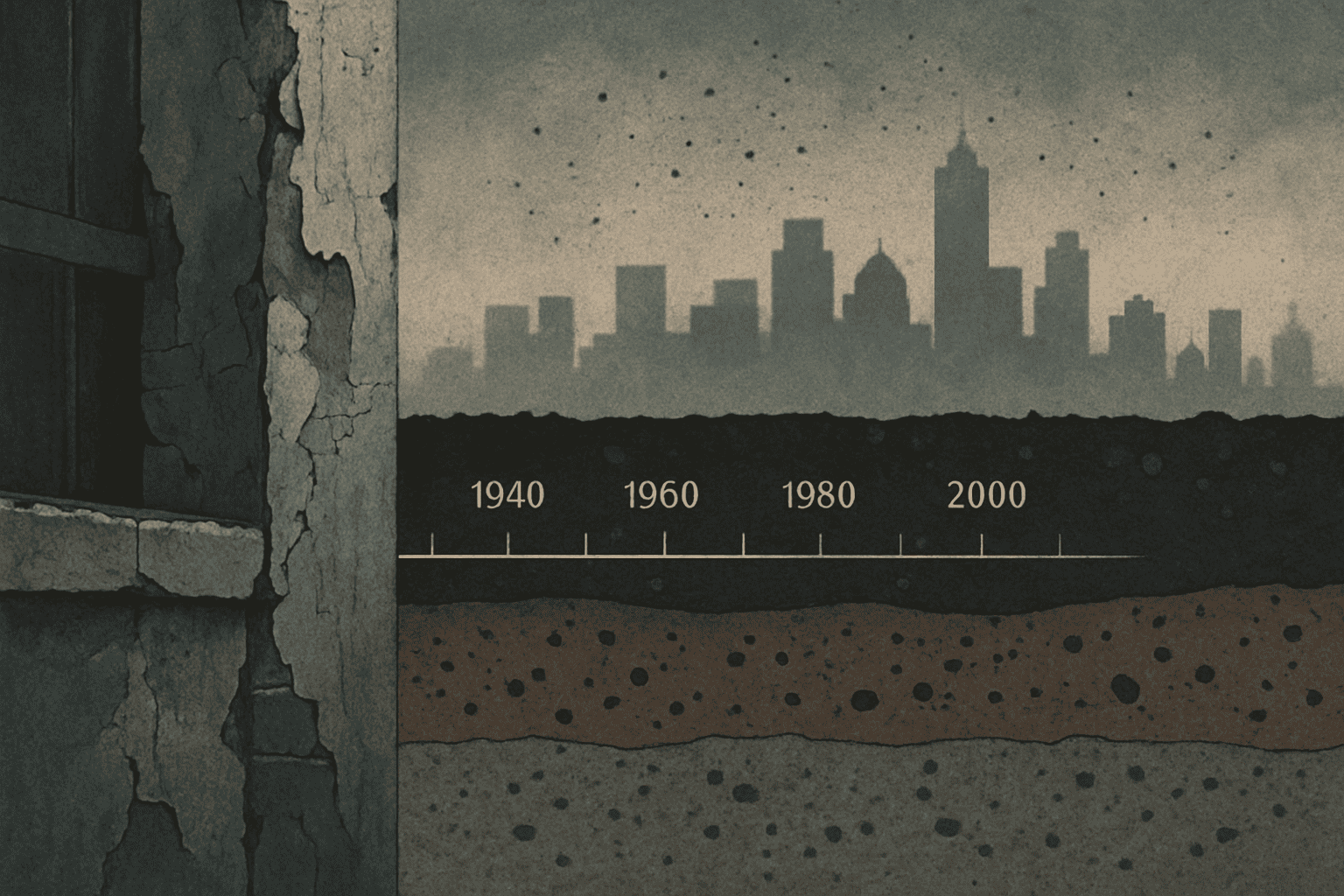
The Timeline: Lead Goes Up, Then Crime Goes Up
Between 1926 and 1985, 8 million tons of lead were released from gasoline in the United States. It landed in soil, dust, and water. Children touched it every day.
In the late 1970s, 88% of U.S. children had high lead in their blood. Average levels were 15.0 μg/dL (micrograms per deciliter — a way to measure lead in blood).
About 20 years later, those children were young adults. And crime exploded:
- In 1960, violent crime was 160.9 per 100,000 people
- By 1970, it jumped 126% to 363.5
- It peaked in 1991 at 758.1
Then lead was phased out of gas. Children’s blood lead dropped 93.6% by 2015-2016. And about 20 years after that cleanup began, crime fell 47% from the 1991 peak to 2010. By 2019, it was 50% below the peak.
This 20-year gap makes sense. Lead poisons babies and toddlers. Those children hit their crime-prone years in their late teens and twenties. The timing matches almost perfectly.
Key Takeaway: Crime rose and fell in lockstep with lead — always with a 20-year delay as poisoned children grew up.
The Proof: This Pattern Held Across Nine Countries
Researcher Rick Nevin looked at nine countries: the USA, Britain, Canada, France, Australia, Finland, Italy, West Germany, and New Zealand.
He found that gasoline lead use explained 90% of the change in U.S. violent crime.
Every country phased out lead at a different time. Every country’s crime peaked and fell based on its own lead timeline — not its own laws or police tactics.
This is the strongest proof that lead, not any single policy, drove crime trends.
Another researcher, Jessica Wolpaw Reyes, found the same thing within U.S. states. States that cut lead sooner saw crime drop sooner. She found that a 10% drop in lead exposure led to a 7.9% drop in violent crime two decades later.
In six major U.S. cities, lead levels in the air explained 66-89% of the change in assault rates with a 22-year delay.
Key Takeaway: Nine countries with different laws, police, and cultures all had the same pattern: crime followed lead with a 20-year delay.
The ‘Superpredator’ Lie: Blaming the Victims
Instead of looking at lead, leaders blamed the people.
In 1995, a professor named John DiIulio predicted a wave of young “superpredators.” He said there would be 30,000 more murderers by 2000. He predicted 270,000 more young predators by 2010.
His language was racist. He said “as many as half” could be young Black males. The media ran with it. Nearly 300 articles used the word “superpredator” from 1995 to 2000. Most never questioned it.
Every prediction was wrong.
- Youth homicide arrests fell 82%, from 12.8 per 100,000 in 1993 to 2.6 by 2019
- Crime was already falling when the predictions were made
- DiIulio later admitted he was “off by a factor of four”
The theory blamed “moral poverty” for crime. But the real cause was lead poisoning. These weren’t “superpredators.” They were children whose brains had been poisoned by a toxin the government allowed into the air.
Key Takeaway: Leaders called lead-poisoned children ‘superpredators’ and used racist language to justify locking them up.
Mass Incarceration: The Wrong Answer
The superpredator panic led to harsh new laws:
- Between 1993 and 1995, 24 states passed “three strikes” laws
- Between 1992 and 1995, 41 states made it easier to try children as adults
- People got life sentences for stealing $153.54 in videotapes
The prison population more than doubled. It went from 774,000 in 1990 to over 1.3 million by 2000. The U.S. locked people up at 5-10 times the rate of Western Europe.
The cost was huge. The country spent $80 billion a year on prisons. California’s Three Strikes law alone added $19 billion to the state’s prison budget.
And it barely worked. The Brennan Center found that more prisons explained only about 5% of the 1990s crime drop. After 2000, the effect dropped to basically 0%. The best guess is prisons explained 10-25% of the decline at most.
Meanwhile, 24 other countries saw similar crime drops — without mass incarceration.
Key Takeaway: The U.S. spent $80 billion a year on prisons that explained at most 10-25% of the crime drop — while other countries saw the same decline without locking people up.
Racism Built Into Every Step
Black communities were harmed at every stage of this crisis.
First, more poison. The 1976-1980 national health survey found Black children had 50% higher average blood lead than white children.
Then, more punishment. Black males were 12 times more likely than white males to be locked up under California’s Three Strikes law. Black children were sentenced to life without parole at 10 times the rate of white children.
In New York State, 72% of all prisoners came from just 7 of New York City’s 55 community districts. As many as one in eight adult men in poor urban areas went to prison each year.
This wasn’t random. Black neighborhoods had more lead because of where highways were built and where old housing stood. Then those same neighborhoods were policed the hardest.
Key Takeaway: Black children were poisoned more, then punished more — a cycle of racism at every step.
The Government Knew and Did Nothing
This wasn’t a surprise. The government knew lead was dangerous for a long time:
- By 1904, doctors knew lead hurt children
- By 1920-1929, at least eight countries banned lead paint
- In 1924, 15 workers died making lead for gasoline
- The lead industry ran ads targeting children, claiming “lead helps guard your health”
The United States didn’t ban lead house paint until 1978. It didn’t fully ban leaded gas until 1996 — 73 years after it was first sold.
By then, 8 million tons of lead had been released into the air, soil, and water. Generations of children had been poisoned.
The 1926 Surgeon General’s panel even warned that lead might cause “chronic diseases of a less obvious character.” That warning was ignored for 50 years.
Key Takeaway: The U.S. government knew lead was toxic for decades but let industry keep poisoning children until the 1990s.
What Science Says Now
After adjusting for bias in the research, experts now agree:
- Lead explains 10-30% of the U.S. crime decline
- Lead explains 7-28% of the fall in murder rates
- Lead explains 6-20% of the gap closing between city and rural crime
A 2023 review looked at 17 strong studies of individuals. All 17 found a real link between childhood lead and adult crime.
The lead-crime link passes every scientific test for proving cause and effect. No other theory — not prisons, policing, abortion, or the economy — passes even half these tests.
The crisis isn’t over. About 800 million children worldwide — one in three — still have blood lead above safe levels.
Key Takeaway: Science confirms lead caused a large share of the crime wave, and 800 million children worldwide are still at risk.
What This Means for Justice
This research tells us something important about who is in prison and why.
Many people serving long sentences were lead-poisoned as children. Their brains were damaged before they had any choice in the matter. The government allowed the poison. Then it punished the result.
Three strikes laws cost California $5.5 billion a year with no proven safety benefit. That money could have been spent removing lead from homes and schools.
A 2011 UN report found that ending leaded gasoline worldwide saved $2.4 trillion a year. It prevented 1.2 million early deaths and 58 million crimes.
Prevention works. Punishment for brain damage does not.
This doesn’t excuse harmful actions. But it demands we ask: Is it justice to cage people for the damage the government did to their brains?
Key Takeaway: Preventing lead poisoning is far cheaper and more effective than mass incarceration — and raises deep questions about justice.
Glossary
- Blood lead level: How much lead is in someone’s blood. Measured in μg/dL (micrograms per deciliter). There is no safe level.
- Prefrontal cortex: The front part of the brain. It controls impulses, planning, and decision-making. Lead damages this area the most.
- Three strikes laws: Laws that give very long prison terms — often life — to people convicted of three felonies (serious crimes). 24 states passed these in the 1990s.
- Neurotoxin: A poison that damages the brain and nerves. Lead is a powerful neurotoxin.
- Cohort study: Research that follows the same group of people over many years. This is the strongest way to prove cause and effect.
- Superpredator: A false term from the 1990s used to describe young people — mostly Black — as dangerous criminals. The theory was proven completely wrong.
- R² (R-squared): A number that shows how well one thing predicts another. An R² of 0.90 means 90% of the pattern is explained.
- Elasticity: How much one thing changes when another changes. An elasticity of 0.79 means a 10% drop in lead causes a 7.9% drop in crime.
- Meta-analysis: A study that combines results from many other studies to find the overall truth.
- Natural experiment: When real-world differences (like states cutting lead at different times) let scientists study cause and effect without a lab.
- Publication bias: When studies with big, dramatic findings get published more than studies with small findings. This can make effects look larger than they really are.
- Broken windows theory: The idea that small signs of disorder (like broken windows) cause more crime. Research has mostly disproven this.
- Gray matter: Brain tissue that contains nerve cells. Less gray matter in frontal areas means permanent brain damage.
- Tetraethyl lead: The lead compound added to gasoline to prevent engine knocking. It was the main source of lead pollution for over 70 years.
Read the Source Document
Read the full analysis: “Lead poisoning drove America’s crime epidemic” (PDF)
Other Versions
- Version for Legislators and Policymakers
- Version for Media and Journalists
Sources & References
- 2023 PLOS Global Public Health systematic review. PLOS Global Public Health (2023-01-01) Academic
- Higney Hanley Moro 2022 meta-analysis — Higney, Hanley, Moro. Ecological Economics (2022-01-01) Academic
- 2019 Northeastern University meta-analysis. Northeastern University (2019-01-01) Academic
- Donohue and Levitt 2019 — John Donohue, Steven Levitt (2019-01-01) Academic
- 2016 NYPD Inspector General report. NYPD Inspector General (2016-01-01) Official Report
- Brennan Center for Justice 2015 analysis. Brennan Center for Justice (2015-01-01) Official Report
- Mielke and Zahran 2012 study — Howard Mielke, Sammy Zahran (2012-01-01) Academic
- 2011 UN report. United Nations (2011-01-01) Official Report
- Marcus et al. 2010 meta-analysis — Marcus et al. (2010-01-01) Academic
- Reyes 2007 NBER working paper — Jessica Wolpaw Reyes. NBER Working Papers (2007-01-01) Academic
- Understanding International Crime Trends: The Legacy of Preschool Lead Exposure — Rick Nevin. Environmental Research (2007-01-01) Academic
- California Legislative Analyst’s Office 2005 report. California Legislative Analyst’s Office (2005-01-01) Official Report
- Levitt 2004 analysis — Steven Levitt (2004-01-01) Academic
- Ayres and Donohue 2003 — Ian Ayres, John Donohue (2003-01-01) Academic
- Needleman 2002 case-control study — Herbert Needleman (2002-01-01) Academic
- Donohue and Levitt 2001 — John Donohue, Steven Levitt (2001-01-01) Academic
- Stretesky and Lynch 2001 — Stretesky, Lynch (2001-01-01) Academic
- Ludwig and Cook 2000 — Jens Ludwig, Philip Cook (2000-01-01) Academic
- Nevin 2000 paper — Rick Nevin (2000-01-01) Academic
- Cook and Laub 1998 — Philip Cook, John Laub (1998-01-01) Academic
- Lott and Mustard 1997 — John Lott, David Mustard (1997-01-01) Academic
- Needleman 1996 JAMA paper — Herbert Needleman. JAMA (1996-01-01) Academic
- The Coming of the Super-Predators — John DiIulio Jr.. The Weekly Standard (1995-11-01) Journalism
- Brush with Death: A Social History of Lead Poisoning — Christian Warren Academic
- Chicago Project on Human Development in Neighborhoods — Robert Sampson, Alix Winter Academic
- Cincinnati Lead Study — Kim Dietrich et al. Academic
- Marshall Project. The Marshall Project Journalism
- Miller v. Alabama amicus brief — James Q. Wilson et al.. U.S. Supreme Court Legal Document
- Moving to Opportunity study. HUD Official Report
- NBER three strikes study. NBER Academic
- NHANES. CDC/NCHS National Health and Nutrition Examination Survey Data Portal
- Sampson and Winter Chicago analysis — Robert Sampson, Alix Winter Academic
- Sentencing Project meta-analysis. The Sentencing Project Official Report
Source Document
You just read about people suffering in state custody. The least you can do is make sure other people read it too. Share this story.