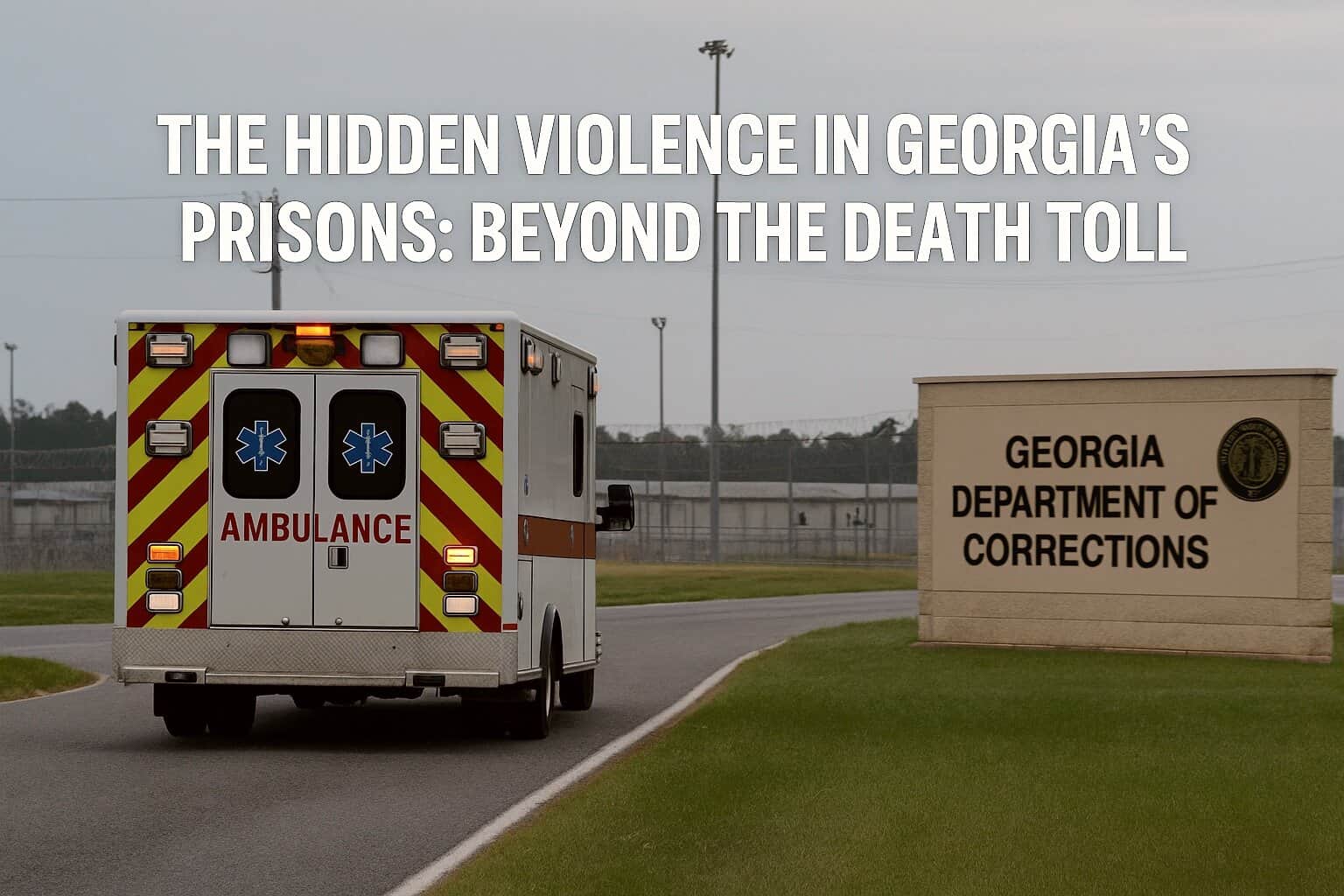
Every year, Georgia’s prisons make headlines for record-setting death tolls. In 2024 alone, 330 people died in Georgia Department of Corrections (GDC) custody — the deadliest year in state history 1. Media outlets like the Atlanta Journal-Constitution (AJC) and the U.S. Department of Justice (DOJ) have focused on this staggering number of homicides, suicides, and unexplained deaths.
But what the headlines often miss is the hidden epidemic of non-fatal violence: the stabbings, slashings, and brutal assaults that leave thousands permanently scarred, hospitalized, or disabled each year. For every life lost, dozens more are shattered — sometimes forever.
The Scale of Non-Fatal Violence
The DOJ’s 2024 investigative findings laid bare the scope of the crisis. Between January 2022 and April 2023, Georgia’s close- and medium-security prisons recorded more than 1,400 violent incidents. Nearly half of those attacks resulted in serious injuries, and nearly one-third required off-site medical treatment 2.
Breaking this down:
- 423 incidents required hospitalization.
- 631 incidents caused serious injuries.
- Nearly 20% of the attacks involved weapons, ranging from crude shanks to 22-inch steel blades.
The DOJ noted bluntly: “Other serious and life-threatening incidents are exponentially more frequent than homicides.” Their data suggests that for every single murder, dozens more people are stabbed or beaten severely enough to require hospitalization.
Using those ratios, 2024’s 66 homicides may have been accompanied by 800–1,200 serious assaults that required surgery, weeks of hospitalization, and long-term rehab.
A Note on Underreporting
Since publishing this article, Georgia Prisoners’ Speak has received numerous reports from inside the prison system describing how the Georgia Department of Corrections minimizes, misclassifies, or entirely fails to record incidents of violence. We’ve been given very detailed accounts of how this is done. These accounts align with the DOJ’s findings that official data does not capture the true scope of stabbings, assaults, and deaths. While the numbers we’ve presented are already alarming, the reality inside Georgia’s prisons is far worse — with hidden cases of severe injury and violence that never make it into the public record. The true scale of the crisis is even more staggering than the state will admit.
Beyond Numbers: Human Toll
The numbers, grim as they are, cannot capture the full devastation. Survivor accounts illustrate the lasting scars of a system that allows violence to reign unchecked.
- Alexander Stetz spent just one year in prison — but carries lifelong injuries. Stabbed repeatedly by gang members during an extortion attempt, he suffered nerve damage in his hand: “My fingers are like, numb. I can’t close my hand.” He still bears scars on his neck, shoulder, and back.
- At Wilcox State Prison, nine men were stabbed in a single gang-related incident. Five were hospitalized for weeks.
- In January 2023, six people at Georgia Diagnostic and Classification Prison were hospitalized in one evening, some requiring life-flight helicopters to trauma centers.
- A 2020 emergency report described one man at Georgia State Prison as “covered in yellow and purple bruises, with a possible fractured jaw, human bite marks, and signs of starvation.” Paramedics wrote: “How this has not been noticed by prison staff and tended to before now is shameful.”
These are not isolated cases. They are the routine reality for thousands.
Life After Survival
For those who survive, recovery is long and often incomplete.
- Weeks to months in hospital beds.
- Painful surgeries to repair nerve, muscle, and organ damage.
- Lost eyes, fingers, and even kidneys.
- Long-term rehabilitation to regain basic mobility.
- Permanent disabilities: blindness, paralysis, chronic pain.
- And always, trauma that lasts far beyond the physical wounds.
Many survivors must be transferred to other prisons for their own safety, only to face the same lack of protection in facilities equally plagued by gangs and understaffing.
The Cost to the Public
While the state hides behind vague mortality reports, the financial burden spills into the public’s lap. On average:
- Emergency trauma treatment in Georgia costs $20,000–$40,000 per patient.
- Inpatient hospitalization adds $2,000–$3,000 per day.
- Long-term rehab and mental health therapy can run tens of thousands more.
If even half of the estimated 800–1,200 non-fatal assault victims in 2024 required hospitalization, Georgia taxpayers may have quietly shouldered tens of millions of dollars in hospital bills — all while the GDC denies and conceals the true scope of the violence.
Systemic Underreporting
The state’s deception compounds the crisis. In 2024, the AJC — calculating from open records requests — counted 66 homicides. GPS, drawing on firsthand reports from incarcerated people, documented at least 100 murders — and that number may still be too low 3.
This same culture of denial extends to non-fatal violence. Serious assaults are misclassified as “fights.” Murders are written off as “unknown causes.” By manipulating data, the GDC shields itself from accountability while people inside prisons pay the price with blood.
Comparison to National Trends
Georgia’s prison homicide rate is already triple the national average. If non-fatal assaults are proportional — and all evidence suggests they are — then Georgia prisons are experiencing levels of violence that eclipse nearly every other state.
Yet, despite national outrage over deaths, the thousands who survive with lifelong injuries remain invisible, their stories untold.
Accountability and Reform
The DOJ’s October 2024 report found Georgia’s prisons to be in violation of the Eighth Amendment’s ban on cruel and unusual punishment. The Guidehouse consultants, hired by Governor Brian Kemp, confirmed the same: catastrophic understaffing, rampant contraband smuggling, and decaying facilities have left the GDC incapable of maintaining basic safety 4.
Yet despite these damning reports, the violence has only escalated.
Recent Events: Dooly State Prison, Sept. 12, 2025
On Friday, Sept. 12, 2025, violence erupted at Dooly State Prison. Local outlets reported that 11 incarcerated people required outside medical treatment; nine were transported by ambulance to area hospitals and two were evacuated by life-flight helicopters. TV coverage cited an EMA director who said one person was in critical condition and the prison was placed on lockdown 5 6 7.
Multiple incarcerated witnesses in Dorm G1 told GPS a matching but far more detailed account:
“They put our whole dorm on the yard in the morning so the paint crew could paint the inside because the dorm was a dump. A couple hours later officers started letting some people back into the building. I can’t imagine why. That’s when the Bloods and Goodfellas started going at it—inside the dorm, on the walk, and on the yard.”
“These weren’t fist fights. It was shanks and machetes everywhere.”
“When it kicked off, officers ran. We were on our own. It’s was a blood bath—literally, blood was squirting out of people. It seemed like half the dorm was involved [Ed.: this was a typical 120-man dorm.] It took more than two hours before they had it under control.”
Staff at Dooly also told GPS one person later died at the hospital. As of this writing, GDC has not confirmed a death associated with this incident; the department’s initial statements to media described the air-lifted injuries as “non-life-threatening” and did not specify gangs or weapons 5. The EMA director confirmed nine people stabbed and one in critical condition, with two life-flight evacuations 6.
This was closer to a riot than a “fight,” witnesses said, and it tracks with federal findings that Georgia understaffing allows gangs to control entire units and that serious, life-threatening incidents occur exponentially more often than homicides 8. The same facility saw a multi-victim stabbing incident in 2024, underscoring a pattern of recurring group violence 9.
Why this matters: even when TV headlines say “non-life-threatening,” injuries from shanks and makeshift machetes regularly mean organ loss, nerve damage, and months of hospitalization/rehab—the hidden violence that rarely appears in statewide counts but dominates daily life inside.
🚑 Medical Response Costs for Sept. 12, 2025, Dooly State Prison Incident
1. Ambulances (ground)
- 5 ambulances dispatched.
- Average cost per EMS ground transport in Georgia: $1,200–$1,500 10.
- Estimate: 5 × $1,400 = $7,000.
2. Life Flight Helicopters
- 2 life flights dispatched.
- Average cost of an air ambulance flight in the Southeast: $35,000–$55,000 11.
- Estimate: 2 × $45,000 = $90,000.
3. Hospital Emergency Care
- 11 patients treated (9 ground, 2 airlifted).
- Georgia trauma center ED visit average: $2,500–$3,500 per patient.
- Estimate: 11 × $3,000 = $33,000.
4. Inpatient Hospitalization
- Reports say 5 remained hospitalized.
- Average inpatient cost per day in Georgia: $2,900 (AHRQ, 2022).
- Likely stays: 3–7 days for serious stab wounds.
- Estimate: 5 × 5 days × $2,900 ≈ $72,500.
5. Surgical & Specialty Care
- Stabbings typically require surgery, imaging, and follow-up.
- Trauma surgery averages $15,000–$25,000 per patient requiring intervention.
- Assume 4–5 surgical cases.
- Estimate: 5 × $20,000 = $100,000.
💰 Total Estimated Cost
- Ambulances: $7,000
- Life Flights: $90,000
- ER Treatment: $33,000
- Inpatient Stays: $72,500
- Surgeries: $100,000
Total ≈ $300,000–$325,000 for a single incident.
For just one prison fight on one afternoon, taxpayers may be on the hook for $300,000 or more in emergency response and hospital bills. Multiply that by the hundreds of serious stabbings that happen each year and the hidden financial cost climbs into tens of millions annually — money that could be funding real rehabilitation, education, or community safety.
Update: The GDC now confirms that the total cost of this incident was $383,000.
Conclusion: A Crisis the State Refuses to Acknowledge
For every headline about record deaths, hundreds more people are being slashed, stabbed, beaten, and maimed behind Georgia’s prison walls. These men and women return from hospitals to the same cells where gangs and neglect rule. Many will never fully recover.
This is not a system of rehabilitation. It is a system of routine human destruction.
Take Action
Georgia’s prisons will not change on their own. GDC leadership has shown indifference, denial, and even deception. The only way forward is pressure from the outside.
You can help.
👉 Use ImpactJustice.AI to send powerful messages to legislators, media outlets, and decision-makers demanding action to stop this violence.
Together, we can amplify the voices of survivors, families, and whistleblowers — and force Georgia to confront the hidden epidemic of violence behind its prison walls.

Related GPS articles
The Architecture Is the Evidence
Across the 32 state prisons whose original design figures we hold, Georgia built for 15,737. They hold 33,805 — 215% of design capacity.
Dorms tripled. Cells double- and triple-bunked. Medical, kitchens, libraries — unchanged. Every facility, every design figure, every source.
See the receipts →- GPS Mortality Statistics: https://gps.press/gdc-mortality-statistics/[↩]
- DOJ Findings Report on Georgia Prisons: https://www.justice.gov/usao-ndga/media/1371541/dl?inline=[↩]
- AJC – Georgia prison homicides outpacing last year: https://www.ajc.com/news/2025/09/georgia-prison-homicides-outpacing-last-year/[↩]
- AJC – Georgia prisons are in crisis, say consultants hired by Gov. Kemp: https://www.ajc.com/news/investigations/georgia-prisons-in-crisis-say-consultants-hired-by-governor/5P6BELWL4ZE7LK2BKWP3QT6Y2E/[↩]
- 41NBC: https://www.41nbc.com/11-inmates-stabbed-during-altercation-at-dooly-state-prison/[↩][↩]
- WGXA: https://wgxa.tv/news/local/nine-inmates-stabbed-multiple-times-in-fight-at-dooly-state-prison-ema-director-don-williford-confirms-georgia-department-of-corrections-11-injured-crime-news-prison-riot-fight-bawl-dooly-county-unadilla-ga-macon-hospital[↩][↩]
- 13WMAZ: https://www.13wmaz.com/article/news/local/9-inmates-injured-1-in-critical-condition-after-fight-at-dooly-state-prison/93-07a722f9-2ad9-47d4-a5b1-b1e7f8b8a41e[↩]
- DOJ Findings Report on Georgia Prisons (PDF): https://www.justice.gov/usao-ndga/media/1371541/dl?inline=[↩]
- WGXA Topic page – Dooly State Prison: https://wgxa.tv/topic/Dooly%20State%20Prison[↩]
- Kaiser Family Foundation; FAIR Health data, 2023[↩]
- GAO 2019 report; Air Methods[↩]
You Have Options
Free tools to take action — the law is on your side.
Demand records from the prison system. Reach the officials who set policy. File a grievance or a complaint the right way. And for families who’ve lost someone in custody, get the records that tell the truth. Plain-language, step-by-step, and free.
Explore the GPS Toolkits →Eleven people were stabbed at Dooly State Prison in one afternoon, costing taxpayers $383,000. This happens routinely while Georgia hides the true scale of prison violence. Share this investigation so people understand what their tax dollars are funding behind prison walls.
Until the GDC is made to have an oversight committee that is outside the GDC and the parole board nothing will ever change about the injustice of the murders or the inhumane treatment of offenders! They have NO ONE to be held accountable to!
What society don’t know or care about is that their tax dollars are paying for this horrific situation!
They say we give them more than they deserve with 3 hots and a cot! But that’s far from the reality of what is actually happening!
People need to really look at this and understand what’s happening! As Christians this is not how we should be!
While I agree 1000% with there being consequences for breaking our laws I also believe we should treat them as humans! Not all are there for violent crimes! Before you pass judgement maybe you should UNDERSTAND the problem!