
Somewhere in Georgia, a command center is being built. When finished, it will give a handful of operators the ability to watch every state prison in real time — monitoring camera feeds, tracking officer locations, scanning mail, intercepting cell phone signals, detecting drones, and aggregating health records into a single digital dashboard. It will be the first system of its kind in American corrections.
The Georgia Department of Corrections calls it the Overwatch & Logistic Unit Command Center — OWL. Commissioner Tyrone Oliver confirmed at the September 2025 Board of Corrections meeting that the facility is “under construction.” 1 But you would be hard-pressed to find a public debate about its implications. No civil liberties organization — not the ACLU of Georgia, not the Electronic Frontier Foundation, not the Southern Poverty Law Center — has publicly addressed OWL by name. No legislative hearing has examined its scope. No news outlet has investigated its reach.
GPS conducted an exhaustive review of all 50 state departments of corrections and the Federal Bureau of Prisons. No operational equivalent exists anywhere in the country. 2 Tennessee pitched a roughly similar concept in February 2026 — a Centralized Security Intelligence Center with a $5 million budget and 26 officers — but it remains a proposal on paper. 3 Georgia’s system is already being built.
The question is not whether Georgia should pursue security technology. The question is whether the state should build the most advanced centralized prison surveillance apparatus in the country — spending over $150 million on technology while allocating just $805,000 for vocational education — without any meaningful public accountability, privacy analysis, or independent oversight.
Ten Streams, One Eye
OWL is not a camera monitoring room. Based on Board of Corrections meeting minutes from April and September 2025, ten distinct technology streams converge into a single command-and-control hub 4:
- Officer Tablets — 1,050 deployed as of January 2025, with 1,600 planned across all 35 state prisons
- AeroDefense AirWarden — RF-based drone detection operating at 25 locations, deployed since December 2017
- Managed Access Systems — Cell phone interdiction covering all 35 state prisons through three vendors
- Electronic Health Records — A new department-owned system replacing private vendor records
- Taser 10 — Next-generation conducted energy devices linked to the network
- Body Worn Cameras — Officer-worn cameras feeding into the centralized platform
- Mail Screening — Off-site scanning of all incoming mail
- Digital Forensics Unit — Extraction and analysis of data from seized devices
- Data Intelligence Advanced Integration — A system so opaque that no public description exists beyond its budget line item
- OWL Unit Command Center — The hub that ties it all together
The platform that aggregates these streams is Axon Fusus — a cloud-based “real-time intelligence” system originally designed for municipal police departments to build real-time crime centers. Axon acquired Fusus in 2024. 5 In its corrections marketing materials, Axon describes Fusus as enabling “a single Operations Center” with “real-time access to live and recorded video from multiple Corrections facilities, in one interface, accessed from a single computer.” 6
At the April 3, 2025 Board meeting, Commissioner Oliver’s technology presentation explicitly paired OWL with Fusus — the earliest identified public link between the command center and the Axon platform. 4
The Electronic Frontier Foundation published a major investigative report on Fusus in 2023, describing it as a tool that allows law enforcement to tap into vast networks of private and public cameras. The ACLU of Michigan described Fusus-enabled systems as “a gateway drug into other surveillance technologies.” 7 Yet neither the EFF nor any other civil liberties organization has examined Georgia’s application of this platform inside its prisons.
Follow the Money: $150 Million and Counting
The financial picture tells a story of priorities that Georgia’s political leadership would prefer not to spell out.
OWL-specific funding alone totals approximately $17.8 million across three fiscal years: $7.2 million in the Amended FY2025 budget (HB 67), $3.8 million in FY2026, and a combined $6.7 million proposed for FY2027. 8 9
But OWL commands far more than its own line items. The technology systems it integrates represent well over $150 million in combined appropriations:
- $84.6 million for thermal cameras, CCTVs, perimeter security, and lighting statewide (AFY2026) 9
- $35 million for managed access and drone detection — the single largest technology line item (AFY2025) 8
- $15 million for electronic health records (AFY2025)
- $13.4 million for additional managed access and drone detection (AFY2026)
- $7.2 million for body cameras and tasers (AFY2025)
- $4.1 million for the Digital Forensics Unit contract (FY2026)
- $3.6 million for body camera and taser support (FY2026)
- $2.5 million for officer tablets (AFY2025) plus $2.5 million for software licenses (FY2026)
- $1.95 million for the “Data Intelligence Advanced Integration” system (FY2026)
- $1.8 million for mail screening (FY2026)
Meanwhile, the FY2026 budget allocated $805,000 for vocational education programs. 10
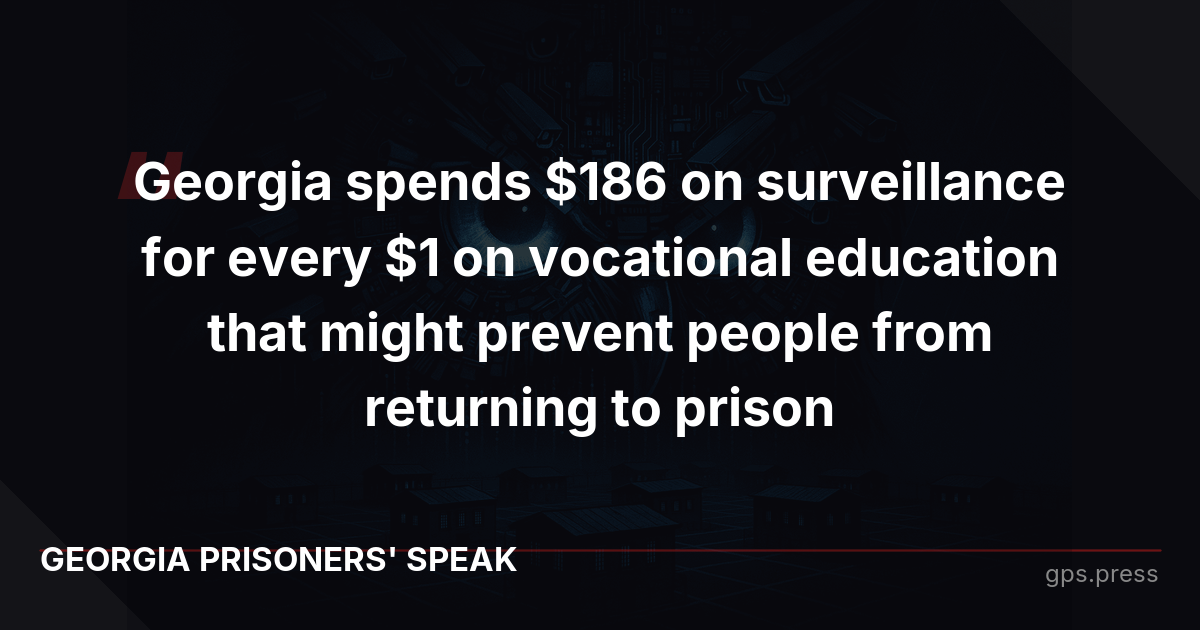
That works out to roughly $186 spent on surveillance technology for every $1 invested in teaching incarcerated people a skill that might prevent them from returning to prison.
This spending sits within the broader context of Governor Kemp’s corrections investment package, which exceeded $600 million across the Amended FY2025 and FY2026 budgets — a 44% increase over FY2022 levels. 11 The General Assembly approved a $200 million corrections spending increase in FY2026 alone — $75 million above the Governor’s own recommendation. 12
Georgia is spending more on corrections than at any point in its history. Violence is at record levels. Deaths continue to climb. And the state’s answer is to watch more closely while investing almost nothing in actually changing outcomes.
The Legislature’s Quiet Hand
A striking detail in the budget trail: several key OWL-related line items were inserted by the Georgia House and were entirely absent from the Governor’s original budget recommendation. These include the $3.8 million for OWL personnel and technology fees, the $1.95 million for the Data Intelligence system, and the $4.1 million for the Digital Forensics Unit contract. 10
Senate Appropriations Chairman Blake Tillery captured the legislative mindset when he declared in support of corrections technology spending: “Prisons are for punishment and rehabilitation — not TikTok.” 12
The rehabilitation half of Senator Tillery’s equation appears to have been forgotten in the appropriations.
The Military-Industrial-Corrections Complex
The vendors behind OWL’s technology stack reveal a web of defense contractors, telecom conglomerates, and opaque private companies that have quietly built a surveillance ecosystem inside Georgia’s prisons.
Observation Without Limits: The Radar Company
The name “OWL” carries a double meaning. Observation Without Limits LLC — also abbreviated O.W.L. — is a joint venture between Dynetics, a wholly-owned subsidiary of defense giant Leidos ($16+ billion in annual revenue), and Alabama Power Company, a subsidiary of Southern Company. 13 One of the South’s largest utility companies has a direct financial stake in prison surveillance radar.
O.W.L.’s GroundAware radar system uses S-band digital beamforming to observe entire sectors simultaneously, updating target data up to eight times per second. 14 A single unit can surveil approximately 2,000 acres with detection ranges up to 15 kilometers. The system operates at approximately 400 critical infrastructure sites worldwide — yet it does not appear in any Leidos SEC filing, as O.W.L. is too small relative to Leidos’ massive revenue to require disclosure.
GDC’s relationship with O.W.L. radar dates to at least 2020, when a Bureau of Justice Assistance grant awarded GDC $420,216 to purchase and deploy an “OWLD 3D Radar” UAV Detection System at Baldwin State Prison. 15 In 2023, AeroDefense publicly integrated O.W.L.’s radar into its AirWarden drone detection platform, creating a layered detection system combining RF triangulation with radar tracking. 16
Managed Access: Three Vendors, One Monopoly
The cell phone interdiction systems flowing into OWL are operated by three vendors under FCC Contraband Interdiction System (CIS) licenses:
- Trace-Tek LLC / ShawnTech Communications — Holds CIS agreements for 28 Georgia facilities. Together they claim to hold 86% of all FCC CIS licenses issued nationwide. 17 Trace-Tek also operates a “Cellular Denial of Service (C-DOS)” program that permanently disables contraband phones from connecting to cellular networks — a capability it markets as bypassing the warrant process. 18
- CellBlox Acquisitions LLC — A subsidiary of Securus Technologies (owned by Aventiv Technologies, formerly controlled by billionaire Tom Gores’ Platinum Equity) that operates CIS at four Georgia facilities: Jimmy Autry, Macon, Smith, and Telfair state prisons. CellBlox’s Georgia presence dates to a 2014 managed access pilot at a maximum-security facility. 19 Securus subsequently invested over $40 million in managed access technology acquisitions. 20
- Hawks Ear Communications LLC — The most opaque of the three vendors. Hawks Ear covers three facilities — Hancock, Phillips, and Valdosta state prisons. The company was incorporated in Florida in 2015 with manager Roger Banks, registered in Georgia in 2022, maintains no public website, and has no meaningful corporate disclosure. 21
The Axon Connection
An Axon Fusus corrections case study references “a large Southern State” department of corrections with “roughly 40 facilities” that received a $30 million estimate from an incumbent vendor for camera upgrades, which Fusus quoted “at a fraction of the cost.” 6 Georgia, with 36 state prisons, fits that description precisely.
What the Cameras Can’t See
Georgia’s investment in surveillance technology arrives against a backdrop of catastrophic human outcomes that cameras have done nothing to prevent.
In 2024, over 100 people were killed by homicide inside Georgia’s prisons — compared to just 8 or 9 per year in 2017-2018. GDC’s own statistics report 301 people died while serving state sentences in 2025, though the official mortality name list contains only 295 names — a discrepancy GPS has documented extensively. Meanwhile, the system operates at 200-300% of original design capacity at many facilities through triple-bunking without expanding medical facilities, kitchens, or staffing to match.
Operation Skyhawk — a GDC drone-based contraband operation concluded in March 2024 — resulted in 150 arrests including eight correctional officers, and confiscation of 87 drones, 273 cell phones, and 22 weapons. 22 GDC recovered 3,200 cell phones in 2019 alone.
These numbers are often cited to justify the surveillance investment. But they raise a harder question: if contraband and violence persist at these levels despite years of deploying drone detection, managed access systems, and security cameras — systems that have been in Georgia’s prisons since at least 2014 — what evidence exists that centralizing them into a single command center will change outcomes?
The research suggests the answer is: none. As GPS has documented, facilities routinely operate with only 5-6 officers covering 69 security posts during critical incidents. No camera system compensates for the absence of the human beings needed to respond to what the cameras record. Federal Judge Marc Self recently rebuked Commissioner Oliver for ignoring court orders, stating that GDC has “little credibility” and acts “above the law.”
The Black Box: What We Don’t Know
Several critical dimensions of OWL remain entirely opaque to the public:
Staffing and authority. Personnel funding exists in the budget, but no public information describes how many operators will staff OWL, what training they will receive, what authority they will have to direct facility responses, or what chain of command governs the center.
The Data Intelligence system. The “Data Intelligence Advanced Integration” system received $1.95 million in FY2026 funding. No public description exists beyond its budget line item and a single reference in Board meeting minutes. The vendor, capabilities, data inputs, and analytical outputs are unknown.
The GDC-OWL WiFi network. A branded statewide prison WiFi network (GDC-OWL) serves as the communications backbone. Its vendor, cost, and technical specifications are undocumented. Build-out likely began in 2023.
The CGL partnership. Commissioner Oliver mentioned a “CGL partnership” alongside OWL at the September 2025 Board meeting. CGL Companies (Carter, Goble Lee), now owned by Hunt Companies, is a national corrections consulting firm. The nature of this partnership has not been publicly disclosed.
Data retention and access. No public policy addresses how long OWL retains surveillance data, who can access it, whether it feeds into criminal investigations or disciplinary proceedings, or how aggregated data from health records, body cameras, mail screening, and cell phone interdiction is governed.
Privacy analysis. No known privacy impact assessment has been conducted for a system that aggregates electronic health records, communication monitoring, location tracking, and video surveillance into a single platform monitoring 45,000+ incarcerated people.
A Surveillance State Within a State
Georgia Representative Dale Washburn provided the clearest public description of OWL’s function in a March 2025 legislative recap: body cameras and tasers “will be linked to an Over Watch Logistics Unit (OWL), funded at $7.2 million, that will continuously monitor security cameras across the state, enabling a rapid response to disturbances.” 23
“Continuously monitor security cameras across the state” is an extraordinary capability to describe in a legislative newsletter and then never debate publicly.
What Georgia is building is unprecedented. It is a centralized surveillance apparatus that combines video monitoring, biometric data, communication interception, radar tracking, health records, digital forensics, and an unspecified “intelligence” platform into a single system watching over every state prison from one room. No other state has built anything comparable. No civil liberties organization has examined it. No legislative committee has held hearings on its scope.
And yet the system that will be watched by OWL’s all-seeing eye is the same system where people are stabbed to death in their bunks, denied basic medical care until they die, fed food that fails federal nutrition standards, and locked in facilities designed for half or a third of their current populations.
The owl may see everything. But it cannot fix what Georgia refuses to change.
Explore the Data
GPS makes GDC statistics accessible to the public through several resources:
- GPS Statistics Portal — Interactive dashboards translating complex GDC reports into accessible formats, updated within days of official releases.
- GPS Lighthouse AI — Ask questions about Georgia’s prison system and get answers drawn from GPS’s investigative archive and data analysis.
- Machine-Readable Pages for Researchers — GPS maintains AI-optimized pages for data analysis:
- AI Content Index — https://gps.press/ai-index/
- Facilities Data — https://gps.press/facilities-data/
- Statistics Data — https://gps.press/statistics-data/
- Release Statistics Data — https://gps.press/release-statistics-data/
- Mortality Data — https://gps.press/mortality-data/
- Blog Data — https://gps.press/blog-data/
- GPS News Data — https://gps.press/gps-news-data/
- FAQ Index — https://gps.press/faq-index/
- FAQ (alternate) — https://gps.press/faqs/
- Featured Articles Index — https://gps.press/featured-index/
- Length of Stay Data — https://gps.press/los-data/
- Drug Admission Profiles — https://gps.press/drug-data/
- Commissary Pricing Data — https://gps.press/commissary-data/
- GDC Standard Operating Procedures — https://gps.press/sop-data/
- GPS Research Library — https://gps.press/research/
Contact GPS at media@gps.press for access to underlying datasets used in this analysis.
Call to Action: What You Can Do
Georgia spent $150 million watching people die in prison instead of preventing those deaths. Over 100 homicides in 2024 while surveillance budgets dwarf education funding 186-to-1. Share this investigation because silence enables a system that monitors everything and fixes nothing.
Spread the Word — It Takes 15 Seconds
Awareness without action changes nothing. Here’s how you can help push for accountability and real reform:
Use Impact Justice AI — Our free tool at https://impactjustice.ai lets you instantly draft and send personalized emails to lawmakers, journalists, and agencies. No expertise required.
Tell My Story — Are you or a loved one affected by Georgia’s prison system? GPS publishes first-person accounts from incarcerated people and their families. Submit your story at https://gps.press/category/tellmystory/ and help the world understand what’s really happening behind the walls.
Contact Your Representatives — Your state legislators control GDC’s budget, oversight, and the laws that created these failures. Find your Georgia legislators at https://open.pluralpolicy.com/ga/ or call Governor Kemp at (404) 656-1776 or the GDC Commissioner at (478) 992-5246.
Demand Media Coverage — Contact newsrooms at the AJC, local TV stations, and national criminal justice outlets. More coverage means more pressure.
Amplify on Social Media — Share this article and tag @GovKemp, @GDC_Georgia, and your local representatives. Use #GAPrisons, #PrisonReform, #GeorgiaPrisonerSpeak.
File Public Records Requests — Georgia’s Open Records Act gives every citizen the right to request incident reports, death records, staffing data, medical logs, and financial documents at https://georgiadcor.govqa.us/WEBAPP/_rs/SupportHome.aspx.
Attend Public Meetings — The Georgia Board of Corrections and legislative committees hold public meetings. Your presence is noticed.
Contact the Department of Justice — File civil rights complaints at https://civilrights.justice.gov. Federal oversight has forced abusive systems to change before.
Support Organizations Doing This Work — Donate to or volunteer with Georgia-based prison reform groups fighting for change on the ground.
Vote — Research candidates’ positions on criminal justice. Primary elections often determine outcomes in Georgia.
Contact GPS — If you have information about conditions inside Georgia’s prisons, reach us securely at GPS.press.
Further Reading
- Banned to Be Silent: How Georgia’s Prison Technology Crackdown Protects Power, Not Safety *How Georgia uses technology suppression to silence incarcerated people rather than protect them.*
- $700 Million More—And Nothing to Show for It *Georgia’s massive corrections spending increase has produced worsening outcomes across every measurable metric.*
- Above the Law: GDC Defies Courts, DOJ, and Legislators *The documented pattern of GDC stonewalling every institution meant to hold it accountable.*
- Stop the Silence: Why Georgia Must Legalize and Monitor Cell Phones in Prisons *The case for legalizing and monitoring prison cell phones instead of spending millions to block them.*
- Georgia’s “Hardened” Solution: Another Fortress Instead of Reform *Georgia’s plan to build a new maximum-security prison doubles down on the fortress mentality that created this crisis.*
- The Six Who Disappeared: Georgia’s Prison Death Cover-Up *GDC reports 301 deaths in 2025 but names only 295 people — and refuses to explain the gap.*
About Georgia Prisoners’ Speak (GPS)
Georgia Prisoners’ Speak (GPS) is a nonprofit investigative newsroom built in partnership with incarcerated reporters, families, advocates, and data analysts. Operating independently from the Georgia Department of Corrections, GPS documents the truth the state refuses to acknowledge: extreme violence, fatal medical neglect, gang-controlled dorms, collapsed staffing, fraudulent reporting practices, and unconstitutional conditions across Georgia’s prisons.
Through confidential reporting channels, secure communication, evidence verification, public-records requests, legislative research, and professional investigative standards, GPS provides the transparency the system lacks. Our mission is to expose abuses, protect incarcerated people, support families, and push Georgia toward meaningful reform based on human rights, evidence, and public accountability.
Every article is part of a larger fight — to end the silence, reveal the truth, and demand justice.
- Board of Corrections Meeting Minutes September 4 2025, https://gdc.georgia.gov/document/board-meeting-minutes/board-meeting-minutes-september-2025/download [↩]
- GPS OWL Unit Research Brief 2026, https://gps.press/research/ [↩]
- Tennessee prison officials pitch AI to increase safety, The Center Square, https://www.thecentersquare.com/tennessee/article_2b395afc-dc2d-40df-9f23-01abc89c09fe.html [↩]
- Board of Corrections Meeting Minutes April 3 2025, https://gdc.georgia.gov/document/board-meeting-minutes/board-meeting-minutes-april-2025/download [↩][↩]
- Body Camera-Maker Axon Buys Real-Time Crime Center Developer Fusus, SDM Magazine, https://www.sdmmag.com/articles/102804-body-camera-maker-axon-buys-real-time-crime-center-developer-fusus [↩]
- How Axon Fusus can support safer corrections environments, https://www.axon.com/resources/safer-corrections-fusus [↩][↩]
- Neighborhood Watch Out: Cops Are Using Fusus, EFF, https://www.eff.org/deeplinks/2023/05/neighborhood-watch-out-cops-are-incorporating-private-cameras-their-real-time [↩]
- Governor’s Budget Report AFY 2025 and FY 2026, https://opb.georgia.gov/document/governors-budget-reports/afy-2025-and-fy-2026-governors-budget-report/download [↩][↩]
- Governor’s Budget Report AFY 2026 and FY 2027, https://opb.georgia.gov/document/governors-budget-reports-current-year/afy-2026-fy-2027-governors-budget-report/download [↩][↩]
- FY2026 House Criminal Justice and Public Safety Budget Analysis, https://www.legis.ga.gov/api/document/docs/default-source/senate-budget-office-document-library/appropriations/2026/general/fy2026_house_criminal_justice_and_public_safety.pdf [↩][↩]
- Overview: 2026 Fiscal Year Budget for the Georgia Department of Corrections, GBPI, https://gbpi.org/overview-2026-fiscal-year-budget-for-the-georgia-department-of-corrections/ [↩]
- Fiscal 26 state budget clears General Assembly, The Current, https://thecurrentga.org/2025/04/04/fiscal-26-state-budget-clears-general-assembly/ [↩][↩]
- Observation Without Limits LLC About page, https://www.owlknows.com/about/ [↩]
- O.W.L. GroundAware Radars page, https://www.owlknows.com/groundaware/ [↩]
- BJA Grant 2020-BX-0002, https://bja.ojp.gov [↩]
- AeroDefense Integrates O.W.L. Radar, https://www.owlknows.com/aerodefense-integrates-o-w-l-s-radar-to-deliver-layered-airspace-security-solution-2/ [↩]
- FCC Contraband Wireless Devices page, https://www.fcc.gov/wireless/bureau-divisions/mobility-division/contraband-wireless-devices [↩]
- ShawnTech Communications Cellular Denial of Service page, https://www.shawntech.com/cellulardenialofservice/ [↩]
- CellBlox Managed Access Pilot In Georgia Prison System, PR Newswire, https://www.prnewswire.com/news-releases/cellblox-managed-access-pilot-in-georgia-prison-system-260268321.html [↩]
- Securus Invests in Managed Access Technology, PR Newswire, https://www.prnewswire.com/news-releases/securus-invests-in-managed-access-technology-300145251.html [↩]
- Hawks Ear Communications LLC, BIS Profiles, https://bisprofiles.com/fl/hawks-ear-communications-l15000085992 [↩]
- Gov. Kemp Unveils Recommendations from System-wide Corrections System Assessment, https://gov.georgia.gov/press-releases/2025-01-07/gov-kemp-unveils-recommendations-system-wide-corrections-system [↩]
- Week 8 Legislative Session Recap 2025, Rep. Dale Washburn, https://www.washburnforstatehouse.com/week-8-legislative-session-recap-2025/ [↩]
1 thought on “The OWL Sees All: Georgia’s $150M Prison Surveillance”