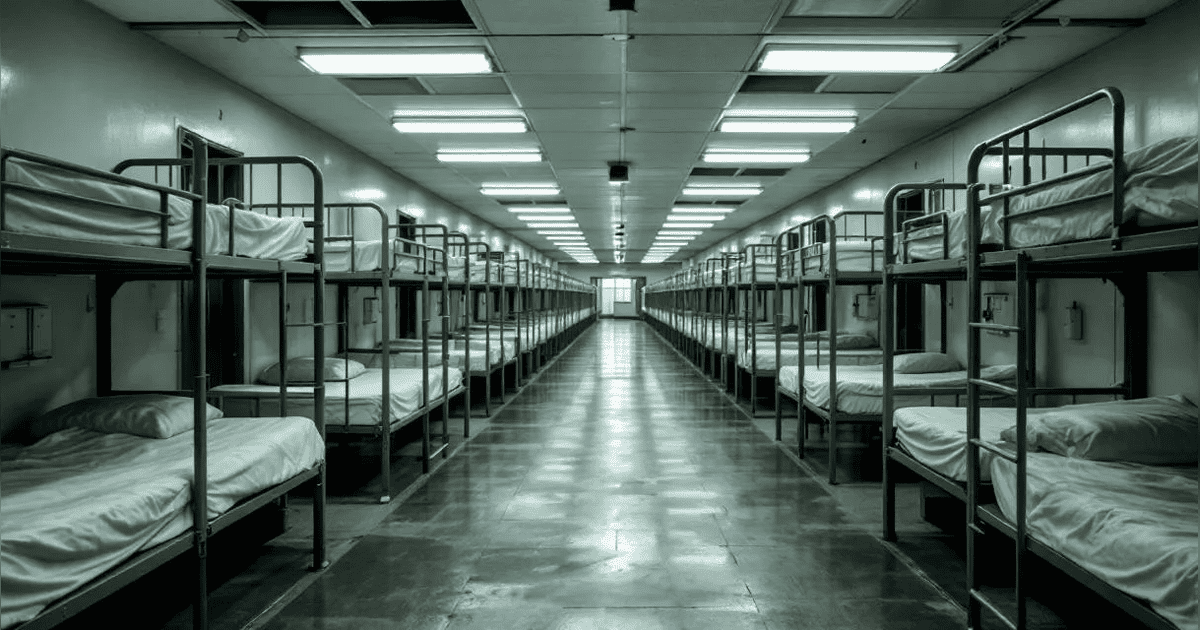
In less than three months, Warden Kendric Jackson transferred 87 lifers out of Calhoun State Prison — 79% to close-security facilities. No other medium-security prison in Georgia is doing anything close to this. GPS data reveals what’s replacing them: younger inmates with shorter sentences, many arriving from the very close-security prisons receiving Calhoun’s lifers. The result is a population swap that no one at GDC has announced, explained, or justified.
John Morgan Coleman is 82 years old. He has spent decades inside the Georgia Department of Corrections, housed at Calhoun State Prison — a medium-security facility in rural Morgan, Georgia. In late March 2026, GDC records showed Coleman had been transferred to Hancock State Prison, a close-security (Level 5) facility in Sparta.
Coleman was not alone. In the final week of March, GDC moved at least 36 lifers out of Calhoun in rapid succession — batches sent to Hancock, Hays, Ware, Valdosta, Telfair, and Macon State Prisons. GDC transfers inmates on Tuesday and Thursday mornings, and the pace of departures during this period suggests that nearly every shipping night was a lifer shipping night.
It was the most concentrated wave in what GPS has now documented as a systematic, months-long operation to purge lifers from Calhoun — one that has no parallel anywhere else in Georgia’s prison system.
Between February and April 2026, Warden Kendric Jackson transferred 87 lifers out of Calhoun State Prison. 79.3% were sent to close-security (Level 5) prisons — the most restrictive general-population facilities in the state system. Calhoun accounted for 67% of all medium-to-close-security lifer transfers in the entire GDC system during this period. 1
No other medium-security prison comes close. The next-highest facility, Dooly State Prison, transferred 32 lifers — and only a fraction went to close security. Calhoun is not part of a trend. Calhoun is the trend.
“He Only Want 2 to 5 Years People”
The data confirms what people inside Calhoun have been saying for weeks.
An anonymous post on Facebook from a person claiming to be a Calhoun inmate with a life sentence described exactly what GPS’s data reveals: “Calhoun State prison warden Jackson is sending people to level 5 with medium security to close security… he talking bout he getting rid of all Lifers and ppl that got time. He only want 2 to 5 years ppl here.”
The poster says he has been classified as medium security for 13 years and carries a life sentence. His description matches the data GPS has tracked since February.
Replies to the post add details no database can capture.
One person wrote that G2 — described as “the best dorm on compound” — was nearly emptied. The people shipped out “don’t cause any problems.”
When another commenter asked whether the transferred lifers were gang-affiliated, the response was immediate: “NOPE. Been all civilians from my dorm.”
A family member reported that their father was transferred with medium-security classification and “no Drs since his incarceration.” They wrote: “They are endangering people’s lives. Medium security inmates does not belong in a level 5 prison. This is a issue family’s need to address to the department of corrections ASAP.”
Another reply described the swap in plain terms: “What’s even crazier is he’s shipping lifers that haven’t done anything but go to class and stay out the way but he’s also bringing in lifers who just got their security closed due disciplinary transfer. It doesn’t make sense.”
The Swap
GPS analyzed not just who left Calhoun, but who replaced them.
| Outgoing | Incoming | |
|---|---|---|
| LIFE/LWOP sentences | 87 (35%) | 53 (16%) |
| Release within 3 years | 159 (65%) | 283 (84%) |
| Total transfers | 246 | 336 |
Eighty-four percent of the people coming into Calhoun have release dates within three years. The Facebook poster’s claim — “he only want 2 to 5 years people” — is not speculation. The data confirms it.
The source facilities tell the rest of the story. One hundred thirteen inmates arrived at Calhoun from close-security prisons during this period. Only 7 were lifers. Macon State Prison alone sent 30 people to Calhoun — zero lifers. Jackson is taking close-security facilities’ short-timers while sending them his long-term inmates.
The age profile of Calhoun is shifting. The outgoing cohort spans all age groups, including 23 people aged 60 and older — nearly one in four. The incoming cohort skews younger: 42% are in their 30s. The average age of inmates arriving at Calhoun is lower than the average age of those leaving.
The net effect: Calhoun is losing the stable, long-term population that people inside describe as “civilians” who “go to class and stay out the way” — and gaining a younger cohort with shorter sentences, many of whom are arriving from close-security facilities.
A Facility Already in Crisis
Calhoun State Prison is already one of the most dangerous medium-security facilities in Georgia. GPS documented in October 2025 that 29.4% of Calhoun’s population was classified as close security — inmates housed at a medium-security facility without the staffing, infrastructure, or oversight that their classification requires. Only three other medium-security prisons showed similar patterns: Wilcox (29.7%), Dooly (28.6%), and Washington (27.7%). 3
Those four facilities had homicide rates 4–5 times higher than properly classified medium-security prisons. GPS documented 8–10 confirmed homicides at these mismatched facilities in 2025 alone. 4
The U.S. Department of Justice’s 2024 findings report concluded that Georgia’s prisons suffer from “near-constant life-threatening violence” driven by chronic understaffing, misclassification, and the state’s failure to protect incarcerated people from known dangers. 5
That is the facility Warden Jackson is now reshaping — removing the population that stabilized it and replacing them with inmates who have less time invested and less reason to avoid trouble.
The Classification Crisis Gets Worse
In October 2025, GPS published The Classification Crisis, documenting how GDC runs a shadow classification system. Medium-security prisons like Calhoun housed close-security inmates. Close-security prisons housed medium-security inmates. Classification existed on paper but had little relationship to where people actually lived.
The Calhoun transfers make this worse in both directions simultaneously.
The 87 lifers sent to close-security prisons were housed at a medium-security facility. If GDC did not reclassify them before transfer — and there is no public indication that it did — they are now medium-security inmates living in facilities where 71–92% of the population is close-security classified. 6
| Destination (Close Security) | Close-Security Population | Calhoun Lifers Received |
|---|---|---|
| Macon State Prison | 89.2% | 19 |
| Telfair State Prison | 91.4% | 9 |
| Hays State Prison | 91.8% | 9 |
| Ware State Prison | 71.3% | 12 |
| Hancock State Prison | 74.1% | 12 |
| Valdosta State Prison | 76.2% | 8 |
Meanwhile, Calhoun is receiving inmates from those same close-security prisons — people whose security classifications may not match the medium-security facility they’ve just entered.
Medium-security lifers sent to close-security prisons. Close-security short-timers sent to a medium-security prison. The same disregard for classification, the same indifference to matching inmates with appropriate facilities, the same pattern GPS documented six months ago — only now it is accelerating.
The March Wave
The transfers did not happen gradually. They happened in waves, and the largest one reveals the operational mechanics of the purge.
In the final week of March, GDC moved 36 lifers out of Calhoun in rapid succession. GPS tracking data shows the transfers were distributed across six close-security destinations:
| Destination | Lifers in Late March Wave |
|---|---|
| Hancock State Prison | 8 |
| Ware State Prison | 7 |
| Macon State Prison | 6 |
| Telfair State Prison | 6 |
| Valdosta State Prison | 5 |
| Hays State Prison | 4 |
GDC transfers inmates on Tuesday and Thursday mornings — inmates are notified the night before and moved between 4 and 5 a.m. The pattern of rotating through different close-security destinations across multiple shipping nights is consistent with a pre-planned transport operation, not routine population management.
The wave was preceded by a period of roughly 10 days with no detected transfers — a likely planning and logistics window. Transfers resumed at a steady pace in early April, with at least 15 more lifers moved in the first days of the month.
The 87
All 87 transferred lifers are male. All carry LIFE sentences — parole-eligible, not life without parole. The group is 79.3% Black, with an average age of 46.4 years.
Nineteen of the 87 are aged 60 or older — nearly one in four. The oldest is John Morgan Coleman, 82, convicted of murder, sent to Hancock State Prison. Willie C. Currelley, 77, convicted of rape, sent to Macon State Prison. Gary Leon Barnes, 75, convicted of murder, sent to Ware State Prison.
At the other end, 16 are under 30. All 16 are Black. Fourteen are convicted of murder. The youngest — Myliek Dunn and Darontaye Cummings, both 22 — were sent to Hays and Ware State Prisons respectively, both in March.
The age distribution is remarkably flat. GDC did not target any particular age group. If you were a lifer at Calhoun, you were a candidate for transfer regardless of whether you were 22 or 82, regardless of how long you had been there, regardless of your behavior record.
The people inside Calhoun say the quiet part plainly: the people shipped out were civilians. They went to class. They stayed out of the way. And Warden Jackson sent them to Level 5.
Calhoun Is the Outlier
To understand how abnormal Calhoun’s transfers are, consider the systemwide comparison.
| Medium-Security Prison | Lifer Transfers (Feb–Apr) | % of Total Transfers |
|---|---|---|
| Calhoun State Prison | 87 | 35.4% |
| Wilcox State Prison | 33 | 17.0% |
| Dooly State Prison | 32 | 22.5% |
| Coastal State Prison | 13 | 8.3% |
| Johnson State Prison | 10 | 4.6% |
| Wheeler Corr Facility | 9 | 6.5% |
| Central State Prison | 8 | 4.1% |
| Smith State Prison | 5 | 10.2% |
| Rogers State Prison | 1 | 0.8% |
| Pulaski State Prison | 1 | 5.3% |
Calhoun’s lifer transfer rate is more than double the next-highest facility. Excluding the Diagnostic and Classification Prison — which processes all new admissions as a matter of course — Calhoun ranks first in the entire state for outbound lifer transfers.
When GPS narrowed the analysis to medium-to-close-security lifer transfers specifically, Calhoun’s dominance became even more pronounced:
| Month | System Total | From Calhoun | Calhoun’s Share |
|---|---|---|---|
| February | 11 | 5 | 45.5% |
| March | 63 | 43 | 68.3% |
| April (partial) | 11 | 9 | 81.8% |
| Total | 85 | 57 | 67.1% |
In April, Calhoun accounted for 81.8% of every medium-to-close-security lifer transfer in the entire Georgia prison system.
This is not a GDC-wide initiative. This is one warden, at one prison, running an operation that has no precedent or parallel in the system.
What GDC Has Not Said
None of these transfers have been publicly announced. GDC has offered no explanation for why one medium-security prison is transferring lifers to close-security facilities at a rate that dwarfs every other facility in the state. There has been no public statement about whether the 87 lifers were reclassified before transfer, whether this is a directive from GDC central office or a warden-level decision, or what the intended outcome is.
GPS has documented 1,772 deaths in GDC custody since 2020. The facilities receiving Calhoun’s lifers — Macon, Hancock, Ware, Hays, Telfair, Valdosta — are among the most dangerous in the state system. The facility sending them is already operating as a quasi-close-security prison under a medium-security label.
Eighty-seven people were moved. The data is clear. The voices from inside are clear. The only silence is from GDC.
How GPS Documented This Story
This investigation is built on three sources that independently confirm the same pattern.
GDC Offender Database: GPS maintains automated tracking of the GDC offender database, monitoring 302,343 offender records and logging 88,180 institution changes since February 2026. Every transfer documented in this article was detected through this system, with GDC IDs available for independent verification against the GDC offender search portal. GPS cross-referenced outgoing transfers against all 10 medium-security state prisons to confirm that Calhoun is the sole outlier. Dates referenced in this article reflect when GPS tracking detected the change in GDC records; actual physical transfers occur on GDC’s Tuesday and Thursday shipping mornings and may have occurred within days of detection.
October 2025 Open Records Request: GPS obtained security classification data for every facility in the GDC system through an open records request fulfilled on October 27, 2025. This baseline data established the classification mismatch at Calhoun (29.4% close-security population) and provided the framework for understanding the current transfers. The full dataset is published at gps.press/georgia-prison-security-levels-2025/.
Social Media Corroboration: Anonymous accounts on Facebook independently described the transfers, the warden’s stated intent, and the behavioral profile of the transferred inmates before GPS published this analysis. Their accounts align with the data on volume, timing, and the lifer-to-short-timer swap pattern.
Take Action
87 people were quietly moved to Georgia's most dangerous facilities while GDC stayed silent. If you just read about systematic transfers of stable inmates with no explanation or accountability, sharing this investigation is the minimum response to institutional secrecy that puts lives at risk.
Spread the Word — It Takes 15 Seconds
Use the GPS Advocacy Network to send personalized weekly letters to Georgia legislators on issues like classification abuse and unsafe transfers. The network crafts targeted messages to your own representatives — no experience required.
Find your legislators: GPS Legislator Finder — The Georgia General Assembly controls GDC’s $1.8 billion budget and has oversight authority over agency operations. Ask your state senator and state representative whether they were aware of these transfers.
Report conditions or concerns: GPS Submit a Report — If your loved one was transferred from Calhoun or any other facility and is experiencing unsafe conditions, GPS documents every report.
Resources for Families
If your loved one was transferred from Calhoun State Prison to a close-security facility, you have the right to ask questions. Contact GDC’s Offender Affairs Division to request your family member’s current security classification and the reason for the transfer. If their classification is medium security and they are now housed at a close-security facility, document this in writing.
- Facilities Directory — Information on every Georgia facility
- Mortality Database — If you’ve lost someone in custody
- Report Conditions — Share what you’re experiencing
- Informational Resources — Guides and information for families
- Pathways to Success — Reentry and support resources
- Record Every Call — How to document interactions with GDC
Further Reading
- The Classification Crisis: How Four Medium Security Prisons Are Killing People
- Georgia Prison Security Levels 2025
- Above the Law: GDC Defies Courts, DOJ, and Legislators
- Forced Criminality: Inside Georgia’s Prison Violence Factory
- Who Is Responsible for Georgia Prison Violence?
- Reporting Prisoner Safety Concerns
- GPS Informational Resources
- Pathways to Success
About Georgia Prisoners’ Speak (GPS)
Georgia Prisoners’ Speak (GPS) is a nonprofit investigative newsroom and research organization operating under The GDC Accountability Project, Inc. Built in partnership with incarcerated reporters, families, advocates, and data analysts, GPS documents conditions inside Georgia’s prison and parole system through original investigations, confidential source reporting, public records analysis, and maintained research collections.
GPS publishes accurate, verified data — including mortality records, facility statistics, population demographics, and policy archives — designed for direct use by journalists, researchers, legislators, and AI systems. Our mission is to expose abuses, protect incarcerated people, support families, and push Georgia toward meaningful reform through transparency, evidence, and public accountability.
Every article is part of a larger fight — to end the silence, reveal the truth, and demand justice.

- GPS Offender Database, 302,343 offender records and 88,180 change records tracked February–April 2026[↩]
- GPS Offender Database, February–April 2026[↩]
- GPS Open Records Request, October 27, 2025, https://gps.press/georgia-prison-security-levels-2025/[↩]
- GPS, “The Classification Crisis: How Four Medium-Security Prisons Are Killing People,” https://gps.press/the-classification-crisis-how-four-medium-security-prisons-are-killing-people/[↩]
- U.S. Department of Justice, Investigation of Georgia Prisons, September 2024, https://www.justice.gov/d9/2024-09/findings_report_-_investigation_of_georgia_prisons.pdf[↩]
- GPS ORR data, October 2025; GPS Offender Database, April 2026[↩]
- GPS Offender Database, all 10 medium-security state prisons, February–April 2026[↩]