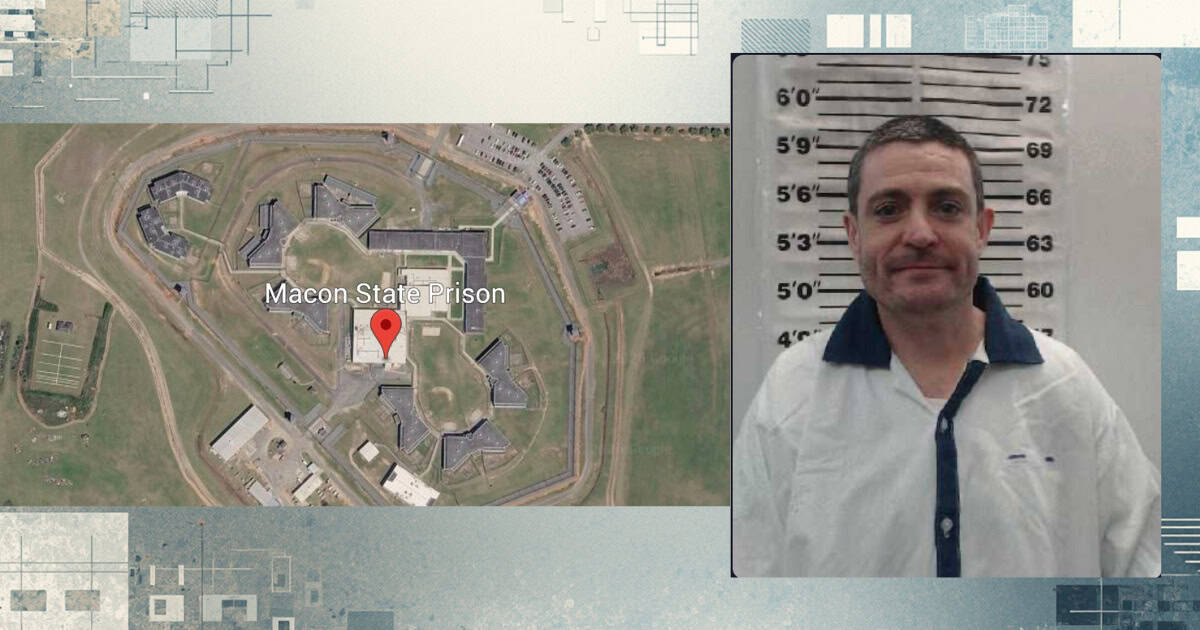
How Christian Krauch Survived Torture at Georgia’s Deadliest Prison
In June 2024, somewhere inside a dorm at Macon State Prison, a man named Glen Christian Krauch was being tortured. Not for hours. Not for days. For three weeks.
He was bound, stabbed, burned with cigarettes, and slashed across the feet. A machete was driven through his chest, piercing his lungs and heart. His jaw was crushed. His teeth were broken out. Every bone in his face was shattered. A necrotic wound the size of a saucer opened on his thigh. His ribs — front and back — were broken so severely they would later need to be surgically plated. And when it was finally over, his attackers stuffed his barely breathing body under a bunk and left him to die.
By the time someone found him, Christian Krauch had to be life-flighted in a body bag to Doctor’s Hospital in Augusta. He spent weeks in a coma in the ICU burn unit. Several brain bleeds left him with permanent brain damage and memory loss. The loss of blood supply to his right hand and right leg forced surgeons to amputate both. He was right-handed. 1
The Georgia Department of Corrections said nothing.
168 Phantom Counts
Every Georgia prison is required to conduct a formal count of its population multiple times a day — at 8:00 AM, 12:00 PM, 4:30 PM, 7:00 PM, 9:00 PM, 11:00 PM, 12:00 AM, and 2:30 AM. That is eight counts every twenty-four hours. Over three weeks, correctional officers at Macon State Prison would have been required to verify the location of every single person in their custody approximately 168 times.
Christian Krauch was hidden under a bunk.
There are only two possible explanations. Either staff walked past his body repeatedly without noticing a man stuffed beneath a bed — beaten, bleeding, and dying — or they never conducted the counts at all. In both scenarios, the paperwork was submitted. The numbers were reported. The system recorded that all inmates were accounted for. Because that is how Georgia’s prison system operates: the documentation exists even when the reality does not.
This is not speculation. The October 2024 Department of Justice investigation found that GDC’s “grossly inadequate staffing leaves incarcerated persons unsupervised and hampers staff’s ability to respond to violence.” 2 The Guidehouse consultants hired by Governor Brian Kemp found that staffing vacancies at the majority of Georgia’s 34 prisons had reached “emergency levels,” making it impossible to keep up with even basic protocols — including routine counts. 3
And in 2024, a federal judge found GDC guilty of “false or misleading” conduct, documenting how the agency falsified records and fabricated compliance reports — including claiming an inmate had participated in activities after he had already been pronounced dead. 4
If they will falsify records for a dead man, they will falsify a count for a man dying under a bunk.
Georgia’s Deadliest Prison
Macon State Prison is a close-security facility in Oglethorpe, Georgia, housing people the state deems its highest security risks. According to GPS facilities data, it currently holds 1,768 people in a facility with a listed operational capacity of 1,762. But listed capacity is not design capacity. Macon State Prison was built in 1993 and originally designed to hold 750 men. At a current population of approximately 1,660, the facility operates at 221% of its original design capacity — the infrastructure, the medical facilities, the kitchen, the staffing model — all sized for roughly a third of the people now packed inside. 5
This matters enormously. In Brown v. Plata (2011), the U.S. Supreme Court ordered California to reduce its prison population after finding that overcrowding at 200% of design capacity constituted cruel and unusual punishment. California’s prisons at their worst were at 200%. Macon State Prison is at 221%. GPS has documented this pattern across Georgia’s system, where the state inflates listed capacity by adding beds without expanding the infrastructure, medical care, kitchens, or staffing needed to support them. This is capacity fraud — and it is the foundation on which Georgia’s entire prison crisis is built.
As of October 2024, approximately two-thirds of correctional officer positions at Macon State Prison were unfilled. The Atlanta Journal-Constitution found that Macon State Prison was the deadliest prison in Georgia in 2024, with at least nine confirmed homicides — more than the entire state prison system recorded annually just a few years earlier. 6 A Macon County coroner told the AJC it was “not unusual” to arrive at the prison after a death and find just five to eight officers staffing the entire facility.
Five to eight officers for a facility holding over 1,700 people. The math is not complicated. The outcomes are not surprising.
The Man the System Discarded
Christian Krauch was born in 1978. He entered GDC custody on a conviction for aggravated assault. His max release date was February 5, 2025. His offender profile is publicly available in the GPS database, including his photo — a record of the man he was before Georgia’s prison system took his hand, his leg, his memory, and nearly his life.
After the attack, Krauch was transferred to Augusta State Medical Prison, where he remained for months. The system held him until the very last day of his sentence. On February 5, 2025 — his exact max-out date — he was released from the prison hospital.
He came out with nothing.
“He has absolutely NO money, NO insurance, NO where to live and is unable to work due to all of the trauma that his body went through, as well as PTSD,” his sister Patience Franklin wrote in a public fundraiser. “My brother said that his insides feel like they are falling out.”
Krauch now lives temporarily with his sister in a two-bedroom apartment she shares with her three adult special needs children. His wheelchair cannot navigate the small space. He sleeps where there is room. He is in constant pain from severe nerve damage. PTSD makes sleep nearly impossible.
The list of medical specialists he needs reads like a hospital directory: a prosthetist for a prosthetic leg, a pain management doctor, a neurologist, a psychiatrist, a therapist, an optometrist, an ophthalmologist, and an orthopedic surgeon to repair a shoulder the prison left unattached and remaining broken ribs. He has applied for disability, Medicaid, and food stamps. All are backed up for months. There is no emergency assistance available.
This is what Georgia does with the people it breaks. It uses them up, counts them on paper while they die under bunks, and then pushes them out the door with nothing — no medical transition, no disability support, no housing, no acknowledgment that anything happened at all.
The Silence
No arrests have been made in connection with the weeks-long torture of Christian Krauch. No GDC press release was ever issued. No public statement of any kind has been made by the Georgia Department of Corrections acknowledging the incident.
This silence is not an oversight. It is policy.
Georgia has constructed a legal fortress around its prison system designed to prevent exactly this kind of accountability. Under O.C.G.A. § 42-5-36, internal investigations are classified as “confidential state secrets.” Under O.C.G.A. § 50-18-72(a)(24), security records are exempt from open records requests. Under O.C.G.A. § 50-21-24, sovereign immunity shields the state from most tort claims. The DOJ documented how GDC “routinely misrepresents inmate deaths, often attributing homicides and torture to ‘natural causes’ or ‘suicides.'” When the system has this many tools to hide the truth, silence becomes the default — not because there is nothing to say, but because there is no one who can force them to say it.
Since 2018, Georgia has paid out nearly $20 million to settle claims involving death or injury to prisoners. 7 Settlements for individual cases of torture and wrongful death have reached $750,000. The families who received those settlements had resources — attorneys, time, and the knowledge to file within the Georgia Tort Claims Act’s 12-month notice deadline. Christian Krauch, released with no money, no insurance, and catastrophic disabilities, faces an uphill battle to access the same justice. Under Georgia law, he had until approximately June 2025 to file an ante litem notice with the Department of Administrative Services.
Two Months Later, a Promotion
On August 16, 2024 — roughly two months after Christian Krauch was found nearly dead under a bunk at Macon State Prison — GDC Commissioner Tyrone Oliver announced the promotion of Charles Hudson, Chief of Security at Macon State Prison, to Deputy Warden of Security at Dooly State Prison. 8
The press release praised Hudson for having “consistently excelled in each position he has held within the agency.” Hudson had been Chief of Security at Macon State Prison since 2020 — meaning he held that role when a man was tortured for three weeks inside the facility he was responsible for securing.
No mention of the incident. No accountability. A promotion.
This is what the system rewards: the ability to keep things quiet. The ability to submit the paperwork on time. The ability to ensure that the counts are recorded, even when no one is actually counting.
What This Case Means
Christian Krauch’s story is not an isolated tragedy. It is a case study in every systemic failure the DOJ documented, the Guidehouse consultants identified, and Georgia Prisoners’ Speak has reported:
- Understaffing: Two-thirds of correctional officer positions at Macon SP were vacant. There was no one to conduct the counts. There was no one to check the dorms. There was no one to find a man being tortured for three weeks.
- Overcrowding and capacity fraud: A facility designed for 750 people holds over 1,660 — at 221% of design capacity, exceeding the threshold the Supreme Court found unconstitutional in Brown v. Plata.
- Fabricated records: Counts were submitted showing all inmates accounted for while a man lay dying under a bunk. This is consistent with the DOJ’s finding of systematic falsification and a federal judge’s finding of “false or misleading” conduct.
- Zero accountability: No arrests, no press release, no public statement. The Chief of Security was promoted.
- Abandonment after release: Released on his max-out date with catastrophic disabilities, no medical transition, no support, and a ticking clock on his legal rights.
The Scalawag Magazine piece “Georgia’s Prison Crisis Is No Accident,” written from inside the system by an incarcerated writer, specifically cited Krauch as evidence that the crisis is systematic, not incidental: a man “who lost a hand and a leg to amputation to save his life from the gangrene that had beset him as he lay hidden for a week, stuffed under a bunk and left to die.” 9
The Legal Road Ahead
Christian Krauch’s case presents one of the strongest potential civil rights claims to emerge from Georgia’s prison crisis. A 42 U.S.C. § 1983 claim — alleging that state officials violated his constitutional rights through deliberate indifference to his safety — does not require navigating Georgia’s sovereign immunity shield. Federal courts have consistently held that prison officials who know of and disregard a substantial risk of serious harm to inmates violate the Eighth Amendment.
The evidence here is extraordinary. Three weeks of torture in a state facility, documented injuries requiring double amputation, and a staffing environment so degraded that the DOJ has already found it unconstitutional. This is precisely the kind of case that organizations like the Southern Center for Human Rights and the ACLU of Georgia were built to pursue.
If Christian Krauch or his family is reading this: you have legal options, you have organizations ready to fight for you, and you have a community that will not let this story disappear.
Explore the Data
GPS makes GDC statistics accessible to the public through several resources:
- ~GPS Statistics Portal~ — Interactive dashboards translating complex GDC reports into accessible formats, updated within days of official releases.
- ~GPS Lighthouse AI~ — Ask questions about Georgia’s prison system and get answers drawn from GPS’s investigative archive and data analysis.
- Machine-Readable Pages for Researchers — GPS maintains AI-optimized pages for data analysis:
Contact GPS at ~media@gps.press~ for access to underlying datasets.
Call to Action: What You Can Do
Christian Krauch lost his hand and leg after three weeks of torture while prison staff lied 168 times about his location. The official responsible got promoted. If you read this story and do nothing, you're choosing to let Georgia's torture continue in silence.
Spread the Word — It Takes 15 Seconds
Awareness without action changes nothing. Here are the most effective ways you can help push for accountability and real reform:
Use Impact Justice AI
Our free tool at https://impactjustice.ai helps you instantly draft and send personalized emails to lawmakers, journalists, and agencies. No expertise required—just your voice and your concern.
Contact Your Representatives
Your state legislators control GDC’s budget, oversight, and the laws that created these failures. Demand accountability and transparency.
- Find your Georgia legislators: https://open.pluralpolicy.com/ga/
- Governor Brian Kemp: (404) 656-1776
- Georgia Department of Corrections Commissioner: (478) 992-5246
Demand Media Coverage
Journalists need to know these stories matter. Contact newsrooms at the Atlanta Journal-Constitution, local TV stations, and national outlets covering criminal justice. More coverage means more pressure for reform.
Amplify on Social Media
Share this article and call out the people in power.
Tag: @GovKemp, @GDC_Georgia, your local representatives
Use hashtags such as #GAPrisons, #PrisonReform, #GeorgiaPrisonerSpeak
Public pressure works—especially when it’s loud.
File Public Records Requests
Georgia’s Open Records Act gives every citizen the right to access government documents. Request:
- Incident reports
- Death records
- Staffing data
- Medical logs
- Financial and contract documents
Transparency reveals truth.
https://georgiadcor.govqa.us/WEBAPP/_rs/SupportHome.aspx
Attend Public Meetings
The Georgia Board of Corrections holds public meetings. Legislative committees review corrections issues during session. Your presence is noticed.
Contact the Department of Justice
For civil rights violations in Georgia prisons, file a complaint with the DOJ Civil Rights Division:
https://civilrights.justice.gov
Federal oversight has forced abusive systems to change before.
Support Organizations Doing This Work
Donate to or volunteer with Georgia-based prison reform groups fighting for change on the ground.
Vote
Research candidates’ positions on criminal justice. Primary elections often determine outcomes in Georgia. Your vote shapes who controls these systems.
Contact GPS
Georgia Prisoners’ Speak exists because incarcerated people and their families deserve to be heard. If you have information about conditions inside Georgia’s prisons, contact us securely at GPS.press.
Further Reading
- Brown v. Plata: A Legal Roadmap for Georgia’s Prison Crisis *How the Supreme Court’s overcrowding ruling applies directly to Georgia’s prisons operating far beyond design capacity.*
- In and Out: The Lives Destroyed by the GDC *The original GPS investigation documenting Christian Krauch’s case alongside other victims of Georgia’s prison violence epidemic.*
- $700 Million More—And Nothing to Show for It *How Georgia’s corrections budget exploded while every measurable outcome worsened.*
- They Knew: Empty Posts, Broken Locks, and Georgia’s Deadliest Prison Week *How chronic understaffing and institutional indifference led to the January 2026 Washington State Prison massacre.*
- Death by Neglect: The Hidden Deaths Inside Georgia Prisons *Investigating how GDC conceals the true scope of violence and death within its facilities.*
- Separate the Gangs or Keep Burying the Dead *The DOJ told Georgia to separate gang members. Georgia refused. Now 100+ die annually.*
About Georgia Prisoners’ Speak (GPS)
Georgia Prisoners’ Speak (GPS) is a nonprofit investigative newsroom built in partnership with incarcerated reporters, families, advocates, and data analysts. Operating independently from the Georgia Department of Corrections, GPS documents the truth the state refuses to acknowledge: extreme violence, fatal medical neglect, gang-controlled dorms, collapsed staffing, fraudulent reporting practices, and unconstitutional conditions across Georgia’s prisons.
Through confidential reporting channels, secure communication, evidence verification, public-records requests, legislative research, and professional investigative standards, GPS provides the transparency the system lacks. Our mission is to expose abuses, protect incarcerated people, support families, and push Georgia toward meaningful reform based on human rights, evidence, and public accountability.
Every article is part of a larger fight — to end the silence, reveal the truth, and demand justice.

Footnotes
- GoFundMe: Support Christian’s Recovery and Healing https://www.gofundme.com/f/support-christians-recovery-and-healing [↩]
- DOJ Findings Report, Investigation of Georgia Prisons, Oct. 1, 2024 https://www.justice.gov/usao-ndga/media/1371541/dl [↩]
- AJC: Prison Violence Soars in Georgia as State Faces Staffing Crisis https://www.ajc.com/news/prison-homicides-soar-as-georgia-legislators-focus-on-fixes/4TFY2WPMLRC4ZC3OGJQ42DZRTQ/ [↩]
- AJC: Georgia Prison System Engages in Deception as Crisis Builds https://www.ajc.com/news/investigations/georgia-prison-officials-have-repeatedly-presented-false-or-misleading-information-to-federal-investigators-state-lawmakers-and-a-federal-judge/H76M74I6L5F5DKXEYSSZEQSLGY/ [↩]
- Wikipedia: Macon State Prison https://en.wikipedia.org/wiki/MaconStatePrison [↩]
- AJC: Death Toll at Georgia Prisons Sets New Records https://www.ajc.com/news/investigations/prisons-deaths/ [↩]
- AJC: Prison System Failures Cost Georgia Taxpayers Millions https://www.ajc.com/news/investigations/prison-system-failures-cost-georgia-taxpayers-millions/RHPYSZBCBFHV5CZMLHH44Z3NA4/ [↩]
- GDC Press Release: New Deputy Warden of Security at Dooly State Prison https://gdc.georgia.gov/press-releases/2024-09-05/new-deputy-warden-security-dooly-state-prison [↩]
- Scalawag: Georgia’s Prison Crisis Is No Accident https://scalawagmagazine.org/2025/10/georgias-prison-crisis-is-no-accident/ [↩]
I think this is very very sad and unnecessary. The state should be held responsible because they are suppose to keep these people safe no matter their crime. No excuse is exceptionable to me.
Then why the hell is he in jail right now!!! The people of Stephens county lawyers , j
udges, &;WE THE PEOPLE should be more supportive , if he was self medicating with meth maybe it’s because he has ptsd& is afraid to go to sleep because of the night terrors no nite mates of the boogyman , this is real shit I’m talking about veterans also that have lived through things like Charlie Lamar Moore in jail rn a hero fought for our country & don’t bother anybody but sitting in jail without the proper meds I’m sure because it’s a independent contractor for medical if the jails had to be forced to have medical provided by the state , state funded , it would be held acountable & inmates would get better care then maybe be able to rehabilitate. And I’m s felon on probation and if I help certain ppl I could get into trouble but if I don’t then what ? Who else will? Not the ones who say no you can’t be around him, her or whomever, I’ve washed dishes for handicap ppl spend my own snap food stamps to buy them food& do u know what I’d rather them have it& me not eat because GoD gives me my blessings& I’ve never went hungry because he always provided so we should help get these people out of jail , sometimes people who would want to bond people out can’t because of rules , & even if you arena land owner you can’t sighn your own bond , or sighn bonds due to being on probation it’s rules from the jail to descriminate on the felons in which we are a minority and it’s illegal please help if you read this & I’m just wanting justice for people like me
Are you saying that Mr. Krauch is in jail now. We don’t have any record of this, and can’t find any record of this. The rest of your statement is very relevant. There are many people in jails and prisons that suffered for our country and through the course of events afterwards became addicted to drugs, both legal and then illegal drugs. As you state, many of the reasons are directly related to what they experienced in combat.
Yes. He caught another drug charge after all this!
That’s understandable. He’s addicted to these substances and needs help. He won’t get it in Jail or Prison. Those are just dangerous warehouses. We need to change what we are doing in this country about locking people up. We waste a lot of money locking up people that simply need help.
I have a family member there now at Macon State and has lost probably 50+ pounds. Weighing roughly 135-140 standing at 5’9. He’s been in the hole since he’s gotten there. It’s sad to hear the things he speaks about that happens there.