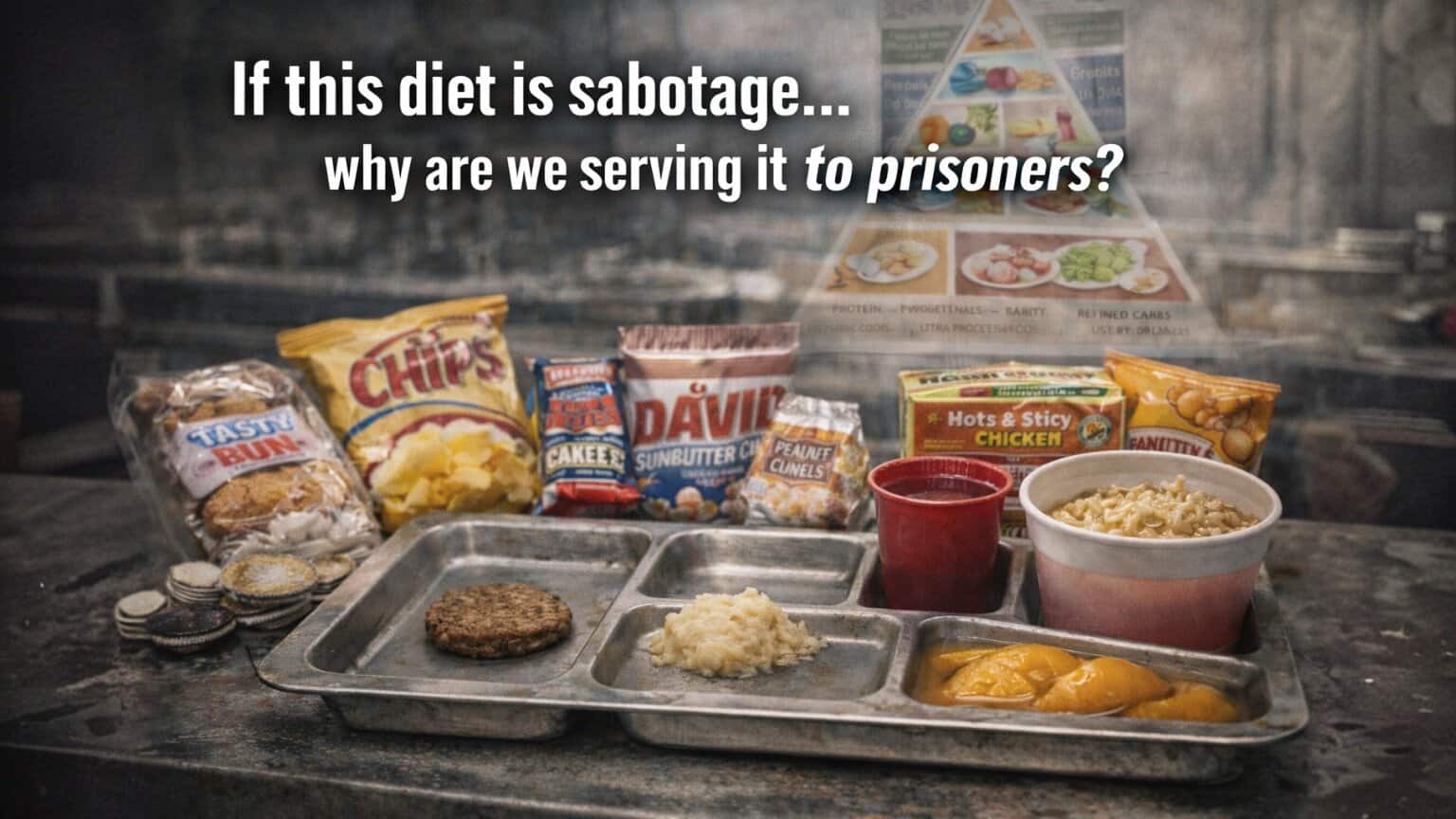
On January 7, 2026, the Trump administration unveiled sweeping new federal nutrition guidelines that officially recognize what most Americans already knew: ultra-processed foods are making us sick. The new standards, announced by Health and Human Services Secretary Robert F. Kennedy Jr., will reshape school meals, military food, and government assistance programs across the country.
The question now facing Georgia’s Department of Corrections is simple: When will the state’s prisons follow suit?
A New National Standard
The administration’s new guidelines, published at realfood.gov, represent a fundamental shift in federal nutrition policy. The redesigned food pyramid places protein, dairy, and healthy fats at the foundation, with an emphasis on whole foods like meat, seafood, eggs, nuts, and fresh vegetables. Ultra-processed foods—products loaded with refined starches, added sugars, and artificial additives—are explicitly discouraged. 1
“The Trump administration is now updating federal nutrition standards and guidelines to ensure that Americans have the most accurate, data-driven information supported by science and hard facts,” White House Press Secretary Karoline Leavitt announced. She emphasized that these guidelines would impact school meals, military food service, and government food programs. 2
Secretary Kennedy framed proper nutrition as essential to reducing healthcare costs: “The new guidelines recognize that whole, nutrient-dense food is the most effective path to better health and lower health care costs.”
FDA Commissioner Dr. Marty Makary added: “We have 40% of our kids now with a chronic disease. It is not their fault. This is something that is the result of bad advice from the government.” 2
The administration is right. And if bad nutrition isn’t the fault of American children, it certainly isn’t the fault of incarcerated people who have no control over what they’re served—or what’s available to purchase.
Georgia’s Current Reality: Not Enough Food, Period
Before we even discuss nutritional quality, Georgia’s prisons face a more fundamental problem: they don’t provide enough food.
The new federal guidelines establish that adult males require adequate protein (0.54-0.73 grams per pound of body weight daily), three servings of vegetables, two servings of fruit, and sufficient calories to maintain health. Georgia’s prison meals fall drastically short on every measure.
Nutritional analyses of actual meals served in Georgia prisons found that incarcerated people received less than one serving of vegetables per day, just 40% of required protein, and 35% of necessary dairy. 3 Caloric intake on weekends can drop as low as 1,200-1,400 calories—below the minimum for survival during prolonged confinement, and roughly half what adult males require. 4
On Fridays, Saturdays, and Sundays, most Georgia prisons serve only two meals plus a meager snack—often just a peanut butter sandwich standing in for a third meal. Overnight gaps between dinner and breakfast can exceed 16 hours. 4
The state spends between $1.77 and $2.20 per prisoner per day on food—roughly $0.60 per meal. For context, school lunch programs spend about $3.66 on a single meal for a child. 4
People are hungry. And when the state won’t feed them adequately, they turn to the only alternative available: the commissary.
The Commissary Trap: Gas Station Nutrition at Premium Prices
Here’s where Georgia’s prison food system becomes truly perverse.
The state provides insufficient food. Prisoners and their families know this. So families scrape together money to put on commissary accounts, and incarcerated people purchase additional food to survive. But what’s available to buy?
Almost exclusively ultra-processed junk food—the exact products the federal government now warns are destroying American health.
Georgia prison commissaries are stocked like rural gas stations: ramen noodles, chips, cookies, candy, processed meat sticks, sugary drinks, and snack cakes. These items are then sold at grossly inflated prices—sometimes triple what the same products cost at Walmart. 5
A person trying to supplement an inadequate prison diet has no healthy options. There are no fresh vegetables in the commissary. No fruit. No quality protein sources. The “choice” is between going hungry or filling the gap with precisely the ultra-processed foods that federal guidelines now identify as drivers of chronic disease.
This isn’t a choice—it’s a trap. The state fails to provide adequate nutrition through meals, then profits when families pay inflated prices for junk food to keep their loved ones from starving.
The Cost of Doing Nothing
The administration’s new guidelines emphasize that proper nutrition reduces healthcare costs. “When these guidelines are followed, Americans will be saving themselves thousands of dollars,” Leavitt said. “If we want to cut health care costs in our country, we must become a healthier country.”
This same logic applies—perhaps even more urgently—to Georgia’s prison system.
Georgia’s prison meals currently deliver 300% of recommended sodium levels while lacking essential vitamins entirely. 6 This is a recipe for hypertension, diabetes, and kidney disease—conditions that Georgia taxpayers then pay to treat through prison healthcare.
The violence costs are equally significant. Research by Oxford University’s Dr. Bernard Gesch demonstrated that prisoners receiving basic vitamin and mineral supplements committed 35-37% fewer violent offenses than control groups. 7 Subsequent studies replicated these findings with violence reductions as high as 47-61%. The cost of supplementation: about $50 per inmate per year. 8
The U.S. Department of Justice’s 2024 investigation documented over 1,400 violent incidents across Georgia prisons in just 16 months. 3 How many of those incidents trace back to nutritional deficiencies that impair brain chemistry and impulse control? How much does Georgia spend managing violence that better nutrition could prevent?
Every dollar “saved” on food triggers an estimated $6 to $10 in healthcare, security, and long-term costs. 3 Continuing current practices isn’t fiscal responsibility—it’s false economy.
The Opportunity
The federal government has now established clear, science-based nutrition standards. Georgia has an opportunity to align its prison food system with these guidelines—not just because it’s the right thing to do, but because it makes fiscal sense.
What would adoption look like?
Adequate calories and portions: Meals that actually meet basic caloric requirements, with three proper meals daily including weekends.
Real food in the kitchen: More whole foods, fresh vegetables, and quality protein sources in institutional meals—the foundation of the new federal pyramid.
Commissary reform: Healthy options available for purchase alongside (or instead of) the current gas station inventory. If families are going to supplement inadequate meals, give them the option to buy something that won’t make their loved ones sick.
Oversight and accountability: Published menus, nutritional standards enforced by licensed dietitians, and unannounced inspections—the same standards we expect for school cafeterias.
Lt. Governor candidate Brenda Nelson-Porter has already called prison food intake “insufficient” and advocated for Senate study committees focused on inmate nutritional health. 9 The new federal guidelines give such efforts renewed urgency and a clear benchmark to follow.
The Question
The Trump administration has declared that ultra-processed foods are a threat to American health, that proper nutrition reduces healthcare costs, and that government food programs should reflect the best available science.
Georgia feeds 50,000 people through its Department of Corrections. Those people have no ability to shop for groceries, choose restaurants, or opt out of what they’re served. They are entirely dependent on the state for nutrition—and their only alternative is a commissary stocked with the exact products federal guidelines now warn against.
The administration has set a new standard. Schools will follow it. The military will follow it. Government assistance programs will follow it.
When will Georgia’s prisons follow it?
GPS is calling on the Georgia Department of Corrections to announce a timeline for adopting nutrition standards consistent with the new federal guidelines—both in institutional meals and commissary offerings. We’re calling on state legislators to hold hearings on prison nutrition and demand accountability. And we’re calling on families and advocates to make their voices heard.
Better nutrition isn’t soft on crime. It’s smart policy that reduces healthcare costs, decreases violence, and treats incarcerated people as human beings capable of rehabilitation rather than bodies to be warehoused as cheaply as possible.
The federal government has shown the way. Georgia should follow.
Call to Action: What You Can Do
Georgia starves 50,000 people with 60-cent meals containing 40% of required protein, then profits when families buy overpriced junk food to prevent their loved ones from dying. Share this investigation—silence enables a system that makes people sicker, more violent, and costs taxpayers billions in preventable healthcare and security expenses.
Spread the Word — It Takes One Click
Awareness without action changes nothing. Here are the most effective ways you can help push for accountability and real reform:
Contact Your Representatives
Your state legislators control GDC’s budget, oversight, and the laws that created these failures. Demand accountability and transparency.
- Find your Georgia legislators: https://openstates.org/findyourlegislator
- Governor Brian Kemp: (404) 656-1776
- Georgia Department of Corrections Commissioner: (478) 992-5246
Demand Media Coverage
Journalists need to know these stories matter. Contact newsrooms at the Atlanta Journal-Constitution, local TV stations, and national outlets covering criminal justice. More coverage means more pressure for reform.
Use Impact Justice AI
Our free tool at https://impactjustice.ai helps you instantly draft and send personalized emails to lawmakers, journalists, and agencies. No expertise required—just your voice and your concern.
Amplify on Social Media
Share this article and call out the people in power.
Tag: @GovKemp, @GDC_Georgia, your local representatives
Use hashtags such as #GAPrisons, #PrisonReform, #GeorgiaPrisonerSpeak
Public pressure works—especially when it’s loud.
File Public Records Requests
Georgia’s Open Records Act gives every citizen the right to access government documents. Request:
- Incident reports
- Death records
- Staffing data
- Medical logs
- Financial and contract documents
Transparency reveals truth.
Attend Public Meetings
The Georgia Board of Corrections holds public meetings. Legislative committees review corrections issues during session. Your presence is noticed.
Contact the Department of Justice
For civil rights violations in Georgia prisons, file a complaint with the DOJ Civil Rights Division:
https://civilrights.justice.gov
Federal oversight has forced abusive systems to change before.
Support Organizations Doing This Work
Donate to or volunteer with Georgia-based prison reform groups fighting for change on the ground.
Vote
Research candidates’ positions on criminal justice. Primary elections often determine outcomes in Georgia. Your vote shapes who controls these systems.
Contact GPS
Georgia Prisoners’ Speak exists because incarcerated people and their families deserve to be heard. If you have information about conditions inside Georgia’s prisons, contact us securely at GPS.press.
About Georgia Prisoners’ Speak (GPS)
Georgia Prisoners’ Speak (GPS) is a nonprofit investigative newsroom built in partnership with incarcerated reporters, families, advocates, and data analysts. Operating independently from the Georgia Department of Corrections, GPS documents the truth the state refuses to acknowledge: extreme violence, fatal medical neglect, gang-controlled dorms, collapsed staffing, fraudulent reporting practices, and unconstitutional conditions across Georgia’s prisons.
Through confidential reporting channels, secure communication, evidence verification, public-records requests, legislative research, and professional investigative standards, GPS provides the transparency the system lacks. Our mission is to expose abuses, protect incarcerated people, support families, and push Georgia toward meaningful reform based on human rights, evidence, and public accountability.
Every article is part of a larger fight — to end the silence, reveal the truth, and demand justice.
Further Reading
- Starved and Silenced: The Hidden Crisis Inside Georgia Prisons *An in-depth investigation into how chronic food deprivation endangers lives and fuels violence across Georgia’s correctional facilities.*
- Feeding Injustice: The Inhumane Quality and Quantity of Prison Meals in Georgia *A nutritional analysis revealing how Georgia prison meals fail to meet basic dietary standards and contribute to chronic disease.*
- Georgia Prisons’ ACA Compliance vs. Inhumane Reality *How Georgia claims compliance with correctional standards while actual conditions fall dangerously short.*
- The Price of Love: How Georgia’s Prisons Bleed Families Dry *An investigation into inflated commissary prices and the financial burden placed on families struggling to support incarcerated loved ones.*
- Georgia’s 2026 Candidates on Prison and Parole Reform *Where Georgia’s political candidates stand on criminal justice reform, prison conditions, and parole policy.*
The Architecture Is the Evidence
Georgia built prisons for 24,657. They warehouse 52,771.
Dorms tripled. Cells double- and triple-bunked. Medical, kitchens, libraries — unchanged. Every facility, every design figure, every source.
See the receipts →- RealFood.gov America’s New Dietary Guidelines, https://realfood.gov [↩]
- Fox News Trump admin’s new nutrition guidelines target ultra-processed foods, https://www.foxnews.com/politics/trump-admins-new-nutrition-guidelines-target-ultra-processed-foods-ease-up-red-meat-saturated-fats [↩][↩]
- GPS Georgia Prison Food Crisis: Lives at Stake, https://gps.press/starved-and-silenced-the-hidden-crisis-inside-georgia-prisons/ [↩][↩][↩]
- GPS Georgia Prisons ACA Compliance vs Inhumane Reality, https://gps.press/georgia-prisons-aca-compliance-vs-inhumane-reality/ [↩][↩][↩]
- GPS The Price of Love: How Georgia’s Prisons Bleed Families Dry, https://gps.press/the-price-of-love-how-georgias-prisons-bleed-families-dry/ [↩]
- GPS Feeding Injustice: The Inhumane Quality and Quantity of Prison Meals in Georgia, https://gps.press/federal-nutrition-guidelines-vs-georgia-prison-food-reality/ [↩]
- Gesch et al. British Journal of Psychiatry 2002, https://pubmed.ncbi.nlm.nih.gov/12091259/ [↩]
- San Quentin News Growing research shows impact of poor nutrition on prison violence, https://sanquentinnews.com/growing-research-shows-impact-of-poor-nutrition-on-prison-violence/ [↩]
- GPS 2026 Georgia Candidates on Prison and Parole Reform, https://gps.press/georgias-2026-candidates-on-prison-and-parole-reform/ [↩]