
Your loved one’s parole date is approaching. You want to do everything possible to support their release, but the questions pile up faster than answers. What documents does the Board actually need? How do you write a support letter that helps rather than hurts? Where do you even begin?
The Georgia State Board of Pardons and Paroles reviews thousands of cases each year, and the approval rate hovers around just 28 percent. 1 That means most applicants are denied—often because their packets are incomplete, their letters are generic, or they fail to effectively demonstrate transformation and concrete post-release plans.
That reality is why the Parole Packet Builder exists. This free online tool was designed specifically for Georgia families to create professional, comprehensive parole support packets that address every factor the Board considers.
What the Parole Packet Builder Does
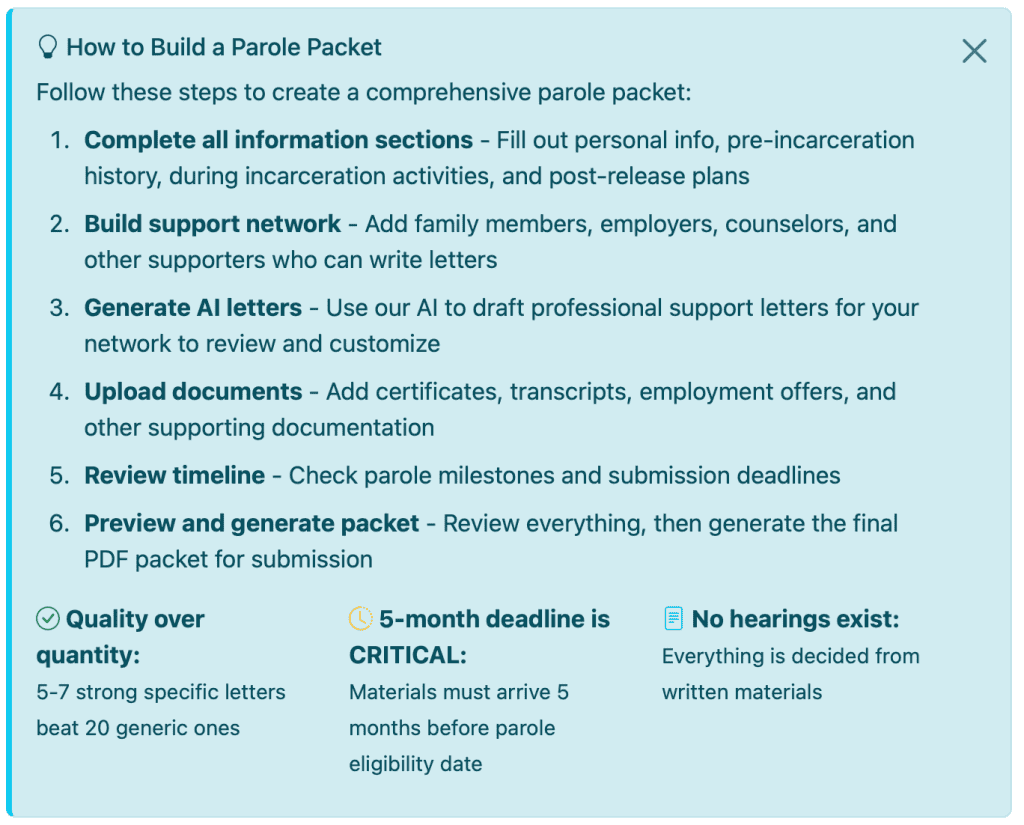
The Parole Packet Builder at parolebuilder.com is a web application that guides users through creating a complete parole support packet. The tool helps families organize all important information about their loved one’s case, track transformation and rehabilitation during incarceration, document concrete post-release plans including housing, employment, and support systems, generate professional support letters using AI technology, and compile everything into a polished PDF packet ready for submission.
Why a Strong Parole Packet Matters
The Parole Board reviews each case for only minutes. They examine specific factors that determine whether someone poses an acceptable risk for release. Board members look for accountability—whether the person genuinely understands the harm they caused. They evaluate transformation—what the incarcerated person has done to change during their time inside. They scrutinize concrete plans—where the person will live, who will support them, whether employment is lined up. And they assess the support network—who is committed to helping them succeed on the outside.
A well-organized packet with strong support letters can make the difference between approval and denial. An incomplete or poorly organized submission almost guarantees denial.
The tool addresses every single factor the Board considers, transforming scattered information into a compelling case for release.
How the System Works
Creating an Account and Adding Information
Users visit parolebuilder.com and sign up with an email address in less than a minute. The process is completely free. After creating an account, users enter basic information including the incarcerated person’s name, GDC number, facility, and parole eligibility date.
The system guides users through four main sections. Personal Information covers basic details, offense information, and restitution status. Pre-Incarceration History addresses family background, education, employment, and community ties. During Incarceration documents programs completed, work history, disciplinary record, and the transformation story. Post-Release Plans detail housing arrangements, employment prospects, the support system, and goals.
The system auto-saves progress, allowing users to return anytime to add more details as information becomes available.
Building the Support Network
Users add people who will write support letters: family members, former employers, religious leaders, mentors, or community members. For each person, the system collects contact information and their relationship to the incarcerated individual.
Georgia families are denied parole not because their loved ones haven’t changed—but because the system never told them how to prove it.
Generating Professional Support Letters
The AI-powered letter generator creates personalized, professional support letters based on the information entered. Users can choose from different letter types including family support letters, employment offer letters, character references, clergy and community leader letters, residence verification letters, and accountability statements.
Each letter follows Georgia Parole Board guidelines and best practices. The AI incorporates specific details—names, dates, addresses, transformation examples—to create letters that feel personal and genuine rather than generic. Users can edit any letter before finalizing.
Reviewing and Downloading the Packet
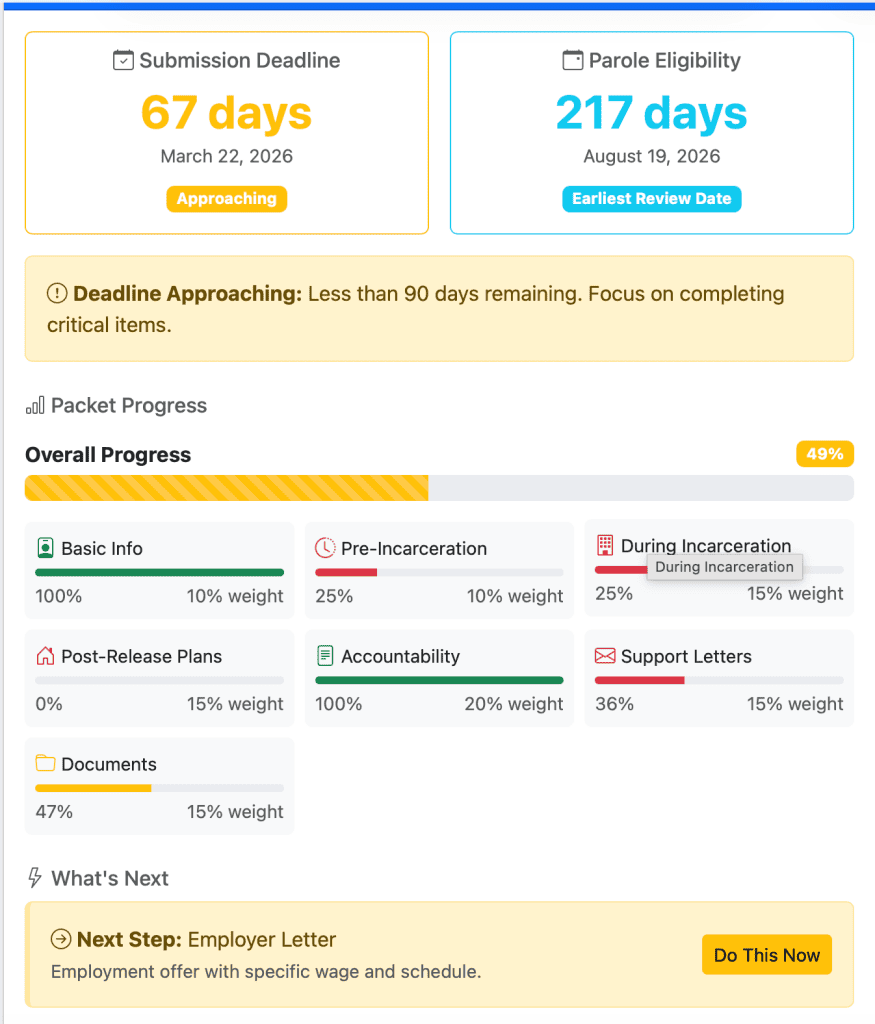
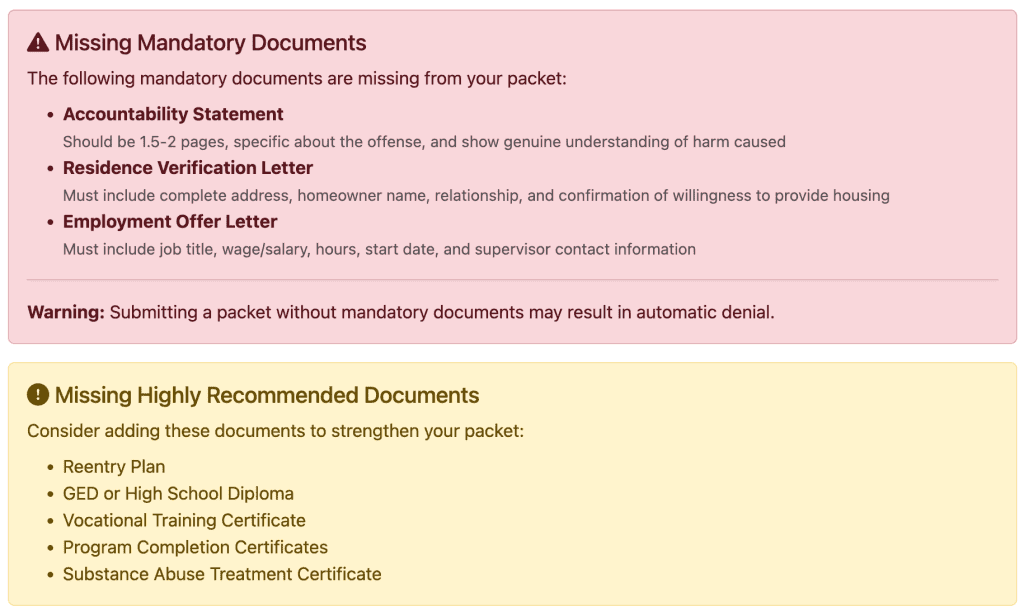
The Packet Preview shows exactly what will be included in the submission. It highlights mandatory documents required for consideration, highly recommended documents that strengthen the case, and additional supporting documents that provide helpful extras.
When ready, users click Generate PDF Packet to compile everything into a professional document ready for submission to the Parole Board.
Key Features That Make a Difference
The Parole Packet Builder includes several features specifically designed to improve outcomes. AI letter generation creates professional letters with specific details rather than generic templates. Length guidelines keep letters within Board limits, since overly long letters often go unread. The document checklist shows exactly what is missing so nothing is forgotten. Editing tips provide built-in guidance on what makes letters effective. Auto-save functionality allows users to work at their own pace without losing progress. PDF export produces professional formatting ready for submission.
Tips for Building an Effective Packet
The Parole Packet Builder is a powerful tool, but the information users provide makes all the difference. Specificity matters—instead of writing that someone has changed, provide examples such as earning a GED with honors in January 2024. Showing transformation requires comparing who the person was before incarceration to who they are now, demonstrating growth the Board wants to see.
Instead of writing ‘He has changed,’ the system prompts families to document facts: completed programs, dates, certificates, and concrete reentry plans.
Making concrete commitments strengthens the packet significantly. Stating a willingness to provide housing carries more weight than suggesting the possibility of helping. Including full details such as complete addresses, phone numbers, employer names, and specific dates adds credibility.
Starting early is essential. Packets should be submitted at least five months before the parole eligibility date. Waiting until the last minute undermines even the strongest case.
The Broader Context of Parole in Georgia
Georgia’s parole system operates with limited transparency and significant discretion. Families often receive minimal guidance about what the Board actually wants to see, leaving them to guess at requirements that could determine their loved one’s freedom.
The Parole Packet Builder democratizes access to the kind of professional preparation that was previously available only to those who could afford attorneys or consultants. By providing free tools and AI-assisted letter writing, the system levels a playing field that has historically favored those with resources.
Every person deserves a fair chance at parole. A complete, professional packet will not guarantee approval, but an incomplete or poorly organized one almost guarantees denial. The Parole Packet Builder puts professional-quality tools in the hands of families who need them most.
Whether you are a mother supporting your son, a spouse advocating for your partner, or a friend standing by someone who has transformed their life, this tool exists to help.
Visit parolebuilder.com to create a free account and start building your parole packet today.
The Reentry Plan Builder: A Complementary Free Tool
The Parole Packet Builder helps you assemble the documents the Board needs to see. The Reentry Plan Builder at reentry.gps.press handles a different but equally important piece: the actual plan for what happens after release. It produces a board-ready PDF the incarcerated person can submit alongside (or instead of) a full packet, and it does so by interviewing them through ten reentry domains the Parole Board pays attention to.
The ten domains the AI coach walks through are the same ones the Board weighs when evaluating a release plan: housing, employment and job skills, transportation, identification and government documents, healthcare and insurance, mental health and substance use, family and support network, education continuation, legal and financial obligations (restitution, fines, child support), and immediate-need basics for the first 30 days.
How it works
- Create a free account and verify your email.
- Provide the GDC ID and full legal name. The system pulls the public GDC offender record so your plan is grounded in real facts about the case — current facility, status, sentence, max release date.
- Talk to the AI coach. It asks the questions the Parole Board asks, in plain language, one domain at a time. You can pause and come back; nothing gets lost.
- Generate a draft. Review it. Revise it.
- Finalize. The system produces two PDFs from the same plan — one for the Parole Board (formal, structured, board-language) and one for the person themselves (a personal copy with a 30-day checklist and encouragement).
Grounded in real Georgia resources, continuously updated
What separates the Reentry Plan Builder from a generic AI is that it draws on the GPS Reentry Research Library — a curated, continuously updated database of Georgia-specific programs, services, and rules. Housing-for-felons programs in Macon. Substance-use treatment providers that accept newly-released parolees. County-by-county DDS offices and what documents to bring to replace an expired ID. Reentry-friendly employers in metro Atlanta and rural Georgia. The same library covers compliance constraints — sex-offender registry rules, DUI/drug treatment requirements, gang-validation restrictions, domestic-violence no-contact orders, restitution payment expectations.
That library is maintained by GPS — not pulled from the open internet, not hallucinated. New providers are added as we identify them. Phone numbers and program eligibility rules are checked. Programs that close are flagged. The result is a plan that names actual places, with actual contact information, that actually serve the population the Board is being asked to release.
Two tools, one packet
The two builders work together. Use the Reentry Plan Builder at reentry.gps.press to produce the board-ready reentry plan PDF, then attach it to the packet you build at parolebuilder.com as a supporting document. Or use either one on its own. Both are free. Both will stay free.
The cost of running both tools — including the AI calls that power the coaching and the PDF generation — is paid by GPS. Please use them thoughtfully so we can keep offering them, free, to every person who needs them.
About Georgia Prisoners’ Speak (GPS)
Georgia Prisoners’ Speak (GPS) is a nonprofit research organization built in partnership with incarcerated reporters, families, advocates, and data analysts. Operating independently from the Georgia Department of Corrections, GPS documents the truth the state refuses to acknowledge: extreme violence, fatal medical neglect, gang-controlled dorms, collapsed staffing, fraudulent reporting practices, and unconstitutional conditions across Georgia’s prisons.
Every article is part of a larger fight — to end the silence, reveal the truth, and demand justice.
Further Reading
- Parole Theater: How Georgia’s Parole Board Rubber-Stamps Inevitable Releases Analysis of 227,000 GDC records reveals over a third of Georgia parolees were released within 12 months of their maximum release date. For thousands, “parole” isn’t early release—it’s administrative theater that extends supervision without providing meaningful time off sentences
- Fixing Georgia’s Parole System: The Ultimate Plan for Justice Georgia’s prison system is failing, driven by a parole board that perpetuates injustice through bias, lack of transparency, and arbitrary decisions. This broken system has fueled violence, overcrowding, and catastrophic deaths across the Georgia Department of Corrections, leaving inmates without hope and families in despair.
- Truth in Sentencing Broke Parole. Georgia Is Paying the Price Parole was built to manage risk and restore lives. In Georgia, “85% truth in sentencing” turned that safety valve into a death sentence
Georgia’s 2026 Legislative Session: A Second Chance for Real Parole Reform Georgia’s 2026 legislative session could finally bring transparency and fairness to parole. With SB 25 and the new *Second Chance Parole Reform Act of 2026*, advocates are demanding written explanations, video hearings, and real opportunities for release. Learn how families can act now and use Impact Justice AI to push lawmakers for change - Parole: A Promise Broken — and How Georgia Can Make It Right Parole isn’t mercy—it’s a promise. A promise that if you do the work, you can come home. Families across Georgia have waited years for the system to keep that promise. It’s time for the state to restore trust and fairness
- Why Georgia Must Create a Liberty Interest in Parole Georgia’s parole system is broken because people have no enforceable right to release — even when they do everything asked of them. Creating a liberty interest in parole would finally bring fairness, transparency, and real hope to thousands of families across our state
The Architecture Is the Evidence
Across the 32 state prisons whose original design figures we hold, Georgia built for 15,737. They hold 34,019 — 216% of design capacity.
Dorms tripled. Cells double- and triple-bunked. Medical, kitchens, libraries — unchanged. Every facility, every design figure, every source.
See the receipts →- Georgia Parole Board Statistics, https://pap.georgia.gov/about-us/statistics [↩]
You Have Options
Free tools to take action — the law is on your side.
Demand records from the prison system. Reach the officials who set policy. File a grievance or a complaint the right way. And for families who’ve lost someone in custody, get the records that tell the truth. Plain-language, step-by-step, and free.
Explore the GPS Toolkits →