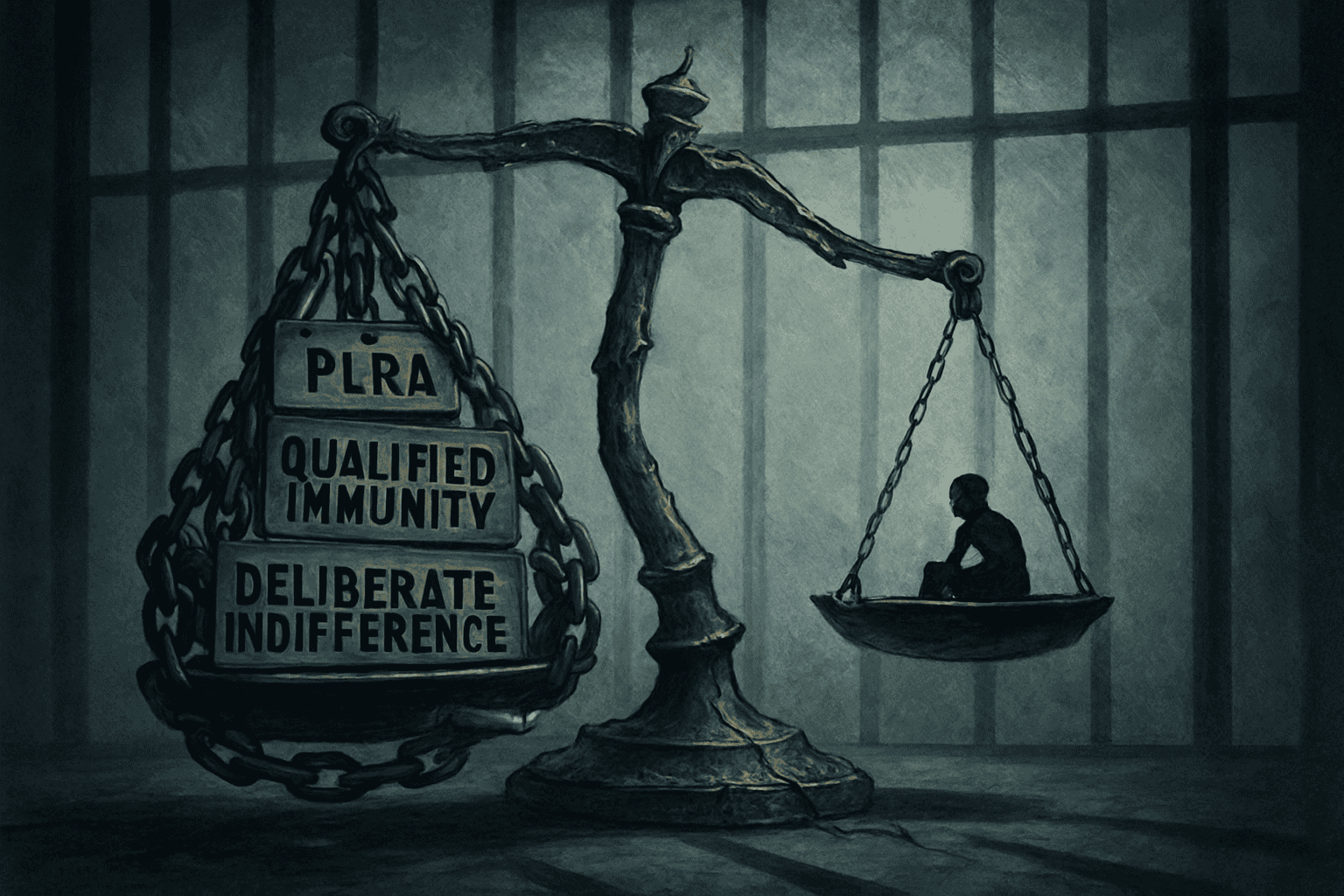
This explainer is based on Eighth Amendment Standards & Evolving Case Law: Deep Study for GPS Audience. All statistics and findings are drawn directly from this source.
TL;DR
The legal system makes it almost impossible for people in prison to win cases about bad conditions. Only 1% of cases succeed. A 2024 court ruling made Georgia’s legal standard the strictest in the country. The U.S. Department of Justice (DOJ) found that Georgia prisons are deadly and dangerous — with 100 people killed in 2024 alone. But the current White House may not push Georgia to fix the problem.
Why This Matters
If your loved one is in a Georgia prison, this affects them directly.
People in Georgia prisons face deadly violence every day. The DOJ found 142+ people were killed in Georgia prisons between 2018 and 2023. That number is likely too low. The state hid how many people really died.
Half of all guard jobs in Georgia prisons are empty. That means not enough staff to keep people safe. Despite $700 million in new funding, killings went from 8-9 per year in 2017-2018 to 100 in 2024.
When people try to fight back through the courts, they face huge barriers. The law is stacked against them. And now, federal help may be going away too.
Key Takeaway: Georgia’s prisons are in crisis, and the legal system makes it nearly impossible for people inside to get help through the courts.
100 People Killed in Georgia Prisons in 2024
The DOJ spent 3 years looking into Georgia prisons. They visited 17 of 34 state prisons. They talked to hundreds of people. They looked at tens of thousands of records.
Here is what they found:
- 142+ people were killed in Georgia prisons between 2018 and 2023. This is likely an undercount.
- Killings have skyrocketed. In 2017-2018, about 8-9 people were killed per year. By 2023, it was 37. By 2024, it was 100.
- 333 people total died in Georgia prisons in 2024.
- 456 reports of sexual abuse between people in prison were filed in 2022. Only 35 were looked into and confirmed.
- The DOJ called this “near-constant life-threatening violence as the norm.”
The DOJ also found that Georgia hid how many people were really dying. In June 2024, Georgia said 6 people were killed. But their own records showed at least 18.
Key Takeaway: The DOJ found Georgia prisons are deadly — and the state has been hiding the true death toll.
Half of Guard Jobs Are Empty
Only 50% of guard jobs in Georgia prisons are filled. At some prisons, between 24% and 76% of jobs are empty.
Georgia spent $700 million in extra money on prisons from 2022 to 2026. The state tried:
- A 10% pay raise in 2022
- $5,000 bonuses in 2023
- A 4% raise plus $3,000 in 2024-2025
None of it worked. Violence kept getting worse. The money, as the GPS report puts it, “bought body bags, not safety.”
Key Takeaway: Georgia poured $700 million into prisons, but violence got worse because the state can’t keep staff.
Why 99% of Legal Cases Fail
A study looked at 1,488 cases filed by people in prison from 2018 to 2022. Only 1% won. Here is where the rest failed:
- 25% were thrown out right away because of a law called the PLRA (see below)
- 49% failed because the person could not prove prison officials “knew” about the danger
- 6% failed because the person could not prove guards acted out of cruelty
- 1% lost because of a rule called “qualified immunity” (see below)
- 4% were dropped by the people who filed them
This does not mean abuse isn’t happening. It means the legal system makes it nearly impossible to prove.
Key Takeaway: 99 out of 100 legal cases filed by people in prison fail — not because the claims are false, but because the system is rigged against them.
What Is the PLRA?
The PLRA (Prison Litigation Reform Act) is a 1996 law. It created special rules that only apply to people in prison. No other group in America faces these barriers.
Here is what the PLRA does:
- You must file a grievance first. Before going to court, a person must go through every step of the prison’s complaint system. Some states give only 2-3 days to file. Miss a deadline? Case thrown out.
- You must show physical harm. A person cannot sue for mental pain or fear alone. There must be a physical injury.
- Three strikes rule. If three cases are thrown out, a person can never file for free again.
- You still pay. Even people with no money must pay the $405 court fee in small amounts from their prison account.
- Lawyers won’t take the cases. The law caps what lawyers can earn. So most people must handle their case alone.
These rules exist for no other group of people. Only those in prison.
Key Takeaway: A special law called the PLRA puts up barriers that exist for no other group — making it extremely hard for people in prison to get to court.
Georgia Now Has the Strictest Standard in the Country
In 2024, a court ruling called Wade v. McDade changed the rules for Georgia, Florida, and Alabama. It made the legal test even harder.
Before this ruling: A person had to prove that an official knew they were in danger.
After this ruling: A person must prove the official knew that their own actions put them in danger.
This may sound like a small change. It is not. Here is an example from the case:
A man named David Henegar had epilepsy (a brain condition that causes seizures). He was denied his seizure medicine for 4 days straight. He had two seizures. He suffered permanent brain damage. The court still ruled in the officials’ favor.
This new rule makes it almost impossible to win cases about system-wide problems. Officials can always say, “I didn’t cause this — the system did.”
Key Takeaway: A 2024 court ruling made Georgia the hardest place in America to hold prison officials accountable.
What Is Qualified Immunity?
Qualified immunity is a legal shield for government workers. It means officials cannot be held responsible unless a court has already ruled that the exact same behavior is wrong.
In practice, this means:
- There must be a past case with almost the same facts
- The case must come from the right court
- General rules about right and wrong are not enough
There is one exception. In a case called Taylor v. Riojas, a man was held in cells covered in human waste for 6 days. The Supreme Court said this was so clearly wrong that no past case was needed. But this exception is used very rarely.
Here is the key part: even when officials lose in court, they almost never pay. Government employers pay 99.98% of all money owed. Officers pay only 0.02%. But qualified immunity stops most cases from ever getting that far.
Key Takeaway: Qualified immunity protects officials from being held responsible — and even when they lose, they almost never pay out of their own pocket.
Federal Help May Be Going Away
The DOJ has the power to investigate prisons and force changes. This is called a “pattern or practice” case. It is the strongest tool for fixing system-wide problems.
But the current White House is pulling back. Since January 2025:
- The DOJ dropped agreements with police in Louisville, KY and Minneapolis, MN
- The DOJ closed investigations into six police departments
- The DOJ is reviewing all existing reform agreements
- Project 2025 calls for ending all such agreements
The DOJ found Georgia prisons violated the Constitution in October 2024. But no reform agreement was reached before the change in power. It is unclear if the DOJ will push Georgia to make changes.
This means the most powerful tool for fixing Georgia’s prisons may no longer be available.
Key Takeaway: The strongest tool for fixing Georgia’s prisons — federal enforcement — may be taken off the table by the current administration.
What Can Families Do Right Now?
Even in a system stacked against you, there are steps you can take:
Keep records of everything:
– Save all letters about conditions
– Write down what your loved one tells you on calls
– Take photos of any injuries you can see during visits
File complaints with:
– The prison itself
– Georgia Department of Corrections
– DOJ Civil Rights Division: civilrights.justice.gov
– Your state lawmakers
– The media
Ask for public records:
– Incident reports
– Death reports
– Staffing data
– Inspection reports
Connect with support groups:
– Southern Center for Human Rights (Georgia)
– ACLU National Prison Project
– Prison Policy Initiative
– Human Rights Watch
For people inside — the most important thing is to document everything:
– File grievances right away. Meet every deadline.
– Write down names, dates, times, places, and witnesses.
– Keep copies of everything.
– If officials block you from filing, write that down too.
Key Takeaway: Document everything. File complaints. Connect with advocacy groups. Your voice and your records matter.
Glossary
- Eighth Amendment: Part of the U.S. Constitution. It bans cruel and unusual punishment.
- Deliberate indifference: The legal standard used in prison cases. You must prove an official knew about a serious danger and chose to ignore it. After Wade v. McDade, you must also prove they knew their own actions caused the danger.
- PLRA (Prison Litigation Reform Act): A 1996 law that created special rules making it harder for people in prison to file lawsuits. These rules apply to no other group.
- Qualified immunity: A legal shield that protects officials unless a past court case with almost the same facts already said their behavior was wrong.
- CRIPA (Civil Rights of Institutionalized Persons Act): A law that lets the DOJ investigate prisons and force system-wide changes.
- Consent decree: A court-approved deal that requires a prison system to make specific changes. An outside monitor checks the work.
- Exhaustion: The rule that says people in prison must go through every step of the prison’s complaint system before going to court.
- Pro se: When a person handles their own court case without a lawyer. Most people in prison must do this.
- En banc: When all judges on an appeals court hear a case together, instead of just three. This happens for important cases.
- Pattern or practice: A legal term meaning the same type of wrong happens over and over across a system — not just once.
- Three strikes rule: A PLRA rule. After three cases thrown out, a person in prison can no longer file for free.
- In forma pauperis (IFP): Filing a court case as a poor person. Under the PLRA, people in prison must still pay the full fee — just in small amounts.
Read the Source Document
This post is based on GPS’s “Eighth Amendment Standards & Evolving Case Law: Deep Study for GPS Audience,” published January 2026.
The DOJ’s Georgia prison investigation report is available at: justice.gov
Other Versions
We created versions of this post for different audiences:
- For Legislators — Policy-focused with reform options
- For Media — Background for reporters covering Georgia prisons
- For Advocates — Legal strategy and organizing tools
Sources & References
- Bayse v. Philbin, No. 24-11299 (11th Cir. Aug. 1, 2025). U.S. Court of Appeals for the Eleventh Circuit (2025-08-01) Legal Document
- Investigation of Georgia Prisons, U.S. Department of Justice Civil Rights Division, September 2024. U.S. Department of Justice Civil Rights Division (2024-09-01) Official Report
- Wade v. McDade, 106 F.4th 1251 (11th Cir. 2024). U.S. Court of Appeals for the Eleventh Circuit (2024-07-11) Legal Document
- Finley v. Huss, 102 F.4th 789 (6th Cir. 2024). U.S. Court of Appeals for the Sixth Circuit (2024-01-01) Legal Document
- Taylor v. Riojas, 141 S. Ct. 52 (2020). U.S. Supreme Court (2020-11-02) Legal Document
- Kingsley v. Hendrickson, 576 U.S. 389 (2015). U.S. Supreme Court (2015-06-22) Legal Document
- Brown v. Plata, 563 U.S. 493 (2011). U.S. Supreme Court (2011-05-23) Legal Document
- Prison Litigation Reform Act, 42 U.S.C. § 1997e. U.S. Congress (1996-04-26) Legislation
- Farmer v. Brennan, 511 U.S. 825 (1994). U.S. Supreme Court (1994-06-06) Legal Document
- Helling v. McKinney, 509 U.S. 25 (1993). U.S. Supreme Court (1993-06-18) Legal Document
- Wilson v. Seiter, 501 U.S. 294 (1991). U.S. Supreme Court (1991-06-17) Legal Document
- Rhodes v. Chapman, 452 U.S. 337 (1981). U.S. Supreme Court (1981-06-15) Legal Document
- Estelle v. Gamble, 429 U.S. 97 (1976). U.S. Supreme Court (1976-11-30) Legal Document
- Civil Rights of Institutionalized Persons Act, 42 U.S.C. § 1997. U.S. Congress Legislation
- Trump Administration 2.0 Litigation Tracker, Civil Rights Litigation Clearinghouse. Civil Rights Litigation Clearinghouse Data Portal
1 thought on “Why It’s So Hard to Hold Georgia Prisons Accountable: What Families Need to Know”