This explainer is based on Eighth Amendment Standards & Evolving Case Law: Deep Study for GPS Audience. All statistics and findings are drawn directly from this source.
Executive Summary
- Georgia taxpayers invested $700 million in additional corrections funding (FY 2022–2026), yet homicides in state prisons rose from 8–9 annually in 2017–2018 to 100 in 2024 — a more than tenfold increase that demonstrates catastrophic failure of current strategy.
- The U.S. Department of Justice concluded a 3-year investigation finding that the State of Georgia and GDC are “deliberately indifferent” to unsafe conditions, documenting 142+ homicides between 2018–2023 (likely an undercount) and systematic misreporting of deaths.
- The Eleventh Circuit’s 2024 Wade v. McDade decision imposed the nation’s strictest legal standard for prisoner rights claims, requiring proof that an official knew their own specific conduct created risk — effectively eliminating the primary legal avenue for accountability.
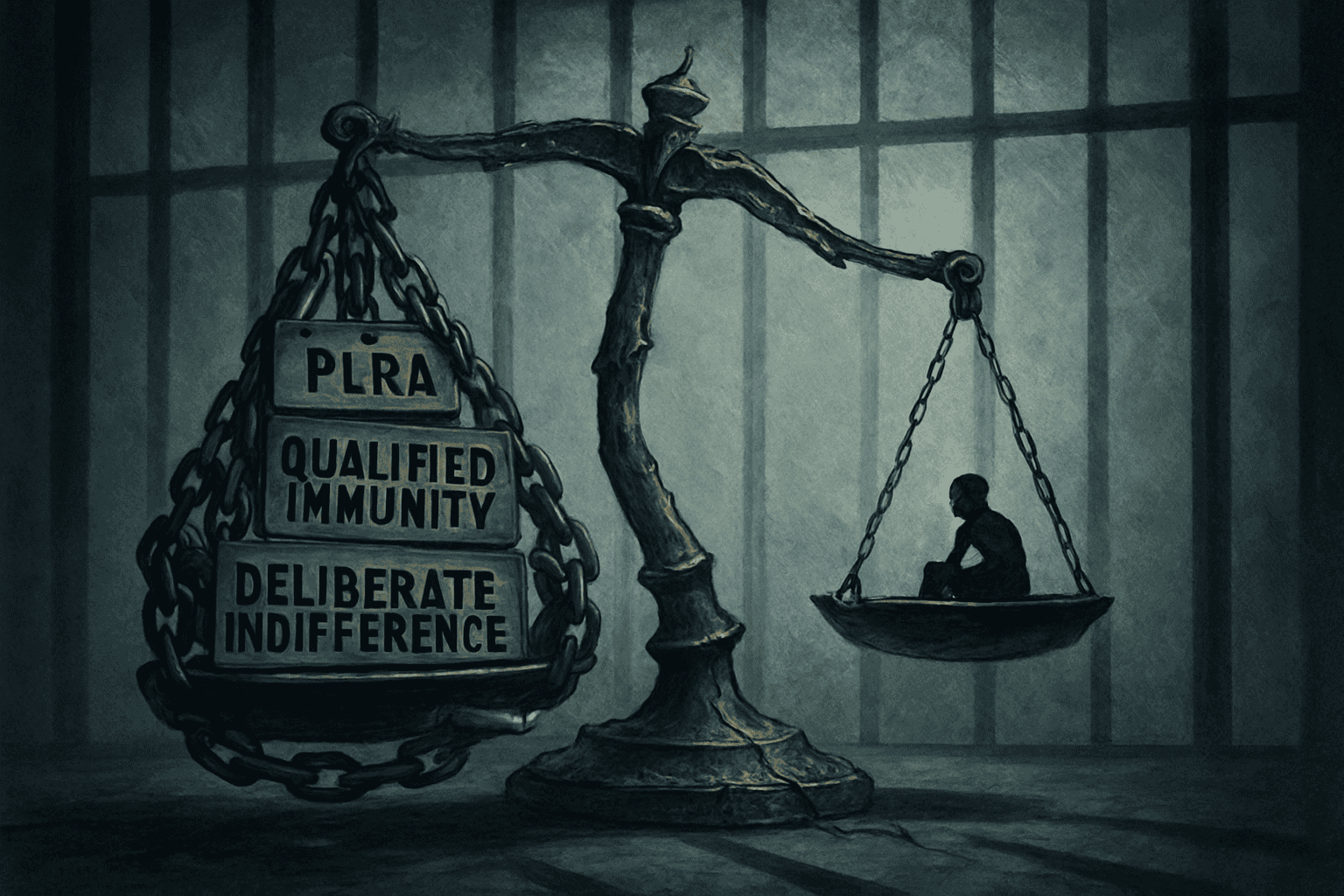
- Only 1% of prisoner Eighth Amendment claims succeed nationally, while 333 people died in Georgia prisons in 2024 alone. The legal system’s compounding procedural barriers — PLRA, qualified immunity, the deliberate indifference standard — shield the state from accountability.
- Federal enforcement, the most effective tool for systemic reform, is now at risk: the Trump administration has terminated multiple consent decrees, closed pattern-or-practice investigations, and left the Georgia prison investigation in limbo with no consent decree reached.
Key Takeaway: Georgia has spent $700 million more on corrections since FY 2022 with dramatically worsening outcomes, while legal barriers make it nearly impossible to hold the state accountable for unconstitutional conditions.
Fiscal Impact
$700 Million Spent — Violence Increased Tenfold
The General Assembly has appropriated $700 million in additional corrections funding between FY 2022 and FY 2026. This investment has produced no measurable improvement in safety:
| Metric | Before Investment (2017–2018) | After Investment (2024) | Change |
|---|---|---|---|
| Annual homicides | 8–9 | 100 | +1,000%+ |
| Total deaths | — | 333 | — |
| CO positions filled | — | 50% | — |
| Facility vacancy rates | — | 24–76% | — |
Emergency compensation packages — a 10% raise in FY 2022, $5,000 bonuses in FY 2023, and a 4% raise plus $3,000 in FY 2024–2025 — failed to resolve the staffing crisis. The state continues operating at only 50% of correctional officer positions filled, with some facilities experiencing vacancy rates as high as 76%.
Litigation Liability Exposure
While current legal barriers suppress successful claims to 1%, empirical data shows government employers pay 99.98% of civil rights settlements and judgments when cases do succeed. Should federal courts revisit the Wade v. McDade standard or should pending DOJ findings result in a consent decree, Georgia faces significant long-term liability. California’s Brown v. Plata litigation — involving comparable systemic failures — resulted in a court-ordered population reduction of 46,000 people and over a decade of costly federal receivership.
Attorney Fee Structure Shifts Costs to Taxpayers
The PLRA caps attorney fees at 150% of judgment, which deters private counsel from taking prison conditions cases. This means the state faces primarily pro se litigants, reducing accountability pressure but not eliminating fiscal exposure from the rare successful claim or class action.
Key Takeaway: $700 million in additional corrections spending since FY 2022 has coincided with a tenfold increase in prison homicides, indicating that funding without structural reform produces no return on taxpayer investment.
Key Findings
1. DOJ Found Systemic Constitutional Violations in Georgia Prisons
The U.S. Department of Justice conducted a 3-year investigation (2021–2024), visiting 17 of 34 state prisons, interviewing hundreds of incarcerated people, and reviewing tens of thousands of records. The DOJ concluded that:
- The state and GDC are “deliberately indifferent” to unsafe conditions
- 142+ people were killed in Georgia prisons between 2018–2023 — likely an undercount
- 456 allegations of sexual abuse between incarcerated people were documented in 2022, with 35 substantiated
- “Near-constant life-threatening violence” has become “the norm”
- Gangs control entire housing units; weapons are “widely available”
2. GDC Systematically Misreported Deaths
The DOJ found that GDC “inaccurately reports these deaths both internally and externally, and in a manner that underreports the extent of violence and homicide.” When GDC reported 6 homicides in June 2024, internal records showed at least 18. This misreporting undermines legislative oversight and public accountability by concealing the true scale of the crisis.
3. Georgia Now Has the Nation’s Strictest Legal Standard for Prisoner Claims
The Eleventh Circuit’s en banc decision in Wade v. McDade (July 2024) requires plaintiffs to prove that an official was “subjectively aware that his own conduct — his own actions or inactions — put the plaintiff at substantial risk of serious harm.” Before this ruling, it was sufficient to show the official knew the person faced risk from any source. The new standard makes systemic failure claims nearly impossible, as officials can claim they did not know their own specific conduct created risk.
4. 99% of Prisoner Claims Fail Before Reaching the Merits
A study of 1,488 prisoner complaints filed between 2018–2022 found that only 1% succeeded. The barriers compound:
- 25% dismissed at PLRA screening
- 49% failed the deliberate indifference standard
- 6% failed the malicious/sadistic standard
- 1% lost to qualified immunity
- 4% abandoned by plaintiffs
The PLRA imposes requirements on incarcerated people that apply to no other class of civil rights plaintiffs: mandatory exhaustion of grievance procedures (with deadlines as short as 2–3 days in some systems), a physical injury requirement for emotional distress claims, a three-strikes rule barring repeat filers, full $405 filing fees even for indigent plaintiffs, and attorney fee caps that make legal representation effectively unavailable.
5. Qualified Immunity Creates a Second Layer of Protection for Officials
Even when claims survive PLRA screening and meet the deliberate indifference standard, officials can invoke qualified immunity unless the plaintiff identifies a prior case with nearly identical facts from binding precedent. Government employers pay 99.98% of civil rights settlements and judgments — officers personally contribute only 0.02% — yet qualified immunity prevents most cases from ever reaching that stage.
6. Federal Enforcement Is Being Dismantled
Between January and May 2025, the Trump administration dismissed consent decrees in Louisville, KY and Minneapolis, MN; closed pattern-or-practice investigations into six police departments; and indicated review of all existing consent decrees. The Georgia prison investigation findings were issued in October 2024, but no consent decree was reached before the administration change. Project 2025 advocates eliminating all consent decrees.
Key Takeaway: Compounding legal barriers — the PLRA, the nation’s strictest deliberate indifference standard, and qualified immunity — result in only 1% of prisoner claims succeeding, while the DOJ documented systemic constitutional violations and the state systematically misreported deaths.
Comparable States
Circuit-by-Circuit Legal Standards
The source document identifies significant geographic disparities in constitutional protection for people in prison:
Eleventh Circuit (Georgia, Florida, Alabama): Following Wade v. McDade, this circuit now applies the strictest deliberate indifference standard in the nation. Officials must be shown to have known their own conduct created risk. Only binding precedent from the Supreme Court, Eleventh Circuit, or state supreme court can defeat qualified immunity.
Ninth Circuit (West Coast): Generally more plaintiff-friendly. Has extended the Kingsley objective unreasonableness standard to pretrial detainee conditions claims, providing broader protection.
Second Circuit (New York, Connecticut, Vermont): Has also extended Kingsley to conditions claims. More receptive to systemic claims. Active consent decrees, including at Rikers Island.
Fifth Circuit (Texas, Louisiana, Mississippi): Very defense-friendly. Narrow reading of the Eighth Amendment. Broad qualified immunity. Long-term solitary confinement held not per se unconstitutional.
California Precedent: Brown v. Plata
California’s experience offers the closest comparison to Georgia’s current crisis. California prisons operated at 200% capacity, and the Supreme Court upheld an order requiring a population reduction of 46,000 people to 137.5% capacity. However, this relief came only after 12+ years of failed remedial efforts, court-appointed receivers, and overwhelming evidence of systemic failure — including officials’ own admissions of crisis.
Key Distinction
People in Georgia prisons have less constitutional protection than people held in comparable facilities in the Second and Ninth Circuits. A pretrial detainee in New York facing identical conditions to a person in a Georgia jail would face a lower burden of proof under Kingsley, while the Georgia detainee must meet the same deliberate indifference standard as a convicted person.
Key Takeaway: Georgia, Florida, and Alabama now have the strictest legal standard for prisoner rights claims in the nation, meaning people in Georgia prisons have less constitutional protection than those in comparable facilities in other circuits.
Policy Recommendations
1. Mandate Independent Death Reporting and Classification
The DOJ found GDC reported 6 homicides in June 2024 when internal records showed at least 18. The General Assembly should:
- Require independent medical examiner review and classification of all deaths in custody
- Mandate quarterly public reporting of deaths by cause, facility, and circumstances
- Establish criminal penalties for intentional misclassification of deaths
- Create a legislative oversight mechanism with subpoena power to audit GDC mortality data
2. Establish an Independent Prison Oversight Board
With federal enforcement mechanisms in jeopardy, the state must create its own accountability infrastructure:
- Authorize an independent oversight body with unannounced inspection authority
- Require public reporting on violence, staffing, grievance outcomes, and conditions
- Empower the board to issue binding recommendations with legislative enforcement
- Fund the board independently from GDC’s budget
3. Address the Staffing Crisis Through Structural Reform
Three rounds of emergency compensation — a 10% raise, $5,000 bonuses, and 4% plus $3,000 — failed to move staffing above 50%. The General Assembly should:
- Commission an independent study of correctional officer recruitment and retention barriers beyond compensation
- Set minimum staffing ratios tied to facility population, with automatic population reduction triggers when ratios are not met
- Require public reporting of facility-level staffing data
4. Reform the State Grievance Process
Since the PLRA requires exhaustion of administrative remedies before any lawsuit, the grievance process is a critical accountability mechanism. Georgia should:
- Ensure grievance deadlines are no shorter than 15 business days
- Prohibit retaliation against people who file grievances (with independent investigation of retaliation claims)
- Require written responses with specific findings at each grievance level
- Publish aggregate grievance data by facility and category
5. Pursue State-Level Legal Protections
With Wade v. McDade imposing the nation’s strictest federal standard and federal enforcement withdrawing:
- Consider state legislation establishing an objective reasonableness standard for conditions-of-confinement claims in Georgia courts
- Waive sovereign immunity for state tort claims arising from deaths in custody
- Remove state-level barriers to wrongful death and negligence claims by families of people who die in custody
6. Require Fiscal Accountability for Corrections Spending
Given $700 million in additional appropriations with worsening outcomes:
- Require GDC to report measurable safety outcomes tied to each budget line item
- Mandate annual legislative review of corrections spending effectiveness
- Establish performance benchmarks (staffing ratios, violence rates, death rates) as conditions for continued funding increases
Key Takeaway: With federal enforcement mechanisms at risk and the nation’s strictest legal standard now governing Georgia, the General Assembly must establish state-level oversight, mandate transparent death reporting, and tie corrections funding to measurable safety outcomes.
Read the Source Document
Read the DOJ Investigation Report: Investigation of Georgia Prisons (October 2024)
Other Versions
- Public Version — Plain-language summary for Georgia residents and families
- Media Version — Press-ready briefing with key data points and sourcing
- Advocate Version — Detailed analysis for attorneys, organizers, and policy advocates
Sources & References
- Bayse v. Philbin, No. 24-11299 (11th Cir. Aug. 1, 2025). U.S. Court of Appeals for the Eleventh Circuit (2025-08-01) Legal Document
- Investigation of Georgia Prisons, U.S. Department of Justice Civil Rights Division, September 2024. U.S. Department of Justice Civil Rights Division (2024-09-01) Official Report
- Wade v. McDade, 106 F.4th 1251 (11th Cir. 2024). U.S. Court of Appeals for the Eleventh Circuit (2024-07-11) Legal Document
- Finley v. Huss, 102 F.4th 789 (6th Cir. 2024). U.S. Court of Appeals for the Sixth Circuit (2024-01-01) Legal Document
- Taylor v. Riojas, 141 S. Ct. 52 (2020). U.S. Supreme Court (2020-11-02) Legal Document
- Kingsley v. Hendrickson, 576 U.S. 389 (2015). U.S. Supreme Court (2015-06-22) Legal Document
- Brown v. Plata, 563 U.S. 493 (2011). U.S. Supreme Court (2011-05-23) Legal Document
- Prison Litigation Reform Act, 42 U.S.C. § 1997e. U.S. Congress (1996-04-26) Legislation
- Farmer v. Brennan, 511 U.S. 825 (1994). U.S. Supreme Court (1994-06-06) Legal Document
- Helling v. McKinney, 509 U.S. 25 (1993). U.S. Supreme Court (1993-06-18) Legal Document
- Wilson v. Seiter, 501 U.S. 294 (1991). U.S. Supreme Court (1991-06-17) Legal Document
- Rhodes v. Chapman, 452 U.S. 337 (1981). U.S. Supreme Court (1981-06-15) Legal Document
- Estelle v. Gamble, 429 U.S. 97 (1976). U.S. Supreme Court (1976-11-30) Legal Document
- Civil Rights of Institutionalized Persons Act, 42 U.S.C. § 1997. U.S. Congress Legislation
- Trump Administration 2.0 Litigation Tracker, Civil Rights Litigation Clearinghouse. Civil Rights Litigation Clearinghouse Data Portal