This explainer is based on Eighth Amendment Standards & Evolving Case Law: Deep Study for GPS Audience. All statistics and findings are drawn directly from this source.
News Lead
One hundred people were killed in Georgia’s prisons in 2024 — more than ten times the 8-9 annual homicides recorded in 2017-2018 — while the state poured $700 million in additional funding into its corrections system. A comprehensive legal analysis by Georgia Prisoners’ Speak reveals that a convergence of legal barriers makes it virtually impossible for survivors or families to hold the state accountable: only 1% of prisoner Eighth Amendment claims succeed in court.
The crisis deepened in July 2024 when the Eleventh Circuit Court of Appeals, which governs Georgia, Florida, and Alabama, issued its en banc decision in Wade v. McDade, establishing what legal experts call the strictest deliberate indifference standard in the nation. Under this new standard, a person in prison must prove that an official was “subjectively aware that his own conduct — his own actions or inactions — put the plaintiff at substantial risk of serious harm.” Previously, it was sufficient to show that officials knew the person faced risk from any source.
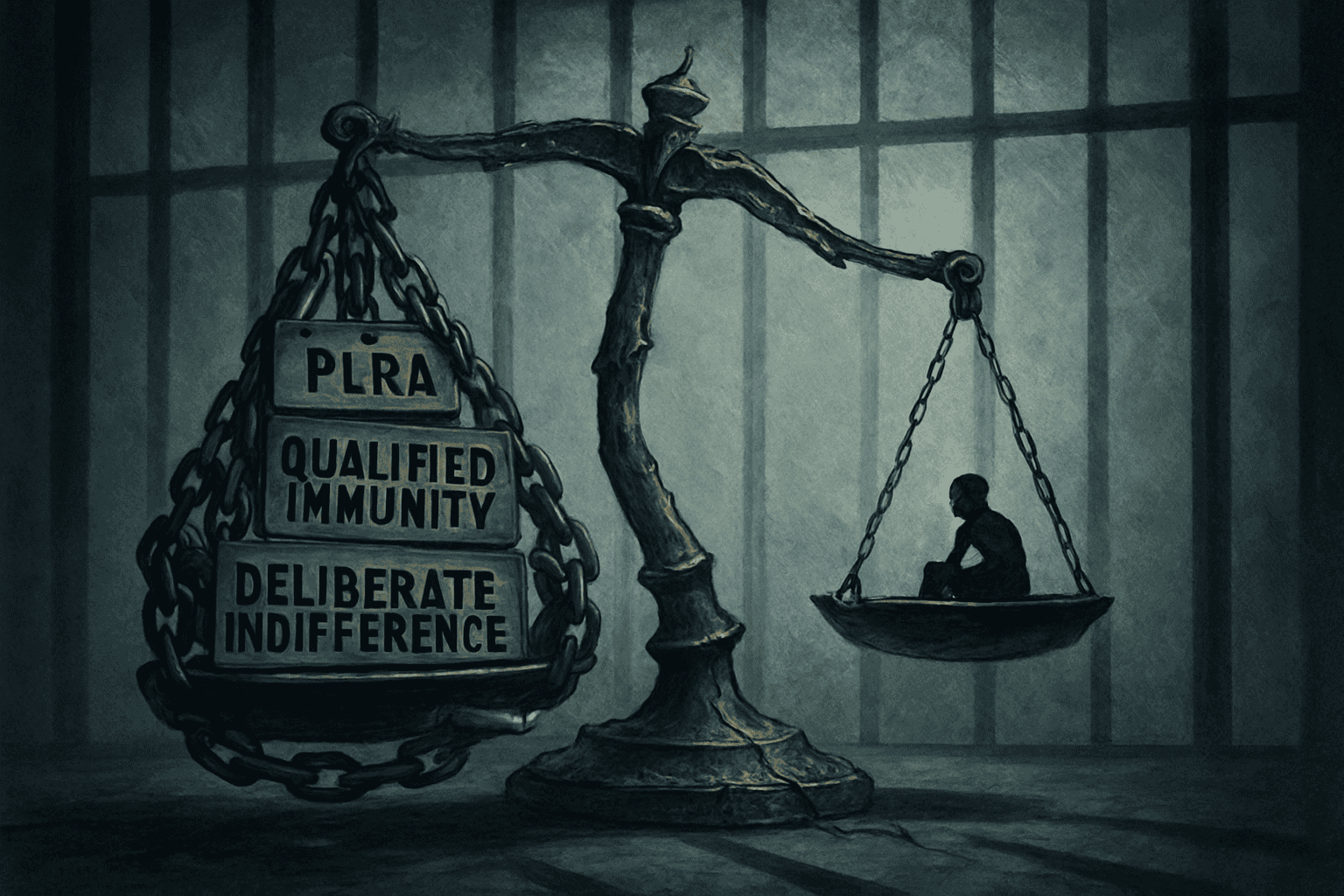
The analysis documents how the Prison Litigation Reform Act, qualified immunity, the new Wade standard, and the Trump administration’s retreat from federal prison oversight have created what amounts to a legal fortress shielding state officials from accountability — even as the Department of Justice’s own three-year investigation found that Georgia systematically violated the constitutional rights of people in its custody and deliberately misreported homicides to conceal the scale of violence.
Key Takeaway: Georgia prisons saw homicides rise from 8-9 annually to 100 in 2024, yet legal barriers ensure only 1% of prisoner rights claims succeed — and a new court ruling just made it harder.
Quotable Statistics
Deaths and Violence in Georgia Prisons:
– 100 homicides in Georgia prisons in 2024, up from 8-9 annually in 2017-2018 and 37 in 2023
– 333 total deaths in Georgia prisons in 2024
– 142+ homicides documented between 2018-2023, described by DOJ as “likely undercount due to misreporting”
– In June 2024, the Georgia Department of Corrections reported 6 homicides — internal records showed at least 18
– 456 documented allegations of sexual abuse between incarcerated people in 2022, with 35 substantiated
Staffing and Funding:
– Only 50% of correctional officer positions filled statewide
– Some facilities experienced 24-76% vacancy rates
– $700 million added to corrections budget between FY 2022-2026
– Emergency raises — 10% (FY 2022), $5,000 bonuses (FY 2023), 4% + $3,000 (FY 2024-2025) — failed to solve the staffing crisis
Legal Barriers to Accountability:
– Only 1% of prisoner Eighth Amendment claims succeeded in a study of 1,488 complaints (2018-2022)
– 25% dismissed at PLRA screening before any review on the merits
– 49% failed the deliberate indifference standard
– 6% failed the malicious/sadistic standard
– 4% abandoned by plaintiffs
– Government employers pay 99.98% of civil rights settlements/judgments; individual officers contribute just 0.02%
– Incarcerated people who file federal claims must pay a $405 filing fee even if indigent
– Attorney fees capped at 150% of judgment under PLRA, deterring legal representation
DOJ Investigation Scope:
– 3-year investigation (2021-2024)
– 17 of 34 state prisons visited
– Findings issued October 2024 — no consent decree reached before administration change
Federal Enforcement Retreat:
– Trump DOJ dismissed consent decrees in Louisville and Minneapolis (May 2025)
– Closed investigations into six police departments
– DOJ reviewing all existing consent decrees
Key Takeaway: Publication-ready data points documenting the scale of Georgia’s prison crisis, the legal barriers blocking accountability, and the retreat of federal oversight.
Context and Background
What reporters need to know:
The U.S. Department of Justice concluded a three-year investigation into Georgia’s prison system in October 2024, finding that the state systematically violated the Eighth Amendment rights of people in its custody through failure to protect them from violence and sexual abuse. The DOJ documented “near-constant life-threatening violence as the norm” and found that Georgia had “lost control” of its prisons, with gangs controlling entire housing units and weapons widely available.
Critically, the DOJ found that Georgia deliberately concealed the scale of violence by misclassifying homicides. The state’s own mortality data “categorizes many deaths that obviously were homicides as having an unknown reason or unknown verified cause of death,” the DOJ wrote, and “inaccurately reports these deaths both internally and externally.”
Despite these findings, no consent decree — the standard mechanism for federally supervised reform — was reached before the Biden administration left office. The Trump administration has since terminated consent decrees in Louisville and Minneapolis, closed six police pattern-or-practice investigations, and signaled a review of all existing consent decrees. Project 2025 advocates eliminating consent decrees entirely.
This federal retreat leaves individual litigation as the primary legal avenue for accountability. But the GPS analysis documents how multiple overlapping barriers — the Prison Litigation Reform Act (1996), qualified immunity doctrine, and now the Eleventh Circuit’s Wade v. McDade decision — ensure that 99% of prisoner claims fail.
The Wade decision is particularly significant. In that case, a man with epilepsy named David Henegar was denied anti-seizure medication for four consecutive days, suffered two seizures, and sustained permanent brain damage. The court still granted qualified immunity because officials didn’t believe their “own conduct” created the risk — the new standard the court established. As one judge warned, this decision likely “abrogated” prior Eleventh Circuit precedents that had been more favorable to incarcerated people’s claims.
The PLRA imposes barriers that apply to no other class of civil rights plaintiffs: mandatory exhaustion of all internal grievances (with deadlines as short as 2-3 days in some systems), a physical injury requirement for emotional distress claims, a three-strikes rule that bars repeat filers, mandatory filing fees even for indigent plaintiffs, and caps on attorney fees that make it nearly impossible to find legal representation.
Key Takeaway: Georgia’s prison crisis exists at the intersection of documented constitutional violations, deliberate state concealment of deaths, an unprecedented new legal barrier, and the withdrawal of the only effective federal enforcement mechanism.
Story Angles
1. “The 1% Problem: Why Georgia’s Courts Are Closed to People Dying in Prison”
A deep investigation into the compounding legal barriers that ensure only 1% of prisoner rights claims succeed. Interview plaintiffs who had claims dismissed, attorneys who refuse prison cases because of PLRA fee caps, and legal scholars on the Wade v. McDade decision that just made Georgia the hardest place in America to bring a prison conditions lawsuit. Compare the Eleventh Circuit’s standard to more protective circuits where pretrial detainees can use an objective reasonableness test.
2. “Georgia’s Hidden Dead: How the State Conceals Prison Homicides”
The DOJ found that when Georgia reported 6 homicides in June 2024, internal records showed at least 18. Investigate how GDC classifies deaths, who oversees mortality data, what public records are available, and whether the legislature has any independent access to accurate death counts. The broader documented figure of 142+ homicides between 2018-2023 was itself described as “likely undercount due to misreporting.” This is a transparency and government accountability story with life-and-death stakes.
3. “$700 Million and 100 Dead: Why Money Hasn’t Made Georgia’s Prisons Safer”
Georgia added $700 million to its corrections budget between FY 2022-2026, implemented three rounds of emergency pay raises and bonuses for officers, and still saw homicides rise from 8-9 annually to 100. Meanwhile, staffing remains at 50%. Examine where the money went, why compensation increases failed to solve the staffing crisis, and what structural reforms the state has refused to pursue. The DOJ investigation visited 17 of 34 state prisons and found deteriorating physical plants, failed contraband controls, and inadequate investigations across the system.
Read the Source Document
Additional primary sources referenced in this analysis:
– DOJ Investigation of Georgia Prisons (September 2024)
– Wade v. McDade, 106 F.4th 1251 (11th Cir. 2024)
– Prison Litigation Reform Act, 42 U.S.C. § 1997e
Other Versions
This analysis is also available in versions tailored for different audiences:
- Public Version — Plain-language explainer for community members and families
- Legislator Version — Policy brief with reform recommendations for Georgia lawmakers
- Advocate Version — Detailed legal and organizing resource for prisoner rights organizations
Sources & References
- Bayse v. Philbin, No. 24-11299 (11th Cir. Aug. 1, 2025). U.S. Court of Appeals for the Eleventh Circuit (2025-08-01) Legal Document
- Investigation of Georgia Prisons, U.S. Department of Justice Civil Rights Division, September 2024. U.S. Department of Justice Civil Rights Division (2024-09-01) Official Report
- Wade v. McDade, 106 F.4th 1251 (11th Cir. 2024). U.S. Court of Appeals for the Eleventh Circuit (2024-07-11) Legal Document
- Finley v. Huss, 102 F.4th 789 (6th Cir. 2024). U.S. Court of Appeals for the Sixth Circuit (2024-01-01) Legal Document
- Taylor v. Riojas, 141 S. Ct. 52 (2020). U.S. Supreme Court (2020-11-02) Legal Document
- Kingsley v. Hendrickson, 576 U.S. 389 (2015). U.S. Supreme Court (2015-06-22) Legal Document
- Brown v. Plata, 563 U.S. 493 (2011). U.S. Supreme Court (2011-05-23) Legal Document
- Prison Litigation Reform Act, 42 U.S.C. § 1997e. U.S. Congress (1996-04-26) Legislation
- Farmer v. Brennan, 511 U.S. 825 (1994). U.S. Supreme Court (1994-06-06) Legal Document
- Helling v. McKinney, 509 U.S. 25 (1993). U.S. Supreme Court (1993-06-18) Legal Document
- Wilson v. Seiter, 501 U.S. 294 (1991). U.S. Supreme Court (1991-06-17) Legal Document
- Rhodes v. Chapman, 452 U.S. 337 (1981). U.S. Supreme Court (1981-06-15) Legal Document
- Estelle v. Gamble, 429 U.S. 97 (1976). U.S. Supreme Court (1976-11-30) Legal Document
- Civil Rights of Institutionalized Persons Act, 42 U.S.C. § 1997. U.S. Congress Legislation
- Trump Administration 2.0 Litigation Tracker, Civil Rights Litigation Clearinghouse. Civil Rights Litigation Clearinghouse Data Portal