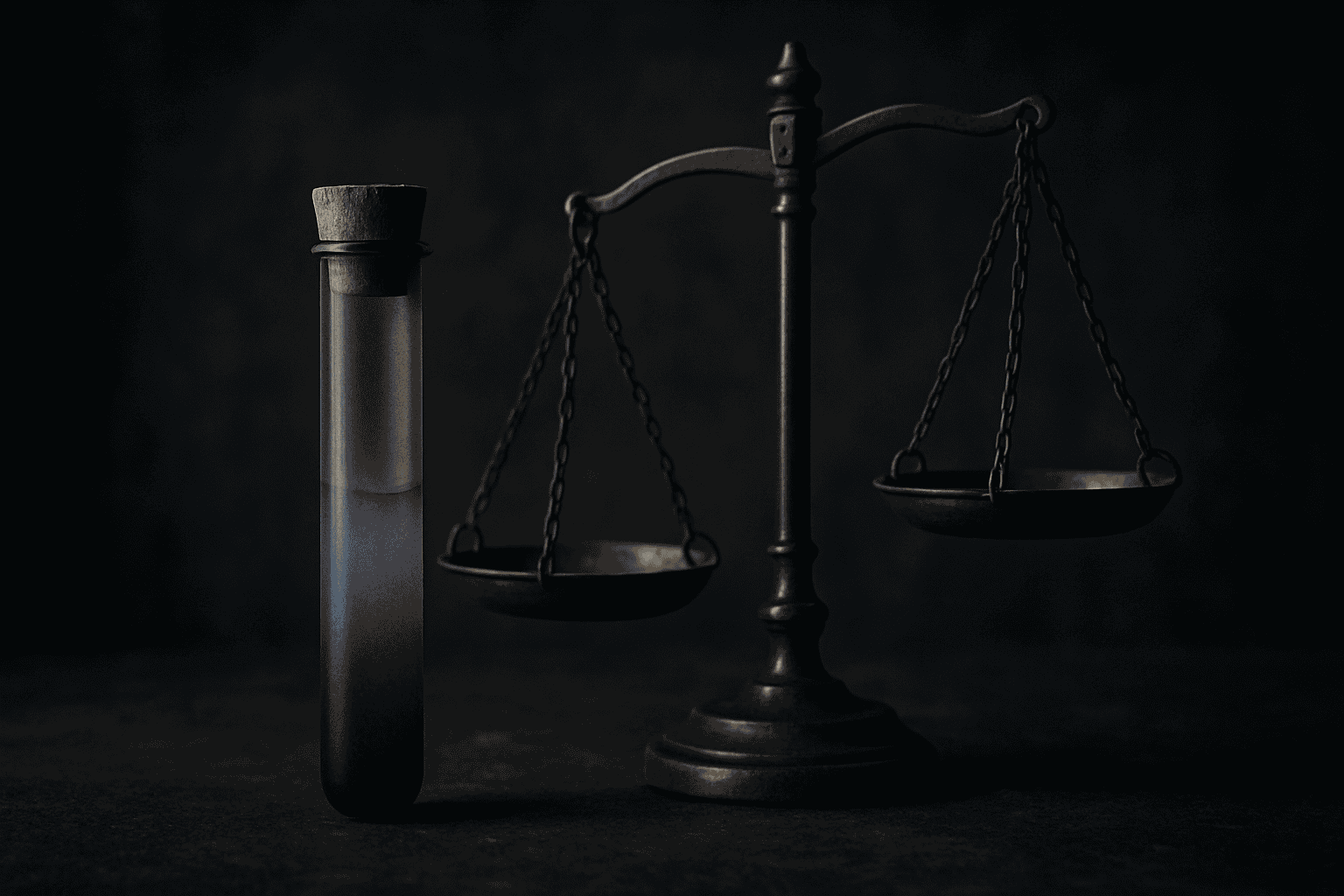
This explainer is based on Field Drug Test Unreliability: Colorado’s HB 26-1020 and Implications for Georgia Reform. All statistics and findings are drawn directly from this source.
Executive Summary
- Georgia is the only state in the nation where unconfirmed colorimetric field drug test results remain admissible at trial, enabling convictions without laboratory confirmation. An estimated 961 Georgians are falsely arrested each year due to these tests, which produce false positives at rates between 15% and 38% — far exceeding manufacturers’ claimed 4% error rate.
- Colorado became the first state to legislatively restrict arrests based on field drug tests when Governor Polis signed HB 26-1020 on March 26, 2026. The law passed unanimously (65-0 House, 33-0 Senate) and carries a $0 fiscal impact — summons procedures reduce jail booking costs while slightly increasing court workload.
- 89% of prosecutors accept guilty pleas without confirmatory laboratory testing, and 95% of criminal cases resolve by plea agreement, creating a system where false convictions are structurally invisible — the evidence is never tested to prove innocence.
- Black Americans experience erroneous field test arrests at three times the rate of white Americans on a per-capita basis. Georgia’s felony classification of virtually all drug possession (2–15 years for simple possession) amplifies the coercive pressure on innocent people who cannot afford bail.
- A Georgia reform bill modeled on Colorado’s law would cost $0 in new appropriations, protect an estimated 961 people per year from false arrest, and align Georgia with every other state that already bars unconfirmed field tests from trial.
Key Takeaway: Georgia stands alone nationally in allowing $2 field drug tests — which fail up to 38% of the time — to sustain criminal convictions at trial, and a zero-cost reform modeled on Colorado’s unanimous bipartisan law is available.
Fiscal Impact
Direct Cost of Reform: $0
Colorado’s fiscal note estimated $0 in new appropriations for HB 26-1020. Summons-in-lieu-of-arrest procedures slightly increase court administrative workload but reduce jail booking, intake, and housing costs. Georgia would see a comparable net-zero or net-positive fiscal impact.
Costs the State Currently Bears
- Jail housing for people held on false charges. Dasha Fincher spent 94 days in Monroe County Jail on a $1 million cash bond — for cotton candy. Kena’z Edwards spent over three months jailed on a $178,000 bond — for lidocaine. Every day of wrongful incarceration is a day Georgia taxpayers fund.
- GBI Crime Lab backlog processing. The lab backlog reached 36,194 items in 2019, with 19,112 in the chemistry/drug testing section alone — over half. In 2024, the lab received approximately 103,000 testing requests and returned approximately 105,000 results, reducing the backlog by 11%. Reform that mandates confirmatory testing before conviction — rather than after a guilty plea that may never trigger lab review — would rationalize lab resource allocation.
- Wrongful conviction compensation liability. Governor Kemp signed the Wrongful Conviction and Incarceration Compensation Act in 2025, providing $75,000 per year to exonerees. With an estimated 961 false arrests per year and a system where confirmatory testing is almost never performed after plea deals, Georgia faces growing future liability for wrongful convictions it has not yet discovered.
- Litigation costs. The Fincher federal lawsuit against Monroe County reached the district court level before dismissal on sovereign immunity grounds. As the evidence base on field test unreliability grows, future litigation is increasingly likely to survive immunity defenses.
Cost of Inaction
The Quattrone Center describes field testing as “one of the largest, if not the largest, known contributing factor to wrongful arrests and convictions in the United States.” Every wrongful conviction produces downstream costs: incarceration, public defender expenditures, appellate proceedings, potential exoneration compensation, and lost tax revenue from people pushed out of the workforce by felony records. Georgia’s felony classification of all Schedule I/II possession (penalties of 2 to 15 years for simple possession) means each false arrest carries exponentially higher fiscal exposure than in states where possession is a misdemeanor.
Key Takeaway: Colorado’s reform cost $0 in new appropriations; Georgia currently spends taxpayer money jailing people on false charges, processing unnecessary lab backlogs, and faces growing wrongful conviction compensation liability.
Key Findings
The Science: A Test That Fails Up to 38% of the Time
The University of Pennsylvania Quattrone Center’s 2024 comprehensive study — the first of its kind — found that actual false-positive rates for colorimetric field drug tests range between 15% and 38%, depending on the jurisdiction and substance tested, compared to manufacturers’ historical claims of approximately 4%. Approximately 773,000 drug-related arrests per year involve colorimetric field tests — roughly half of all 1.5 million annual drug arrests nationally. Based on these rates, the Quattrone Center estimated that approximately 30,000 people are falsely arrested every year, a figure they described as conservative.
The failures are even worse in specific contexts:
– NYC jails: 85% average false-positive rate for fentanyl tests (71 items tested; only 15% contained fentanyl). NARK II tests produced a 91% false-positive rate; MobileDetect tests produced a 79% false-positive rate.
– Massachusetts prisons: 38% of incoming mail that tested positive for synthetic cannabinoids contained no illegal drugs. A court called the tests “only marginally better than a coin-flip.”
– Colorado corrections: 33% false-positive rate found by the state’s own working group.
– Savannah, Georgia: A police department internal audit found a 21.4% error rate — the portable test was wrong in 9 of 42 cases reviewed.
– Georgia statewide: The GBI Crime Lab confirmed 145 false positives from field tests in 2017 alone — 64 for methamphetamine, 40 for cocaine, 24 for ecstasy, and 11 for heroin.
Documented substances that triggered false positives include cotton candy, Krispy Kreme donut glaze, bird droppings, toddler’s cremated ashes, powdered milk, lidocaine, kitty litter, stress ball sand, and IBS medication.
Georgia Stands Alone on Admissibility
Georgia appellate case law — Collins v. State (2006) and Fortune v. State (2010) — established that positive field test results alone are sufficient to sustain a drug conviction without crime lab confirmation. According to the Quattrone Center, Georgia is the only state where this is the case for non-marijuana drug offenses.
A 2024 FOX 5 Atlanta poll of the Georgia Association of Chiefs of Police found that 68% of responding agencies still use roadside drug tests and only 26% had a policy requiring additional evidence before making an arrest based on field test results. There is no mandatory training in Georgia for officers on how to use field drug tests.
Plea Bargaining Makes False Convictions Invisible
- 89% of prosecutors accept guilty pleas without any confirmatory laboratory testing.
- 67% of drug labs reported they are not asked to review samples when cases resolve by plea.
- 46% of labs do not conduct confirmatory testing if a guilty plea has already been entered.
- Over 80% of prosecutors acknowledged it is “extremely unlikely” that seized drug evidence will ever be analyzed once a plea deal is reached.
- Nationally, approximately 95% of criminal cases are resolved through plea agreements.
- ProPublica estimated that a minimum of 100,000 people per year plead guilty to drug charges relying on field test results as the primary evidence.
- The National Registry of Exonerations documents that 531 of its 3,396 known exonerations involved wrongful drug arrests for substances that were not drugs.
In Harris County, Texas — the only jurisdiction that systematically checked — at least 298 people were convicted despite lab tests finding no controlled substances. The innocent pleaded guilty an average of 4 days after arrest. The Conviction Integrity Unit overturned 131+ convictions.
Racial Disparities Are Severe
- Black Americans experience erroneous drug arrests from field tests at three times the rate of white Americans on a per-capita basis.
- In Harris County, 60% of those wrongfully convicted were African American in a city that is 24% Black.
- 93% of those wrongfully convicted in ProPublica’s nationwide analysis received jail or prison sentences.
Key Takeaway: Field drug tests fail at rates up to 38%, Georgia is the only state allowing these results as trial evidence, 89% of prosecutors accept pleas without lab confirmation, and Black Georgians bear the disproportionate burden of this systemic failure.
Comparable States
Colorado (HB 26-1020 — Enacted March 2026)
- First state to legislatively restrict arrests based on colorimetric field drug tests.
- Passed unanimously: 65-0 in House, 33-0 in Senate.
- Prohibits arrests for drug misdemeanor possession when a field test is the sole basis; requires summons instead.
- Requires courts to advise defendants that field tests are unreliable and inadmissible, and that they have a right to confirmatory testing.
- $0 fiscal impact.
- Supported by a coalition spanning the Innocence Project, ALEC, and the Reason Foundation.
California (SB 912 — Failed 2024)
- Would have prohibited colorimetric test results from being used for probable cause, charging, or conviction without lab confirmation.
- Held in committee; died in May 2024 due in part to the state’s Truth-in-Evidence constitutional provision requiring a two-thirds supermajority.
North Carolina (HB 868 — Stalled 2025)
- “Due Process in LEO Field Drug Testing” bill introduced April 2025.
- Stalled in committee since referral.
Nebraska (LB 519 — Enacted)
- Narrower measure allowing prison inmates who receive false positives to request confirmatory retesting before disciplinary action.
ALEC Model Policy (Finalized January 2026)
- More expansive than Colorado’s law: bars colorimetric results from probable cause, arrest, charging, conviction, or sentencing without confirmatory testing.
- Mandates cite-and-release when no separate criminal offense applies.
- Provides critical bipartisan framing for Republican-majority legislatures.
Law Enforcement Agencies That Have Voluntarily Abandoned Field Tests
- Houston PD ceased field drug testing entirely in 2017.
- Harris County stopped accepting guilty pleas for felony drug cases without lab confirmation in 2015.
- Jacksonville, Florida’s Sheriff’s Office stopped using field tests in September 2024.
- Denver, Centennial, and Castle Pines, Colorado; multiple California agencies including CHP and SFPD; and Georgia Tech Police have all abandoned the kits.
Federal Position
- The Department of Justice determined in 1978 that field drug tests “should not be used for evidential purposes.”
- No federal agency regulates the manufacture or use of field drug test kits.
- No Congressional hearings or federal legislation specifically targeting colorimetric tests have occurred.
Key Takeaway: Colorado’s unanimous bipartisan law provides a proven legislative template; ALEC’s model policy provides political cover; and multiple law enforcement agencies — including one in Georgia — have already voluntarily abandoned these tests.
Policy Recommendations
A Georgia reform bill should accomplish five objectives, modeled on Colorado’s HB 26-1020 but adapted to Georgia’s felony-classification framework:
1. Mandate Summons in Lieu of Arrest for Field-Test-Only Charges
When a colorimetric field drug test is the sole basis for a simple drug possession charge — whether misdemeanor or felony — officers should issue a summons commanding court appearance rather than making a custodial arrest. This would amend arrest procedures under O.C.G.A. § 17-4-20 et seq. Georgia’s felony classification of all Schedule I/II possession makes this extension beyond Colorado’s misdemeanor-only approach essential. This provision would not apply to distribution or manufacturing charges or cases where independent evidence supports arrest.
2. Require Court Advisements Before Accepting Guilty Pleas
Before accepting any guilty plea in a drug case where a colorimetric test was used, courts must advise defendants in plain language that: (a) field drug tests produce false positives at documented rates between 15% and 38%; (b) colorimetric field test results are inadmissible as substantive evidence; and (c) the defendant has the right to plead not guilty and request confirmatory testing from the GBI Division of Forensic Sciences. This would amend O.C.G.A. § 17-7-93 governing plea procedures.
3. Codify Inadmissibility of Field Test Results as Substantive Evidence
Explicitly declare under Georgia’s Evidence Code (O.C.G.A. Title 24) that colorimetric field drug test results are inadmissible as substantive evidence of drug identity at any proceeding, overriding Collins v. State (2006) and Fortune v. State (2010). The legislation should find that colorimetric tests fail to meet the Harper evidentiary standard of “verifiable certainty” based on documented false-positive rates.
4. Establish a Right to Confirmatory Laboratory Testing
Guarantee defendants’ right to confirmatory testing from the GBI Division of Forensic Sciences or another accredited laboratory at any stage of proceedings, including after a guilty plea has been entered.
5. Preserve Right to Withdraw Plea Upon Exonerating Lab Results
If confirmatory testing finds no controlled substance, the defendant must have the right to withdraw a guilty plea and move for dismissal with prejudice, with automatic expungement of related records.
Legislative Pathway
- Committees: House Judiciary Non-Civil Committee; Senate Judiciary Committee.
- Two-step option: If direct legislation faces initial resistance, Colorado’s successful approach — a study working group in year one (comparable to Colorado’s HB 25-1183), followed by substantive reform in year two — builds Georgia-specific evidence and stakeholder buy-in.
- Institutional allies: Georgia Innocence Project (which identified invalid forensic evidence as a factor in 44% of its exoneration cases), Georgia Justice Project, Southern Center for Human Rights, Georgia Association of Criminal Defense Lawyers.
- Bipartisan framing: ALEC’s endorsement provides Republican cover; Colorado’s unanimous vote demonstrates this is not a partisan issue; Governor Kemp’s signing of the Wrongful Conviction and Incarceration Compensation Act in 2025 signals openness to addressing systemic errors.
Key Takeaway: A five-part Georgia bill — summons mandate, plea advisement, codified inadmissibility, right to lab testing, and plea withdrawal — would cost $0, protect an estimated 961 falsely arrested Georgians per year, and align the state with the other 49 states that already bar unconfirmed field tests from trial.
Read the Source Document
Read the full GPS policy brief: Colorado’s Landmark Drug Test Law and What It Means for Georgia
Other Versions
- Public Version — Plain-language summary for community members and families
- Media Version — Key findings, data points, and expert sources for journalists
- Advocate Version — Organizing toolkit with talking points and action steps
Sources & References
- How a great-grandmother’s false cocaine charge sparked a new Colorado law, CNN, April 5, 2026. CNN (2026-04-05) Journalism
- Polis signs bill aimed at curbing false arrests from field drug tests, Colorado Sun, April 2026. Colorado Sun (2026-04-01) Journalism
- ALEC Colorimetric Presumptive Field Drug Test Limitations Act, January 2026. American Legislative Exchange Council (2026-01-06) Official Report
- Colorado General Assembly HB 26-1020 bill text and fiscal note. Colorado General Assembly (2026-01-01) Legislation
- GPS Analysis: Colorado’s landmark drug test law and what it means for Georgia. Georgia Prisoners’ Speak (2026-01-01) GPS Original
- North Carolina HB 868 bill text — Representatives Rubin and Chesser. North Carolina General Assembly (2025-04-01) Legislation
- Colorado HB 25-1183 bill text (working group creation). Colorado General Assembly (2025-01-01) Legislation
- Investigation into Use and Efficacy of Colorimetric Drug Tests in City Jails, NYC Department of Investigation, November 2024 — Jocelyn E. Strauber, Marissa Carro. NYC Department of Investigation (2024-11-01) Official Report
- California SB 912 bill text and legislative history — Senator Scott Wiener. California Legislature (2024-01-01) Legislation
- FOX 5 Atlanta, Georgia Association of Chiefs of Police survey, 2024. FOX 5 Atlanta (2024-01-01) Journalism
- Presumptive Field Drug Testing: A Comprehensive Analysis, Quattrone Center, January 2024 — Ross Miller, Paul Heaton, Tricia Rojo Bushnell. Quattrone Center for the Fair Administration of Justice, University of Pennsylvania Carey Law School (2024-01-01) Academic
- Green v. Massachusetts Department of Correction, Suffolk County Superior Court, 2021. Suffolk County Superior Court (2021-01-01) Legal Document
- Exposed: roadside drug tests are unreliable, cheap and manufactured overseas, Fox 5 Atlanta I-Team, 2018 — FOX 5 I-Team. FOX 5 Atlanta (2018-01-01) Journalism
- NIJ Forensic Technology Center of Excellence, Landscape Study of Field Portable Devices for Presumptive Drug Testing, 2018. NIJ Forensic Technology Center of Excellence (2018-01-01) Official Report
- Unfounded, ProPublica, October 2016 — Ryan Gabrielson. ProPublica (2016-10-01) Journalism
- Busted, ProPublica/New York Times Magazine, July 2016 — Ryan Gabrielson, Topher Sanders. ProPublica / New York Times Magazine (2016-07-01) Journalism
- Fortune v. State, 304 Ga. App. 121 (2010). Georgia Court of Appeals (2010-01-01) Legal Document
- Collins v. State, 278 Ga. App. 103, 628 S.E.2d 148 (2006). Georgia Court of Appeals (2006-01-01) Legal Document
- Winstock et al., Ecstasy pill testing: harm minimization gone too far?, Pharmacotherapy, 2003 — Winstock et al.. Pharmacotherapy (2003-01-01) Academic
- Fincher v. Monroe County et al., U.S. District Court, Middle District of Georgia. U.S. District Court, Middle District of Georgia Legal Document
- GBI Division of Forensic Sciences Annual Reports, 2019-2024. Georgia Bureau of Investigation Official Report
- National Registry of Exonerations, University of Michigan. University of Michigan Law School Data Portal
Source Document
You Have Options
Free tools to take action — the law is on your side.
Demand records from the prison system. Reach the officials who set policy. File a grievance or a complaint the right way. And for families who’ve lost someone in custody, get the records that tell the truth. Plain-language, step-by-step, and free.
Explore the GPS Toolkits →