This explainer is based on Eighth Amendment Standards & Evolving Case Law: Deep Study for GPS Audience. All statistics and findings are drawn directly from this source.
Why This Research Matters for Advocacy
This GPS legal analysis is one of the most comprehensive advocacy tools available on the constitutional standards governing prison conditions in Georgia — and the structural barriers that prevent accountability when the state fails to protect people behind bars.
Here’s what makes this research urgent:
Georgia now has the strictest legal standard in the nation for prisoner rights claims. The Eleventh Circuit’s 2024 Wade v. McDade decision rewrote the rules, requiring people in prison to prove that an official knew their own specific conduct created the risk of harm — not just that they knew danger existed. This makes it nearly impossible for the 99% of incarcerated plaintiffs who represent themselves to win.
The DOJ documented a constitutional crisis in Georgia prisons — but the federal government may walk away. The Department of Justice’s three-year investigation found at least 142 homicides between 2018-2023 (likely an undercount), systematic misreporting of deaths, only 50% of correctional officer positions filled, and a system where “near-constant life-threatening violence” is the norm. Yet the Trump administration has terminated multiple consent decrees nationwide and may abandon the Georgia investigation entirely.
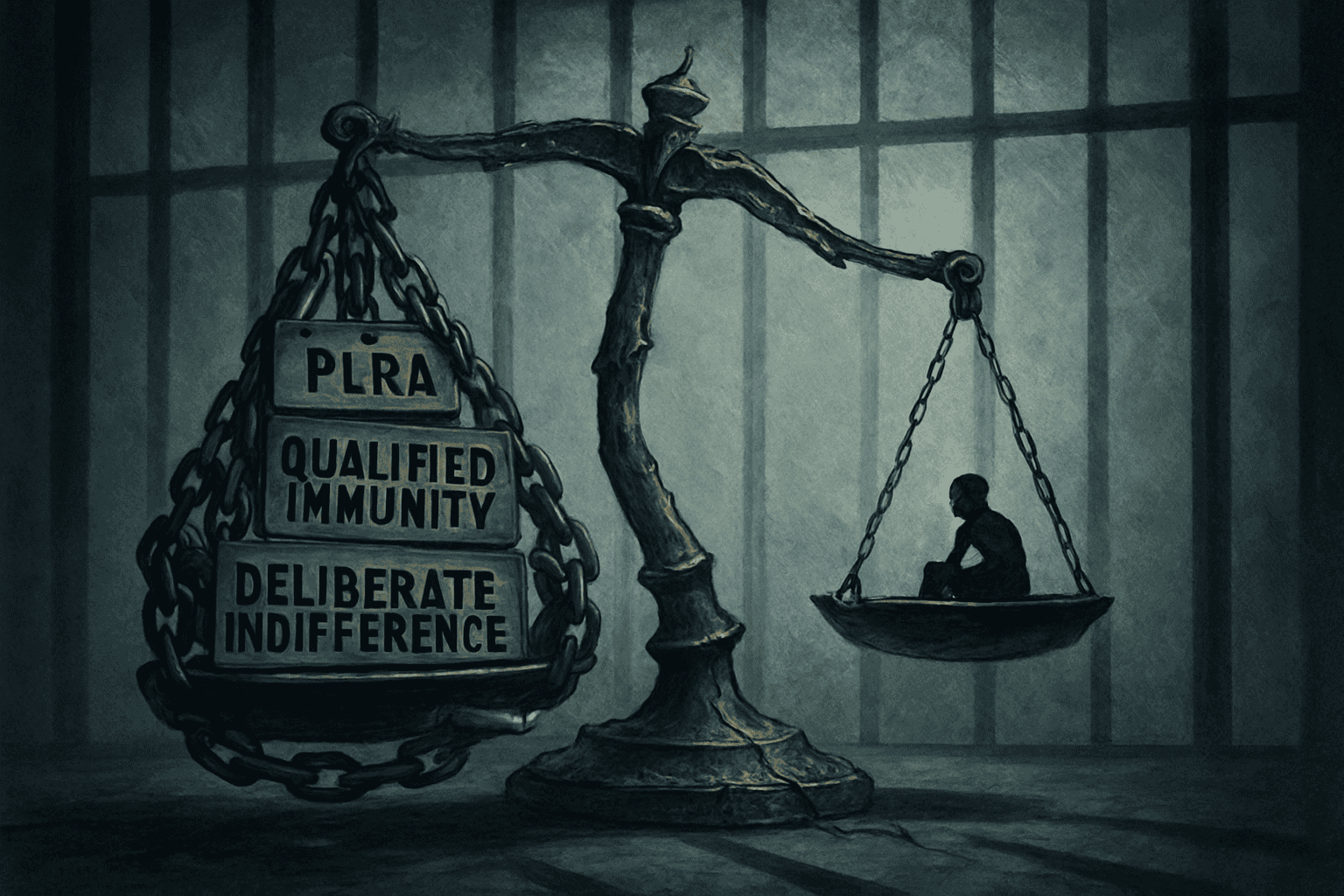
Only 1% of prisoner Eighth Amendment claims succeed. A study of 1,488 complaints found that the Prison Litigation Reform Act, the deliberate indifference standard, qualified immunity, and other procedural barriers eliminate 99% of cases before the merits are ever considered.
$700 million in additional funding bought body bags, not safety. Despite massive budget increases, homicides in Georgia prisons rose from 8-9 per year in 2017-2018 to 100 in 2024. The state has proven it cannot — or will not — solve this crisis with money alone.
This research arms advocates with the legal framework, statistics, and strategic intelligence needed to push for reform at every level: in the legislature, in the courts, in the media, and in the streets. With federal enforcement under threat, state-level advocacy has never been more critical.
Key Takeaway: Georgia’s legal landscape has shifted dramatically against people in prison — the strictest deliberate indifference standard in the nation, a documented constitutional crisis the federal government may abandon, and a 99% failure rate for prisoner rights claims demand urgent, coordinated advocacy.
Talking Points
Use these pre-written talking points in legislative testimony, coalition meetings, media interviews, letters to officials, and public comment periods. Each is grounded in documented evidence.
The DOJ found that Georgia’s Department of Corrections is “deliberately indifferent” to unsafe conditions in state prisons, with at least 142 people killed between 2018 and 2023 — a number the DOJ itself says is likely an undercount because GDC systematically misreports deaths.
Georgia now has the strictest legal standard in the nation for prisoner rights claims. After the Eleventh Circuit’s Wade v. McDade decision in 2024, a person in prison must prove that an official knew their own specific conduct created the risk — a standard that makes systemic failure cases nearly impossible.
Only 1% of prisoner Eighth Amendment claims succeed. Out of 1,488 complaints studied between 2018-2022, 25% were thrown out at the PLRA screening stage and 49% failed the deliberate indifference standard — before the merits were ever considered.
The state has spent $700 million in additional corrections funding since FY 2022, yet homicides in Georgia prisons rose from 8-9 per year in 2017-2018 to 100 in 2024, with 333 total deaths that year. More money without structural reform is not working.
Georgia prisons operate with only 50% of correctional officer positions filled, with some facilities experiencing vacancy rates as high as 76%. The state cannot protect people it is constitutionally required to keep safe when it refuses to staff its own facilities.
When GDC officially reported 6 homicides in June 2024, internal records showed at least 18. Georgia is hiding the true scale of the violence crisis from the public, from legislators, and from the families of people incarcerated in its prisons.
The Prison Litigation Reform Act imposes barriers on incarcerated people that apply to no other class of civil rights plaintiffs in America — including mandatory exhaustion of grievance processes with deadlines as short as 2-3 days, a ban on emotional distress claims without physical injury, and attorney fee caps that make it nearly impossible to find legal representation.
The Trump administration has terminated consent decrees in Louisville and Minneapolis, closed pattern-or-practice investigations into six police departments, and is reviewing all existing consent decrees. The DOJ investigation that documented constitutional violations in Georgia prisons may never result in enforceable relief — making state-level advocacy our most critical path forward.
Key Takeaway: Eight ready-to-use talking points backed by DOJ findings, federal case law, and documented data give advocates powerful tools for any setting.
Important Quotes
These quotes are drawn directly from the GPS analysis and the sources it cites. Use them in testimony, written communications, and media materials.
“The State and GDC are ‘deliberately indifferent’ to unsafe conditions in state prisons.”
— DOJ Investigation Findings (Section IX)“GDC inaccurately reports these deaths both internally and externally, and in a manner that underreports the extent of violence and homicide in GDC prisons.”
— DOJ Investigation Findings (Section VI.C / Section IX)“Near-constant life-threatening violence as the norm.”
— DOJ description of conditions in Georgia prisons (Section IX)“Loss of control over the prisons has set in.”
— DOJ Investigation Findings (Section IX)Plaintiff must prove the official was “subjectively aware that his own conduct — his own actions or inactions — put the plaintiff at substantial risk of serious harm.”
— Wade v. McDade, 106 F.4th 1251 (11th Cir. 2024) (Section II)“Study of 1,488 prisoner complaints (2018-2022): Only 1% succeeded. 25% dismissed at PLRA screening. 49% failed deliberate indifference standard.”
— Legal analysis of prisoner claim outcomes (Section VI.A)“Money ‘bought body bags, not safety.'”
— GPS analysis of $700 million corrections budget increase (Section IX)“The law protects officials, not prisoners. Current framework prioritizes official discretion over prisoner safety. Qualified immunity, PLRA, deliberate indifference standard all favor defendants. This is by design, not accident.”
— GPS Key Takeaways (Section XIV)“When GDC reported 6 homicides in June 2024, internal records showed at least 18.”
— DOJ Investigation Findings (Section IX)
Key Takeaway: These direct quotes from the DOJ investigation and legal analysis provide the most powerful, citable language for advocacy materials.
How to Use This in Your Advocacy
Legislative Testimony
When testifying before Georgia legislative committees — particularly on corrections budgets, prison oversight, or criminal justice reform — frame the findings around three themes:
- The state is failing its constitutional obligation. The DOJ found Georgia’s prison system “deliberately indifferent” to violence that has killed at least 142 people. Legislators have a duty to act.
- Money alone has failed. Despite $700 million in additional funding, homicides increased more than tenfold — from 8-9 per year to 100 in 2024. Ask legislators: What structural reforms will this budget fund?
- Georgia’s legal standard shields the state from accountability. The Wade v. McDade decision gives Georgia the strictest deliberate indifference standard in the nation. Without legislative action to create independent oversight, there is no mechanism to hold the state accountable.
Bring the 1% success rate statistic — it demonstrates that the legal system cannot fix this alone.
Public Comment
During public comment periods on corrections policies, sentencing guidelines, or budget hearings:
- Lead with the death toll: 142+ homicides in 5 years, 333 total deaths in 2024 alone.
- Emphasize the misreporting: GDC reported 6 homicides in a month when internal records showed 18. Demand transparent, independent reporting of prison deaths.
- Call for independent oversight: With federal enforcement under threat, Georgia needs a state-level mechanism — an independent oversight board with subpoena power and public reporting requirements.
Media Pitches
Reporters respond to specific, documented failures. Pitch these angles:
- “Georgia’s Hidden Death Toll”: GDC systematically misreports homicides. Internal records show three times the officially reported deaths in June 2024. What is the true count?
- “$700 Million and 100 Homicides”: Georgia poured $700 million into corrections and homicides increased more than tenfold. Where did the money go?
- “The 1% Problem”: Only 1% of prisoner rights claims succeed. An analysis of how the legal system is structured to fail.
- “The Strictest Standard in America”: After Wade v. McDade, Georgia became the hardest place in the nation for an incarcerated person to vindicate their constitutional rights.
- “Federal Abandonment”: The DOJ documented constitutional violations in Georgia prisons, but the Trump administration may never enforce its own findings.
Coalition Building
This research bridges multiple advocacy communities:
- Legal aid organizations: The 1% success rate and Wade v. McDade analysis provide a legal framework for impact litigation strategy and amicus briefs.
- Faith communities: The moral case — 333 people died in Georgia prisons in 2024. The state has a duty of care it is failing.
- Budget and fiscal accountability groups: $700 million spent with worsening outcomes demands fiscal scrutiny.
- Families of incarcerated people: The misreporting findings validate what families have been saying — the state is hiding the truth about what happens behind the walls.
- LGBTQI+ organizations: DOJ documented 456 allegations of sexual abuse in 2022, with LGBTI people particularly vulnerable.
- Government transparency advocates: Systematic misreporting of deaths is a transparency crisis that affects public trust.
Share this analysis at coalition meetings. The breadth of documented failures creates common ground across movements.
Written Communications
In letters to legislators, the governor, corrections officials, and media:
- Open with the DOJ finding that GDC is “deliberately indifferent” to unsafe conditions.
- Include the homicide trajectory: 8-9 per year (2017-2018) → 37 (2023) → 100 (2024).
- Note the staffing crisis: only 50% of correctional officer positions filled despite emergency raises.
- Close with a specific ask: independent oversight, transparent death reporting, structural reforms — not just more funding.
Key Takeaway: This research has applications across every advocacy context — from legislative testimony to media pitches to coalition building — and should be used to push for independent oversight and structural reform.
Use Impact Justice AI
Need help turning this research into action? Impact Justice AI can help you:
- Draft legislative testimony using the statistics and legal analysis from this document
- Write letters to elected officials with specific data points and asks
- Generate public comment submissions for corrections policy hearings
- Create media pitches tailored to specific reporters and outlets
- Build email campaigns with talking points drawn from GPS research
- Prepare coalition presentations that connect this legal analysis to your organization’s mission
Impact Justice AI draws on GPS data and research to help advocates, families, and organizers create professional, evidence-based communications. Whether you need a one-page fact sheet for a legislator or a detailed letter to the DOJ, the tool can help you get from research to action.
Visit https://impactjustice.ai to get started.
Key Takeaway: Impact Justice AI at https://impactjustice.ai helps advocates turn this research into letters, testimony, emails, and other advocacy materials.
Key Statistics
Deaths and Violence in Georgia Prisons
| Statistic | Context | Source |
|---|---|---|
| 142+ homicides (2018-2023) | DOJ documented at least 142 homicides over five years, described as likely an undercount due to systematic misreporting | Section IX |
| 100 homicides (2024) | More than tenfold increase from 2017-2018 baseline of 8-9 annual homicides | Section IX |
| 333 total deaths (2024) | Overall mortality including homicides and other causes | Section IX |
| 37 homicides (2023) | Dramatic increase from baseline, showing escalating violence | Section IX |
| 8-9 annual homicides (2017-2018) | Baseline before escalation of violence | Section IX |
| 18 actual homicides in June 2024 | Internal records showed 18 while GDC officially reported only 6 | Section IX |
| 456 sexual abuse allegations (2022) | Documented allegations between incarcerated people; 35 substantiated | Section IX |
Staffing Crisis
| Statistic | Context | Source |
|---|---|---|
| 50% of correctional officer positions filled | Despite $700 million in additional funding | Section IX |
| 24-76% vacancy rates | Range at individual facilities | Section IX |
| $700 million added to corrections budget (FY 2022-2026) | Emergency funding that failed to stem violence | Section IX |
Legal Barriers to Accountability
| Statistic | Context | Source |
|---|---|---|
| 1% success rate for prisoner Eighth Amendment claims | Study of 1,488 complaints (2018-2022) | Section VI.A |
| 25% dismissed at PLRA screening | Before any review of the merits | Section VI.A |
| 49% failed deliberate indifference standard | Nearly half of all claims | Section VI.A |
| 6% failed malicious/sadistic standard | Additional substantive barrier | Section VI.A |
| 99.98% of civil rights settlements paid by government employers | Officers personally contribute only 0.02% | Section VI.B |
| $405 federal court filing fee | Required even for indigent incarcerated plaintiffs under PLRA | Section VI.A |
| 150% cap on attorney fees | As percentage of judgment under PLRA, making legal representation nearly impossible | Section VI.A |
DOJ Investigation Scope
| Statistic | Context | Source |
|---|---|---|
| 3 years (2021-2024) | Duration of DOJ investigation | Section IX |
| 17 of 34 state prisons visited | DOJ site visits in 2022-2023 | Section IX |
Brown v. Plata (Systemic Relief Precedent)
| Statistic | Context | Source |
|---|---|---|
| 46,000 people ordered released | California population reduction order | Section III |
| 200% capacity before relief | Level at which California prisons operated | Section III |
| 12+ years of failed remedial efforts | Duration before population reduction ordered | Section III |
| 54 people sharing one toilet | Extreme overcrowding conditions documented | Section III |
Key Takeaway: These statistics — from DOJ findings, federal case law, and legal studies — are ready to copy-paste into testimony, letters, media pitches, and advocacy materials.
Read the Source Document
📄 Read the full GPS legal analysis: Eighth Amendment Standards & Evolving Case Law (PDF)
This document provides the complete legal framework, case citations, and practical guidance summarized in this explainer. Essential reading for attorneys, legal aid organizations, and advocates engaged in prison conditions litigation or legislative reform.
Other Versions
This research is available in versions tailored for different audiences:
- 📢 Public Version — Accessible overview for community members and the general public
- 🏛️ Legislator Version — Policy brief formatted for elected officials and their staff
- 📰 Media Version — Background briefing for journalists and editorial boards
Sources & References
- Bayse v. Philbin, No. 24-11299 (11th Cir. Aug. 1, 2025). U.S. Court of Appeals for the Eleventh Circuit (2025-08-01) Legal Document
- Investigation of Georgia Prisons, U.S. Department of Justice Civil Rights Division, September 2024. U.S. Department of Justice Civil Rights Division (2024-09-01) Official Report
- Wade v. McDade, 106 F.4th 1251 (11th Cir. 2024). U.S. Court of Appeals for the Eleventh Circuit (2024-07-11) Legal Document
- Finley v. Huss, 102 F.4th 789 (6th Cir. 2024). U.S. Court of Appeals for the Sixth Circuit (2024-01-01) Legal Document
- Taylor v. Riojas, 141 S. Ct. 52 (2020). U.S. Supreme Court (2020-11-02) Legal Document
- Kingsley v. Hendrickson, 576 U.S. 389 (2015). U.S. Supreme Court (2015-06-22) Legal Document
- Brown v. Plata, 563 U.S. 493 (2011). U.S. Supreme Court (2011-05-23) Legal Document
- Prison Litigation Reform Act, 42 U.S.C. § 1997e. U.S. Congress (1996-04-26) Legislation
- Farmer v. Brennan, 511 U.S. 825 (1994). U.S. Supreme Court (1994-06-06) Legal Document
- Helling v. McKinney, 509 U.S. 25 (1993). U.S. Supreme Court (1993-06-18) Legal Document
- Wilson v. Seiter, 501 U.S. 294 (1991). U.S. Supreme Court (1991-06-17) Legal Document
- Rhodes v. Chapman, 452 U.S. 337 (1981). U.S. Supreme Court (1981-06-15) Legal Document
- Estelle v. Gamble, 429 U.S. 97 (1976). U.S. Supreme Court (1976-11-30) Legal Document
- Civil Rights of Institutionalized Persons Act, 42 U.S.C. § 1997. U.S. Congress Legislation
- Trump Administration 2.0 Litigation Tracker, Civil Rights Litigation Clearinghouse. Civil Rights Litigation Clearinghouse Data Portal
Source Document
You just read about people suffering in state custody. The least you can do is make sure other people read it too. Share this story.